Have you ever heard someone read a story in a flat, rushed voice and noticed that the story suddenly seemed less interesting or harder to understand? The same words can sound completely different depending on how they are read. Strong readers do more than say words out loud. They read correctly, at a pace that makes sense, and with a voice that matches the meaning. That is called fluent reading, and it helps both the reader and the listener understand the text better.
When you read aloud, your job is not just to get through the page. Your job is to make the meaning clear. That means paying attention to the words, the punctuation, the mood, and the way ideas fit together. In grade 4, readers begin to handle longer sentences, more difficult vocabulary, and both prose and poetry. Because of that, oral reading becomes a skill that combines accuracy, rate, and expression.
Reading aloud helps you hear the structure of language. You notice where a sentence begins and ends, which words are important, and how punctuation changes the sound of a sentence. Oral reading also reveals whether you truly understand what you are reading. If a sentence does not make sense, your voice may sound confused, choppy, or hesitant. That is a clue to stop, think, and reread.
Fluent oral reading supports comprehension. Comprehension means understanding what a text says and means. When you spend too much energy figuring out each word, it becomes harder to think about the meaning of the whole sentence or paragraph. But when you read smoothly and accurately, your brain has more room to focus on ideas, characters, details, and themes.
Fluency is the ability to read with accuracy, appropriate rate, and expression so that the meaning of the text is clear.
Prose is writing in sentences and paragraphs, like stories and articles.
Poetry is writing that often uses line breaks, rhythm, sound patterns, and carefully chosen words to create meaning and feeling.
Oral reading also matters in real life. People read aloud when they share announcements, perform in plays, read to younger children, present speeches, or recite poems. In all of these situations, how the reading sounds affects how well the audience understands and enjoys it.
Fluent reading has three main parts, and each part matters, as [Figure 1] illustrates. A reader needs to say the words correctly, move at a sensible pace, and use a voice that matches the meaning of the text.
Accuracy means reading the words correctly. If you change a word, skip a word, or misread a long word, the meaning of the sentence can change. Accuracy depends on noticing letters, spelling patterns, syllables, and familiar word parts.
Rate means how fast or slow you read. Appropriate rate is not the fastest possible reading. It is the speed that helps the text make sense. Some parts should be read a little more slowly, especially when the ideas are complex or important.
Expression means reading with feeling, phrasing, and attention to punctuation. Expression helps the listener hear whether a character is excited, worried, confused, or calm. It also helps sentences sound natural instead of robotic.
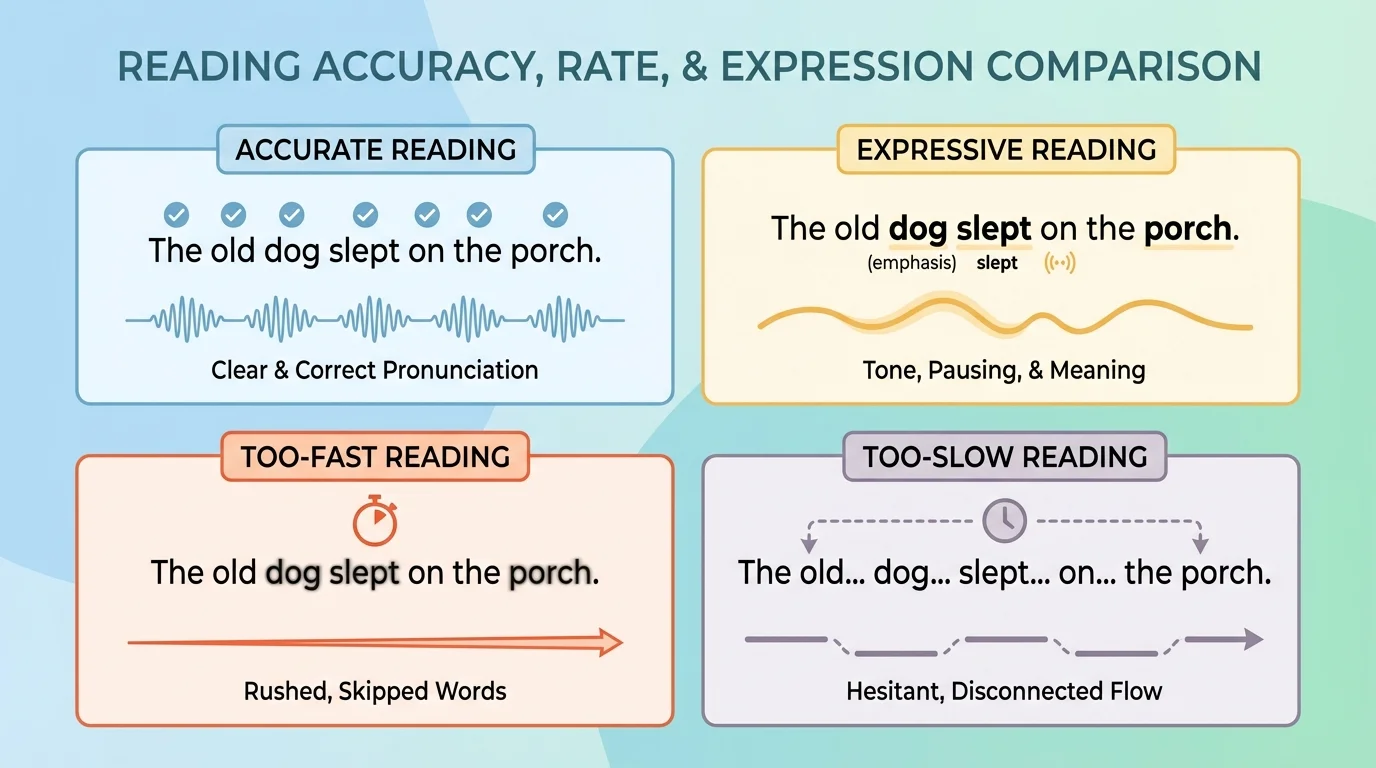
These three parts work together. A reader who is accurate but too slow may lose the flow of the passage. A reader who is fast but careless may make mistakes. A reader who says every word correctly but uses no expression may miss the meaning and feeling of the text. True fluency combines all three.
When you read aloud, multisyllable words can be challenging, but readers can decode them by looking for familiar parts. Instead of guessing, fluent readers look carefully at the whole word and break it into smaller chunks.
[Figure 2] One helpful strategy is to notice syllables. A syllable is a part of a word with one vowel sound. For example, the word remembering can be broken into re-mem-ber-ing. Reading long words in chunks makes them easier to pronounce and understand.
Another strategy is to use spelling patterns and word parts. Readers look for prefixes, base words, and suffixes. A prefix is a word part added to the beginning of a word, such as un- in unhappy. A suffix is a word part added to the end, such as -ful in helpful. Knowing these parts helps readers both pronounce words and understand what they mean.
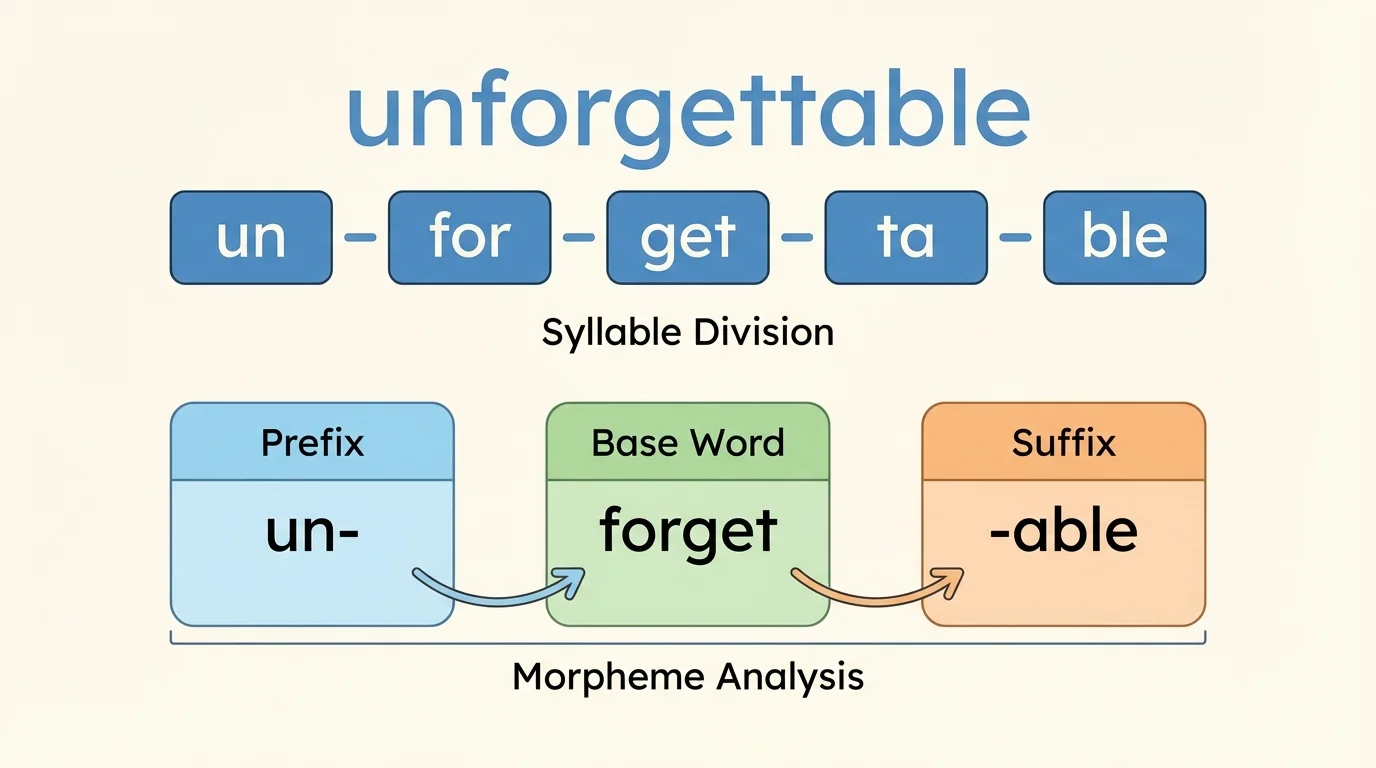
For example, if you come to the word careless, you might notice the base word care and the suffix -less. That suffix means "without," so careless means "without care" or "not careful." When decoding and meaning work together, reading becomes stronger.
Readers also use morphology, which is the study of meaningful word parts. If you know that re- often means "again," then replay means "play again," and rewrite means "write again." This helps when reading new words in stories and poems.
Accuracy also includes self-correction. Good readers do not pretend mistakes never happen. If a sentence sounds wrong, they stop and fix it. Suppose someone reads, "The kitten crawled under the sofa" as "The kitten called under the sofa." A careful reader notices that called under does not make sense and goes back to reread. That kind of checking shows strong reading habits.
Using word parts to read a difficult word
Look at the word disagreement.
Step 1: Spot the familiar base word.
The base word is agree.
Step 2: Notice added parts.
The prefix dis- can mean "not" or "opposite of." The suffix -ment turns the word into a noun.
Step 3: Put the parts together.
Disagreement means a state of not agreeing.
Breaking a long word into meaningful parts helps with both pronunciation and meaning.
As you continue reading more difficult texts, the chunking strategy shown in [Figure 2] remains useful. It reminds readers that long words are often built from smaller, familiar pieces.
A strong reader pays attention to pace. Reading too quickly can cause mistakes and confusion. Reading too slowly can make the text sound broken apart and can make it harder to follow the ideas. Appropriate rate means reading smoothly enough to keep the meaning connected.
Different texts call for different speeds. A fast-moving action scene in a story might be read a little more quickly, while an important description or a tricky informational sentence may need a slower pace. Poems also often need slower, more careful reading so that listeners can notice the rhythm, images, and line breaks.
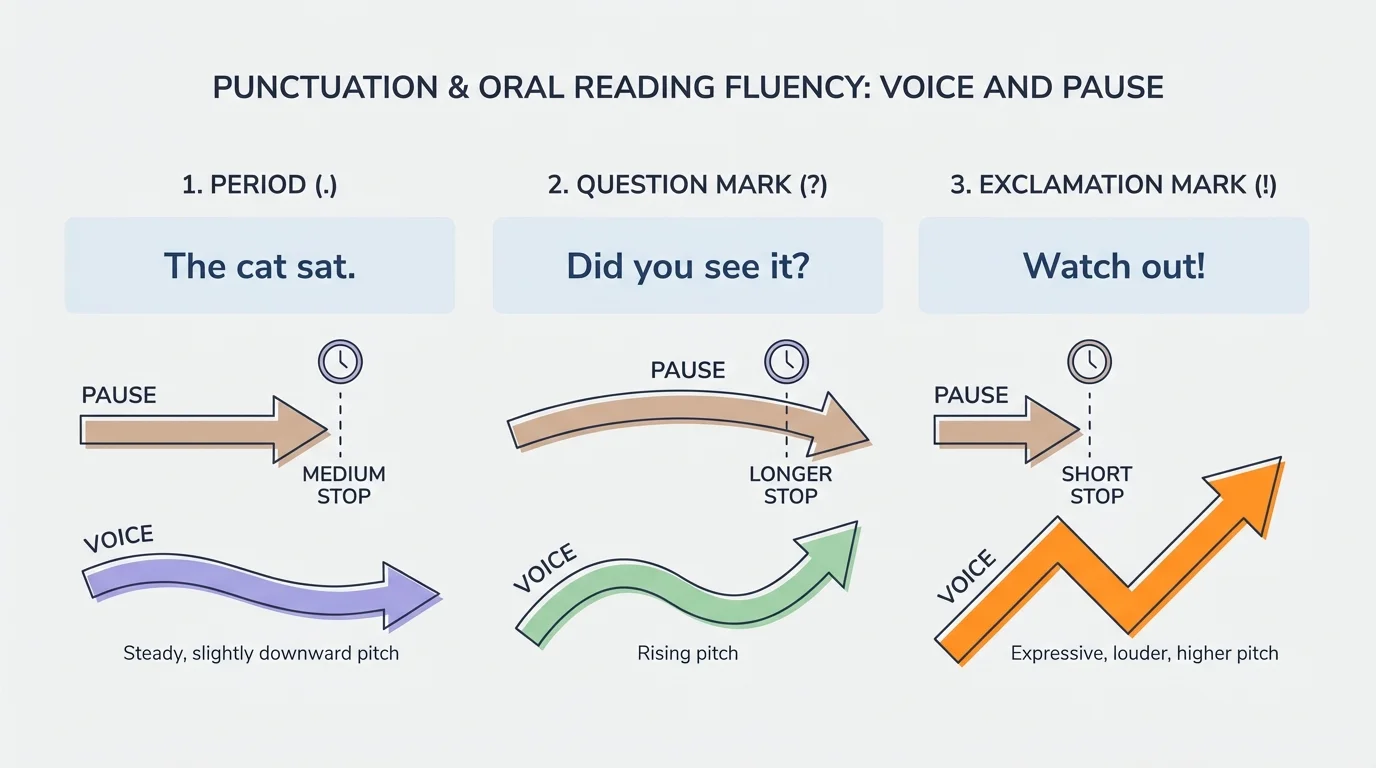
Punctuation helps control rate. Periods signal a full stop. Commas signal a shorter pause. Question marks often change the rise or shape of the voice. Quotation marks help readers notice when a character is speaking. If you ignore punctuation, the text can sound confusing even when every word is pronounced correctly.
Rate should support understanding. If you read a sentence and realize you cannot explain what it meant, that is a sign to slow down and reread. Fluent readers do not treat speed as a race. They choose a pace that keeps the meaning clear.
Professional actors and audiobook readers practice pacing carefully. They often slow down at important moments, pause before surprising information, and change their speed slightly to match what is happening in the text.
This is one reason successive readings are so powerful. The first reading may be careful and slower. On later readings, when the words are more familiar, the pace often becomes smoother and more natural.
Readers use their voices to show meaning, and punctuation gives many of the clues. Expression includes volume, stress, pauses, and changes in pitch. Pitch is how high or low a voice sounds. You do not need to act wildly, but you do need to sound like the words matter.
[Figure 3] Read these sentences silently and notice how differently they sound: "You found it." "You found it?" "You found it!" The words are almost the same, but the punctuation changes the voice. A period sounds calm. A question mark sounds uncertain or curious. An exclamation point sounds excited or strong.
Expression also depends on phrasing. Instead of reading one word at a time, fluent readers group words that belong together. For example, in the sentence "After the heavy rain, the river rushed over the rocks," the phrase After the heavy rain belongs together, and the river rushed over the rocks belongs together. Reading in phrases makes the sentence easier to understand.
Dialogue in stories needs expression too. If a character whispers, your voice should become softer. If a character is frightened, your voice might sound tense or shaky. If a character is joyful, the voice might sound lighter and brighter. Expression helps listeners understand feelings without stopping to explain them.
Poetry especially depends on expression. The reader must notice the mood, the important words, and the way the poem moves. A gentle nature poem should not sound the same as a loud, playful poem. The punctuation guide in [Figure 3] still matters in poetry, but poets also use line breaks and repeated sounds to shape how the poem should be heard.
How expression connects to meaning
Expression is not extra decoration added after reading. It grows out of understanding. When a reader understands what a character feels, where a sentence should pause, and which word should be stressed, the voice naturally becomes more meaningful. That is why comprehension and expression strengthen each other.
Even informational prose can be expressive. A reader might stress key words in an explanation, slow down for an important fact, or pause before a list. Expression does not only belong in stories. It belongs anywhere the reader wants the meaning to be clear.
Stories, articles, and poems are not arranged the same way on the page, and they should not sound the same when read aloud. Prose usually flows across the page in sentences and paragraphs. Poetry often uses shorter lines, line breaks, repeated sounds, and rhythm.
[Figure 4] When reading prose, readers mainly follow sentences and punctuation. They pay attention to paragraph flow, dialogue, and the order of events or ideas. Prose often sounds like natural speech, though it can vary depending on whether the text is a story, an article, or a speech.
When reading poetry, readers must notice both punctuation and line breaks. Sometimes a line ends where the sentence does not. That means the reader should not always stop at the end of every line. Instead, the reader listens for the meaning and for the poem's rhythm. Some poems sound musical. Some sound quiet and thoughtful. Some sound playful or dramatic.
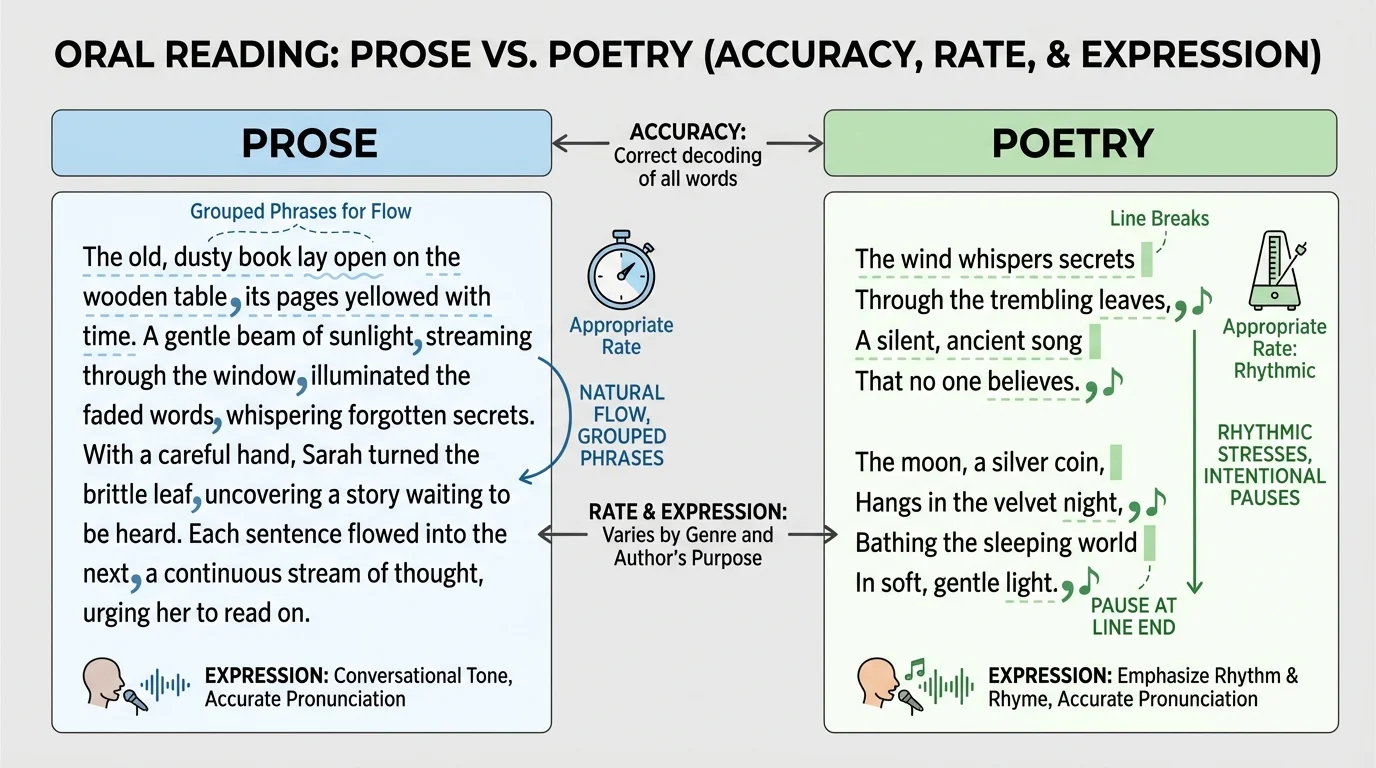
For example, a poem may repeat a sound or phrase to create a pattern. Reading that repeated part in a consistent way helps the audience hear the pattern. A prose paragraph usually depends more on sentence flow than on repeated sound. The comparison in [Figure 4] makes this difference clear by showing how phrasing changes between the two forms.
Some students make poetry sound too chopped up by stopping hard at every line. Others read poems like ordinary paragraphs and miss the rhythm. Fluent poetry reading balances both the words on the page and the meaning of the sentence.
Successive readings mean reading the same text more than once, with a purpose each time. This is one of the best ways to build fluency. On the first reading, a student may focus mostly on getting the words right. On the second reading, the student may notice smoother phrasing. On the third reading, the student may add stronger expression because the text is now more familiar.
Rereading does not mean doing the exact same thing again and again without thinking. Each reading gives your brain another chance to recognize words more quickly, understand difficult sentences, and hear how the text should sound. This builds confidence as well as skill.
A first reading of a poem might feel uncertain because the line breaks are new. A second reading may reveal a pattern. A third reading may make the poem feel natural and musical. The same happens with prose. A story that sounded bumpy on the first read often becomes smoother and more meaningful after rereading.
How a passage improves over three readings
A student reads a paragraph from a story.
Step 1: First reading
The student hesitates on long words, pauses in odd places, and sounds unsure during dialogue.
Step 2: Second reading
The student recognizes more words quickly, groups phrases better, and follows punctuation more carefully.
Step 3: Third reading
The student reads smoothly, uses a clear voice for the characters, and understands the paragraph more deeply.
Each reading improves both fluency and understanding.
Successive readings are helpful because fluency is not built in one perfect try. It grows through attention, effort, and practice with the same meaningful text.
Fluent readers think while they read. They ask themselves whether the sentence makes sense. They notice whether a word sounds right and fits the context. If not, they stop and repair the reading.
Context can help with unknown words. Suppose you read, "The exhausted hikers finally reached the cabin." Even if exhausted is unfamiliar, the rest of the sentence suggests that the hikers are very tired. When readers combine context with word parts and careful pronunciation, they become more accurate and more confident.
Meaning also tells readers where to place emphasis. In the sentence "The tiny spark started the huge fire," a reader may stress tiny spark and huge fire because the contrast matters. Expression grows stronger when the reader notices what is important in the sentence.
Earlier reading skills still matter here: recognizing sight words, using phonics patterns, noticing punctuation, and checking whether a sentence makes sense. Fluency builds on all of those skills rather than replacing them.
When listening to yourself read, you can ask: Does this sound like language people would really say? Does my voice match the mood? Did I pause in the right places? Those questions help connect oral reading to understanding.
Many reading problems have simple causes. A reader may rush because they are nervous. Another may read too slowly because they are focusing on every single word separately. Another may sound flat because they are not yet thinking about how the text feels.
Here are some common problems and useful fixes.
| Problem | What it sounds like | Smart fix |
|---|---|---|
| Misreading long words | Stopping, guessing, or saying the wrong word | Break the word into syllables and meaningful parts |
| Reading too fast | Few pauses, lost meaning, skipped words | Slow down at punctuation and tricky parts |
| Reading too slowly | One-word-at-a-time reading | Group words into phrases |
| Flat voice | Everything sounds the same | Notice punctuation, dialogue, and mood |
| Ignoring meaning | Words are correct but confusing | Reread and ask what the sentence means |
Table 1. Common oral reading problems and practical ways to improve them.
Even strong readers have moments when a text feels difficult. What matters is how they respond. They slow down, reread, check the word parts, and think about meaning. Improvement comes from using strategies, not from expecting every first reading to be perfect.
Strong oral reading develops over time. Readers grow when they pay close attention, listen to their own voices, and reread with purpose. Small changes matter: pronouncing one long word correctly, pausing at the right comma, or making a question actually sound like a question.
Good readers also know that fluency is not about sounding fancy. It is about making the text understandable and alive. A clear, natural voice is more helpful than a dramatic voice that ignores the meaning. The goal is always to help the words say what they truly mean.
"Read the words, hear the meaning, and let your voice carry both."
As you read more stories, articles, and poems, you will notice that fluency changes with the text. Some passages need calm pacing. Some need energy. Some need gentleness. Some need suspense. The best readers are flexible. They adapt their accuracy, rate, and expression to fit what the text is saying.
