Have you ever tried to convince someone to let you choose the movie, the game, or the snack? If you just say, "Because I want to," your idea may not be very convincing. But if you say, "My opinion is that we should watch this movie because it is funny. In addition, everyone in the family can enjoy it," your message becomes much stronger. Good writers do the same thing. They connect what they believe with clear reasons.
When you write an opinion piece, you tell what you think about a topic or a text. Then you support that point of view with reasons and information. A strong opinion is not just a feeling. It is a thought that is explained.
A reason tells why you believe something. Information, facts, details, and examples help prove that your reason makes sense. But even if you have great ideas, your writing can feel jumpy if the parts are not connected. That is why writers use special words and phrases to link ideas together.
Opinion writing shares what a writer thinks about a topic or text and supports that thinking with reasons and information.
Reasons explain why the writer has that opinion.
Linking words and phrases connect ideas so the writing is easier to follow.
Think of linking words as bridges. A bridge helps you move from one side to the other. In writing, a link helps the reader move from your opinion to your reason, from your reason to an example, or from one idea to the next.
A linking word or phrase helps show the relationship between ideas. It tells the reader, "Here comes another reason," or "Here is an example," or "This explains the purpose." Without these clues, the reader has to guess how your thoughts fit together.
Read these two examples:
Without linking words: I think recess should be longer. Students need exercise. Students come back to class ready to learn.
With linking words: I think recess should be longer because students need exercise. In addition, students come back to class ready to learn.
The second version sounds smoother because the ideas are clearly connected. The reader understands that the second and third ideas are reasons supporting the opinion.
How links guide a reader
Linking words do not add random extra words. They give signals. A reader can tell whether the writer is adding a reason, giving an example, explaining a purpose, or wrapping up the point. These signals make writing easier to understand and more persuasive.
Writers use many kinds of links. Some are single words, such as because or also. Some are phrases, such as for instance, in order to, or as a result. Each one has a special job.
Linking words have different jobs, as [Figure 1] shows through groups of phrases that help writers add ideas, give examples, explain purpose, and conclude. Choosing the right one helps your reader know exactly what you mean.
Here are some common groups of linking words and phrases that are useful in opinion writing:
| Job | Linking words and phrases | How they help |
|---|---|---|
| Add another reason | also, another, in addition, furthermore | They introduce more support for the opinion. |
| Give an example | for example, for instance, such as | They show specific details that support a reason. |
| Show purpose | in order to, so that | They explain why something should be done. |
| Show cause or explanation | because, since | They connect an opinion to a reason. |
| Conclude or wrap up | therefore, so, in conclusion | They bring the writing to a clear ending. |
Table 1. Common linking words and phrases used in opinion writing and the job each one does.
For example, if you say, "Our class should plant a garden because it will make the school look better," you are giving a reason. If you add, "For instance, flowers near the front door would make the entrance bright and welcoming," you are adding an example. If you write, "We should plant a garden in order to attract butterflies," you are showing a purpose.
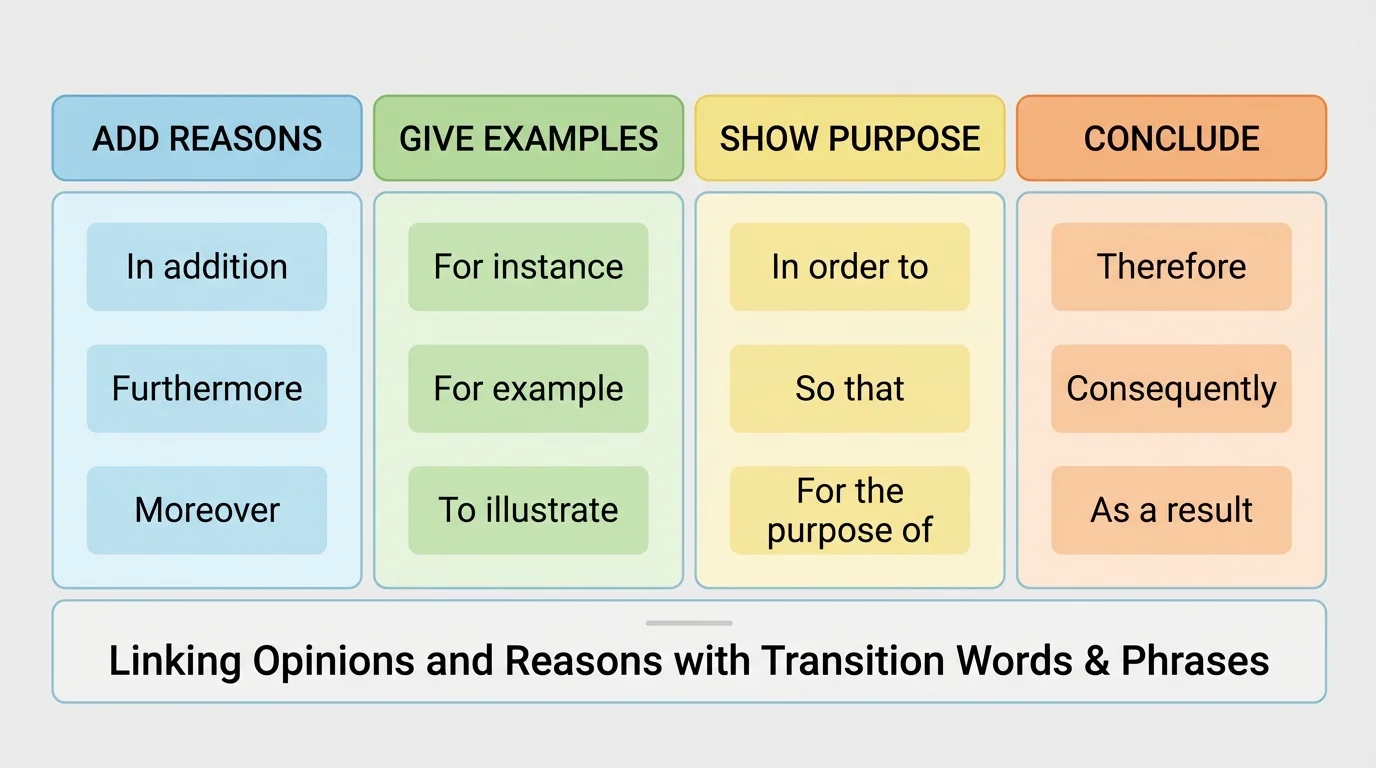
Notice that not every link means the same thing. You cannot always swap one phrase for another. "For instance" introduces an example, but "in addition" adds another point. "In order to" explains purpose, but "therefore" sounds like a conclusion. Knowing the job of each one helps you write more precisely.
Professional writers use transitions all the time, not only in essays. You can find them in book reviews, sports articles, speeches, and even instructions. These small words help big ideas stay organized.
Later, when you draft a paragraph, you can return to the groups in [Figure 1] to check whether your link matches your meaning.
A strong opinion sentence often has three parts: the opinion, a reason, and sometimes information or an example. Linking words help these parts fit together.
Here are useful sentence patterns:
Pattern 1: Opinion + because + reason
I think students should read every day because reading grows vocabulary.
Pattern 2: Opinion + reason. In addition, + another reason
Our town should build more bike paths. In addition, bike paths can make riding safer.
Pattern 3: Reason + for instance + example
Pets can teach responsibility. For instance, a dog must be fed and walked every day.
Pattern 4: Opinion + in order to + purpose
Schools should recycle paper in order to reduce waste.
Example of connected sentences
Topic: school library hours
Step 1: State the opinion.
The school library should stay open longer after school.
Step 2: Add a reason with a link.
The school library should stay open longer after school because many students need a quiet place to read and study.
Step 3: Add more support with another link.
In addition, some students cannot use the library before school starts.
Step 4: Give an example.
For instance, a student who rides a busy bus in the morning may only have time to finish homework after school.
Now the opinion sounds thoughtful and supported.
When you write, ask yourself: Did I tell what I believe? Did I explain why? Did I connect the parts clearly?
A comparison helps you see how opinion writing improves when links are added, and [Figure 2] makes that change easy to notice. The ideas may stay similar, but the writing becomes more organized and convincing.
Read the weak version:
School uniforms are a good idea. They reduce arguments about clothing. They save time in the morning. Students can focus on learning.
This version has good ideas, but the ideas are stacked together. The reader has to figure out how they connect.
Now read the stronger version:
School uniforms are a good idea because they reduce many arguments about clothing. In addition, uniforms can save time in the morning. As a result, students can focus more on learning.
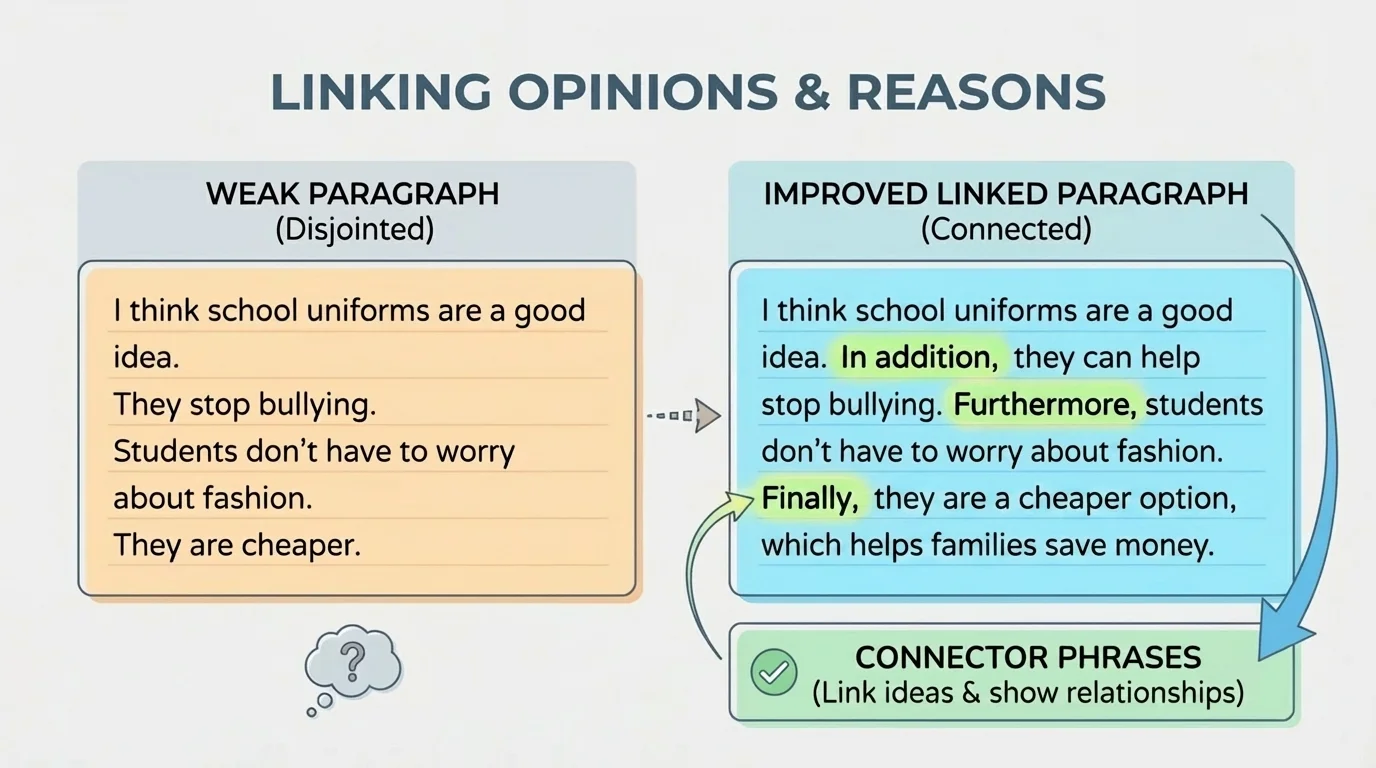
The second version is stronger for two reasons. First, the word because clearly connects the opinion to a reason. Second, in addition and as a result show how one point leads to another. The reader no longer has to guess.
Writers do not become stronger by making sentences longer only. They become stronger by making relationships clear. That is the lesson shown again in [Figure 2]: clear connections make writing more powerful.
A full opinion paragraph has connected parts that work together, as [Figure 3] illustrates by separating the opinion, reasons, example, and conclusion. Each sentence has a job, and linking words help those jobs fit together smoothly.
Here is a model paragraph:
I believe every classroom should have plants because plants can make the room feel calm and welcoming. In addition, plants help students notice the natural world every day. For instance, a class that grows a bean plant can observe how leaves and roots develop over time. Schools should include plants in order to make classrooms more peaceful and interesting places to learn. Therefore, classroom plants are a smart addition to learning spaces.
This paragraph starts with an opinion. Then it gives one reason, adds another reason, includes an example, explains a purpose, and ends with a conclusion. The paragraph does not sound choppy because every idea is linked.
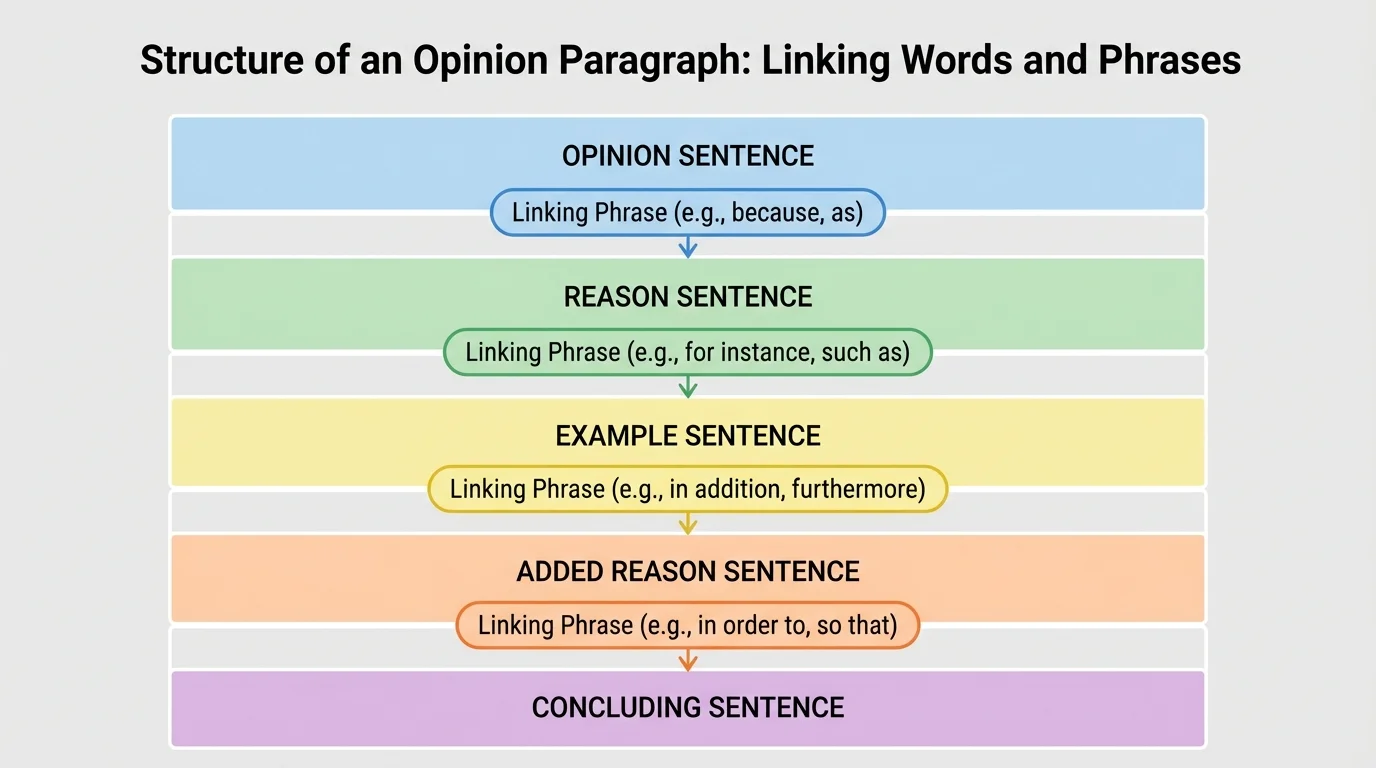
You do not need to use every type of link in every paragraph. However, you should use enough to make your thinking easy to follow. A reader should be able to point to each reason and understand how it supports your opinion.
When you learned about paragraphs, you saw that sentences in a paragraph should stay on one topic. Linking words help with that job, but they do not replace good ideas. First choose a clear opinion and strong reasons. Then use links to connect them.
If you read the model paragraph again, the structure in [Figure 3] becomes even easier to spot. You can almost trace the path from opinion to evidence to ending.
Different links create different meanings. If you use the wrong one, your sentence may sound confusing.
Look at these examples:
Correct: We should have a class pet because it can teach responsibility.
Correct: We should have a class pet. For instance, students could take turns feeding a fish.
Correct: We should have a class pet in order to help students practice caring for a living thing.
Now notice what happens if the links are mixed up:
Confusing: We should have a class pet for instance it can teach responsibility.
Confusing: We should have a class pet. In order to, students could take turns feeding a fish.
These do not work because the linking phrase does not match the job. A writer must choose a link that fits the idea.
It also helps to vary your transitions. If every sentence starts with "because," your writing may sound repetitive. You can mix different links when their meanings fit: because, in addition, for example, therefore.
One common mistake is adding a linking word without adding a real reason. For example, "I think we need more art class because art is good" is not very strong. The reason is too vague. A better sentence is "I think we need more art class because art helps students express ideas in creative ways."
Another mistake is using an example that does not match the reason. If your reason is about saving time, your example should show saving time. If your reason is about safety, your example should show safety.
A third mistake is using too many transitions. Good writing is connected, but it should still sound natural. You do not need to put a link in front of every sentence. Use them where they truly help the reader.
Fixing weak sentences
Weak sentence: I think our school should have more clubs because clubs are nice.
Step 1: Make the reason specific.
I think our school should have more clubs because clubs help students explore new interests.
Step 2: Add another reason.
In addition, clubs can help students make friends who enjoy the same activities.
Step 3: Add an example.
For instance, a robotics club lets students work together to design and build projects.
The revised version sounds clearer, stronger, and more convincing.
Always check whether your links are helping your ideas, not hiding weak ideas. Strong opinion writing needs both: clear thinking and clear connections.
Sometimes you write an opinion about a topic you know well, such as homework, pets, or school lunch. Other times you write about a text you read, such as a story, article, or poem. In both cases, linking words help you connect your opinion to support.
For a topic, you might write: I think our town needs a bigger playground because many families use the park on weekends. In addition, the current swings are often full.
For a text, you might write: I think the main character in the story is brave because she protects her little brother during the storm. For instance, she leads him to safety even though she is frightened. Here, the opinion is about a character, and the support comes from details in the text.
When you write about a text, it is especially important to include information from what you read. Your opinion should not float alone. It should be tied to events, details, or examples from the text.
Opinions need support from information
A convincing opinion does not rely only on feelings. It uses reasons and supporting details. Those details might come from facts, observations, or evidence from a text. Linking words make that support easier for readers to follow.
This is one reason opinion writing is useful in real life. People share opinions in reviews, speeches, class discussions, and letters. The people who are most convincing usually explain why they think something and connect their reasons clearly.
When you are writing an opinion piece, start with a clear point of view. Next, choose reasons that truly support it. Then add examples or information that make your reasons stronger. Finally, use linking words and phrases to guide the reader from one idea to the next.
You can think of your writing like a path. Your opinion is the starting place. Your reasons are the stepping-stones. Your examples and information make the path solid. Linking words show the reader exactly where to step next.
"Strong writers do not just state opinions. They connect opinions to reasons so readers can follow their thinking."
If your ideas are linked well, your writing will sound more organized, more thoughtful, and more convincing.
