Have you ever heard someone tell a story that jumped around so much that you could not tell what happened first? A good story is not just a list of events. It is a path that leads the reader from one moment to the next. Transitional words and phrases help build that path. They tell readers when something happens, what happens next, and how one event connects to another.
When you write a narrative, you are telling a story about events in a certain order. That order is called a sequence. Readers need to know whether a character opened the door before the dog ran out or after the dog ran out. A small change in order can completely change the meaning of the story.
Transitions are like road signs for your reader. They point to the beginning, the middle, a change, or the end. Without these clues, the reader may feel lost. With them, the reader can move smoothly through the story and enjoy the action, feelings, and dialogue.
Why writers use sequence transitions
Sequence transitions help readers follow the order of events. They make a story easier to understand, and they can also help create suspense, surprise, or a calm step-by-step feeling. Strong writers do not just tell what happened. They guide readers through when it happened and how each moment connects to the next.
Narratives can be real or imagined, but both kinds need clear timing. If you write about losing a tooth, scoring a goal, or discovering a hidden cave in a made-up story, your reader still needs help following the order of events.
A transition is a word or phrase that connects one idea, sentence, or event to another. In narrative writing, transitions often show time and order. Some are only one word, such as first, next, or finally. Others are phrases, such as a little later, after a while, or at that moment.
These words and phrases help answer questions like these: What happened first? What happened after that? Did something happen at the same time? Did the action suddenly change? Is the story ending?
Transitional words and phrases are words or groups of words that connect ideas and show relationships between events. In narratives, they often show time, order, or a change from one moment to another.
Here are some common sequence transitions:
Writers often choose transitions by the job they do. Some launch the story, some move events forward, some show that time has passed, and some signal that the story is wrapping up.
It helps to think of transitions as tools in different groups. If you only use then again and again, your story may sound flat. If you choose from several groups, your writing sounds more natural and interesting.
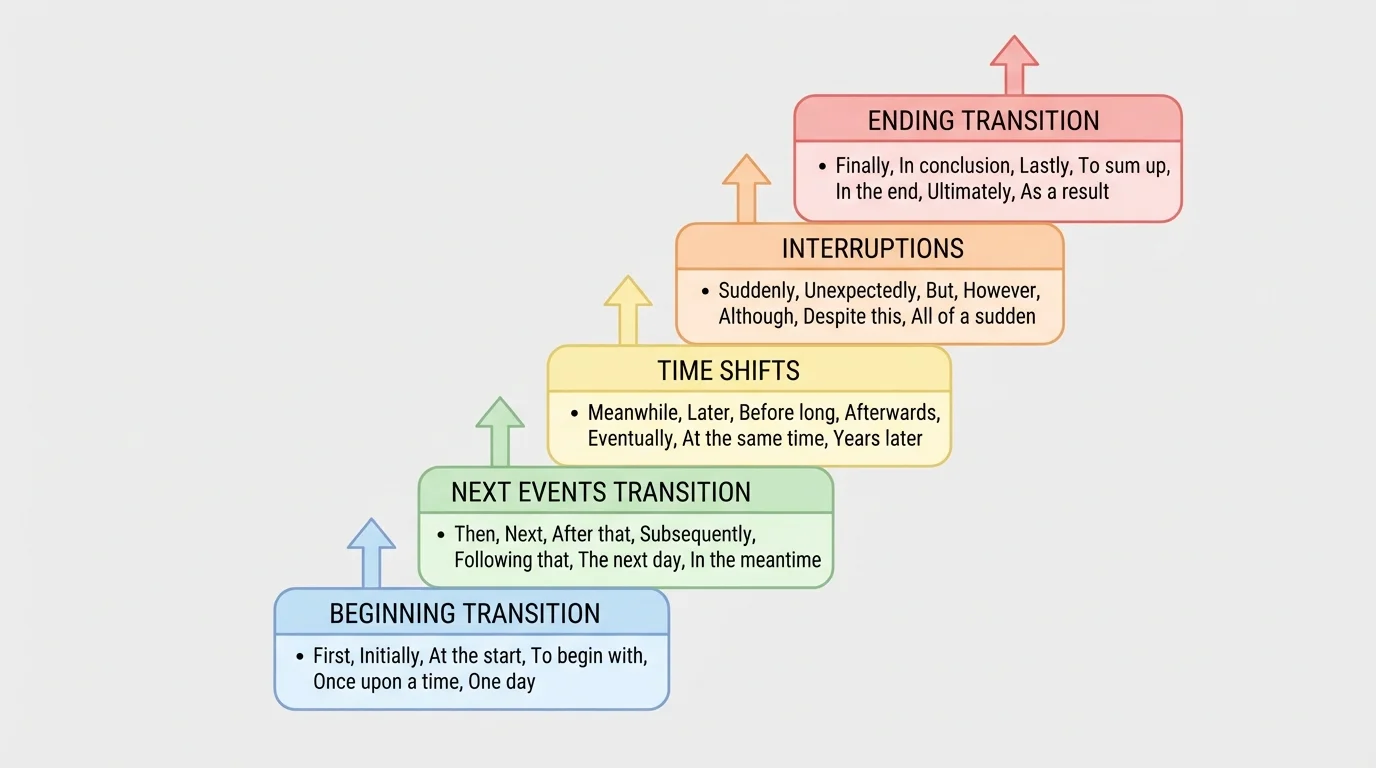
Transitions for the beginning help readers enter the story: early that morning, to start, in the beginning, on Saturday. These can quickly set the scene.
Transitions for the middle move events ahead: next, after that, soon, before long, a few minutes later. They help readers follow one action after another.
Transitions for a time shift show that some time has passed: later that day, by evening, the next morning, after several hours. These are useful when every tiny step is not important.
Transitions for an interruption or surprise can change the pace: suddenly, all at once, just then, without warning. These help create excitement.
Transitions for the ending help close the story: finally, at last, in the end, eventually. These let readers know the sequence is finishing.
| Purpose | Examples | How It Helps |
|---|---|---|
| Beginning | first, early that morning, to start | Starts the sequence clearly |
| Continuing | next, then, after that, soon | Moves the action forward |
| Time shift | later, the next day, after a while | Shows time passing |
| Same time | meanwhile, at the same time | Shows two events happening together |
| Surprise | suddenly, just then, all at once | Adds excitement or interruption |
| Ending | finally, eventually, in the end | Closes the sequence |
Table 1. Groups of transitional words and phrases used to organize narrative events.
Not every transition fits every moment. Good writers choose one that matches the kind of event they are describing. If a character slowly walks home after school, suddenly would not fit unless something unexpected happens. If a thunderstorm begins without warning, a little later may be too calm.
Look at how the feeling changes with different transitions:
Notice that transitions do more than show order. They can also shape the mood. At last suggests relief. Just then suggests a quick interruption. Meanwhile tells the reader that another event is happening at the same time.
Even professional authors revise transitions many times. A single word like meanwhile or eventually can change how fast or slow a scene feels to the reader.
Transition groups help writers choose words by purpose, not just by habit. That is why strong narratives usually sound smooth instead of repetitive.
Writers can place transitions in different parts of a sentence. A transition might come at the beginning: First, we searched under the porch. It might come in the middle: We searched under the porch, and then we checked the garage. It can also appear in a phrase that sets time: A few minutes later, the kitten meowed from a box.
Transitions also work well with dialogue. Dialogue is the spoken words of characters. Sequence words help readers understand when someone speaks during the action.
Example: "I heard something!" Luis whispered. A moment later, the bushes shook again.
In that example, the phrase a moment later connects the spoken line to the next action. Without it, the story would still make sense, but the timing would be less clear.
Example: placing transitions in different ways
Step 1: Beginning of a sentence
After lunch, the class walked to the garden.
Step 2: Middle of a sentence
The class planted seeds, and then everyone watered the soil.
Step 3: Before dialogue
Just then, Emma shouted, "Look! A ladybug!"
Step 4: Ending a sequence
By the end of the afternoon, tiny rows of planted seeds covered the garden bed.
Transitions can connect big events, but they also connect small actions. In a strong narrative, the reader can easily follow each movement, each sound, and each response.
One important writing skill is narrative flow. This means the story moves smoothly from one event to the next. Transitions help create flow, but variety matters. If every sentence begins with then, your writing may sound choppy.
Read this example: Then I got my backpack. Then I ran outside. Then I missed the bus. Then I called my dad. The order is clear, but the repetition makes the writing dull.
Now read the revised version: First, I grabbed my backpack. Next, I raced outside. A second later, I watched the bus pull away. In the end, I had to call my dad for a ride. The second version has clearer timing and a more interesting sound.
Writers already know how to put events in order. Transitional words and phrases make that order easier for readers to follow. They do not replace details. They work together with details.
Good flow also comes from combining transitions with descriptive details. Instead of writing only later, you might write later that windy afternoon. Instead of just next, you might write next, as the crowd grew louder. These details make the sequence vivid.
A comparison helps writers see how transitions improve flow. Revision means looking again at your writing and making it clearer, smoother, and stronger.
Here is a plain version of a short narrative: I walked to the creek. I saw something shiny. I bent down. It was a silver key. I heard footsteps behind me.
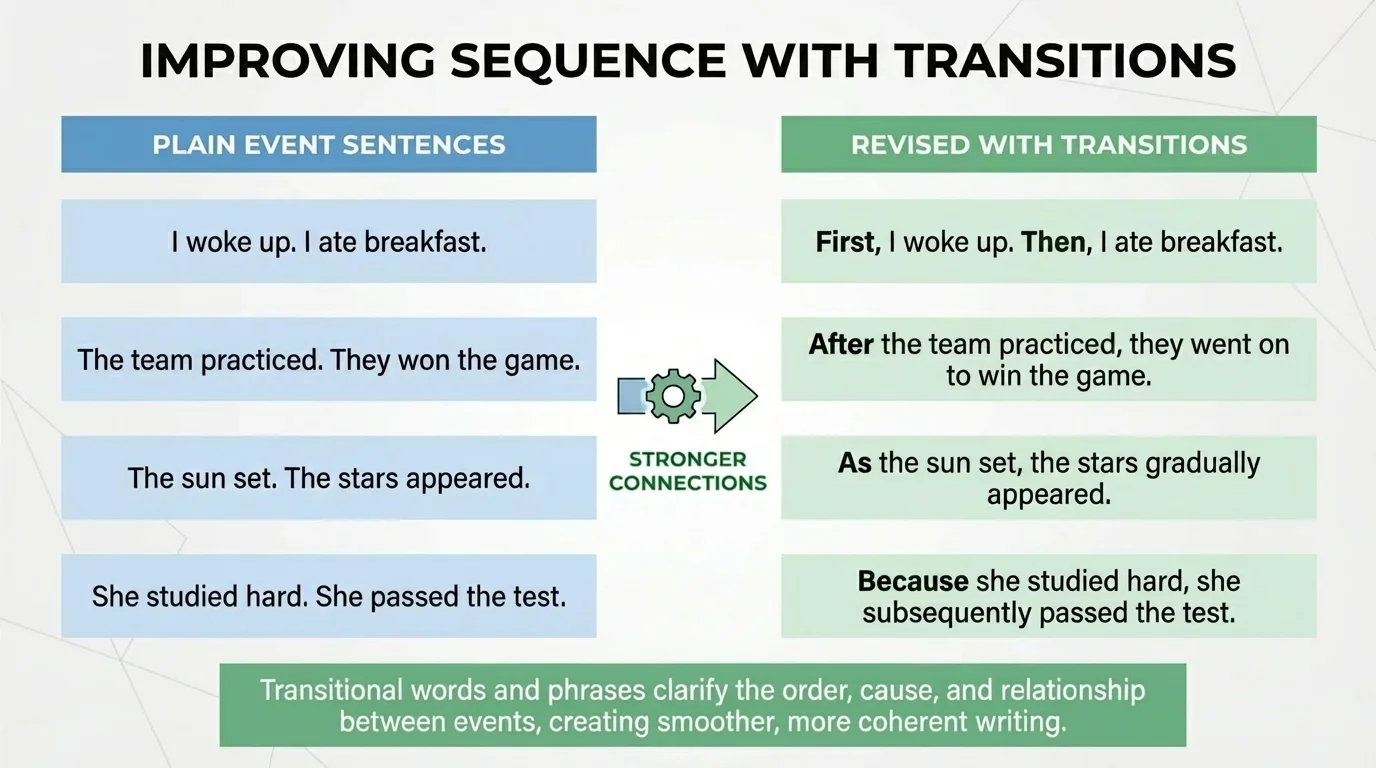
The events are in order, but the writing feels bare. The reader can follow it, yet the story does not flow very smoothly. Stronger transitions can connect the moments.
Revision example
At the start of my walk, I followed the narrow path to the creek. A few minutes later, something shiny caught my eye near the water. Curious, I bent down and discovered a silver key. Just then, I heard footsteps behind me.
Notice what changed:
Step 1: The writer added a beginning transition.
At the start of my walk tells when the sequence begins.
Step 2: The writer added a time-passing transition.
A few minutes later shows a small jump in time.
Step 3: The writer added a surprise transition.
Just then creates tension and makes the final event more dramatic.
This revised version is no longer plain just because it has extra words. It is stronger because each event connects clearly to the next. The transitions guide the reader through the scene.
Later, if the story continues, the writer can use the same sequence pattern by choosing a beginning, middle, and surprise transition that match each new event.
One common mistake is repetition. This means using the same word too many times. Writing then in every sentence makes the story sound flat.
Another mistake is using transitions that do not fit the event. For example, finally should usually come near the end of a sequence, not in the middle. Meanwhile should be used when another action is happening at the same time.
A third mistake is skipping transitions where readers need them most. If your character goes from the playground to home to bedtime with no clues about time, the sequence may feel jumpy. Readers may wonder how much time has passed.
A fourth mistake is believing transitions can fix everything. They help, but they cannot replace clear sentences. The events themselves must make sense, and the details must match the order.
How to check your own transitions
After writing, read your story aloud. Listen for places where the order feels confusing or where the same transition repeats too often. Ask yourself whether each transition matches the kind of moment you are describing: a beginning, a next step, a time jump, a surprise, or an ending.
If the story sounds smooth when you read it aloud, your transitions are probably helping. If it sounds bumpy, you may need to add, remove, or replace some of them.
You can use sequence transitions in many kinds of narratives. In a personal narrative, you might tell about a field trip, a birthday surprise, or the day you learned to ride a bike. In an imagined story, you might describe a lost treasure map, a talking fox, or a race through a storm.
Here is how transitions help in real writing situations:
Suppose you are writing about a soccer game. You might write: At the start of the second half, our team was losing by one goal. Soon, Maya stole the ball. Moments later, she passed it to Jordan, who scored. Finally, with only seconds left, we took the lead. The transitions organize the action and help the game feel exciting.
Suppose you are writing about baking cookies with a grandparent. You might write: First, we measured the flour. Next, Grandma added chocolate chips. After a while, the warm smell filled the kitchen. In the end, we ate the cookies right off the tray. The order is clear, and the details make the memory come alive.
Whether your narrative is funny, serious, realistic, or magical, transitions are part of what helps your reader travel through it. They make your writing easier to understand and more enjoyable to read.
"A story moves best when each moment leads naturally to the next."
As you grow as a writer, you will learn that strong storytelling depends on both events and connections. Actions, descriptions, and dialogue are important, but the links between those moments matter too. Transitional words and phrases build those links.
