Have you ever heard two people argue about the same topic, like whether school uniforms are helpful or whether kids should have more recess? Usually, the stronger argument is not just the loudest one. It is the one that gives good reasons and strong evidence. Authors do the same thing in informational texts. They want readers to believe a certain idea, so they support that idea with reasons and evidence.
When you read closely, you are not only learning the facts in a text. You are also figuring out how the author builds the text. That means noticing what the author is trying to prove, why the author says it is true, and what evidence the author provides. This skill helps you understand books, articles, websites, and even speeches more clearly.
Informational texts are everywhere. You see them in science articles, social studies textbooks, biographies, news stories, and even instructions for games or devices. Many of these texts include ideas the author wants readers to accept. Those ideas are often called points. A point is a statement the author wants to make or prove.
If readers cannot tell which reasons and evidence support a point, they may miss the author's message. They may also be fooled by weak arguments. Careful readers ask questions such as: What is the author saying? Why does the author believe it? What proof is given? These questions turn reading into detective work.
Point is the idea, claim, or message an author wants readers to understand or believe.
Reason is an explanation that tells why the point is true or important.
Evidence is the proof that supports a reason. Evidence can include facts, examples, quotations, statistics, or other details from the text.
Think of it this way: a point is like the top of a tower, the reasons are the strong beams holding it up, and the evidence is the material that makes the beams sturdy. Without support, the author's point feels shaky.
Authors often build support in layers, as [Figure 1] shows. First comes the main point. Then the author gives one or more reasons. After that, the author adds details, facts, and examples to prove those reasons.
For example, suppose an author's point is: School gardens are valuable for students. That is the main idea the author wants readers to accept. But the author cannot stop there. The reader may ask, "Why are school gardens valuable?"
The author might give these reasons: school gardens teach science in a hands-on way and encourage healthy eating. Those are reasons because they explain why the gardens matter.
Then the author needs proof. For the first reason, the text might say that students observe plant growth, measure rainfall, and record changes in soil. For the second reason, the text might say that students are more willing to taste vegetables they helped grow. These details are evidence because they support the reasons.
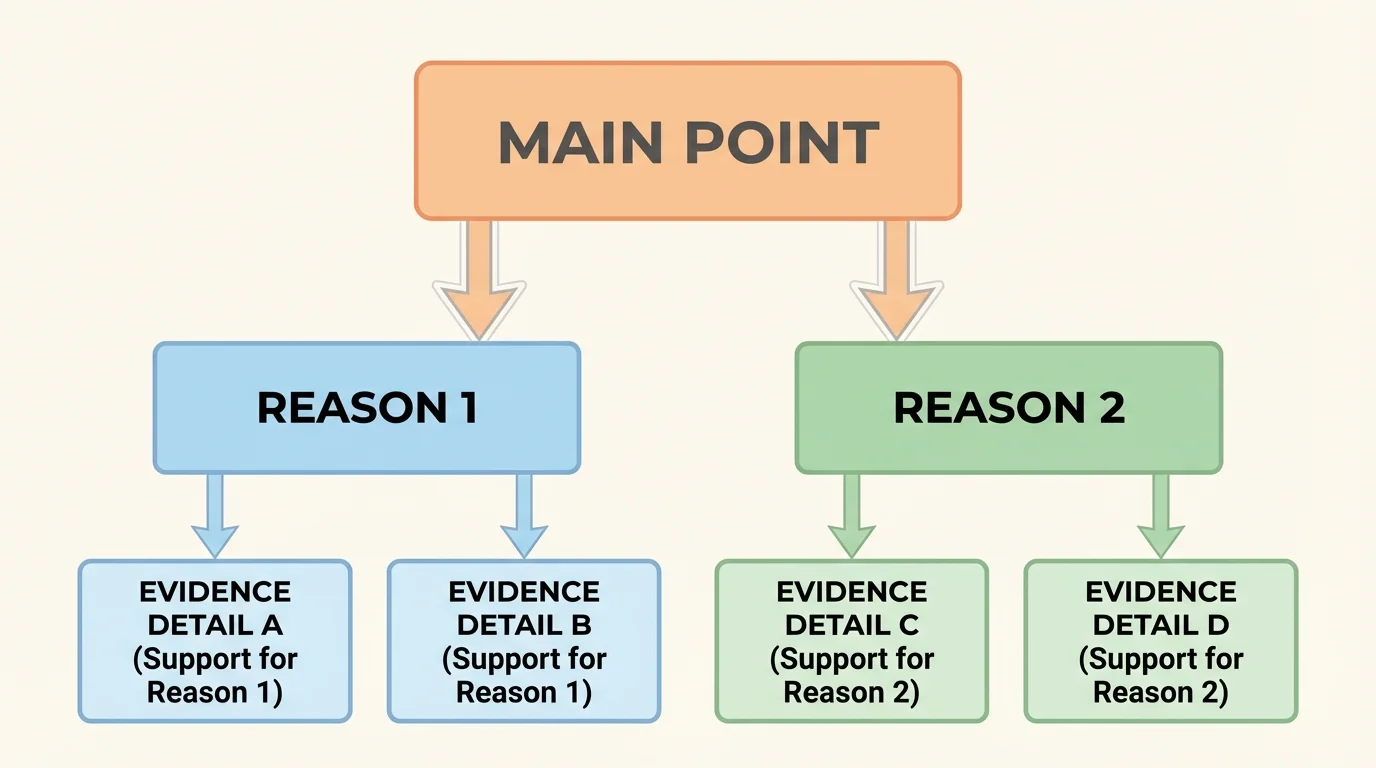
Notice the pattern: point, then reasons, then evidence. Once you know this pattern, many informational texts become easier to understand. You can ask yourself where each sentence fits. Is it stating the point? Giving a reason? Providing evidence?
Strong readers often pause after each paragraph and quickly label it in their minds: point, reason, or evidence. This tiny habit can make a long article much easier to follow.
Sometimes the point is stated clearly in one sentence. Other times, readers have to infer it by putting together several details. Even when the point is not directly announced, the reasons and evidence usually help reveal it.
A reason must match the point it supports. If the point is about why an invention is useful, the reasons should explain its usefulness. If the point is about why a problem is serious, the reasons should explain the problem's effects, causes, or importance.
Here is an example. Point: Public libraries are important to communities. One reason might be that libraries give free access to books and information. Another reason might be that libraries offer programs for children and families. Each reason connects directly to the point because each one explains why libraries matter.
If the author suddenly says that some library buildings are painted brick red, that detail may be interesting, but it does not support the point unless the color somehow connects to the libraries' importance. A detail can be true and still not be useful support.
Reasons must answer the question "Why?" When you identify a point, ask, "Why does the author believe this?" The answer is often the reason. If a sentence does not explain why the point is true, it may not be a reason at all.
Sometimes one reason supports only one point. Sometimes one reason can help support more than one point if the text is more complex. In grade 5 texts, authors usually make the connections fairly clear, but readers still need to track them carefully.
Evidence is the proof behind the reason. If a reason says, "Libraries help people learn," the evidence should show how that is true. Maybe the text includes a fact about free tutoring, an example of students using research materials, or a quotation from a librarian.
Authors can use different kinds of evidence. Facts are pieces of information that can be checked. Examples show the idea in action. Quotations include someone's exact words. Statistics are number facts, such as how many people visit a place or how much something has changed. Anecdotes are short stories that illustrate a point.
Here is a short model: Point: Recycling programs help schools. Reason: Recycling reduces waste. Evidence: The text explains that one school reduced cafeteria trash by collecting paper, plastic, and cans separately. That evidence supports the reason because it shows waste decreasing.
Good evidence is not just any detail. It has to connect clearly to the reason. If the evidence is random, the reader may not be convinced.
When a text includes more than one point, readers need a way to keep track of support, as [Figure 2] illustrates. One helpful strategy is to pause after each paragraph and decide which point is being discussed.
For example, a text about bike riding might make two points: biking is healthy, and biking is good for the environment. The evidence about stronger muscles and better heart health supports the first point. The evidence about less air pollution supports the second point. If you mix them up, the text becomes confusing.
A useful method is to make simple notes in your mind or on paper. You might label one point with "A" and another with "B." Then, as you read, you can sort reasons and evidence under the correct label. This makes the author's structure easier to see.
Look at this short passage idea: City parks are important because they give people places to exercise and because they protect nature in crowded areas. If the next sentence talks about walking trails and basketball courts, that supports the first point about exercise. If another sentence talks about birds, trees, and habitats, that supports the second point about protecting nature.
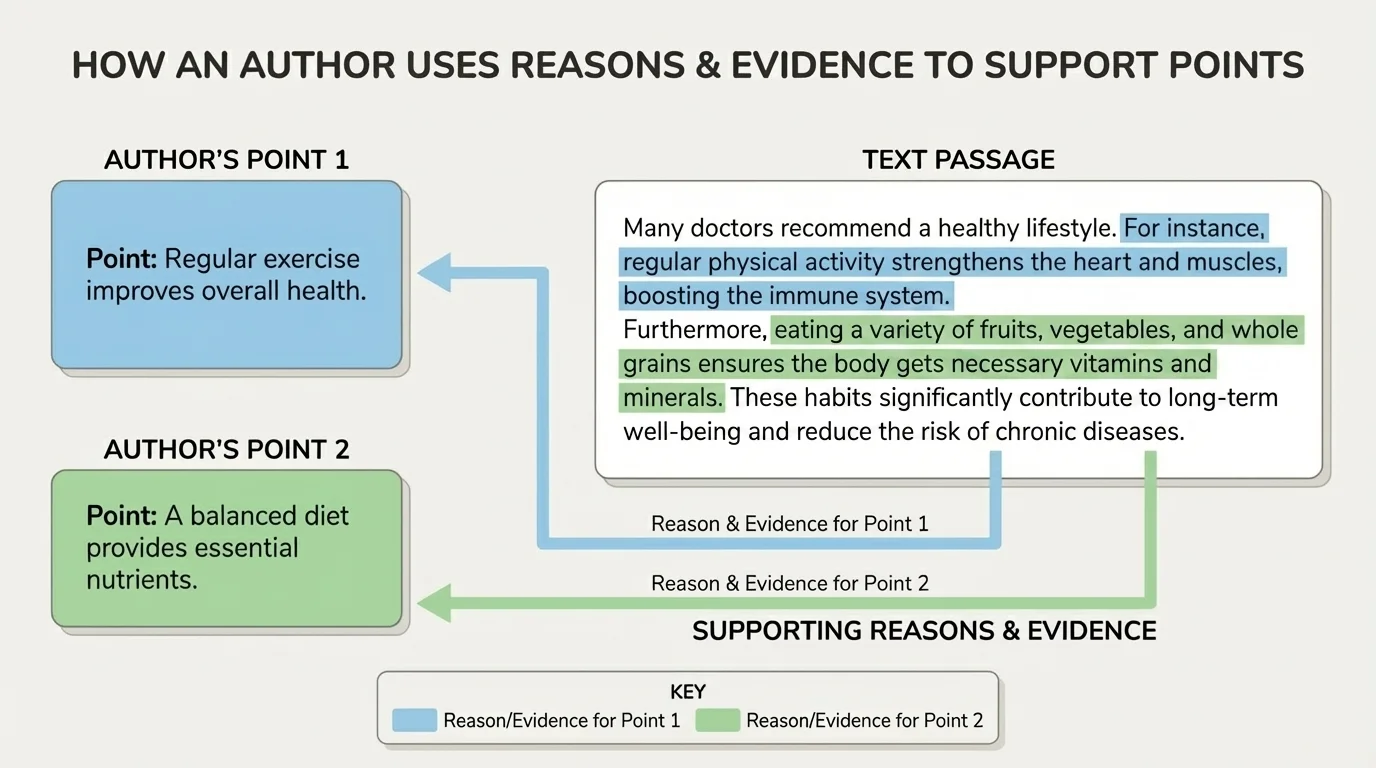
As you continue reading, ask two questions again and again: Which point is this sentence supporting? Is it a reason or evidence? This habit helps you separate the parts of the author's argument instead of blending them together.
Example: Matching support to points
Read this mini-text idea: After-school sports programs benefit students. They improve teamwork and help students stay active. In one school, coaches reported fewer conflicts among team members after students practiced passing and communication drills. The program also gave students 45 extra minutes of movement each day.
Step 1: Find the point.
The point is After-school sports programs benefit students.
Step 2: Find the reasons.
The reasons are that sports programs improve teamwork and help students stay active.
Step 3: Match the evidence.
The detail about fewer conflicts after communication drills supports the reason about teamwork. The detail about 45 extra minutes of movement supports the reason about staying active.
Each piece of evidence matches a different reason, and both reasons support the same point.
In longer texts, authors may repeat a point in different words. They may also place evidence several sentences after the reason. That is why active reading matters. You are tracing the path from point to reason to evidence.
Readers should not only identify support; they should also judge its quality, as [Figure 3] shows. Strong support is clear, relevant, and believable. Weak support is unclear, unrelated, or not convincing.
Suppose the point is: Drinking water is important during exercise. A strong reason is that the body loses water through sweat. Strong evidence might include a fact from a health expert or a description of how dehydration affects the body. Weak evidence would be something like, "My cousin once forgot a water bottle." That is a detail, but it may not be enough to prove the point well.
Strong evidence is often relevant, which means it directly connects to the point. It is also often specific. "Many kids like gardens" is weaker than "Students at three schools said they tried vegetables for the first time after working in school gardens." Specific details usually support a point more clearly.
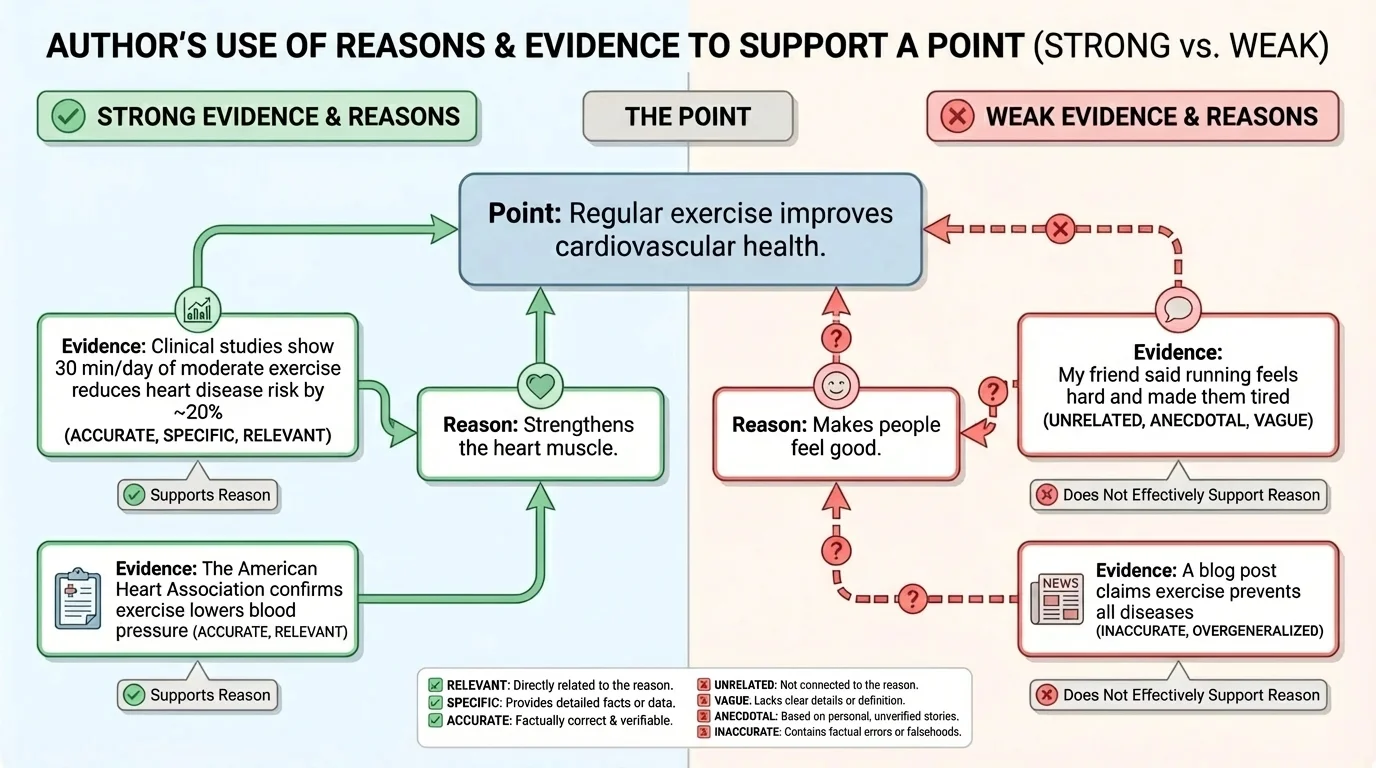
Good readers notice when support does not really fit. Maybe the author gives only opinions instead of proof. Maybe the evidence is too broad. Maybe the reason sounds strong, but the evidence underneath it does not actually prove anything. When you spot that, you are reading like an analyst.
You may already know how to find the main idea and supporting details. This skill builds on that knowledge. A point is like a focused main idea the author wants to prove, and reasons and evidence are the supporting details that hold it up.
Another thing to watch for is whether the evidence is accurate and from a trustworthy source. In student reading, the source is often built into the text itself, but in real life, readers should still wonder where the information came from.
When a text feels complicated, break it into steps. First, identify the topic. The topic tells what the text is about, such as oceans, recycling, or inventors. Then identify the point, which tells what the author is saying about that topic.
Next, find the reasons. Ask, "What explanations does the author give?" After that, look for evidence under each reason. Ask, "What proof, facts, examples, or details support this explanation?"
Signal words can help. Words such as because, since, for example, for instance, according to, and as a result often introduce reasons or evidence. These words are clues, though not every reason and evidence sentence includes them.
You can also pay attention to text features. Headings, captions, charts, and sidebars often include evidence that supports a point in the main text. In informational reading, support does not always appear in just one paragraph.
Consider this passage: Many towns should protect local wetlands. Wetlands reduce flooding by absorbing extra rainwater. During heavy storms, these areas hold water that might otherwise rush into streets and homes. Wetlands also provide habitats for birds, frogs, and insects. In one state park, scientists counted dozens of animal species living in wetland areas.
The point is: Many towns should protect local wetlands. The first reason is that wetlands reduce flooding. The evidence for that reason is the detail that wetlands absorb extra rainwater during heavy storms and keep it from rushing into streets and homes.
The second reason is that wetlands provide habitats for animals. The evidence for that reason is the detail about scientists counting many species in a wetland area. That detail proves that wetlands support living things.
Example: Sorting support in a passage
Passage idea: Classroom pets can be useful. They teach responsibility because students must feed and care for them. In one class, students made a daily schedule for giving a rabbit water and fresh hay. Pets can also make students more interested in science. During observations, students recorded the rabbit's eating habits and behavior.
Step 1: State the point.
The point is Classroom pets can be useful.
Step 2: Identify the reasons.
The reasons are that pets teach responsibility and increase interest in science.
Step 3: Match the evidence to each reason.
The feeding schedule supports the reason about responsibility. The observations of eating habits and behavior support the reason about science learning.
This is another example of one point supported by two reasons, each with its own evidence.
Notice how helpful it is to sort each detail. Without sorting, all the details may seem like one pile of information. With sorting, the author's thinking becomes visible.
Some informational texts do not stop with one point. An article may explain that solar energy saves money, reduces pollution, and can be used in remote places. These are related ideas, but each one can be treated as its own point or sub-point.
When that happens, it helps to think in layers. There may be one big overall point, such as solar energy is useful. Under that, the author may include several smaller points. Each smaller point has its own reasons and evidence.
This is where the earlier structure in [Figure 1] matters again. Authors often organize writing like a branching tree. A main point can lead to several reasons, and each reason can have more than one piece of evidence. In more complex texts, each branch may become its own mini-argument.
As you read, be careful not to attach a piece of evidence to the wrong branch. For example, a statistic about saving money supports the money point, not the pollution point. A fact about cleaner air supports the pollution point instead.
When you identify reasons and evidence, you also learn more about the author's purpose. The author may want to inform readers, persuade them, or explain why something matters. The kind of support the author chooses helps reveal that purpose.
An author's point of view is the way the author thinks about a topic. If an author strongly supports one side of an issue, the reasons and evidence often make that point of view clear. For example, if an author includes many benefits of community gardens and no drawbacks, the author likely views community gardens positively.
This does not always mean the author is wrong. It simply means readers should notice how the support is shaping the message. Smart readers pay attention not only to what is said, but also to what is left out.
"Good readers do not just collect information. They examine how the information is used."
That habit becomes especially important in articles about real-world issues, where authors may try to persuade readers. If you can identify the point, reasons, and evidence, you are much better prepared to decide whether the argument is convincing.
One common mistake is confusing the topic with the point. If a text is about bicycles, that is the topic. If the text argues that bicycles are one of the best ways for kids to get exercise, that is the point.
Another mistake is calling every detail evidence. A detail counts as evidence only if it supports a reason or point. If it does not help prove something, it is just extra information.
Readers also sometimes confuse reasons with evidence. Remember: a reason explains why the point is true, while evidence proves the reason. "School lunches should include more fresh foods because healthy meals help students focus" is a reason. "A nutrition study found that students who ate balanced meals paid attention longer" is evidence.
Finally, do not assume the first sentence always contains the point. Sometimes the point appears in the middle or at the end. Sometimes the author hints at it through repeated reasons and evidence. Keep reading and keep asking what idea the author is building toward.
When you practice this skill, informational texts become much more understandable. You begin to see not just a group of facts, but a carefully built structure of ideas. And once you can trace which reasons and evidence support which point, you are reading with power and precision.
