Even professional authors, journalists, and songwriters almost never get everything perfect on the first try. A strong story, report, or opinion piece usually starts as a rough draft and becomes better through careful changes. That means writing is not just about putting words on a page. It is also about improving those words until they clearly say what you mean.
Writing involves a writing process. A process is a series of steps. Writers often plan, draft, revise, edit, and sometimes rewrite. Each step helps in a different way.
When you write your first draft, your main job is to get your ideas down. You may still be deciding what example to use, how to explain something, or which order makes the most sense. That is normal. A first draft is not supposed to be perfect. It is supposed to give you something to improve.
Draft is a version of a piece of writing. A first draft is the beginning version. Revision means changing writing to improve ideas, organization, and clarity. Editing means correcting grammar, spelling, punctuation, and other writing conventions so meaning is clear.
A helpful way to think about it is this: revising helps the writing say more and say it better; editing helps the writing say it correctly. Both matter. A paragraph with exciting ideas but confusing grammar can be hard to understand. A paragraph with correct punctuation but weak ideas can still feel dull.
Strong writers often begin by deciding on a topic, a purpose, and an audience, as [Figure 1] shows through a simple organizer. Your purpose is why you are writing. Are you trying to tell a story, explain information, or convince someone? Your audience is the person or group who will read your writing.
Planning can be quick and simple. A student writing about recess safety might jot down a topic sentence, three reasons, and one example for each reason. Another student writing a narrative might list the characters, setting, problem, and solution. Planning helps you avoid getting stuck halfway through your draft.
Writers use different planning tools. Some brainstorm in a list. Some make a web. Some use boxes and bullets. Some talk through their ideas with a classmate or teacher before writing. The exact tool can change, but the goal stays the same: organize your thinking before you build full sentences.
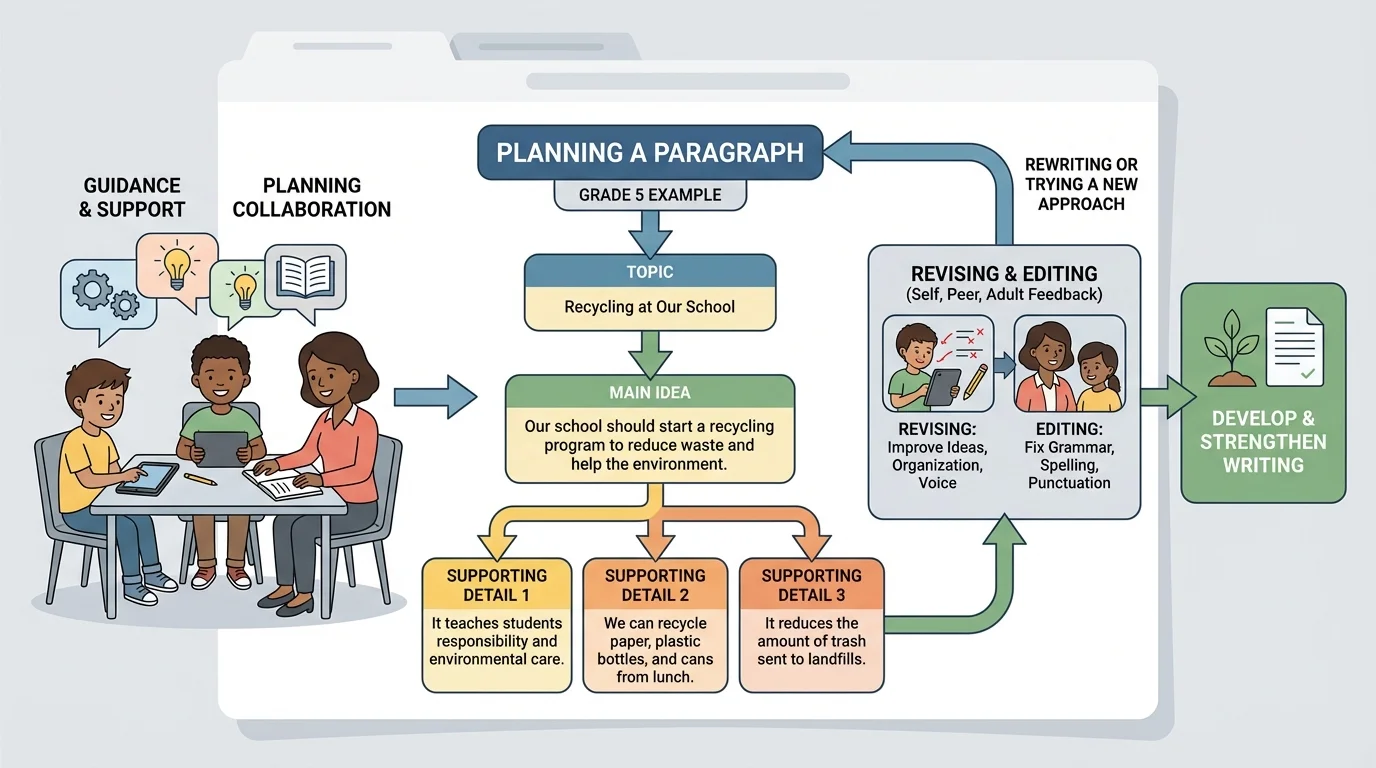
Suppose you are writing an informational paragraph about why school gardens are useful. A simple plan might look like this: main idea, school gardens help students learn; detail one, students observe plant growth; detail two, gardens teach responsibility; detail three, gardens can provide food for the cafeteria or community. With a plan like that, drafting becomes much easier.
You already know that complete sentences need a clear subject and predicate, and paragraphs should stay focused on one main idea. Planning helps you do both more successfully because you know what you want each sentence and paragraph to do before you draft.
Planning also helps with style. If you know your purpose is to persuade, you may choose strong reasons and convincing examples. If your purpose is to entertain, you may choose exciting actions and descriptive details. If your audience is your classmates, you may use examples they understand easily. Good writing choices begin before the first full draft.
After planning, writers begin drafting. This is the stage when ideas become sentences and paragraphs. Many students slow down too much because they want every sentence to sound perfect immediately. But drafting works better when you keep moving. Write the important ideas first. You can improve them later.
During drafting, it is fine to leave yourself notes. You might write, "Add a better ending here," or "Need another fact about turtles." These notes remind you what to fix later. They keep you from losing your train of thought.
A draft should match your plan, but it does not have to follow it perfectly. Sometimes while drafting, a better idea appears. A writer may notice that a different example works better or that two paragraphs should switch places. Flexible writers are often stronger writers because they let their ideas grow.
Many famous books went through many drafts before publication. Writers often cut pages, add scenes, or completely change endings before readers ever see the finished version.
Drafting is also the time to use what you know about grammar and mechanics in a sensible way. Try to write complete sentences and use punctuation correctly, but do not stop every few words to fix tiny mistakes. Save most of that close checking for the editing stage.
Revision is where real improvement happens, and [Figure 2] illustrates that revision changes the writing itself, not just surface mistakes. When you revise, you look closely at your message. Is it clear? Is it interesting? Is it organized? Does it include enough details?
Revising may involve adding examples, removing repeated ideas, changing the order of sentences, or rewriting an unclear part. Sometimes a writer discovers that the beginning is weak and needs a stronger opening. Sometimes the ending feels rushed and needs a clearer conclusion.
One useful revision question is, "Does each part help the whole piece?" If a sentence does not fit the main idea, it may need to be changed or removed. Another useful question is, "Will my reader understand this?" If the answer is no, the writer may need to explain more clearly.
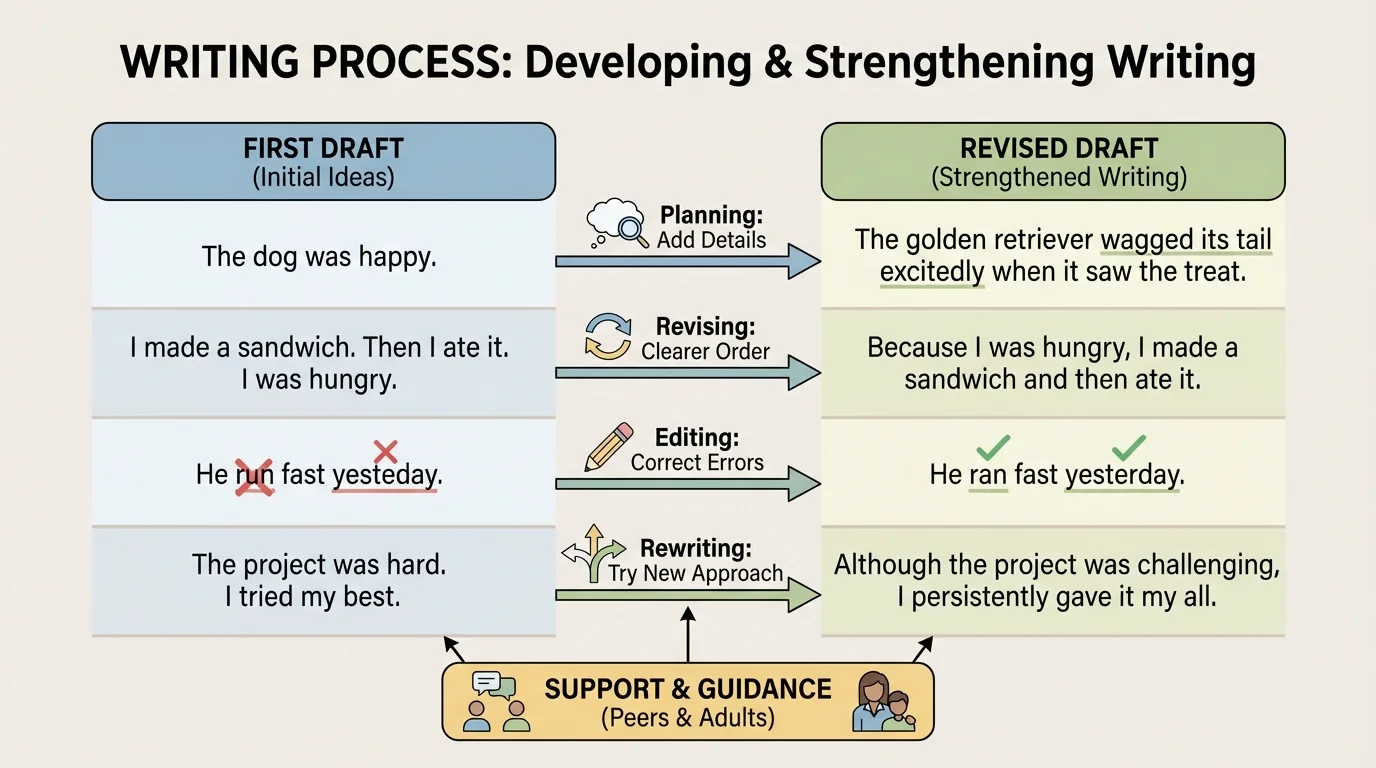
Look at this simple example. First draft: "The field trip was fun. We went to the science center. I liked it." This tells very little. A revised version might say, "The field trip to the science center was exciting because I built a model bridge, tested it, and watched it hold more weight than I expected." The revised sentence is more specific and more interesting.
Revision improves meaning. Writers revise to make their ideas stronger, clearer, and better organized. A revision may add sensory details to a narrative, stronger facts to an informational piece, or better reasons to an opinion piece. Revision asks, "How can this writing communicate better?"
Revision can also improve transitions, which are words and phrases that connect ideas. Words like first, next, for example, because, and finally guide readers through your writing. If the writing jumps too suddenly from one idea to another, stronger transitions can help.
As you saw earlier in [Figure 1], a clear plan makes revision easier because the writer can compare the draft to the original main idea and supporting details. If the draft wanders away from the plan, revision is the time to bring it back into focus or improve the plan itself.
After revising, writers edit. Editing focuses on conventions of standard English: grammar, usage, capitalization, punctuation, and spelling. These conventions matter because they help readers understand the writing without confusion.
For example, punctuation changes meaning. Compare these two sentences: "Let's eat, Grandma." and "Let's eat Grandma." One missing comma creates a completely different meaning. That is why careful editing matters.
Writers edit for complete sentences, correct verb tense, subject-verb agreement, capitalization of proper nouns, correct use of commas and apostrophes, and accurate spelling. They also check whether pronouns are clear. If a paragraph says, "Jada told Maya that she was late," the word she could mean Jada or Maya. Editing can fix that confusion.
Editing example
Here is a sentence from a student draft: "my friend and me was running to the library because we forget are books"
Step 1: Fix capitalization.
The sentence should begin with a capital letter: "My friend and me was running to the library because we forget are books."
Step 2: Fix grammar and usage.
"Me was" is incorrect. It should be "I was" or, more naturally in this sentence, "My friend and I were."
Step 3: Fix verb tense and word choice.
"Forget" should be "forgot," and "are books" should be "our books."
Step 4: Read the corrected sentence.
"My friend and I were running to the library because we forgot our books."
The edited sentence is much clearer and follows standard English conventions.
Editing is easiest when you go slowly. Reading aloud can help because your ears often catch mistakes that your eyes skip. It also helps to check one kind of error at a time. For example, first look for capitals and punctuation, then spelling, then grammar.
Good editing strengthens style too. Short, choppy sentences can sometimes be combined. A sentence that repeats the same word many times can be improved by choosing a more exact word. Editing is not only about fixing errors. It is also about helping the writing sound smooth and clear.
Sometimes a piece of writing needs more than small changes. A writer may realize that the whole structure is weak. In that case, rewriting is a smart choice, not a failure. Rewriting means creating a new version that uses what you learned from the earlier draft.
For example, a student may begin an opinion piece by listing reasons in a confusing order. After reading the draft, the student might decide to start over with the strongest reason first, then add evidence, then finish with a powerful conclusion. Another student writing a narrative may realize that the story would be more exciting if it started in the middle of the action instead of with a long explanation.
Trying a new approach can also mean changing the form of the writing. A report might work better with headings. A long paragraph might become two shorter paragraphs. A weak opening might become a question, a surprising fact, or a vivid scene. Writers are problem-solvers, and sometimes the best solution is a fresh start.
"Good writing is rewriting."
— A common rule many writers follow
This does not mean you always need to rewrite everything. It means you should be willing to change course when a piece is not working. Strong writers do not cling to every sentence they first wrote. They focus on what will help the reader most.
Writers often improve faster with guidance from others, and [Figure 3] shows how feedback can move a draft through several rounds of improvement. A classmate might notice a confusing sentence. A teacher may suggest a stronger ending. A parent or other adult may point out where more details are needed. Support from peers and adults helps writers see their work from a reader's point of view.
When you ask for feedback, it helps to ask specific questions. Instead of saying, "Do you like it?" you can ask, "Is my main idea clear?" "Which part is confusing?" or "Do I need more details in the middle?" Specific questions lead to more useful answers.
Good feedback is kind, honest, and helpful. "This is bad" is not useful. "Your beginning got my attention, but I'm not sure how the second paragraph connects to the first" is much more helpful. Good writers learn to listen without getting upset and then decide which suggestions improve their work.
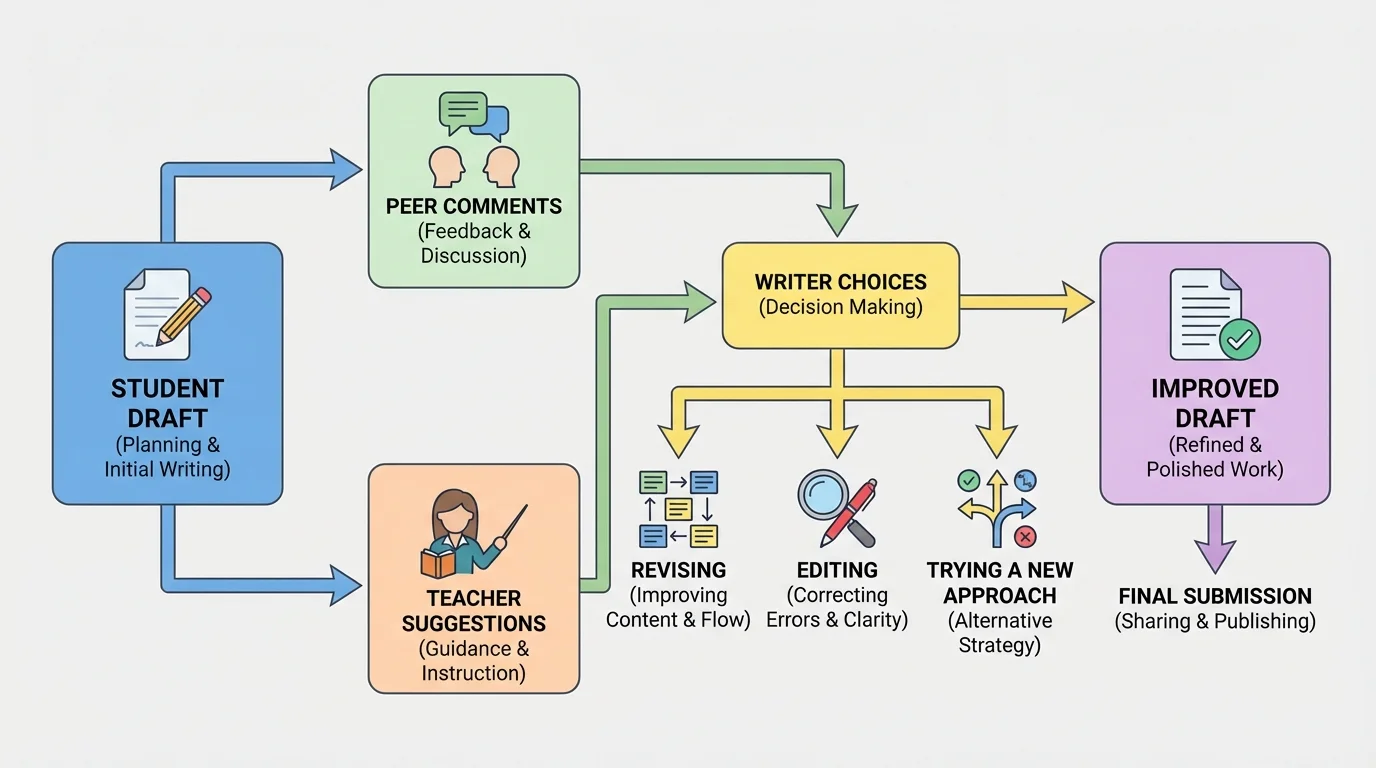
Not every suggestion must be accepted. The writer makes the final choices. However, if several readers are confused by the same part, that is an important clue that revision is needed. Feedback is most powerful when the writer listens carefully, thinks deeply, and makes purposeful changes.
Feedback example
A student writes a paragraph about why dogs make good pets. A peer says the paragraph repeats the word "good" too many times. The teacher says the reasons are listed, but no examples are included.
Step 1: The writer replaces repeated words.
Instead of saying dogs are "good" again and again, the writer uses words like loyal, playful, and helpful.
Step 2: The writer adds examples.
The writer explains that dogs can play fetch, comfort people when they feel sad, and protect a home by barking when strangers come near.
Step 3: The writer rereads the paragraph.
Now the paragraph sounds more specific, less repetitive, and more convincing.
Later, as [Figure 3] shows, feedback leads to choices. Writers do not simply collect comments. They use them to decide what to revise, what to edit, and what to rewrite.
Here is how the whole process might work for a grade 5 student writing about why reading every day is important.
First, the student plans: main idea, daily reading builds knowledge, improves vocabulary, and strengthens imagination. Next, the student drafts a paragraph with those three reasons. Then comes revision. The student notices that the second reason is too short and adds an example about learning the meaning of new words from context. The student also changes the order so the strongest reason comes first.
After revising, the student edits. A run-on sentence is split into two complete sentences. A missing capital letter is corrected. A few words are spelled incorrectly and fixed. The student asks a classmate to read the paragraph and hears that the ending feels abrupt. The student rewrites the conclusion to connect back to the main idea. The result is a stronger, clearer piece of writing.
Each step has a job. Planning prepares ideas. Drafting gets ideas down. Revising improves content and organization. Editing corrects mistakes and sharpens clarity. Rewriting gives the writer a chance to rebuild when needed. Feedback supports all of these steps.
This is why writing improves over time. A good final piece rarely appears all at once. It grows through choices, checks, and changes.
Strong writers develop habits that help them every time they write. They leave space to make changes. They reread their work carefully. They ask for help when they need it. They are willing to cross out weak parts and replace them with stronger ones.
They also remember the difference between big changes and small changes. If the ideas are weak, revising comes first. If the ideas are solid but the punctuation is messy, editing comes next. Knowing which kind of improvement is needed saves time and leads to better writing.
Most importantly, strong writers understand that improving a piece of writing is part of writing, not something extra. Planning, revising, editing, rewriting, and trying a new approach are not signs that a writer failed. They are signs that a writer is working like a real author.
