Have you ever heard two people tell the same story and noticed that it sounded like two completely different events? One person says, "It was amazing!" and another says, "It was a disaster." The event may be the same, but the way it is described changes because of point of view. In reading, understanding point of view helps us notice not just what happened, but also who is telling about it and how that shapes every detail we hear.
In a story, the narrator is the voice that tells the events. In a poem or speech, the speaker is the voice that shares ideas, feelings, or experiences. The point of view is the position from which that voice tells the story or shares thoughts.
Point of view matters because it affects what readers learn. A narrator may know only what one character sees. Another narrator may know what many characters think. A speaker may feel joyful, angry, lonely, or proud, and that feeling changes the words that are chosen. When we study point of view, we ask, "Who is telling this?" and "How does that person's view affect the description?"
Narrator means the voice that tells a story. Speaker means the voice speaking in a poem or speech. Point of view means the angle or position from which events, thoughts, and feelings are presented.
A narrator or speaker is not always the same as the author. An author creates the text, but the narrator or speaker is the voice inside the text. For example, an author might write from the point of view of a young child, a brave explorer, or even an animal. That choice changes the whole way the events are described.
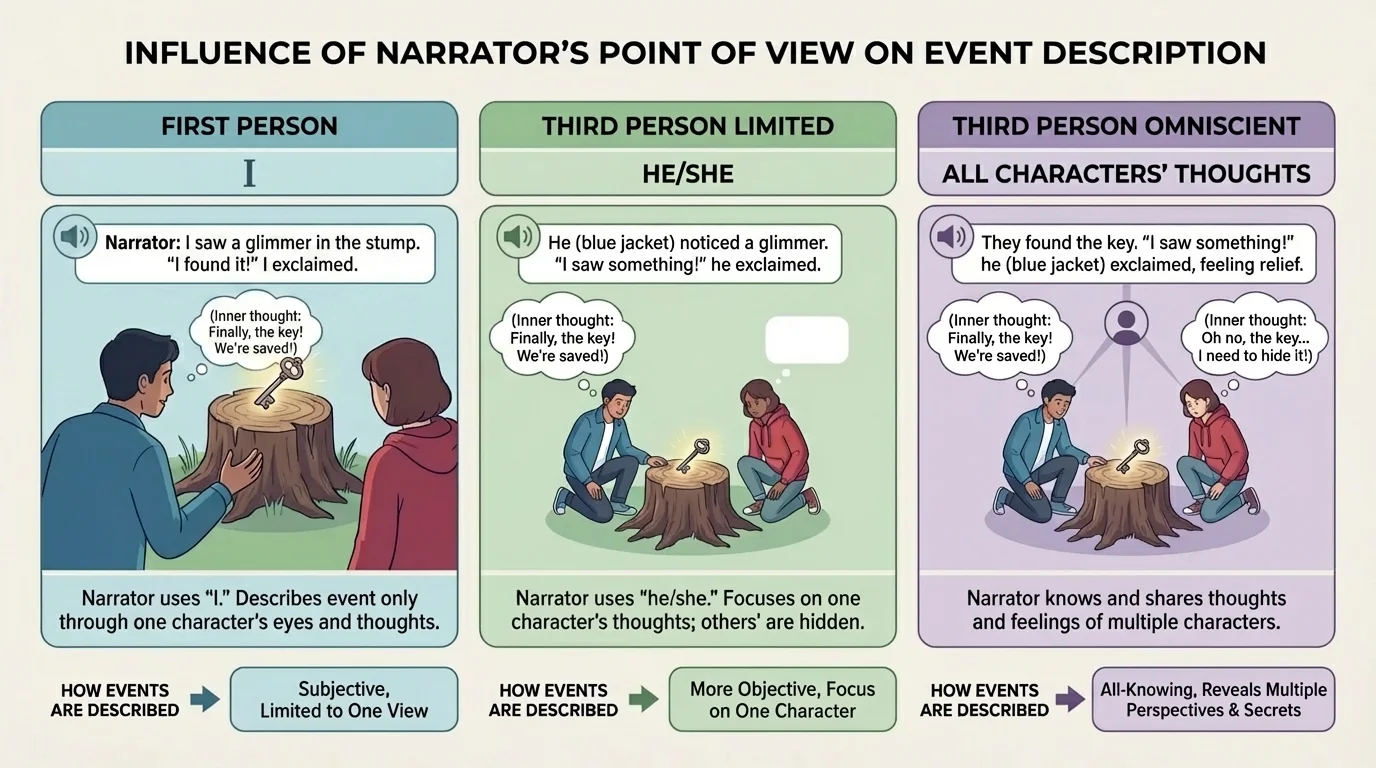
There are several common kinds of point of view, and each one gives readers different information, as [Figure 1] shows in a side-by-side comparison. If you know the type of point of view, you can better understand why the text gives certain details and leaves out others.
First-person point of view uses words like I, me, my, and we. The narrator is part of the story. Readers experience events through that narrator's eyes. This can make the story feel close and personal, but it can also limit what readers know, because the narrator cannot fully know another character's thoughts unless those thoughts are spoken aloud.
Second-person point of view uses the word you. It is less common in stories, but sometimes authors use it to make the reader feel pulled into the action. For example, "You step into the dark hallway and hear the floor creak." This point of view can feel immediate, but it is used less often in school reading.
Third-person point of view uses words like he, she, they, and their. There are two important kinds. Third-person limited stays close to one character's thoughts and feelings. Third-person omniscient means the narrator knows the thoughts and feelings of many characters. When readers know this difference, they can tell why one story feels more mysterious while another feels more complete.
Suppose a story says, "Lena gripped the microphone and hoped her hands would stop shaking." That sounds like third-person limited because readers know Lena's feelings. If the story adds, "In the audience, her brother felt sure she would do great," then the narrator knows more than one mind, which suggests third-person omniscient. This difference changes how events are described and how much the reader understands.
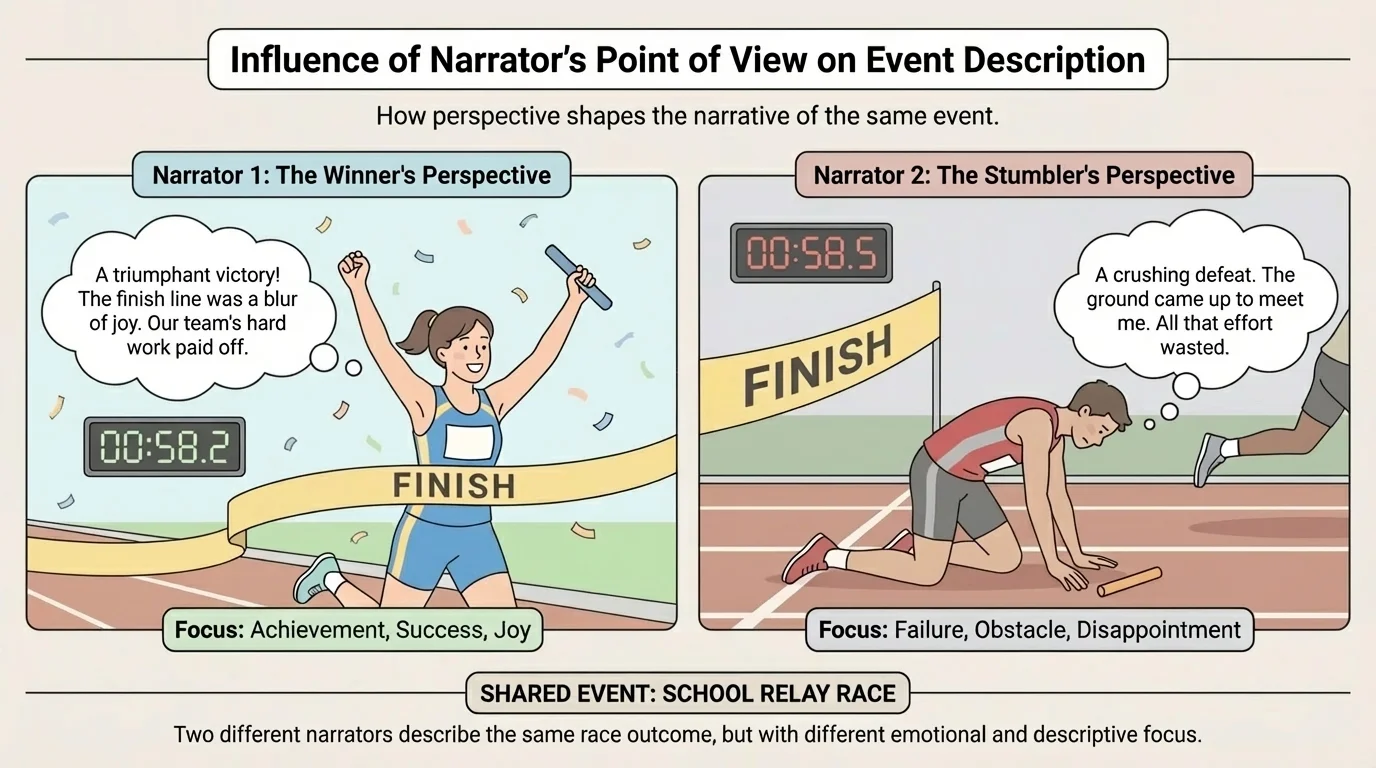
The same event can sound exciting, unfair, scary, or funny depending on who tells it, and [Figure 2] introduces that idea through one school race seen from different perspectives. Point of view influences the details a narrator includes, the feelings connected to those details, and the words used to describe what happened.
Imagine a class is having a relay race at field day. One student who wins might say, "I flew across the grass and handed off the baton just in time. Everyone cheered, and it felt like the best moment of the year." The same race, told by a student who tripped, might sound very different: "The grass was slippery, my shoe twisted, and before I knew it, the other team was gone."
Both descriptions tell about the same event, but the narrator's point of view changes the picture in the reader's mind. The winning student notices speed, cheering, and success. The student who fell notices the slippery grass, the shoe, and the feeling of disappointment. Neither description is necessarily false. Each one is shaped by personal experience.
Point of view also affects tone. Tone is the feeling or attitude carried by the words. A narrator who feels confident may describe a storm as thrilling. A narrator who feels frightened may describe the same storm as dangerous and terrifying. Because of point of view, readers do not just learn facts about events; they also sense how the teller feels about them.
Comparing one event told two ways
Event: A dog runs into a picnic and grabs a sandwich.
Step 1: View from a hungry child
"I had been waiting all afternoon to eat my sandwich, and that muddy dog snatched it right out of my hand. I could not believe my terrible luck."
Step 2: View from the dog's owner
"Biscuit dashed toward the blanket before I could catch his leash. He looked so proud carrying that sandwich that I almost laughed, even though I knew I had to apologize."
Step 3: Notice the difference
The child focuses on loss and frustration. The owner notices the dog's behavior and feels embarrassed but amused.
Writers often rely on this effect to make characters seem more real. When readers notice how point of view changes description, they can better understand why one character sounds trustworthy, confused, jealous, hopeful, or upset.
A narrator's or speaker's point of view shapes three big parts of description: knowledge, feelings, and attention. First, point of view controls what the narrator knows. A child narrator may not understand adult decisions. A narrator in first person may know personal feelings but not hidden facts. An omniscient narrator may know things happening in several places at once.
Second, point of view affects feelings. If a character is nervous before a spelling bee, the room may be described as too quiet, too bright, or too hot. If the same room is described by a confident student, it may seem full of opportunity. Feelings color description the way tinted glasses color what someone sees.
Third, point of view affects what the narrator notices. A soccer player may notice the muddy field, the score, and the goalie's position. A coach might notice teamwork and mistakes. A younger sibling watching from the sidelines might notice snacks, cheers, and how long the game feels. Different people in the same place pay attention to different details.
Bias and reliability also matter in point of view. Bias means a person has feelings or opinions that push descriptions in a certain direction. A narrator who is angry may exaggerate someone's mistakes. A narrator who admires someone may describe that person in a glowing way. Readers should think carefully about whether the narrator seems fully fair and accurate.
This does not mean readers should distrust every narrator. It means readers should be thoughtful. If a character says, "Everyone was against me," readers may ask whether that is completely true or whether the character feels hurt and is describing the event from that emotion. Strong readers pay attention to both the event and the teller's perspective.
Point of view is not only important in stories. In poetry, the speaker's perspective shapes the images, feelings, and meaning of the poem. A poem about winter written from the point of view of a child might describe sparkling snow, sled tracks, and rosy cheeks. A poem about winter from the point of view of someone without shelter might describe bitter wind and danger. The topic stays the same, but the speaker's point of view changes everything.
In speeches, point of view can influence how events or ideas are presented. A student giving a speech about recycling might focus on protecting nature because that matters deeply to them. Another speaker might focus on keeping the neighborhood clean. The same subject can be described through different values and goals.
Readers and listeners should pay attention to word choice. If a speaker says "precious forest," that suggests care and love. If a speaker says "unused land," that suggests a very different point of view. Specific words reveal perspective. They help readers hear the speaker's attitude, not just the topic.
Poems sometimes leave out exact names and facts on purpose so readers focus more on the speaker's feelings and perspective. That is why figuring out the speaker's point of view can unlock the poem's meaning.
Even when a speaker never says, "I feel sad," readers can often tell by noticing images, tone, and details. A poem filled with empty benches, gray skies, and slow footsteps may suggest loneliness. The speaker's point of view is built into what is described and what is left unsaid.
Readers can look for clear clues to identify point of view, and [Figure 3] organizes these clues into a simple path for thinking. One major clue is pronouns. Words like I and we often signal first person. Words like he, she, and they often signal third person.
Another clue is what the narrator knows. If the text reveals only one character's thoughts, it may be third-person limited. If it reveals many characters' thoughts, it may be third-person omniscient. If the narrator is speaking about personal experience and uses I, it is likely first person.
Readers should also ask what details are emphasized. If a narrator keeps noticing insults, unfairness, and slights, the narrator may feel defensive or hurt. If a speaker keeps describing beauty, music, and bright colors, the speaker may be full of joy or wonder. Paying attention to repeated details helps readers understand perspective.
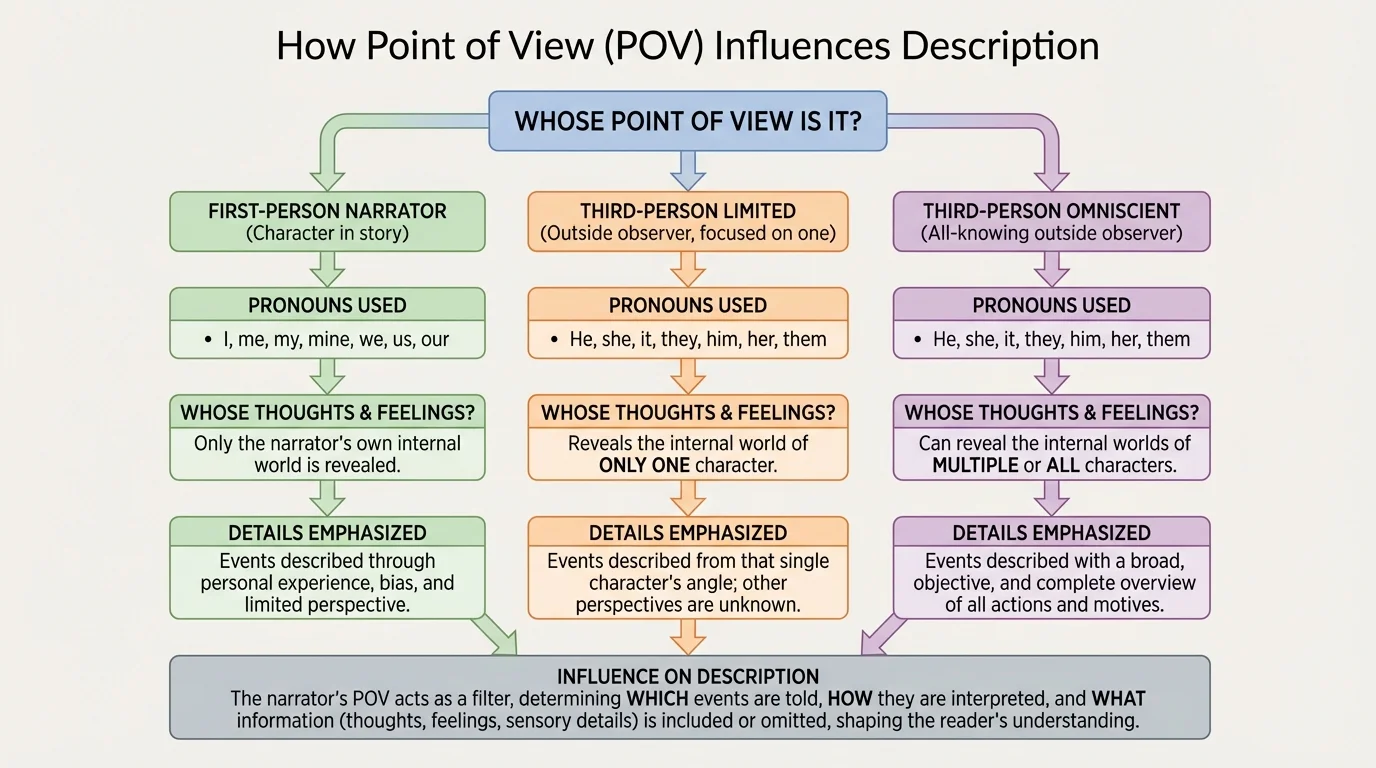
A helpful way to think is to ask three questions: Who is telling? What does that voice know? How does that voice feel? These questions help readers move beyond simply naming first person or third person. They lead to stronger understanding of how events are described.
For example, if a passage says, "I knew the attic held secrets, and I was sure my brother was hiding something," readers can tell the narrator is in first person. They also learn that the description may be shaped by suspicion. The brother might not actually be hiding anything, but the narrator's point of view makes the attic seem mysterious.
Authors choose point of view carefully because it changes the reader's experience. A first-person narrator can make readers feel close to a character's heart and mind. Third-person limited can build suspense, because readers know only what one character knows. Third-person omniscient can help readers understand a larger situation by showing many viewpoints.
As we saw earlier in [Figure 1], changing point of view changes how much information reaches the reader. Authors use that power on purpose. If an author wants readers to feel confused along with a character, a limited point of view works well. If an author wants readers to compare several characters' thoughts, an omniscient point of view may be the best choice.
Point of view can also help build sympathy. When readers see a difficult event through one character's eyes, they may understand that character more deeply. A scene about moving to a new town feels different when told by the nervous new student instead of by a classmate who barely notices the change.
When you analyze a text, look at both what happened and how it is told. Craft and structure matter because authors make choices that shape meaning. Point of view is one of those important choices.
This is why strong readers do more than retell events. They explain how the narrator or speaker influences the description. That kind of thinking helps readers understand character, mood, theme, and the author's purpose.
Suppose a power outage happens during a thunderstorm. One description says, "The house went black, and I felt my stomach drop. Every crash of thunder sounded like it was right over the roof." This narrator feels afraid, so the event sounds intense and threatening.
Another description says, "When the lights went out, Grandma lit candles and told stories while the rain drummed on the windows. The storm made the whole room feel secret and special." This teller describes the same kind of event, but the point of view creates a calmer, warmer feeling.
The event is not just the storm itself; it also includes the human experience of the storm. That is why point of view matters so much in literature. It shapes mood, description, and meaning. When readers compare descriptions, they begin to see how much power a narrator or speaker has.
This is also true in the relay race we considered earlier, as shown again in [Figure 2]. The race itself does not change, but success, disappointment, pride, or frustration can completely reshape the way it is told. A careful reader listens for those clues.
When you read, notice not only the events but also the lens through which you see them. The narrator's or speaker's point of view acts like that lens. It can zoom in, leave things out, brighten some details, or darken others. Understanding that lens helps you become a sharper, more thoughtful reader.
