Have you ever noticed that you do not read a game rule, a mystery story, and a science article in exactly the same way? Strong readers shift their attention depending on the job they need the text to do. Sometimes you read to learn facts. Sometimes you read to follow steps. Sometimes you read to enjoy a story and understand characters. Reading well is not just saying the words correctly. It is reading with a clear purpose and building understanding as you go.
When you read on-level text, you are reading material that is appropriate for your grade. These texts may include stories, poems, articles, biographies, directions, and explanations. The goal is not to race through them. The goal is to read accurately enough, smoothly enough, and thoughtfully enough that the meaning becomes clear.
Purposeful reading means reading with a reason in mind, such as learning information, following directions, or understanding a story. Comprehension is understanding what a text says and means. Fluency is reading accurately, at an appropriate pace, and with expression so the text sounds meaningful.
Good readers use many tools at once. They notice important words, connect ideas, and stop when something does not make sense. They also use their knowledge of word parts and word relationships to figure out unfamiliar vocabulary. That is especially important as texts include more challenging words and more complex ideas.
A reading purpose acts like a flashlight. It helps you focus on what matters most. If you are reading a recipe, your main goal is to follow steps in the correct order. If you are reading a folktale, your goal may be to understand the plot, the problem, and the lesson. If you are reading a science article, you may focus on key facts, causes, effects, and new vocabulary.
Purpose changes the kinds of questions you ask. In a story, you might ask, "Why did the character make that choice?" In an informational article, you might ask, "What is the main idea, and what details support it?" In directions, you might ask, "What should I do first, next, and last?" Readers who know their purpose are more likely to stay focused and remember what they read.
Purpose also helps when a text gets difficult. If you know why you are reading, you can decide what to slow down for. You may reread an important sentence, look closely at a heading, or stop to figure out an unfamiliar word because you know that understanding it matters to your goal.
Your brain does not read every text in the same way. It pays attention differently when you search for facts, follow instructions, or picture a story world.
That is why strong readers do not use one single reading style for everything. They adjust.
[Figure 1] shows how reading well depends on three connected skills: accuracy, fluency, and comprehension. If one part is weak, understanding becomes harder. When the parts work together, reading feels smoother and meaning becomes easier to build.
Accuracy means reading the words correctly. If a reader changes too many words, skips words, or guesses often, the meaning may change. For example, if a sentence says "The desert climate is harsh," but a reader says "The dessert climate is harsh," the sentence no longer makes sense. Accurate reading matters because the exact words carry the author's ideas.
Fluency means reading at a steady, natural pace with expression. A fluent reader does not usually stop at every word. Instead, the words flow in groups that sound meaningful. This helps the brain pay attention to ideas instead of spending all its energy on decoding. A choppy reader may still get some meaning, but it takes more effort.
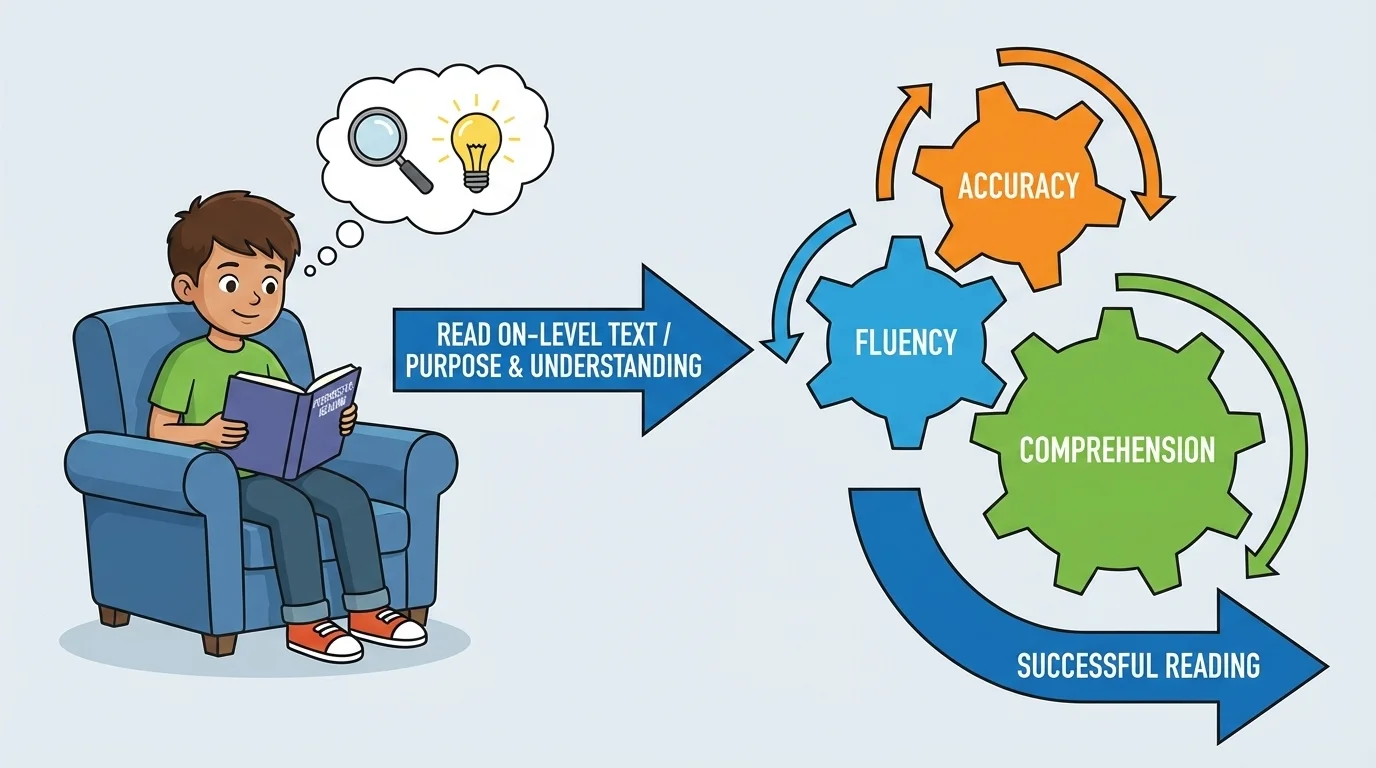
Comprehension is the result of making sense of the text. It includes understanding facts, ideas, character actions, causes and effects, and the author's message. You can think of comprehension as the whole point of reading. Accurate and fluent reading support it.
Suppose two students read the same paragraph. One reads every word correctly but so slowly that the beginning is forgotten by the time the ending arrives. Another reads quickly but skips important words. Both may struggle to understand. This is why the three skills depend on one another.
How fluency supports understanding
When readers recognize many words automatically, they free up brain power to think about meaning. That extra attention can go toward noticing the main idea, making predictions, and connecting details. Fluent reading is not about speed alone. It is about reading in a way that sounds and feels meaningful.
Expression matters too. When your voice changes naturally at a question mark or around exciting dialogue, you are showing that you understand the sentence structure and mood. Reading in a monotone can make important meaning harder to notice.
One powerful strategy for unknown words is morphology, the study of meaningful word parts. Many words can be taken apart into smaller pieces that help you predict meaning. These pieces include prefixes, roots, and suffixes.
A prefix is added to the beginning of a word. For example, re- often means "again," so replay means "play again." Un- often means "not," so unhappy means "not happy." A suffix is added to the end. In careless, the suffix -less means "without," so careless means "without care."
[Figure 2] helps show how a root is the base part that carries the main meaning. In the word preview, the prefix pre- means "before," and the root view relates to seeing. So preview means "to see before." In transport, the root relates to carrying, so the word has to do with carrying across or from one place to another.
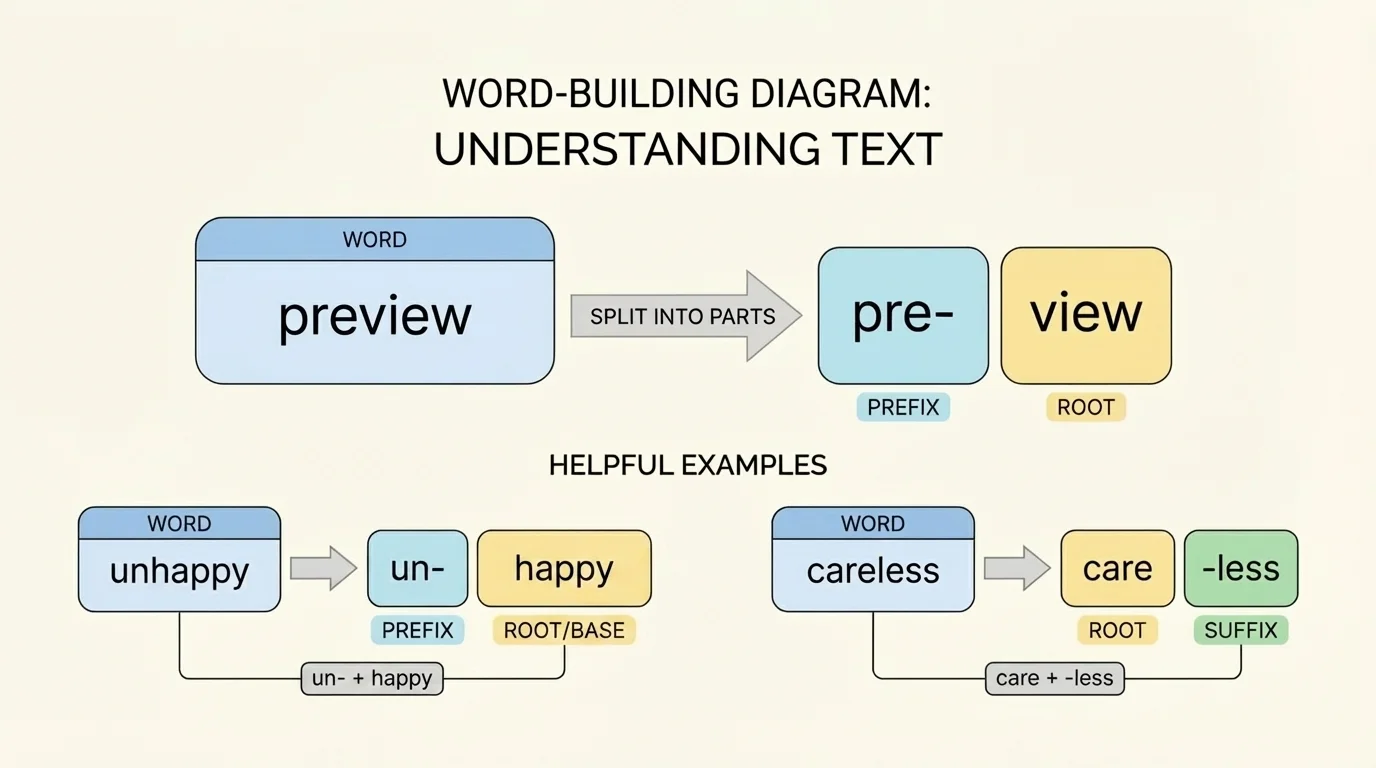
Knowing common word parts helps you take smart guesses. If you read the sentence, "The submarine moved underwater," the prefix sub- can help. It often means "under," so submarine likely has something to do with being under water. You do not need to know every word ahead of time if you know how to examine its parts.
Word parts are especially helpful in subjects like science and social studies. A word such as disagree can be broken into dis-, meaning "not" or "opposite," and agree. A word such as careful includes the suffix -ful, meaning "full of." A careful reader shows care and attention.
| Word Part | Meaning | Example | What It Suggests |
|---|---|---|---|
| un- | not | unfair | not fair |
| re- | again | rewrite | write again |
| pre- | before | preview | see before |
| -less | without | hopeless | without hope |
| -ful | full of | helpful | full of help |
Table 1. Common word parts and how they help readers infer meaning.
Of course, word parts do not solve every mystery. Sometimes a part has more than one meaning, or the word has changed over time. That is why readers combine morphology with context clues from the sentence and the whole paragraph.
Using word parts in a sentence
Read this sentence: "Before the play opened, the audience watched a preview of one scene."
Step 1: Look for familiar parts.
The word preview contains pre-, meaning "before," and view, meaning "see."
Step 2: Combine the parts.
The word likely means "see before."
Step 3: Check the sentence.
The audience watched something before the full play, so preview means an early look at what is coming.
Using both word parts and context leads to a strong, sensible meaning.
Later, when you meet harder words, the same strategy still works. Breaking words apart makes large words feel smaller and more manageable.
Words do not stand alone. Their neighbors often provide hints. A context clue is a word or phrase near an unknown word that helps explain it. Readers can learn to spot several common types of clues while reading.
Sometimes the author gives a direct definition. For example: "A habitat, the natural home of a plant or animal, can change over time." Even if you did not know habitat, the words after the comma explain it.
Sometimes the clue is a synonym, a word with a similar meaning. "The road was enormous, huge enough for trucks to pass." The word huge helps explain enormous. Other times the clue is an antonym, a word with an opposite meaning. "Unlike his timid sister, Marco was bold." The contrast with bold helps explain timid.
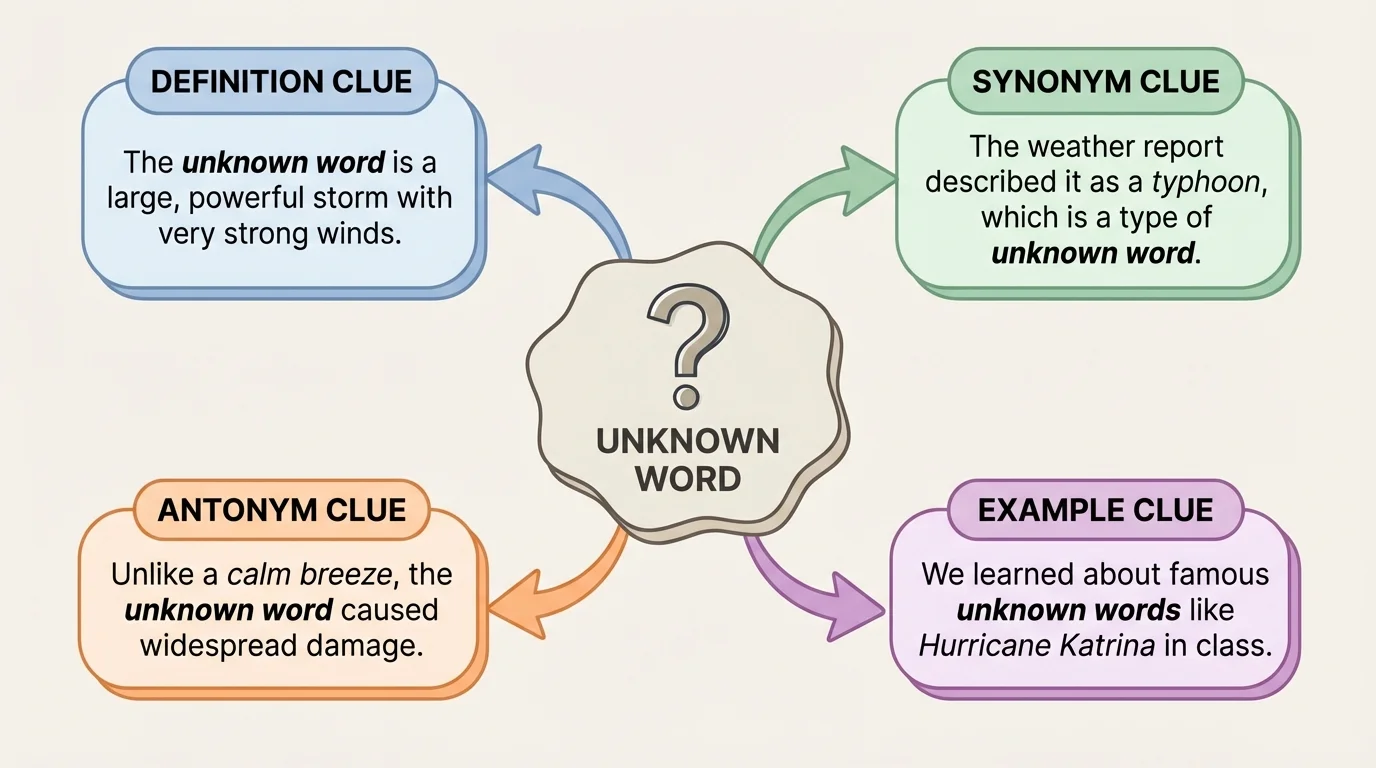
Examples can help too. "Arctic animals, such as polar bears, seals, and arctic foxes, need thick coverings to stay warm." The examples reveal the kind of animals being discussed.
Word relationships also matter. If two words are compared, contrasted, listed together, or connected by a cause-and-effect relationship, those patterns give clues. Suppose a passage says, "The trail was steep and difficult, but the flat road was easy." Even if you do not know steep, the contrast with flat helps you understand.
You already know that sentences work together to express a complete idea. When one sentence feels unclear, the sentences before and after it often provide missing information. Skilled readers use the whole paragraph, not just one line, to make meaning.
The best readers combine strategies. They look inside the word for parts, around the word for clues, and across the paragraph for relationships. If one clue is weak, another may help. That flexible thinking makes unfamiliar vocabulary less scary.
When a social studies book uses a word like conflict, the surrounding details may mention disagreement, struggle, or opposing sides. Those connected ideas help define the word. The clue types shown in [Figure 3] are tools you can use in nearly every subject.
Readers adjust their approach to fit the text type. A story, an article, a poem, and a set of instructions all require understanding, but the kind of understanding changes. Purpose tells you what to notice first.
In a story, pay attention to characters, setting, conflict, events, and theme. Ask what the characters want, what obstacles they face, and how they change. In fiction, details may help create mood or reveal personality.
[Figure 4] compares how readers approach different text types. In an informational text, focus on the main idea and supporting details. Notice headings, captions, bold words, diagrams, and examples. Ask what the author is teaching and how each section adds to that idea.
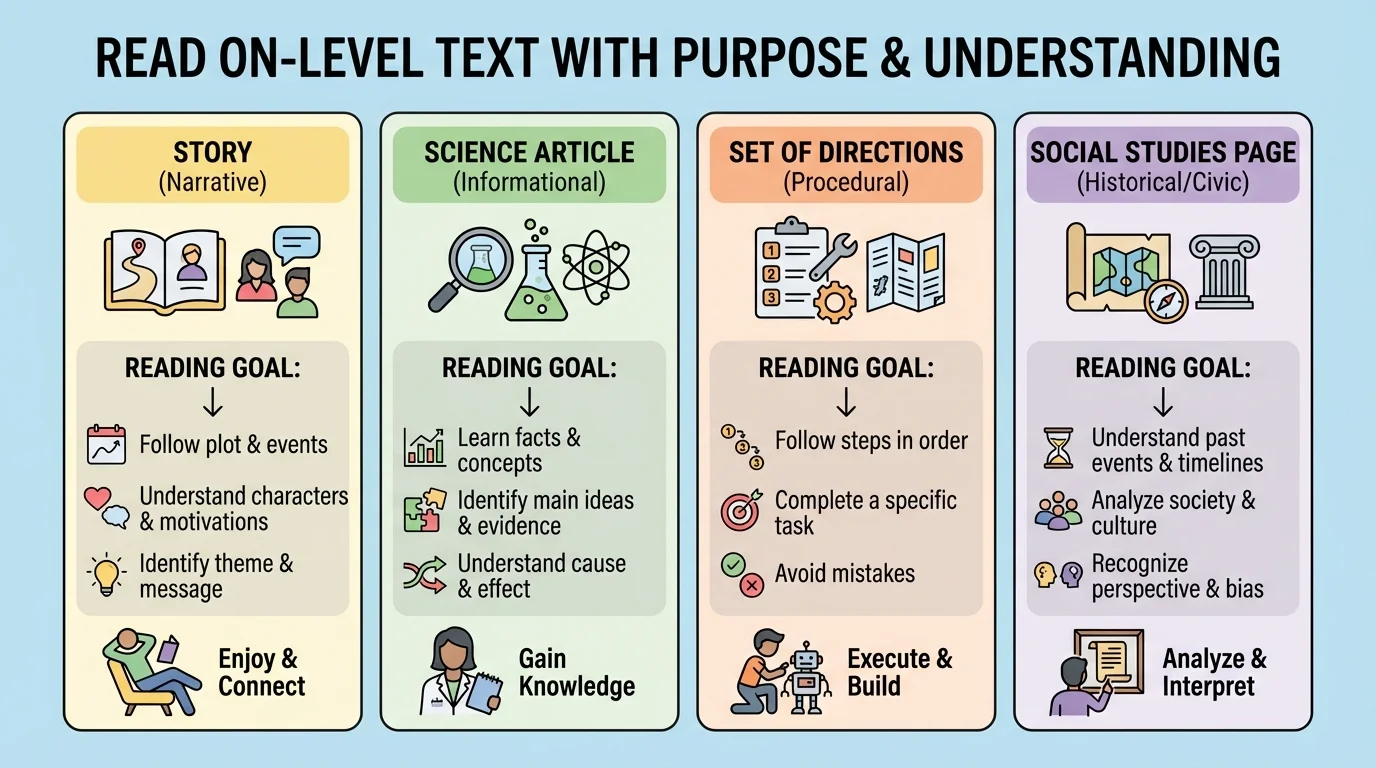
In directions, sequence is everything. Missing one step can cause confusion. Words like first, next, after, and finally are clues that help organize action. In a poem, read more slowly and notice word choice, rhythm, and images that create feelings or ideas.
| Text Type | Main Reading Purpose | What to Notice |
|---|---|---|
| Story | Understand plot and characters | Problem, events, character choices, theme |
| Informational article | Learn facts and ideas | Main idea, details, headings, domain-specific vocabulary |
| Directions | Follow a process correctly | Sequence words, exact steps, warnings |
| Poem | Interpret language and feeling | Images, rhythm, repeated words, tone |
Table 2. How reading purpose changes with different kinds of text.
Being able to read on-level text means being ready for all these forms. School reading is not one thing. In one day, you might read a chapter from a novel, word problems in math, science procedures, and a biography in social studies. Flexible readers move between these smoothly.
How purpose changes attention
Suppose you read the sentence, "Stir the mixture for two minutes, then add cold water slowly."
Step 1: Identify the text type.
This sounds like directions or a procedure.
Step 2: Match the reading purpose.
The purpose is to do the task correctly.
Step 3: Decide what matters most.
The order, the time, and the word slowly are all important.
If you read this like a story and ignore the sequence, you may not complete the task correctly.
When you switch from reading a story to reading directions, your brain should switch jobs too. That comparison makes the change visible.
Strong readers pay attention not only to the text but also to their own understanding. This is called monitoring. It means noticing when meaning is clear and noticing when it breaks down.
Sometimes confusion is obvious. A sentence may sound strange, or a paragraph may seem disconnected. Sometimes confusion is quieter. You may finish a page and realize you cannot explain what you just read. Monitoring means catching that moment and doing something about it.
Helpful actions include rereading, slowing down, reading aloud, looking back at headings, and asking questions. You might ask, "What just happened?" "What does this word probably mean?" or "How does this detail connect to the main idea?" These questions turn reading into active thinking.
Fix-up strategies
When understanding breaks, readers can repair it. They may reread a tricky part, break a long sentence into smaller chunks, use morphology, look for context clues, or summarize one paragraph before moving on. Fix-up strategies keep small confusions from becoming big ones.
It is normal not to understand everything instantly. Even skilled readers pause and repair meaning. The difference is that they notice the problem and respond. They do not simply keep going while meaning slips away.
Purposeful reading also depends on habits. Reading for understanding takes attention, and attention grows with practice. The more often you read on-level texts, the more familiar sentence structures, vocabulary, and text features become.
One useful habit is reading in phrases rather than word by word. For example, in the sentence "The red-tailed hawk circled above the field," a fluent reader groups words naturally: The red-tailed hawk / circled above / the field. Grouping helps meaning come through more clearly.
Another habit is using punctuation as a guide. Periods, commas, question marks, and dialogue marks help shape the flow of reading. Punctuation is not decoration. It supports meaning and expression.
Readers who practice reading aloud with expression often improve silent reading too, because they become better at hearing how sentences are supposed to sound and connect.
Stamina matters as well. Longer texts require readers to hold ideas in mind across several paragraphs or pages. That becomes easier when you pause to think, remember your purpose, and keep track of the most important ideas.
Reading with purpose and understanding is not just a school skill. Athletes read play instructions. Gamers read updates and rules. Cooks read recipes. Travelers read maps and signs. Scientists read procedures. Doctors read charts and reports. In every case, success depends on understanding what the text is trying to communicate.
In school, purposeful reading helps across subjects. In science, it helps you follow experiments and understand cause and effect. In social studies, it helps you track events, people, and reasons. In math, it helps you understand the language in word problems. In language arts, it helps you analyze characters, themes, and the author's craft.
When a reader uses accuracy, fluency, word-part knowledge, word relationships, context clues, and monitoring, reading becomes more powerful. You are no longer just looking at words. You are building meaning on purpose.
"Reading is thinking with the help of print."
— A core idea of strong literacy
The more you practice reading with purpose, the more confident you become. Hard words become puzzles you can solve. Different texts become easier to handle. Most of all, reading becomes a tool for learning, exploring, and understanding the world.
