Have you ever agreed with someone's opinion at first, but then gotten confused when they tried to explain why? That happens in writing, too. A strong opinion is not enough by itself. A writer also needs to guide the reader from the opinion to the reasons that support it. When writers connect those ideas clearly, their writing sounds thoughtful, organized, and convincing.
Opinion writing appears everywhere: in book reviews, letters to a principal, speeches, classroom debates, and articles about school or community issues. Good writers do more than state what they believe. They explain their thinking in a way that helps the reader follow each step. That is why linking language matters so much.
An opinion piece shares a point of view about a topic or a text. It tells what the writer believes and gives reasons, facts, examples, or details to support that belief. If a student writes, "Recess should be longer," that is an opinion. But if the student adds, "because exercise helps students focus in class," the writing becomes stronger. The reason helps the reader understand the thinking behind the opinion.
In opinion writing, the reader should never have to guess how one idea connects to the next. The writer needs to build a bridge between ideas. That bridge is often made of linking words, phrases, and clauses.
Opinion is what a writer believes, thinks, or feels about a topic.
Reason is an explanation that tells why the writer holds that opinion.
Supporting information includes facts, examples, details, or explanations that make the reason stronger.
When these parts work together, the writing becomes easier to understand. A reader can see the opinion, follow the reasons, and notice how the details support the whole argument.
Transitions are words and groups of words that show how ideas connect. They help writing flow instead of sounding choppy or random. Without transitions, a paragraph may feel like a pile of separate thoughts. With transitions, the paragraph becomes a chain in which each part links to the next.
Look at this example without linking language: "Our class should grow a garden. Plants teach science. Students work together. Vegetables can be served at lunch." The ideas are related, but the connection is weak. Now read it with clearer links: "Our class should grow a garden because plants teach science. In addition, students work together while caring for the garden. As a result, the vegetables could even be served at lunch." The second version helps the reader follow the writer's logic.
Linking language can show many kinds of relationships. It can show cause, sequence, addition, emphasis, clarification, or result. A writer chooses the link that matches the job the sentence needs to do.
Different linking words do different jobs for the reader, as [Figure 1] shows. Some connectors introduce a reason. Others add a detail, give an example, or show a result. If a writer chooses the wrong connector, the writing may sound confusing even if the ideas are good.
Here are some common kinds of linking language used in opinion writing. One useful group gives reasons: because, since, and for the reason that. Another group adds information: also, in addition, another reason, and furthermore. A third group explains or narrows an idea: specifically, for example, in particular, and to explain. A fourth group shows results: therefore, consequently, as a result, and for this reason.
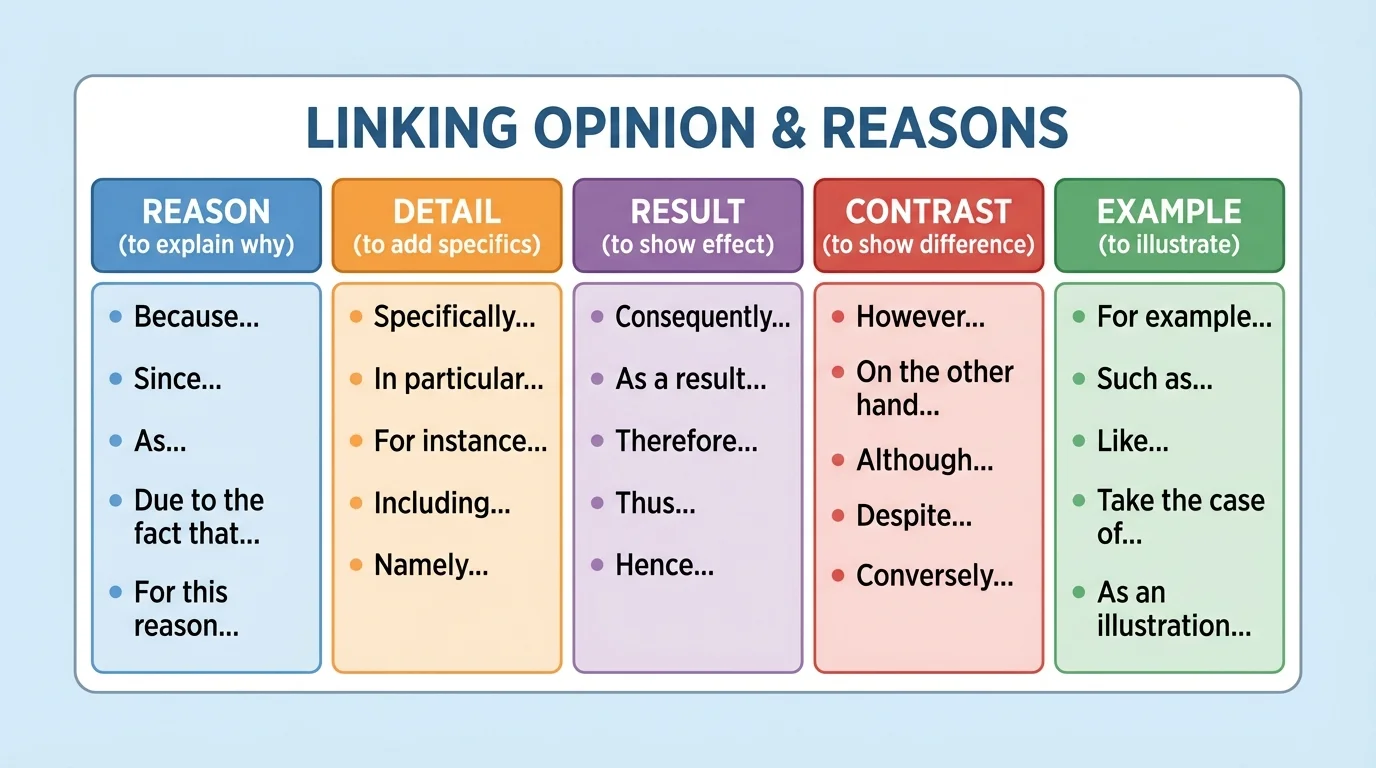
Writers also sometimes need to show contrast or answer another point of view. For that job, they might use however, on the other hand, or although. Even in opinion writing, it can be useful to admit that another side exists and then explain why your own opinion is stronger.
Think about the difference between these sentences:
"School uniforms are helpful because they reduce distractions."
"School uniforms are helpful; specifically, they reduce arguments about clothing brands."
"School uniforms are helpful; consequently, students may focus more on learning."
Each sentence supports the same opinion, but the linking word changes the relationship. Because introduces a reason. Specifically adds a more exact detail. Consequently shows a result.
Small words can do a huge job in writing. A single connector like because or however can completely change how a reader understands the relationship between two ideas.
That is why choosing precise linking language matters. The reader does not just need your ideas. The reader needs to know how those ideas fit together.
Writers can connect ideas in three main ways: with a single word, with a phrase, or with a clause. These forms connect ideas in slightly different ways, and [Figure 2] illustrates how the same opinion can be linked using each kind.
A linking word is one word that joins ideas. Examples include because, therefore, however, and also. A linking word is short, but it can still do important work.
A phrase is a small group of words that acts together. Examples include for example, in addition, as a result, and on the other hand. Phrases often sound a little more formal than single-word connectors.
A clause is a group of words that includes a subject and a verb. Some clauses can stand alone as sentences. Others cannot. In opinion writing, dependent clauses often help connect reasons to opinions. Examples include because it saves time, although some people disagree, and since students need exercise.
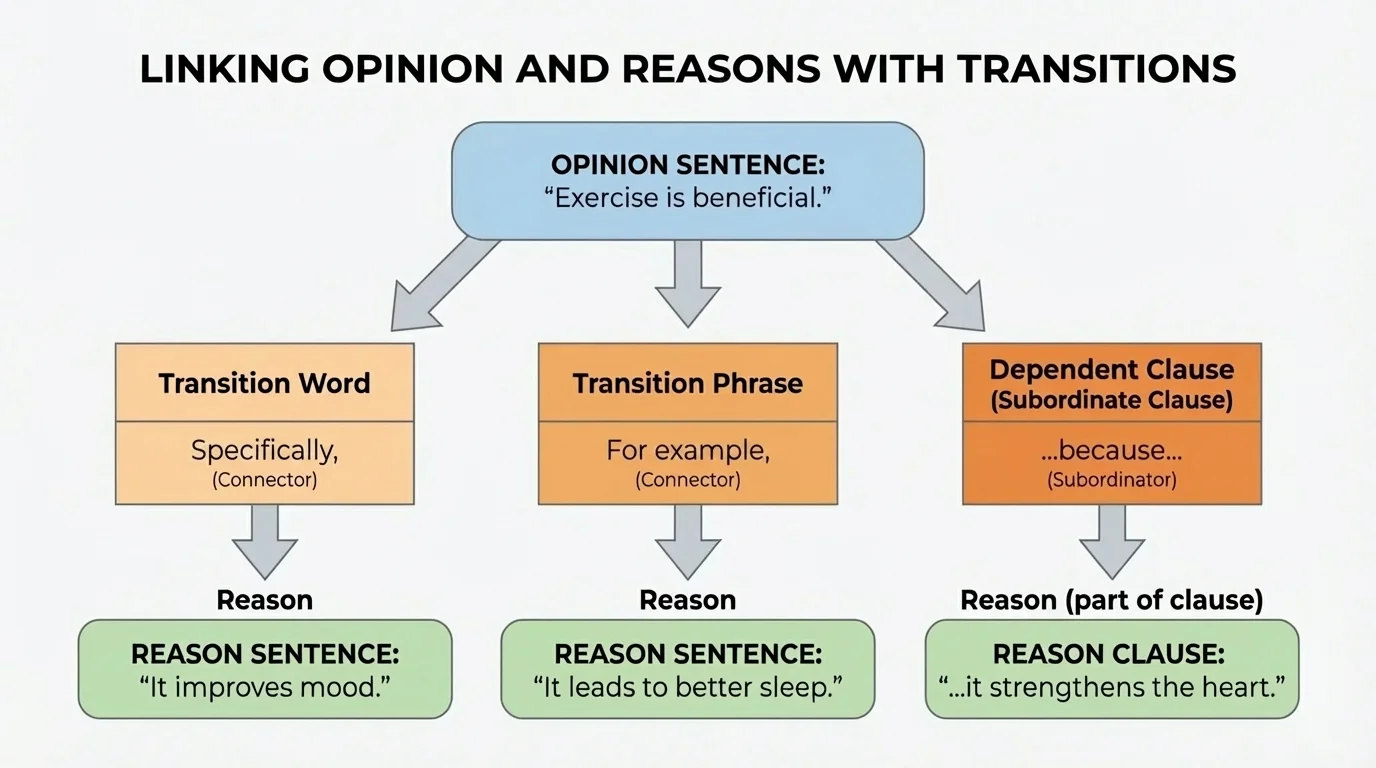
Read how all three forms can work:
Word: "Students should read every day; therefore, schools should protect reading time."
Phrase: "Students should read every day. For example, reading at home can build vocabulary."
Clause: "Students should read every day because they gain knowledge and language skills."
All three versions make connections, but they do not sound exactly the same. Skilled writers choose the form that fits the sentence and the tone they want.
One of the most important writing decisions is matching the link to the meaning. If you are giving a reason, use a connector that signals a reason. If you are giving a result, use one that signals a result. If you are adding a detail, use one that signals addition or clarification.
Here is a simple comparison:
| Purpose | Useful linking language | Example |
|---|---|---|
| Give a reason | because, since, for the reason that | "Field trips matter because students learn from real places." |
| Add another point | also, in addition, furthermore, another reason | "In addition, field trips make lessons memorable." |
| Be more exact | specifically, in particular, for example | "Specifically, a museum visit helps students see history up close." |
| Show a result | therefore, consequently, as a result, for this reason | "As a result, students often understand the topic better." |
| Show contrast | however, although, on the other hand | "Although field trips cost money, they can still be worth it." |
Table 1. Common purposes for linking language in opinion writing, with examples.
Notice that the same opinion can be developed in many directions. A writer might first state a reason, then add another reason, then give a specific example, and finally explain the result. This pattern helps the paragraph sound complete rather than rushed.
Earlier, [Figure 1] grouped connectors by purpose. That same idea helps you make better choices while drafting: ask yourself what job the next sentence needs to do.
[Figure 3] shows how a strong opinion paragraph moves in a clear order: it begins with a claim, adds a reason, supports that reason with details or examples, and explains why those details matter. Linking language helps the reader travel through that order without getting lost.
Here is a weak paragraph: "The cafeteria should serve more fresh fruit. Students need healthy food. Apples and oranges are easy to serve. Healthy food helps students." The ideas all point in one direction, but the paragraph feels jumpy.
Now look at a clearer version: "The cafeteria should serve more fresh fruit because students need healthy food choices. For example, apples and oranges are easy to serve and do not require complicated preparation. As a result, students can choose snacks that help them stay energized during the day." The opinion, reason, example, and result now connect smoothly.
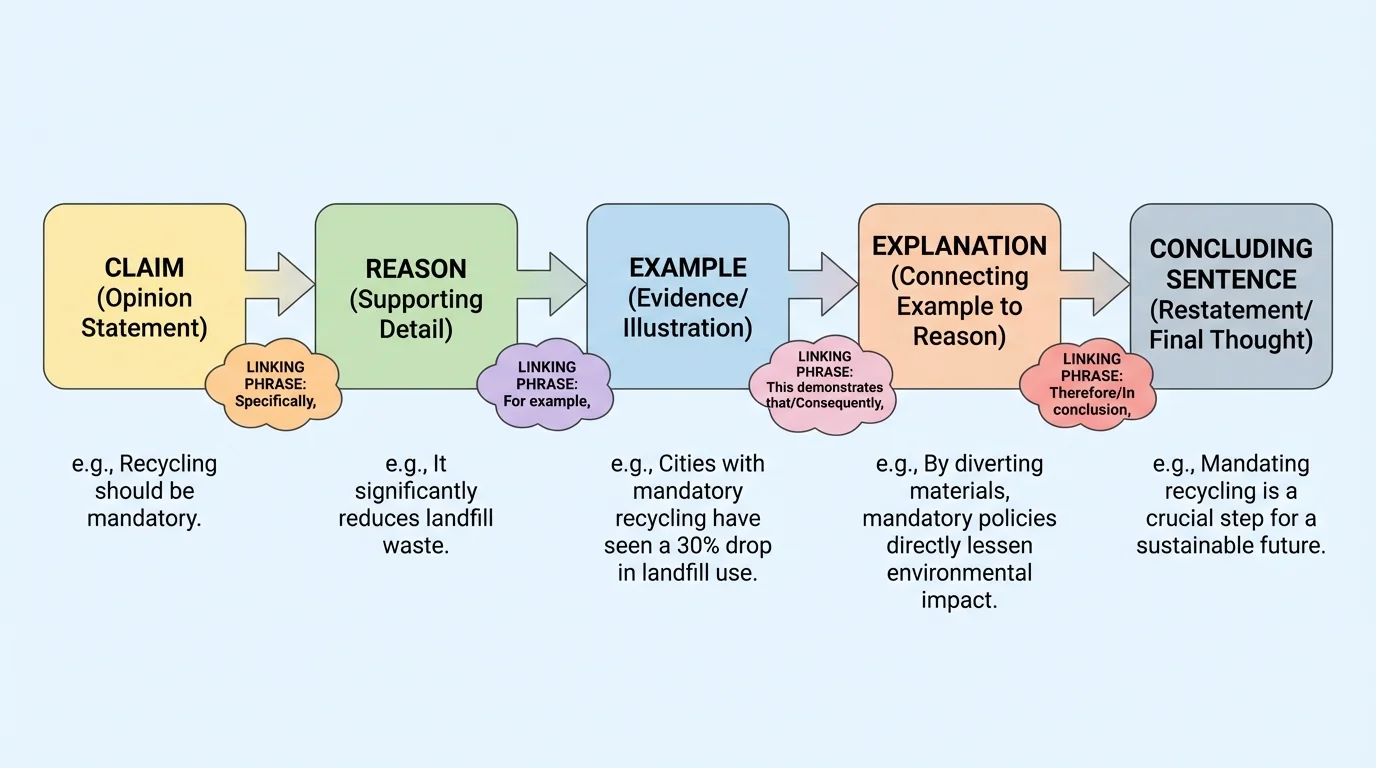
Good paragraphs often use more than one kind of linking language. A writer might begin with because, add a detail with specifically, and finish with therefore. That variety keeps the writing from sounding repetitive.
From claim to explanation
Opinion writing becomes convincing when the writer does not stop after stating a reason. A reason should be followed by support and explanation. For example, if a writer says that homework should be shorter because students need time to rest, the next sentences should explain what kind of rest matters, how it helps learning, and why that supports the opinion.
You can think of an opinion paragraph as a line of connected steps: claim, reason, support, explanation. When even one step is missing, the writing feels weak. When the links are clear, the paragraph feels complete.
One common mistake is using the same connector again and again. A paragraph filled with because in every sentence may sound dull. Variety makes writing smoother and more interesting.
Another mistake is using a connector that does not match the idea. For example, if a sentence gives an example, for example fits better than therefore. If a sentence shows a result, consequently may work better than in addition.
A third mistake is adding a linking word without adding real support. This sentence sounds organized but is still weak: "Pets should be allowed at school because they are nice." The connector is present, but the reason is too vague. A stronger version is: "Pets should be allowed at school in some supervised programs because calm animals can help students feel less anxious."
Writers also need to be careful with sentence structure. Sometimes students create run-on sentences by joining too many ideas with connectors. Clear linking should improve understanding, not make sentences too long.
A complete opinion response needs more than a statement of belief. It should include a clear claim, at least one solid reason, and supporting information that helps the reader trust the writer's thinking.
As you revise, read each sentence and ask: "What connection am I trying to show here?" If the answer is not clear, the linking language may need to change.
Writers do not always write for the same audience. The best linking language can change depending on whether you are writing to classmates, a teacher, a principal, or a community group. A short classroom response may use simple links such as because and also. A formal letter may sound stronger with phrases like in addition, specifically, and for this reason.
Example: one topic for different audiences
Opinion topic: students should have more time to read independently.
Step 1: Writing to classmates
"Students should have more reading time because it helps us enjoy books we choose ourselves. Also, we can discover new authors."
Step 2: Writing to a teacher
"Students should have more independent reading time because choice builds motivation. For example, many students read longer when they pick their own books."
Step 3: Writing to a principal
"Students should have more independent reading time because regular reading builds vocabulary and stamina. In addition, students who read often are better prepared for assignments across subjects. For this reason, protecting reading time supports schoolwide learning."
Notice that all three examples express a similar opinion, but the language shifts to fit the audience. The version for the principal sounds more formal and includes broader effects.
The same paragraph pattern works for all of these audiences. The difference is in word choice, level of detail, and tone.
Strong opinion writing does not sound like a list of transition words. It sounds natural because the writer chooses links carefully and mixes them with clear reasons and specific details. Instead of forcing a connector into every sentence, use them where they truly help the reader understand the relationship between ideas.
Precision matters. If you want to narrow a reason, specifically can help. If you want to show what happened because of that reason, consequently or as a result may fit better. If you want to answer a different viewpoint, however or although can help you shift clearly.
For example, compare these two versions:
"School should start later because students are tired. Because sleep matters. Because learning is important."
"School should start later because many students do not get enough sleep. Specifically, older students often stay up late finishing homework or activities. Consequently, they may arrive at school too tired to focus well."
The second version sounds stronger because each connector has a clear job. It moves from opinion to reason to specific detail to result.
That pattern is also why the comparison in [Figure 2] matters. Writers can express connections with a word, a phrase, or a clause, but the best choice is the one that sounds clear, smooth, and exact.
"Good writing is clear thinking made visible."
— Writing principle
When your thinking is organized, your writing becomes easier to trust. Linking language does not replace strong ideas, but it helps strong ideas reach the reader.
