Have you ever finished a class discussion and realized that people talked a lot, but not everyone agreed on what the most important point was? That happens because listening is not only about hearing words. Strong listeners also sort ideas, connect them, and decide what those ideas mean. When you can review the most important things people said and then draw a careful conclusion, you become a stronger speaker, listener, reader, and thinker.
In classroom conversations, students work with partners, small groups, and the whole class. These discussions can be about a story, a science topic, a social issue, or a problem to solve. In all of these situations, it is important to notice the main points people share, think about how the ideas fit together, and decide what understanding makes the most sense. This skill helps you learn from others instead of only waiting for your turn to talk.
When people discuss a topic, they often share facts, examples, opinions, questions, and explanations. Some ideas are more important than others. Reviewing means looking back at what was said so you can separate the most important parts from the less important parts. It is like picking out the strongest threads in a rope. If you miss those threads, your understanding may be weak.
Reviewing key ideas also helps you collaborate better. You can build on someone else's thought, correct a misunderstanding, or explain how two ideas connect. In a respectful discussion, students do not just repeat their own opinions. They listen carefully, think, and respond to what others actually said.
Key ideas are the most important thoughts, facts, or points expressed in a discussion. A conclusion is a reasonable understanding or judgment reached after thinking about the key ideas and what you already know.
These two skills belong together. First, you review the key ideas. Then, you draw a conclusion from them. If the first step is weak, the second step will also be weak.
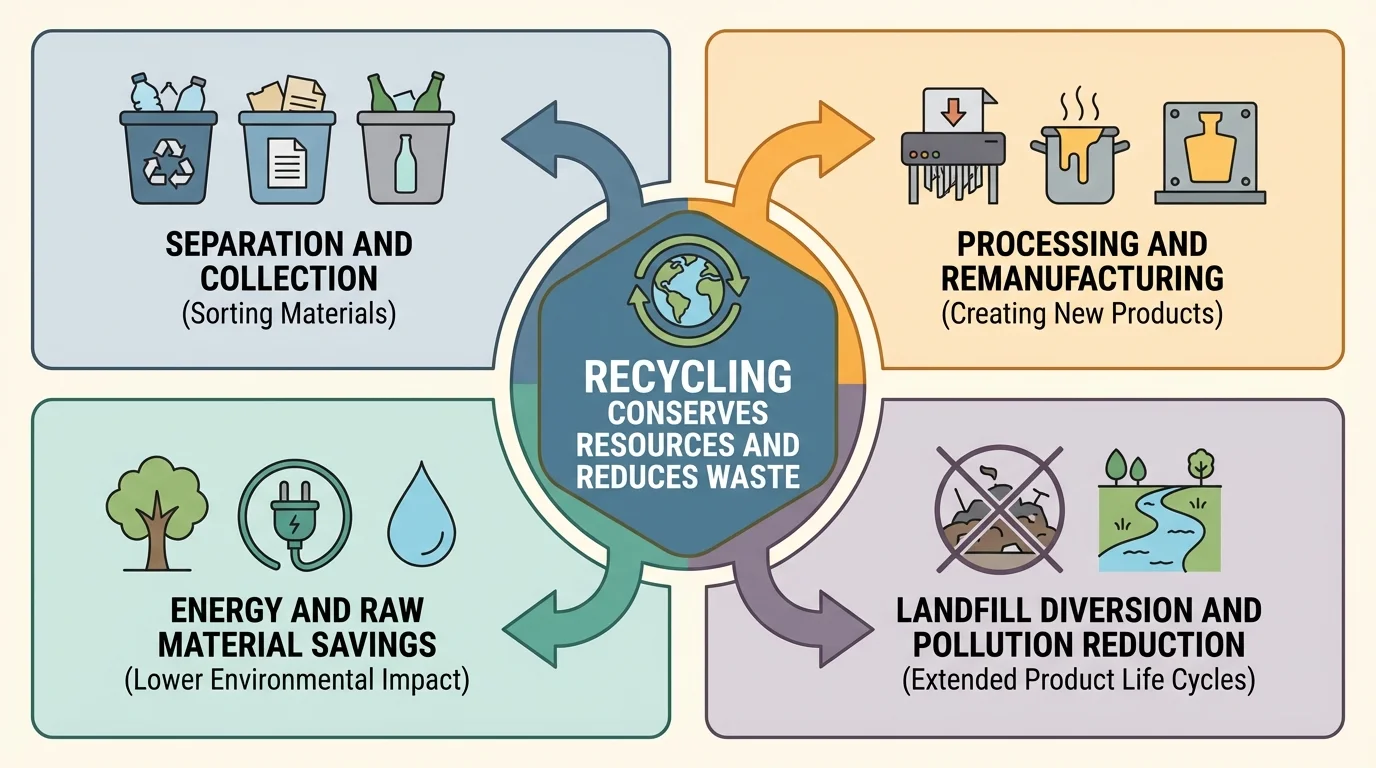
A discussion usually has a central point, as [Figure 1] shows, and that central point is often supported by details, examples, or reasons. The main idea is the biggest or most important message. Supporting details help explain or prove that main idea. For example, if students discuss whether the school should start a recycling program, the main idea might be that recycling helps reduce waste at school. Supporting details might include that it lowers the amount of trash, teaches responsibility, and helps the environment.
Not every statement in a discussion is a key idea. Some comments may repeat a point that has already been made. Others may be interesting but not very important. Strong listeners ask themselves questions such as: What point keeps coming up? Which facts or reasons support that point? Which ideas seem most connected to the topic?
You should also notice different kinds of information. A fact is something that can be checked. An opinion is what someone thinks or believes. An example can help explain either a fact or an opinion. During discussion, students often use all three. To understand the key ideas well, you need to notice which comments are backed by evidence and which comments are personal beliefs.
Suppose one student says, "Our cafeteria throws away many plastic bottles each day." Another says, "Recycling bins would make the school look cleaner." The first statement sounds more like a fact that could be checked. The second is an opinion, but it may still matter in the discussion. Both can be important, but they do not work in the same way.
In many real meetings, from school groups to city councils, people assign someone to take notes because important ideas can be forgotten quickly once many people begin sharing at once.
As you continue listening, the picture becomes clearer. The central idea and its support start to stand out as one big idea connects to several smaller details.
To review a discussion well, you need active listening. Active listening means paying close attention to the speaker, thinking about the meaning of the words, and preparing to respond in a thoughtful way. Active listeners look at the speaker, avoid interrupting, and notice important words or repeated ideas.
One useful strategy is paraphrasing. To paraphrase means to restate what someone said in your own words without changing its meaning. For example, if a classmate says, "The main character changed because she finally learned to trust her friends," you might respond, "So you think the character grows because she stops trying to solve everything alone." That short response helps check understanding and keeps the discussion moving forward.
Another strategy is to keep simple notes. Your notes do not need to be long. You can write the topic, the strongest reasons, and any questions that remain. Some students make a quick list. Others use columns such as "main point," "evidence," and "my thinking." [Figure 2] The goal is not to write every word. The goal is to remember the important ideas.
Reviewing is a thinking process
When you review a discussion, you are not making a transcript. You are sorting information. You notice what matters most, what supports it, what repeats, and what still needs clarification. This helps you prepare for a stronger conclusion.
It also helps to pause mentally after a few comments and ask, "What have we learned so far?" That quick check can stop you from getting lost in many details. In group discussions, this skill is especially valuable because several people may speak in a short time.
In collaborative discussions, each speaker may bring in a different piece of the answer. Combining those pieces is an important skill, and separate comments can lead to one stronger understanding. One student may provide a fact, another may give an example, and another may raise a question that makes the group think more deeply.
For example, imagine a discussion about starting a school garden. One student says the garden could provide vegetables. Another says it would help students learn science. A third says it would take work to maintain. If you combine these ideas, you can say, "The discussion suggests that a school garden could be useful for food and learning, but it would need regular care to succeed." That statement includes several viewpoints instead of only one.
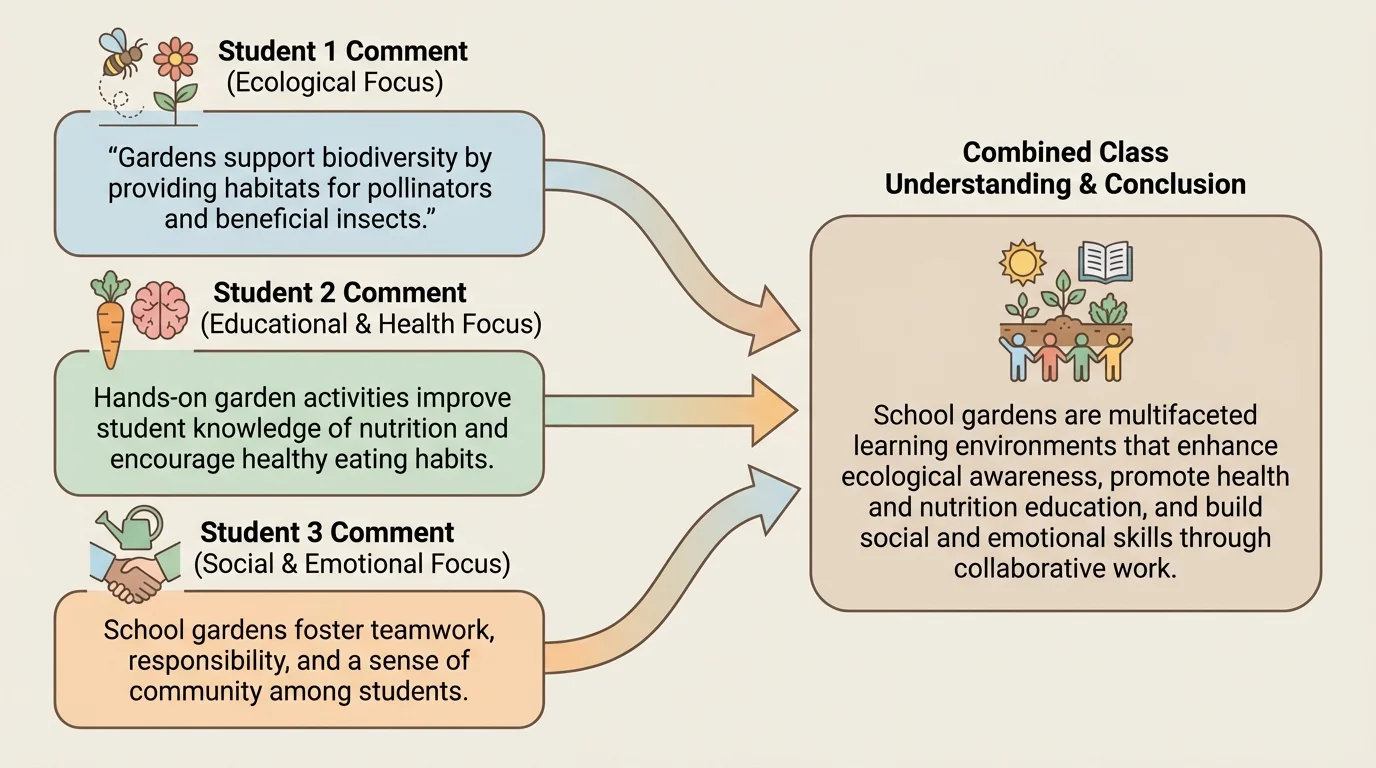
This is called synthesizing, or putting ideas together into a clearer whole. When students synthesize, they do more than list comments. They connect the comments. They notice agreements, differences, and patterns.
A good listener asks: Which ideas fit together? Which ideas disagree? Is one person giving evidence while another is giving an opinion? Is the group moving toward an answer, or are there still missing pieces? Later, when you explain your conclusion, those connections help your thinking sound complete and fair.
| Type of contribution | What it does in discussion | Example |
|---|---|---|
| Main idea | States the central point | The school should reduce waste. |
| Supporting detail | Explains or proves the point | Recycling cuts down on trash. |
| Example | Shows the point in action | Plastic bottles from lunch can be recycled. |
| Question | Pushes the group to think more | Who would empty the bins? |
| Different viewpoint | Adds balance or challenge | Some students may forget to sort items correctly. |
Table 1. Different types of contributions students may hear and use during collaborative discussions.
A conclusion is not a random guess. It is a thought-out judgment based on what was said and what you already know. When you draw a conclusion, you look at the clues and decide what they show together. In reading, students do this with stories and articles. In discussions, students do it with spoken ideas.
For example, if several students explain that a character becomes more patient, points to scenes where the character waits and listens, and compares the beginning and ending of the story, you may conclude that the character matured over time. That conclusion comes from evidence in the discussion, not from making something up.
You may already know how to identify the main idea of a paragraph or text. Drawing a conclusion in discussion uses a similar skill, but now the information comes from several speakers instead of one written passage.
Sometimes a conclusion answers a question. Sometimes it explains a pattern. Sometimes it helps a group decide what seems most true or most likely. A strong conclusion should match the evidence and should not ignore important ideas that were shared.
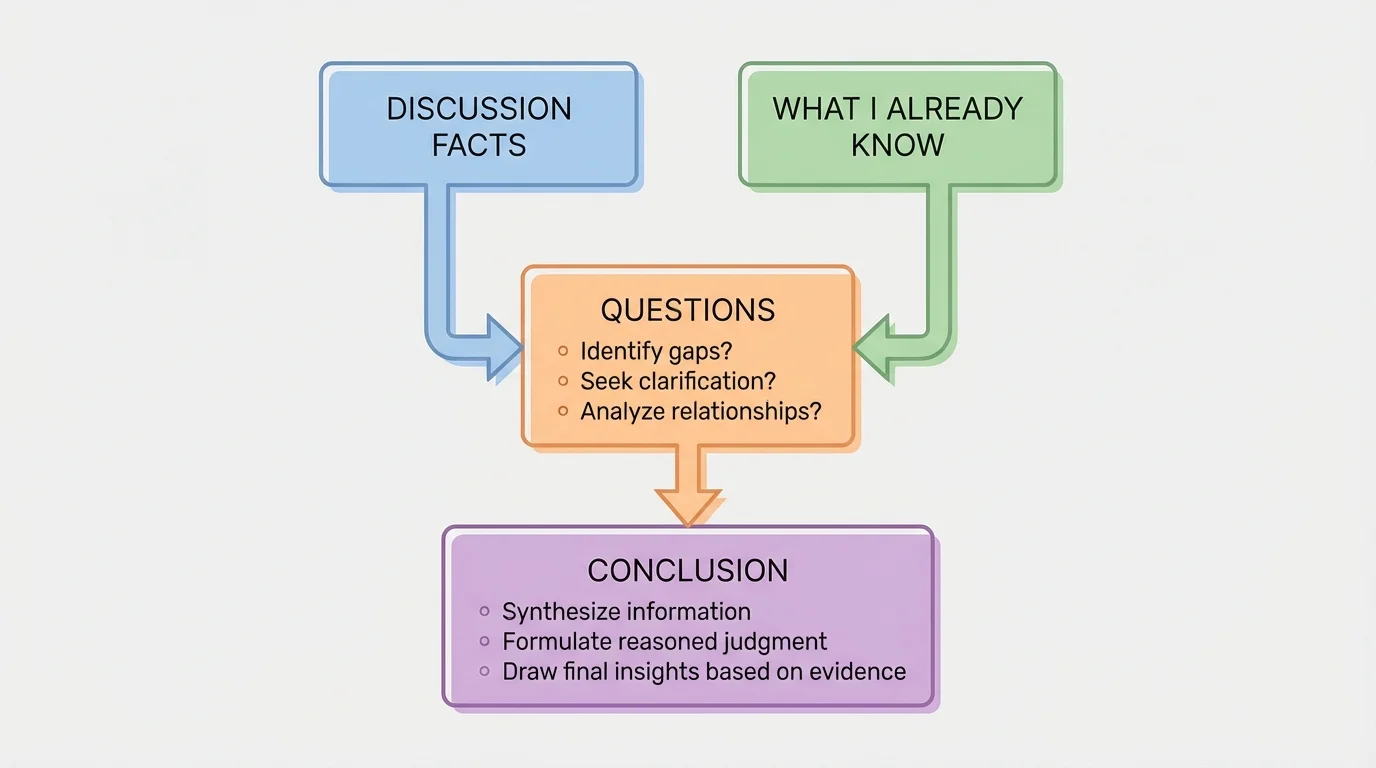
Drawing conclusions works best when you follow a clear process, and [Figure 3] presents that process as a set of connected steps. First, identify the important information from the discussion. Second, connect that information to your background knowledge. Third, ask what understanding makes the most sense. Finally, check whether your conclusion is supported by enough evidence.
Background knowledge means what you already know from reading, observation, past lessons, or experience. Suppose your class discusses why some plants in the schoolyard grow better than others. Students mention sunlight, water, and soil. Because you already know plants need these things, you can combine the discussion with prior knowledge and conclude that the healthiest plants are growing where conditions are best.
Notice that this is different from guessing. Guessing happens without enough evidence. Drawing a conclusion uses clues. If the clues are weak or missing, a careful thinker says, "We need more information."
Example: drawing a conclusion from a literature discussion
Students discuss why a boy in a story finally apologizes to his friend.
Step 1: Review the key ideas
One student says the boy looked guilty after lying. Another says he missed his friend. A third says the boy learned that honesty repairs trust.
Step 2: Connect the ideas
These comments all point to the boy understanding that his actions hurt the friendship.
Step 3: Draw the conclusion
A strong conclusion is: The boy apologizes because he feels responsible and wants to rebuild trust.
That conclusion is stronger than saying, "He apologized because the story needed to end." The weaker statement does not come from the discussion evidence. The stronger one does.
The same thinking pattern applies in science, social studies, and everyday classroom problem-solving. Facts and prior knowledge work together to support a reasonable conclusion.
Good thinkers test their conclusions. One way is to ask, "What evidence supports this?" Another is to ask, "Did I ignore anything important?" If a discussion included different opinions, your conclusion should not pretend those opinions never existed.
For example, if a group discusses longer recess and most students support the idea, you still need to mention concerns if several students explained that more recess might shorten class time. A fair conclusion might be: "The group mostly supports longer recess because it may improve focus and health, but time for learning would need to be protected." This conclusion includes the main direction of the discussion while still recognizing an important concern.
A weak conclusion may be too broad, too certain, or based on only one comment. A fair conclusion stays close to the evidence. [Figure 4] Sometimes the best conclusion is careful language such as "The discussion suggests..." or "Based on the ideas shared, it seems likely that..." These phrases help you sound thoughtful rather than overconfident.
"Good conclusions grow from good listening."
Another important test is whether your conclusion makes sense with known facts. If your conclusion goes against the evidence or against strong background knowledge, it probably needs to be revised.
Students use these skills in many settings, and three common discussion situations are partner talk, small-group discussion, and teacher-led conversation. The skill stays the same, but the way you use it can change depending on the setting.
In a collaborative discussion with one partner, it may be easier to remember everything that was said. You can ask follow-up questions right away and paraphrase often. In a small group, you may need to listen for several viewpoints and keep track of who said what. In a teacher-led discussion, you may hear many comments in a row, so it becomes even more important to identify repeated ideas and strong evidence.
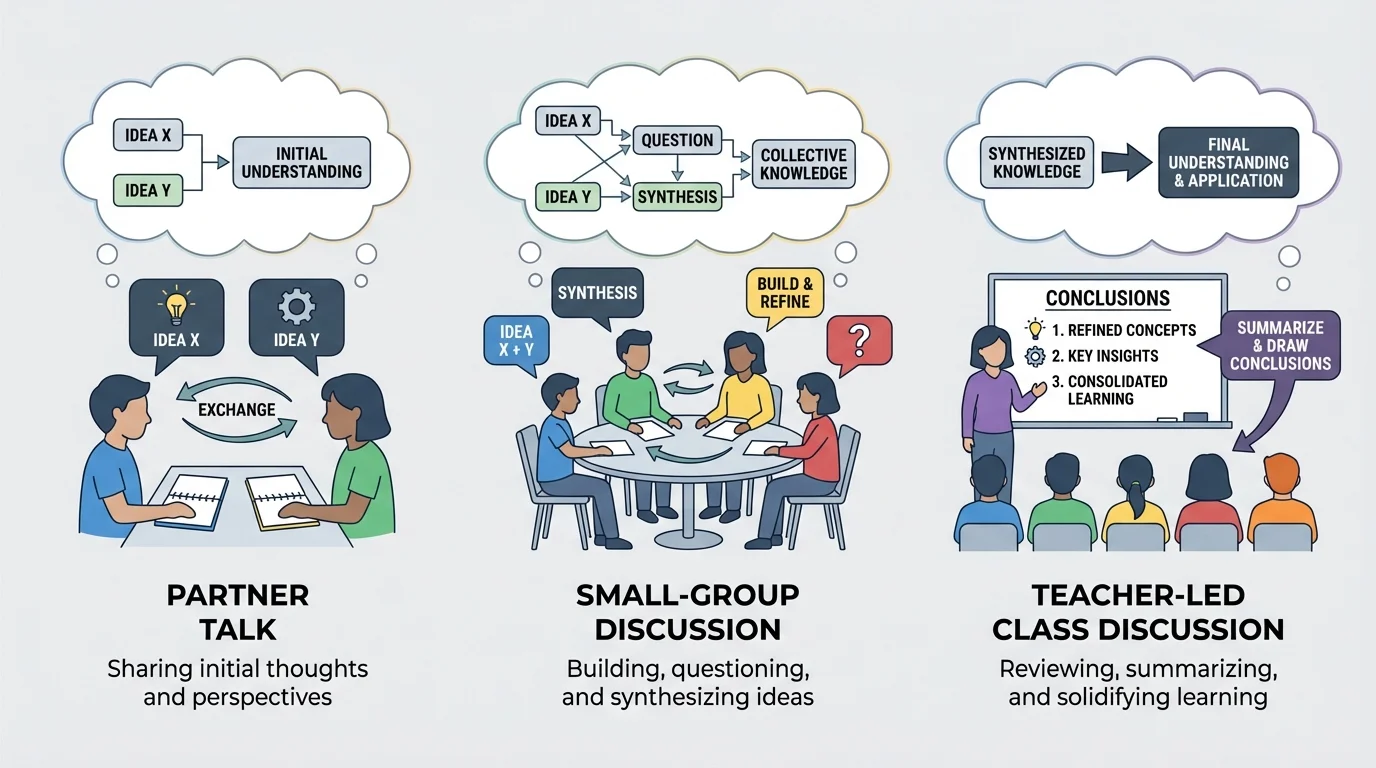
Consider a science discussion about conserving water. In partner talk, you and a classmate may decide that turning off the faucet while brushing teeth saves water. In a small group, students may add fixing leaks, taking shorter showers, and collecting rainwater for gardens. In a teacher-led discussion, the class may conclude that conserving water requires both personal habits and community planning.
These examples show that as more voices join the conversation, more ideas must be reviewed. They remind us that the setting changes, but careful listening and thoughtful conclusions remain important in each one.
Example: drawing a conclusion from a science discussion
Students talk about why a patch of grass near a tree is greener than grass in another area.
Step 1: Gather discussion details
Students mention shade, cooler soil, and more moisture.
Step 2: Use prior knowledge
You know that water evaporates more slowly in cooler, shaded places.
Step 3: State the conclusion
A strong conclusion is: The grass near the tree is greener because the shaded area keeps more moisture.
This conclusion is based on ideas from the group and on what students already know about sunlight and water.
Once you have reviewed key ideas and formed a conclusion, you need to express it clearly. Good speakers make it easy for others to follow their thinking. One helpful pattern is: state the conclusion, explain the evidence, and mention any important different viewpoint.
You might say, "I conclude that the explorers were unprepared because several people mentioned their lack of supplies and the difficult weather." Or you might say, "Building on Maya's idea, I think the character changes because the examples we discussed show increasing responsibility." These sentence patterns help you connect your thinking to the discussion instead of speaking as if your idea appeared from nowhere.
Building on others' ideas
In strong discussions, students connect their thinking to what others said. Phrases such as "I agree with... because...," "I want to add to...," "I see it differently because...," and "The discussion suggests..." help speakers stay respectful and clear.
Respectful disagreement is also important. You can disagree without being rude. A useful response is, "I understand that point, but the evidence makes me think..." This kind of language keeps the focus on ideas, not on winning.
Clarity matters. Avoid vague comments like "I just think that" without evidence. Instead, point to the ideas that led you to your conclusion. When students explain their reasoning, the whole group understands more.
One common mistake is confusing a small detail with a key idea. If one person mentions a minor example, that does not always mean it is the main point. To fix this, look for ideas that are repeated, supported, or strongly connected to the topic.
Another mistake is jumping to a conclusion too quickly. This happens when a student hears one comment and decides the answer before listening to the rest of the discussion. To fix this, wait until enough evidence has been shared. Then review the whole conversation before deciding.
A third mistake is ignoring different viewpoints. Even if you disagree with them, those viewpoints may affect the best conclusion. Good thinkers include important counterpoints and explain why they still reached their final understanding.
Example: improving a weak conclusion
Topic: Should the class have a pet?
Step 1: Weak conclusion
"We should get a pet because pets are cute."
Step 2: Review the discussion
Students also mentioned responsibility, allergies, cost, and classroom rules.
Step 3: Stronger conclusion
"The class seems interested in having a pet, but the discussion shows we would need a plan for care, cost, and student allergies before deciding."
The stronger version includes more than one idea and shows careful thinking.
When students practice reviewing key ideas and drawing conclusions, their discussions become more meaningful. They listen more closely, respond more thoughtfully, and learn how ideas grow stronger when people think together.
