Have you ever been sure you were right about something, then heard someone else explain their idea and thought, "Wait, I never looked at it that way"? That happens to everyone. In a strong discussion, people do not just wait for their turn to talk. They listen, think, and then decide what they really believe. That is how better ideas are built.
Listening to others and forming your own opinion is an important skill in school, at home, and in your community. You might use it during a class discussion about a story, a group science project, or even when deciding the rules of a game. Good thinkers are not people who always speak first. Good thinkers are people who can listen carefully, understand different ideas, and then make thoughtful choices.
When people talk together, each person brings something different: knowledge, experiences, questions, and ideas. One student may notice a detail in a book that others missed. Another may think of a solution to a problem. If no one listens, the group loses those useful ideas.
Listening also shows respect. Respect means showing that another person matters. When you look at a speaker, avoid interrupting, and consider what they say, you show that their thoughts are worth hearing. Even if you disagree later, listening first helps everyone feel safe enough to share.
[Figure 1] Strong listening makes discussions fairer. Sometimes a loud voice gets attention, but the loudest idea is not always the best idea. Careful listening gives quieter students a chance to contribute too. That helps the whole group make wiser decisions.
Some of the best inventions and team decisions happen when people combine several ideas instead of choosing the first idea they hear.
In classrooms, listening helps students learn from one another. A teacher is not the only source of good thinking. Classmates can offer examples, ask questions, and explain ideas in ways that make learning clearer.
Active listening means paying close attention deliberately through body language, eye contact, turn-taking, and note-taking. It is more than being quiet. A student can be silent and still not really listen. Active listening uses your ears, eyes, mind, and self-control.
When you listen actively, you face the speaker, keep your body calm, and avoid doing distracting things. You listen to the whole idea instead of planning your answer right away. You may nod, take short notes, or wait until the speaker finishes before asking a question.
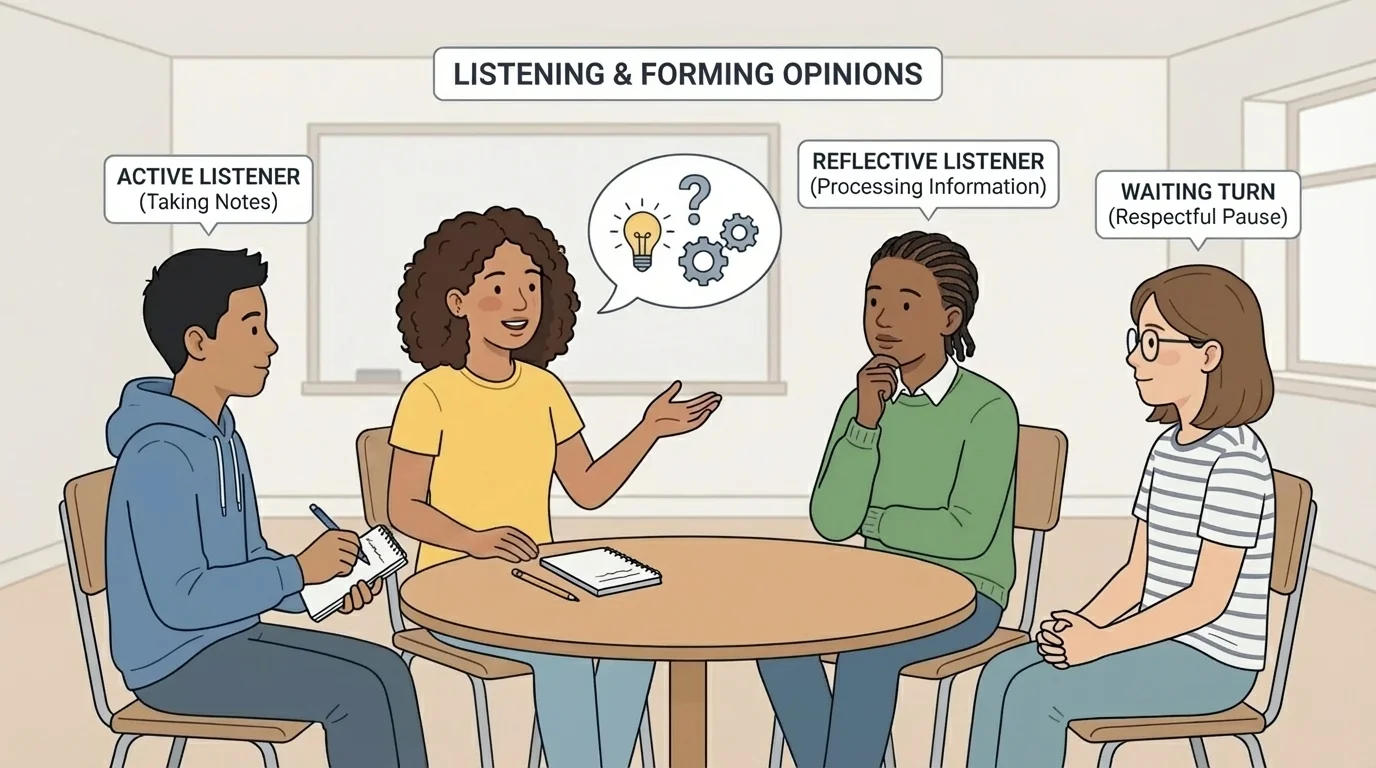
Active listening also includes thinking about the speaker's meaning. Ask yourself: What is this person trying to say? What reasons are they giving? What examples are they using? These questions help you understand the message instead of just hearing words.
Sometimes active listening involves paraphrasing. A paraphrase is when you say the idea again in your own words to check your understanding. For example, if a classmate says, "I think the main character was brave because she admitted her mistake," you might respond, "So you think her honesty shows bravery." That does not mean you agree yet. It means you understood.
Active listening is listening carefully with attention, self-control, and a goal of understanding the speaker. Paraphrase means restating someone's idea in your own words to make sure you understood it correctly. Opinion is what a person thinks or believes about a topic.
Questions are another part of active listening. Good questions are not meant to trap a speaker. They are meant to clarify. You could ask, "What makes you think that?" or "Can you give an example?" Questions like these help everyone understand the idea more clearly.
Later in a discussion, the listening habits shown in [Figure 1] still matter. If students start interrupting or looking away, the discussion becomes weaker, even if the topic is interesting.
One important rule in discussions is this: listening is not the same as agreeing. You can listen carefully to an idea without deciding that it is right. In fact, good listeners often understand ideas they do not agree with.
This matters because people sometimes stop listening the moment they hear something they dislike. Then they may answer a point the speaker did not actually make. That leads to confusion and unfair arguments. Before you judge an idea, make sure you understand it.
A helpful habit is to identify the speaker's viewpoint. A viewpoint is the way someone sees a topic. Two students can look at the same situation and have different viewpoints because they notice different details or care about different things.
For example, a class might discuss whether homework should be shorter. One student might say shorter homework gives more time for family, sports, or reading. Another might say homework helps students practice what they learned. Both students are talking about the same topic, but their reasons come from different viewpoints.
When listening, try to notice the speaker's reasons and evidence. Evidence is the information, examples, or facts that support an idea. If someone says, "We should grow plants near the school entrance," the reasons might include making the area prettier, helping pollinators, or creating shade. The evidence might include observations about which areas get sunlight or examples from other schools.
Example: Understanding before judging
During a book discussion, Maya says, "The character should not have left home alone." Leo wants to disagree.
Step 1: Leo listens to the whole idea.
He does not interrupt after hearing only the first few words.
Step 2: Leo checks understanding.
He says, "Are you saying the character was too young to travel alone?"
Step 3: Maya adds her reason.
She explains that the character had no map and no plan.
Step 4: Leo forms his response.
Now he can answer the real idea: "I see your point. I think leaving was risky, but the character felt there was no safe choice at home."
Notice what happened. Leo did not copy Maya's opinion, and he did not ignore it. He listened, clarified, and then responded with his own thinking.
[Figure 2] Forming an opinion is a process, not a race. A thoughtful opinion is built from listening, thinking, and choosing.
When you form your own opinion, you use three main parts. First, you consider what others said. Second, you connect those ideas to what you already know. Third, you decide which reasons seem strongest. This helps you avoid simply repeating the last thing you heard.
A strong opinion often includes a claim and reasons. The claim is your main point. The reasons explain why you think that claim makes sense. Sometimes you also use evidence, such as examples from a text, observations, or information from class.
Suppose your class is deciding whether recess should include more organized games or more free choice. After listening to others, you might think: organized games help include more students, but free choice allows creativity and independence. Then you decide which reasons matter most to you. Your opinion might be, "Recess should have both, but free choice should come first because students need time to make their own decisions."
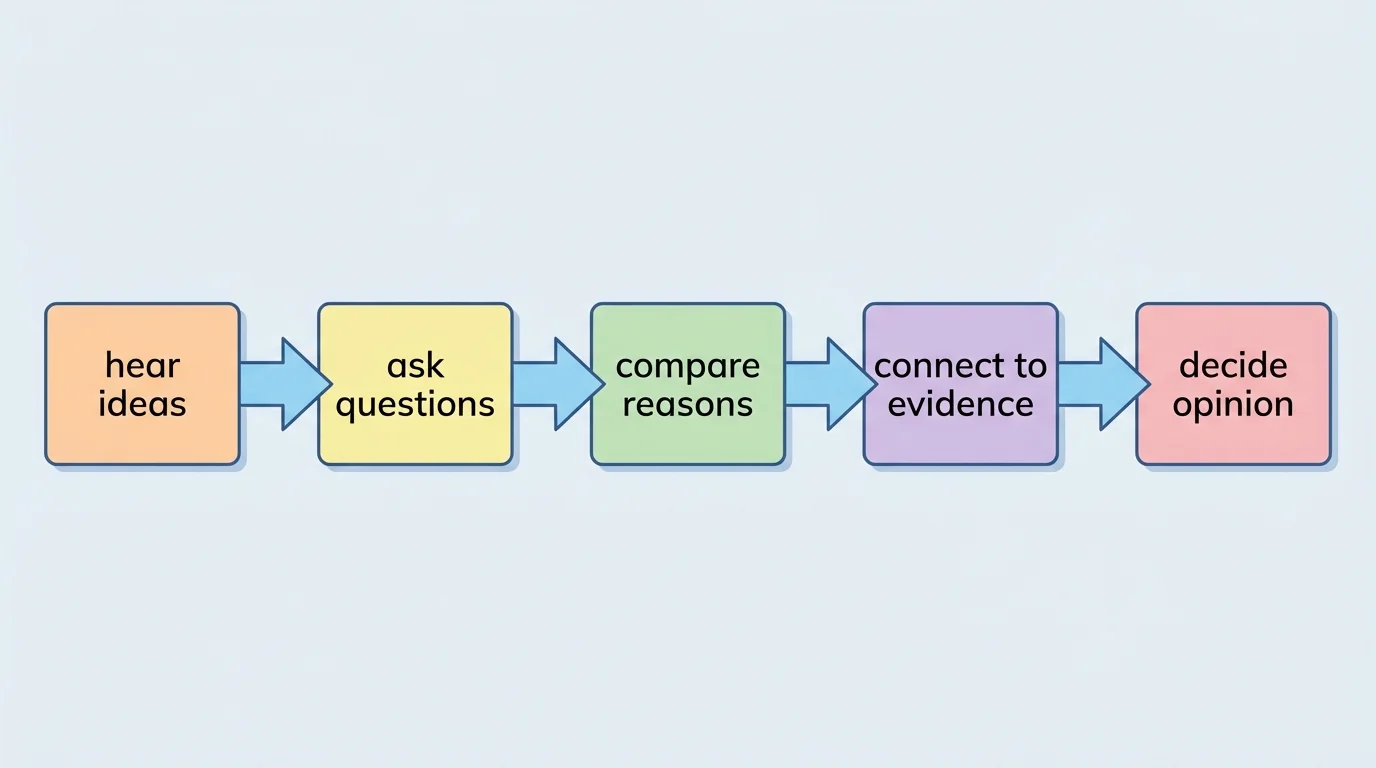
Good opinions can change. Changing your opinion after hearing strong reasons is not weakness. It is a sign that you are thinking carefully. At the same time, changing your opinion just because someone popular spoke is not strong thinking. Your opinion should grow from thought, not pressure.
You should also be able to explain your opinion clearly. Saying "That is just what I think" is sometimes honest, but it does not help others understand your reasoning. It is better to say, "I think this because..." and then give your reasons.
How opinions become stronger
An opinion becomes stronger when it is based on listening, clear reasons, and useful evidence. It becomes weaker when it is based only on guessing, copying others, or reacting too quickly.
The steps shown earlier in [Figure 2] are useful in many situations, from choosing a class project topic to discussing how characters act in stories. Listening and thinking work together.
The words you choose can keep a discussion thoughtful or turn it into a fight. Respectful discussion does not mean everyone agrees. It means people treat each other well while sharing different ideas.
If you agree, you can say, "I agree with your point because..." or "I want to add to what you said." If you disagree, you can say, "I see it differently because..." or "I understand your idea, but I think..." These sentence starters help you focus on ideas instead of attacking people.
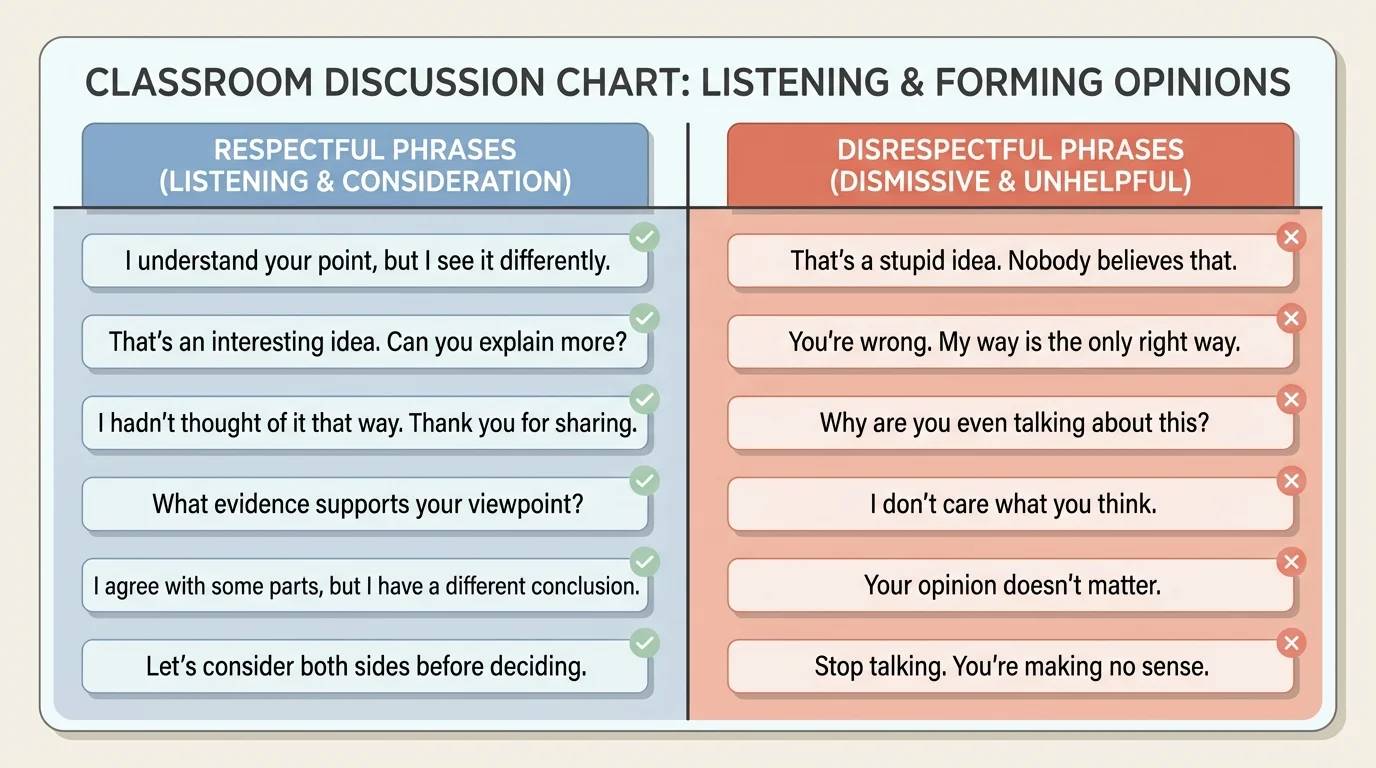
Notice the difference between disagreeing with an idea and insulting a person. Saying, "I disagree because the text gives a different example," is respectful. Saying, "That idea is stupid," is disrespectful. Respectful speakers challenge ideas with reasons.
Tone matters too. A person might use polite words but still sound rude. That is why self-control is part of discussion. If you feel upset, pause before answering. A calm response helps others listen to you.
| Discussion move | Helpful example |
|---|---|
| Agreeing | I agree because your example shows the same pattern. |
| Adding on | I want to add that another character acted similarly. |
| Clarifying | Can you explain what you mean by fair? |
| Disagreeing respectfully | I understand your point, but I think the evidence supports a different answer. |
| Restating | So your main idea is that students need more choice. |
Table 1. Examples of discussion moves that help students respond clearly and respectfully.
Much later in a discussion, the comparison in [Figure 3] still helps. If the discussion starts slipping into interrupting or rude comments, students can return to those respectful language choices.
"Listen to understand, not just to reply."
That idea reminds us that discussions are for thinking together, not just for winning.
Not all discussions are the same. The purpose of a discussion changes how you listen and respond. In a book discussion, you may listen for themes, character choices, and evidence from the text. In science, you may listen for observations, test ideas, and clear explanations. In a class meeting, you may listen for fairness, needs, and possible solutions.
For example, if your group is planning a science investigation, one student may want to test plant growth in sunlight and shade. Another may say that water amount should be tested instead. Instead of arguing right away, the group can listen to each proposal, ask what question each experiment answers, and then choose the plan that fits the class goal best.
In social situations, listening can prevent problems. If two classmates disagree about a game at recess, hearing both sides helps people solve the problem more fairly. One student may think a rule was broken. Another may think the rule was never explained. Listening to both ideas leads to a better solution than choosing sides too quickly.
Example: Forming an opinion in a class meeting
The class is deciding whether to create a silent reading corner.
Step 1: Listen to different ideas.
Some students want the corner because it helps them focus. Others worry it will take up too much space.
Step 2: Identify reasons.
One side values quiet and concentration. The other side values space for group work.
Step 3: Think for yourself.
You decide a reading corner is a good idea if it is small and placed in one part of the room.
Step 4: Share your opinion respectfully.
You say, "I support the idea, but I think it should be limited to one area so we still have room for group activities."
This kind of response shows careful listening and independent thinking at the same time.
One common mistake is interrupting. Interrupting can make the speaker feel ignored, and it often causes important details to be missed. Wait until the speaker finishes, unless the discussion rules allow a short clarifying question.
Another mistake is listening only for a chance to speak. In that case, a student may hear words but miss meaning. To avoid this, focus on the speaker's full idea and try to restate it before answering.
A third mistake is copying someone else's opinion without thought. This sometimes happens when a student wants to fit in. But a real opinion comes from thinking about reasons and evidence. It is fine to agree with someone, but you should know why you agree.
Some students make the opposite mistake: refusing to change their minds no matter what they hear. Strong thinkers stay open. Being open does not mean believing everything. It means being willing to consider new information honestly.
Good discussions use both speaking and listening. Speaking shares your thinking. Listening helps your thinking grow.
Another mistake is confusing opinions with facts. An opinion is what someone believes. A fact can be checked. In many discussions, students use both. For example, "Blue is the best color" is an opinion. "Blue light has a shorter wavelength than red light" is a fact from science. When forming opinions, facts and evidence can make your reasons stronger.
Like any skill, listening and forming opinions improve with practice. You can become stronger by setting small goals. One day, your goal might be to avoid interrupting. Another day, your goal might be to ask one thoughtful question. Another might be to explain your opinion with two reasons.
These skills matter beyond school. People use them in teams, workplaces, families, and communities. Leaders need to hear others before making decisions. Friends need to listen to understand each other. Citizens need to hear different viewpoints before deciding what they believe about issues that affect everyone.
When students learn to listen well, they become stronger learners. When students learn to form their own opinions, they become stronger thinkers. And when they can do both at once, they become valuable members of any discussion.
