Have you ever heard two people read the same story and come up with completely different ideas about it? That happens all the time. The best readers are not just people who read the words correctly. They are people who can prove their thinking. When they say, "I think this character is brave," or "I predict the storm will cause trouble," they can point to the exact parts of the text that helped them decide.
Reading is a little like detective work. A detective does not solve a mystery by guessing wildly. A detective looks for clues. In reading, those clues are words, sentences, actions, descriptions, and repeated ideas. When you learn how to locate the right information, you become a stronger reader, speaker, and writer.
Evidence is information from a text that supports an idea. Prediction is a thoughtful guess about what may happen next based on clues. Inference is an idea you figure out by combining text clues with your own thinking. Theme is the big message or lesson a text suggests about life or people.
These skills work together. You may form an opinion about a character, make a prediction about what happens next, infer what a character is feeling, and decide on the author's message. In every case, the text should support your thinking.
Sometimes students answer questions with ideas that sound reasonable but are not actually supported by the passage. For example, if a student says, "The boy is selfish," but the story only shows him sharing with others, that answer does not match the evidence. Good reading responses stay connected to what the author actually wrote.
Evidence can be direct or indirect. Direct evidence is stated clearly. If the text says, "Mia's hands shook as she opened the letter," that directly tells you she is nervous. Indirect evidence is not stated in a simple sentence, but it can still be discovered from clues. If the text says, "Mia read the letter three times and bit her lip," you can infer she is worried, even if the word worried never appears.
When readers use evidence, they do more than copy a sentence. They choose the part that matters and explain how it supports their idea. That final explanation is important because it shows your thinking.
Not all evidence looks the same. A story gives readers many kinds of clues. You can use character actions, dialogue, setting details, descriptions, and even the title. In an informational text, you may also use headings, captions, diagrams, and facts.
The first time text evidence appears in your thinking, ask yourself, "What exactly in the text makes me say that?" If you cannot point to a detail, you may need to reread. Strong readers often go back and look again.
Here are some common places to find useful information:
| Text feature or detail | What it can help you understand |
|---|---|
| Character actions | Traits, motivations, feelings, and future choices |
| Dialogue | Relationships, mood, conflict, and personality |
| Descriptions | Setting, tone, and hidden clues |
| Repeated words or ideas | Important message or theme |
| Title and ending | Main idea, message, or shift in meaning |
| Headings and captions | Key facts and organization in nonfiction |
Table 1. Different kinds of text information and what each kind can help a reader understand.
Looking for information in different parts of a text helps you avoid weak answers. If you rely on only one tiny detail, your idea may not be strong enough. The best support often comes from more than one clue.
Readers often have opinions about a story or article, and strong readers know that opinions in reading should be supported by proof from the text. An opinion is what you think, but in reading, it should be based on evidence, not just personal preference.
Suppose you read a story about a girl named Elena who practices soccer every morning before school, encourages a teammate who missed a goal, and stays late to clean up equipment. You might say, "Elena is responsible." That is an opinion, but it is also supported because the text gives several details that match the idea.
A strong reading opinion often follows a simple pattern: opinion, evidence, explanation. First, state your idea. Next, add details from the text. Then explain how those details support your idea.
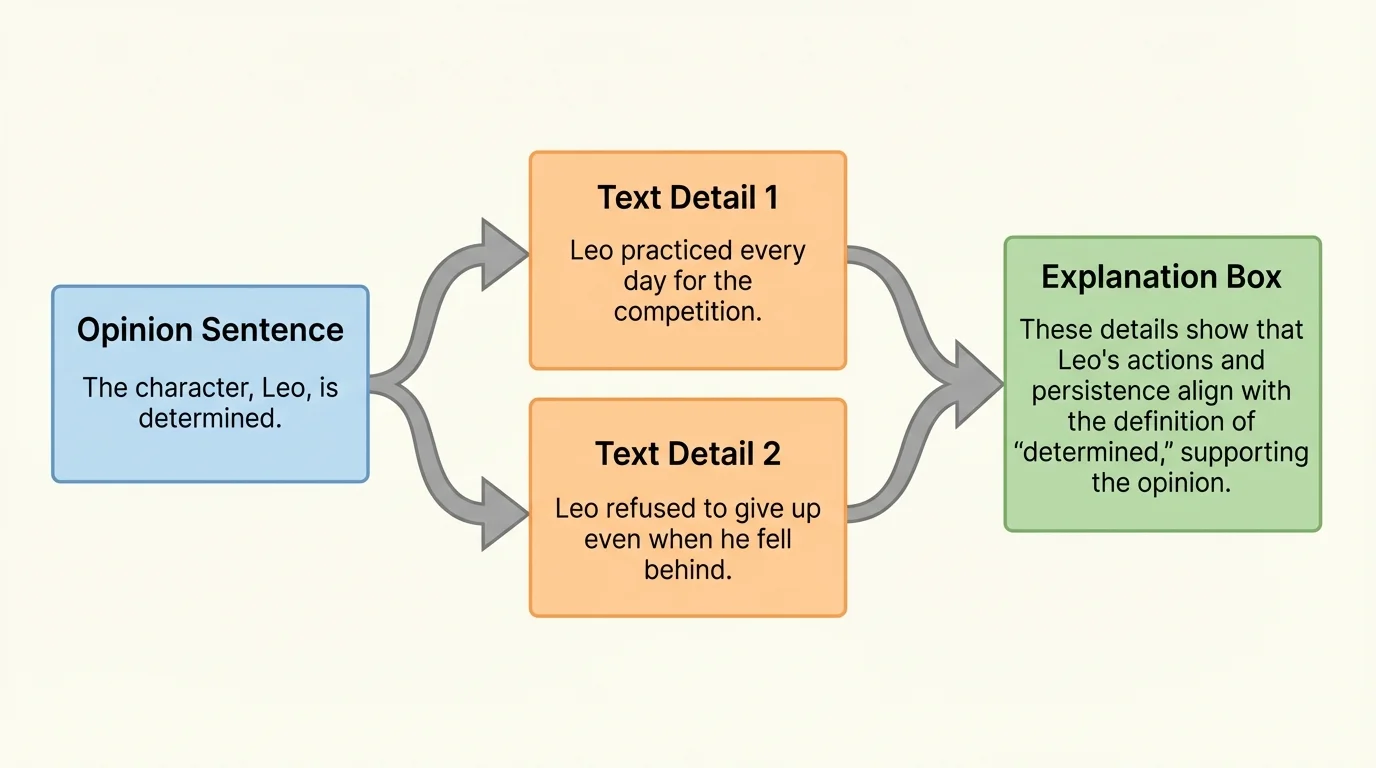
Here is an example response: "I think Elena is responsible because she practices before school and stays late to clean up the equipment. These actions show that she takes her team duties seriously." Notice that the answer does not stop after listing details. It explains what the details mean.
Example: Supporting an opinion about a character
Story detail: Jamal notices that his neighbor's groceries have spilled, helps pick them up, and carries the bags to the porch even though he is late for a game.
Step 1: State the opinion.
Jamal is thoughtful.
Step 2: Find evidence.
He stops to help pick up the groceries and carries the bags to the porch.
Step 3: Explain the evidence.
These actions show he cares about another person's needs, even when he is in a hurry.
A complete response gives the opinion and supports it with details and explanation.
Later, if you compare two characters or decide whether a character made a good choice, the same pattern still works. As we see in [Figure 1], one idea becomes much stronger when it is connected to clear proof.
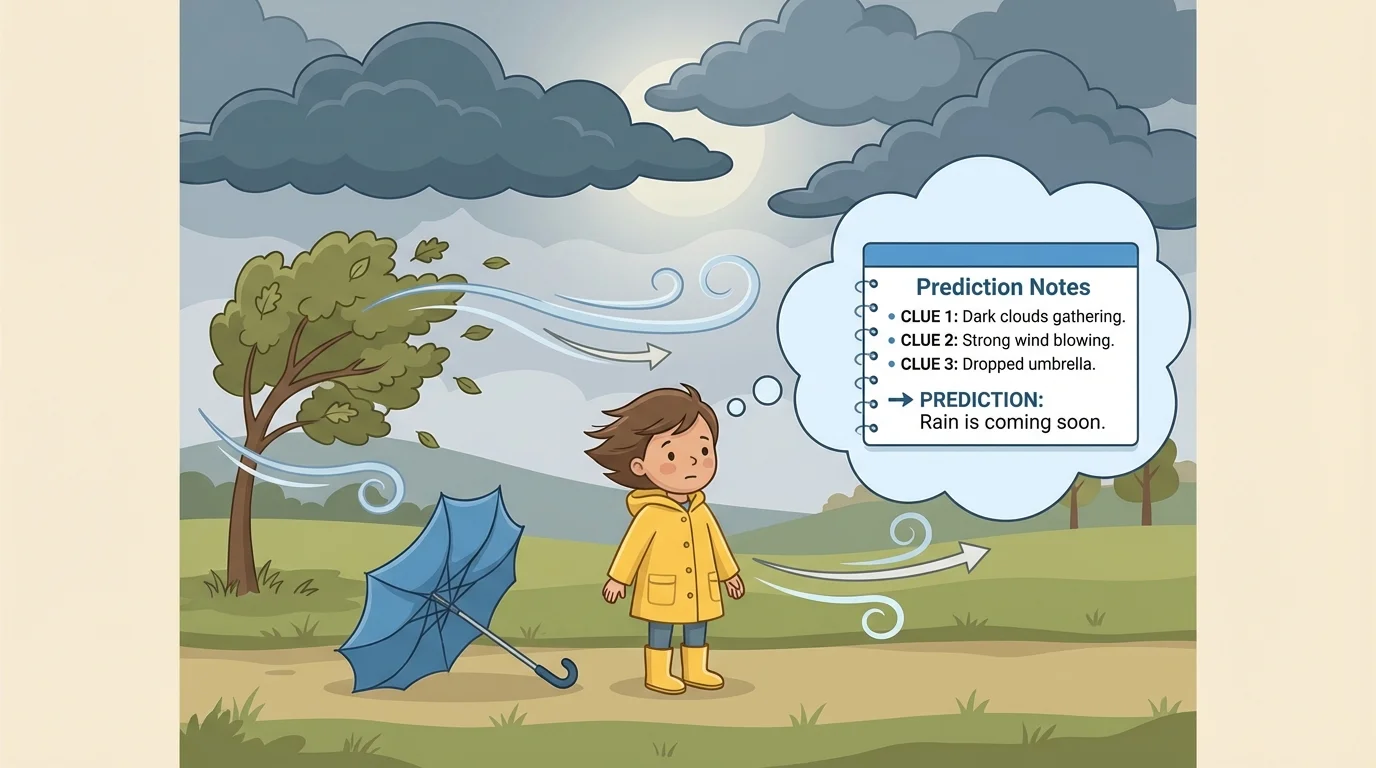
A prediction is not a random guess. It is a smart idea about what may happen next, built from clues and thinking, as [Figure 2] illustrates. Good readers notice what is happening now and ask, "Where is this leading?"
If a story says that dark clouds gather, the wind begins to howl, and a family rushes outside to bring in blankets from the yard, you can predict that a storm is coming. Each clue points in the same direction.
Predictions can change. As you read more, you may find new evidence that strengthens or weakens your first idea. That is not a mistake. It is part of active reading. Readers update their predictions when the text gives new information.
Here is another example. In a chapter book, a student keeps hiding unfinished homework, avoids eye contact with the teacher, and looks nervous every time papers are handed back. A reader may predict that the teacher will soon discover the problem. The clues suggest that the conflict is growing.
Predictions are strongest when you can name the clues directly. Instead of saying, "I just know something bad will happen," say, "I predict the bridge will collapse because the boards are cracked, the ropes are loose, and the characters keep noticing the danger." The second answer is much stronger because it is supported.
Strong readers often make quick predictions while they read and then quietly test them against the next few paragraphs. This habit keeps the brain active and focused on the text.
When you read mysteries, adventure stories, or realistic fiction, prediction becomes especially useful. The same skill also helps in nonfiction. If an article explains one cause of pollution and then introduces another problem, you may predict that the next section will discuss solutions.
An inference happens when the author gives clues, but not the full answer. You use those clues and your own knowledge to figure something out. People often call this "reading between the lines."
For example, if a text says, "Luis stared at the trophy on the shelf and shoved his hands in his pockets while everyone cheered for Ava," you may infer that Luis feels disappointed or jealous. The text does not say, "Luis was jealous," but his actions give clues.
Inferences help readers understand feelings, causes, relationships, and hidden meanings. They also help readers notice when an author wants them to think deeply instead of just collecting facts.
Clues plus thinking
Inference works like this: the text gives clues, and your mind connects them. If a character speaks in a short, sharp voice, slams a door, and refuses to answer questions, you infer anger or frustration. Your answer must still be based mostly on the text, not only on your own experience.
A common mistake is making an inference that is too far from the evidence. If a girl sighs once and looks out a window, you might infer boredom, sadness, or worry, depending on the rest of the passage. But you should not suddenly infer something extreme unless the text truly supports it.
Inference and prediction are related, but they are not the same. Inference helps you understand what is happening now or what something means. Prediction helps you think about what may happen next.
The theme of a literary text is not usually written in one neat sentence. Instead, it grows out of many details across the story, as [Figure 3] shows. To find it, readers look at what characters learn, what problems matter most, and what ideas repeat.
A theme is different from a topic. A topic might be friendship, courage, or honesty. A theme says something about that topic, such as "True friendship requires trust," or "Honesty can be hard, but it leads to respect."
To identify a theme, start by asking questions such as: What does the main character learn? What changes from the beginning to the end? What idea seems important again and again? What does the ending suggest about life or people?
Suppose a story shows a boy who refuses help because he wants to do everything alone. He makes mistakes, becomes frustrated, and finally accepts help from friends to finish a community garden. A possible theme is: Working together helps people achieve more than working alone.
That theme is supported by events across the whole story, not by one sentence. The sequence from refusal, to struggle, to cooperation helps readers see the message. This movement from events to lesson shows how details lead to a larger idea.
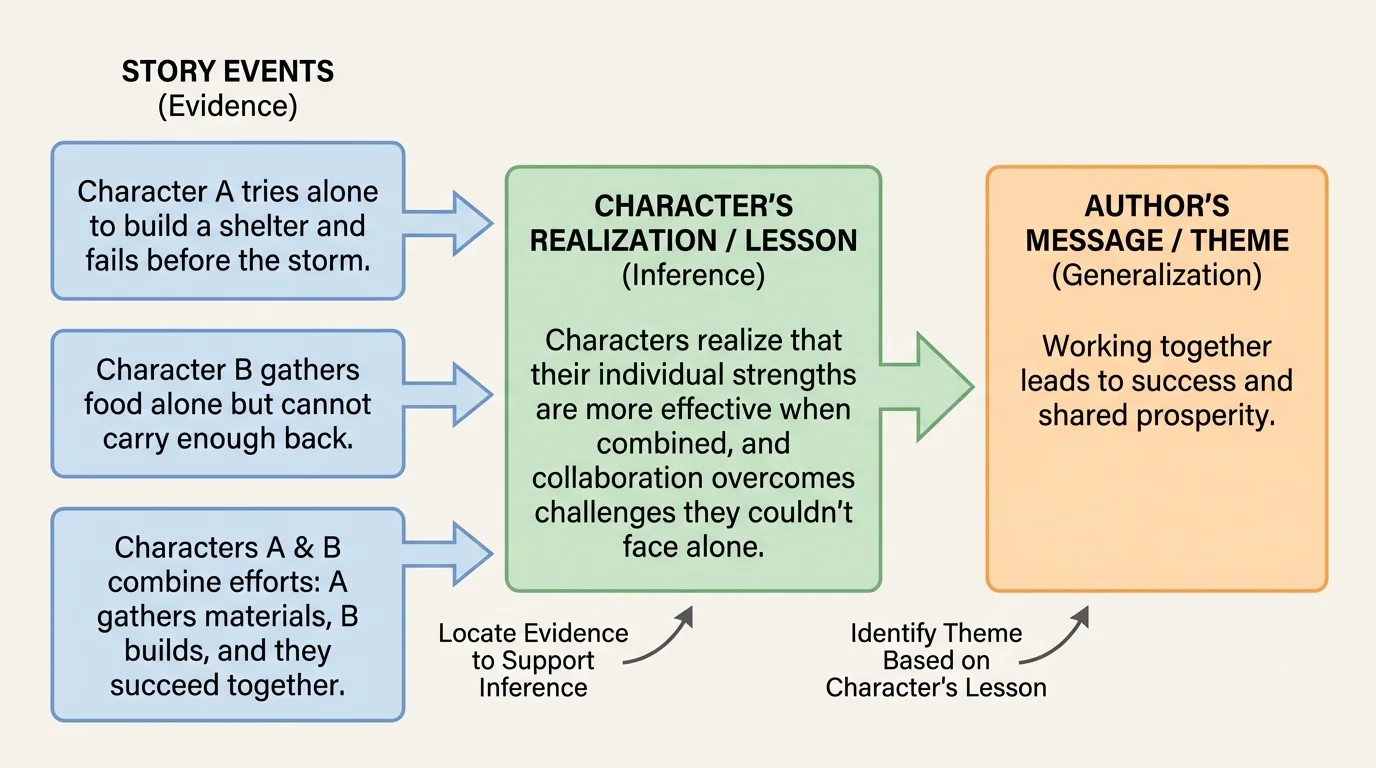
The author's message is often closely related to theme. In some texts, especially fables or short stories, the message is a lesson the author wants readers to understand. In poetry or longer fiction, the message may be more open and thoughtful, but it still comes from the details in the text.
Example: Topic or theme?
Look at these ideas from a story about two sisters who argue, face a challenge together, and become closer.
Step 1: Identify the broad subject.
The topic is family.
Step 2: Look for what the story says about that subject.
The sisters learn that listening and cooperating help them solve problems.
Step 3: State the theme.
Family members grow stronger when they listen to one another and work together.
The topic is one word or phrase. The theme is a full idea about life.
When you identify theme, avoid making it too narrow or too broad. "The red kite got stuck in a tree" is too narrow because it is only one event. "Life" is too broad because it says almost nothing. A theme should be wide enough to matter beyond the story but specific enough to fit the evidence.
Authors make choices about craft and structure, and those choices help shape meaning, as [Figure 4] explains. Craft includes how an author uses words, dialogue, and style. Structure includes how a text is organized, who tells the story, and how ideas are arranged.
Word choice matters. If an author says a dog crept across the room instead of walked, the word crept suggests quiet movement, maybe fear or secrecy. One carefully chosen word can change the mood and help support an inference.
Point of view matters too. In first-person narration, a character tells the story using words like I and we. In third-person narration, the story is told using names like Lina or pronouns like he and they. The point of view affects what readers know and how they understand events.
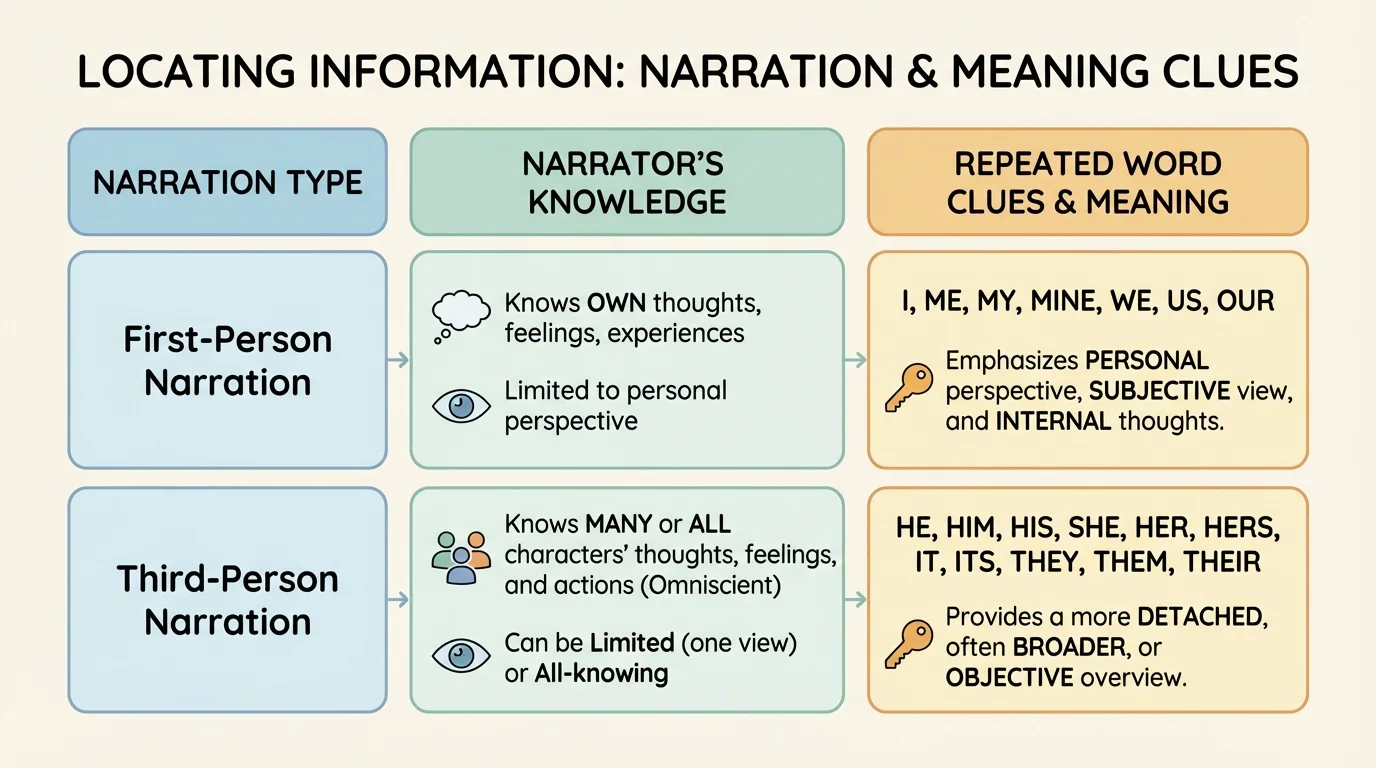
If a first-person narrator says, "I was definitely not scared," while also trembling and backing away, readers may infer that the narrator is not being fully honest. If the same scene were told by a third-person narrator, the reader might get different information. This is why structure helps support understanding.
Repeated images or repeated lines can also point toward theme. If a poem keeps returning to images of light after hard moments, the author may be developing a message of hope. Repetition tells readers, "Pay attention to this." The comparison in [Figure 4] helps show how author choices guide interpretation.
Even the ending is part of structure. A surprising ending may change your opinion about a character. A hopeful ending may reveal the message more clearly. A circular ending, where something from the beginning returns at the end, may show growth or deeper meaning.
When you answer a question about reading, your job is not only to have a good idea. Your job is to communicate it clearly. A useful pattern is: answer the question, include evidence, explain the evidence.
For example, if the question asks, "What can you infer about Mrs. Chen?" a strong response might be: "I can infer that Mrs. Chen is patient because she repeats the instructions calmly, smiles when the class makes mistakes, and gives students time to try again. These details show that she does not get upset quickly and wants students to learn."
This kind of answer does three things well. First, it gives a clear inference. Second, it points to details. Third, it explains how those details connect to the idea. Without the explanation, the response may feel unfinished.
Quoting or paraphrasing details is helpful, but evidence only becomes powerful when you connect it to your thinking. The text gives the clue; you provide the reasoning.
Sometimes one piece of evidence is enough, but often two related details make a stronger case. If several clues point in the same direction, your answer becomes more convincing.
One common mistake is giving an answer based only on personal feelings. For example, "I like this character, so she is good" is not enough. A stronger answer would explain what the character says or does that makes her seem kind, brave, or helpful.
Another mistake is confusing prediction with wishful thinking. Saying "I hope the team wins" is not a prediction. Saying "I predict the team will win because it has practiced hard, changed its strategy, and started scoring more" is a supported prediction.
Readers also often confuse topic and theme. If you say the theme is "friendship," you have named a topic, not a full message. To fix that, turn the topic into a statement, such as "Good friendship depends on trust and honesty."
A final mistake is choosing evidence that does not really connect to the idea. If your opinion is that a character is generous, details about the weather will not help unless the weather somehow connects to generosity. Pick evidence that matches your claim closely.
Close readers move slowly when needed. They notice details, ask questions, and return to important parts of the text. They underline clues in their minds even when they are not holding a pencil. They keep asking, "What in the text helps me know this?"
This habit is useful in stories, poems, articles, and even everyday reading. When you understand how to locate information, you stop depending on guesses. Instead, you build ideas carefully. You support opinions, make thoughtful predictions, draw strong inferences, and identify the author's message or theme with confidence.
The more you practice this kind of reading, the more you will notice that texts are full of clues. Authors leave them there on purpose. Your job is to find them, connect them, and explain what they show.
