Have you ever read a paragraph that felt as if it lacked clear connections? The sentences may have been correct, but the writing still seemed jumpy or confusing. Strong writers know that good information is not enough. Readers need clear signals that show how one idea connects to the next. Those signals are called transitions, and they help writing move smoothly instead of sounding like a pile of separate statements.
In informative and explanatory writing, the goal is not just to list facts. The goal is to help readers understand a topic. That means a writer must organize ideas carefully, explain them clearly, and show the relationships among them. A well-placed transition can show that one detail adds to another, that two ideas are different, that one event caused another, or that a writer is moving to a new point.
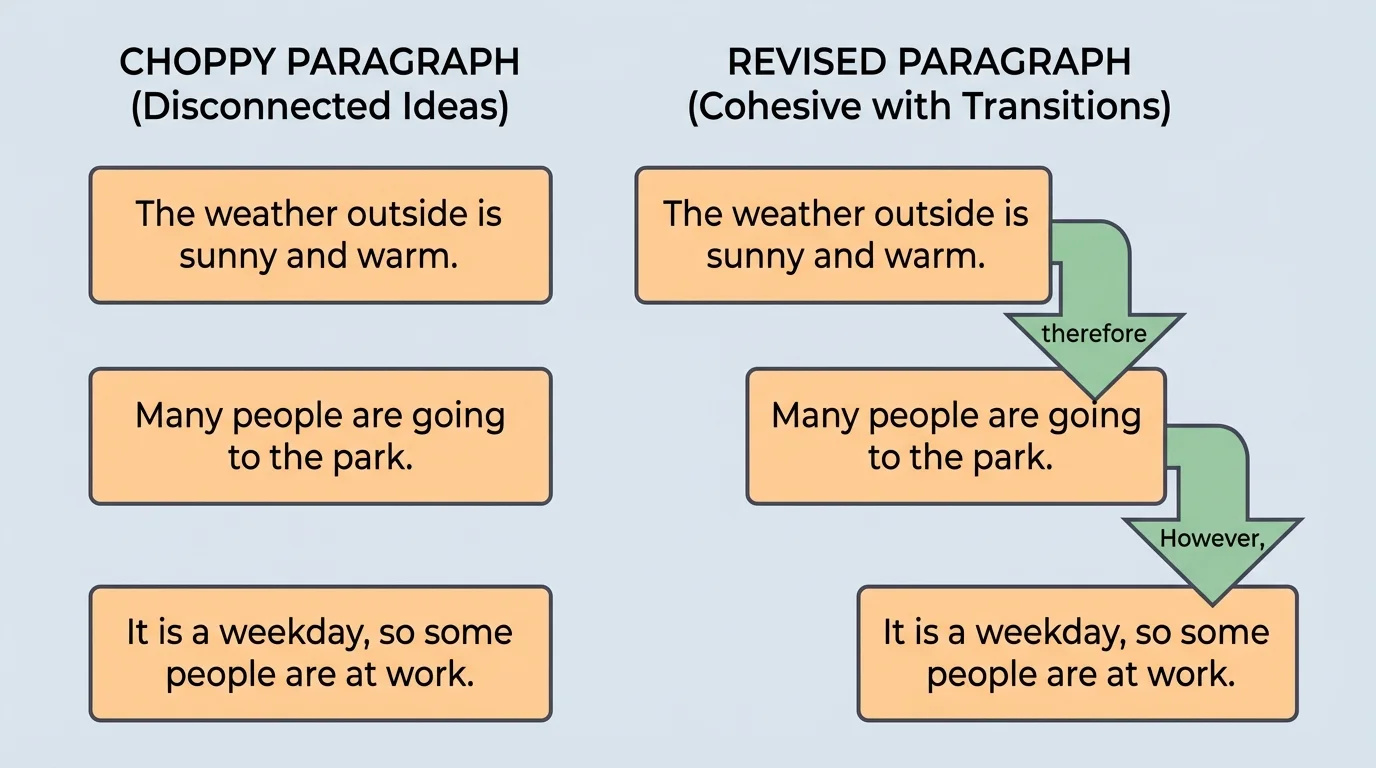
Transitions act like road signs for readers, as [Figure 1] shows in the difference between a choppy paragraph and a connected one. Without them, readers may understand each sentence by itself but miss the bigger pattern connecting the ideas. With them, the writing gains cohesion, which means the parts of the text hold together in a clear, logical way.
Consider these two versions of the same idea. Version one: "Solar panels collect sunlight. They produce electricity. They do not work as well on cloudy days." The information is accurate, but the relationships are not fully clear. Version two: "Solar panels collect sunlight and produce electricity. However, they do not work as well on cloudy days." The second version helps the reader understand that the last idea contrasts with the first two.
Transitions also help create confidence in the writer. When ideas are connected clearly, the reader can focus on learning the topic instead of guessing how the ideas fit together. Informative writing often includes definitions, examples, steps, and evidence. Transitions guide the reader through all of those parts.
Transition is a word or phrase that connects ideas and shows the relationship between them.
Cohesion is the smooth connection of ideas in a piece of writing so the whole text feels unified.
Relationship among ideas means the logical connection between pieces of information, such as sequence, contrast, cause and effect, or example.
Transitions do not work like decoration. A writer should not add them just to sound more advanced. Instead, each transition should do a real job. If the relationship between ideas is not clear in the writer's thinking, the transition will not fix the problem. Good transitions grow out of clear thinking and careful organization.
A transition can perform many jobs in a text. It can add information, as in "also," "in addition," or "furthermore." It can show sequence, as in "first," "next," "then," or "finally." It can compare, as in "similarly," and it can contrast, as in "however," "on the other hand," or "in contrast."
Some transitions show cause and effect. These include "because," "therefore," "as a result," and "consequently." Others introduce examples, such as "for example," "for instance," and "to illustrate." Still others signal a summary or conclusion, such as "in conclusion" or "overall."
Notice that some transitions are single words, while others are phrases. Also, some transitions fit better in formal school writing than in casual conversation. For example, "plus" may sound fine in speech, but "in addition" is often stronger in explanatory writing.
Many professional writers revise transitions late in the writing process. They often draft their ideas first and then strengthen the links between those ideas during revision.
The best transition depends on the exact connection you want to show. "Also" and "therefore" are not interchangeable. One adds information; the other signals a result. Choosing the wrong transition can confuse readers even when the facts themselves are correct.
Different transitions signal different kinds of logical connections, and [Figure 2] organizes these relationships into categories that writers use often. When you know the relationship you want to show, you can choose a transition that matches it. This is much more effective than inserting random linking words.
Here are some common categories of transitions used in informative writing.
| Relationship | Purpose | Examples |
|---|---|---|
| Addition | Adds another related idea | also, in addition, furthermore, moreover |
| Sequence | Shows order or steps | first, next, then, finally, afterward |
| Comparison | Shows similarity | similarly, likewise, in the same way |
| Contrast | Shows difference | however, in contrast, on the other hand, although |
| Cause and Effect | Shows reason or result | because, therefore, as a result, consequently |
| Example | Introduces evidence or illustration | for example, for instance, to illustrate |
| Clarification | Restates or explains more clearly | in other words, that is, specifically |
| Conclusion | Signals an ending idea | overall, in conclusion, to sum up |
Table 1. Categories of transitions and the relationships they signal in informative writing.
Suppose you are writing about the effects of sleep on learning. If one sentence says, "Sleep helps the brain organize memories," and the next says, "Students who sleep well often perform better on tests," you might use "as a result" if you want to stress the outcome. If you add another related benefit, "in addition" would fit better.
Writers sometimes memorize lists of transition words. That can help, but memorizing alone is not enough. You must understand the meaning of the relationship. For instance, "meanwhile" shows that things happen at the same time, while "later" signals a time shift. They are both about time, but they are not the same.
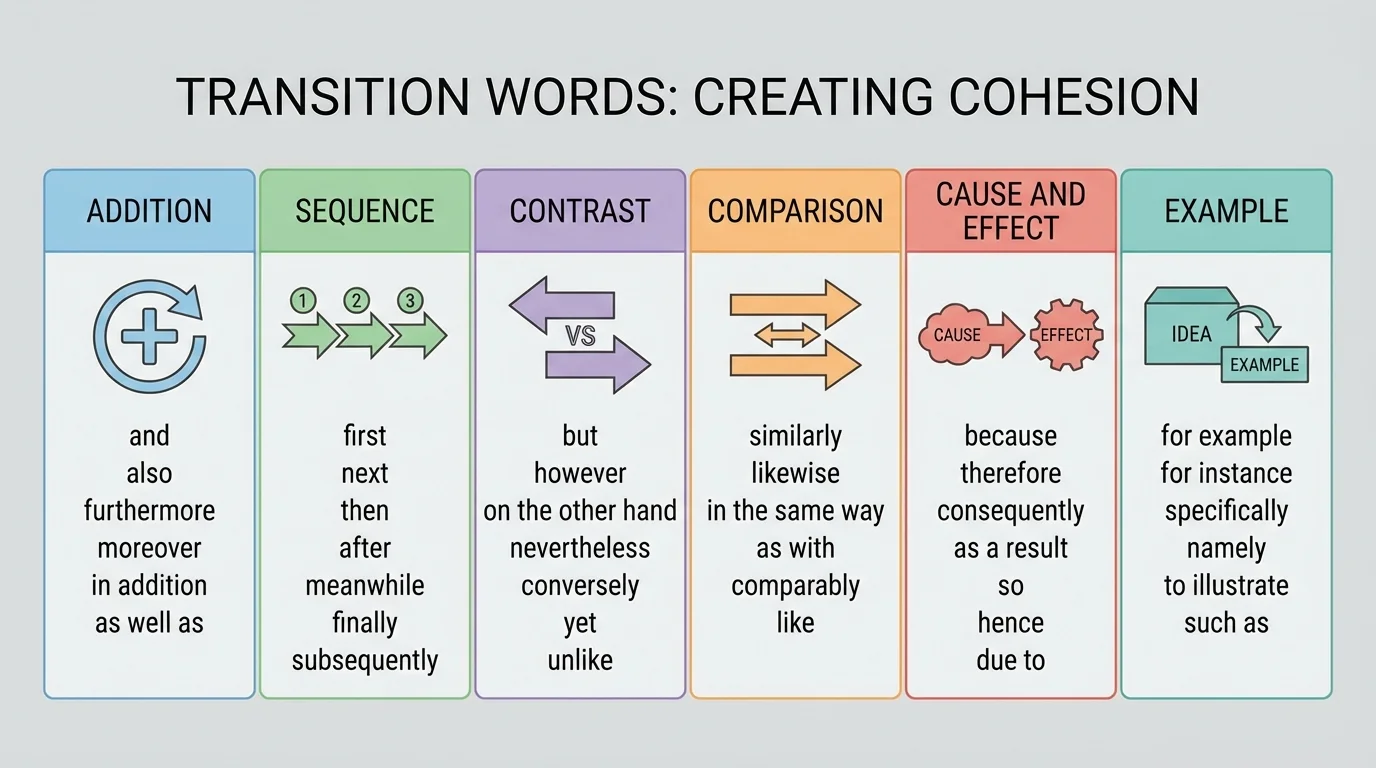
As you continue writing longer pieces, this category system becomes useful again and again. It helps you think like a reader: What connection needs to be made clear right here?
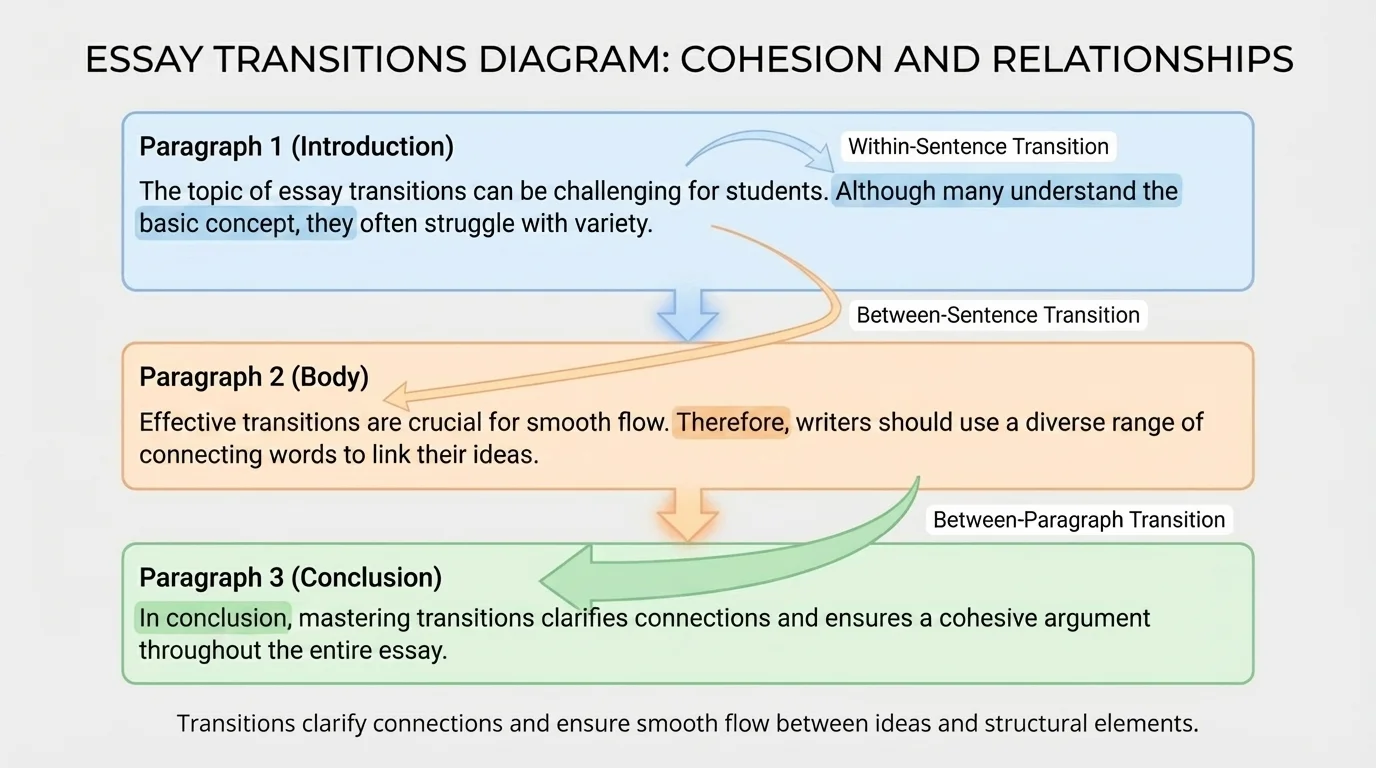
[Figure 3] Transitions work at more than one level. They can connect parts of a sentence, link one sentence to the next, and guide the reader from one paragraph to another. Strong writing uses all three levels, not just one.
Within a sentence, transitions often connect clauses or phrases. Example: "The desert receives little rainfall; therefore, many plants store water." Here, the transition directly links cause and effect inside one sentence.
Between sentences, a transition helps one sentence grow naturally from the previous one. Example: "The Arctic is warming quickly. As a result, sea ice is melting earlier each year." The second sentence clearly depends on the first.
Between paragraphs, a transition helps the whole essay stay organized. One paragraph may explain the causes of a problem, and the next may explain the effects. A topic sentence such as "These changes also affect wildlife in several ways" can bridge the two paragraphs by connecting the old idea to the new one.
Transitions are not only single words. A full phrase or even a sentence can act as a transition. In paragraph writing, a topic sentence often connects the new paragraph to the idea that came before it. This creates smoother movement through a longer explanation.
That is why effective writers think beyond a single word list. They ask whether the connection is being made at the right level. Sometimes "however" is enough. Other times the reader needs a fuller bridge, such as "While renewable energy has many advantages, it also presents challenges in storage and cost."
A transition should match the exact relationship between ideas. If a sentence gives a result, use a result transition. If it provides an example, use an example transition. If it shifts to an opposite idea, use a contrast transition. This may sound simple, but many writing problems happen because a transition sounds impressive while signaling the wrong thing.
For example, look at this sentence pair: "Plastic waste harms ocean life. For example, many scientists are studying ways to reduce it." The transition is weak because the second sentence is not an example of harm. It is a response to the problem. A better version would be: "Plastic waste harms ocean life. As a result, many scientists are studying ways to reduce it."
Precision matters. "Since" can indicate time or cause. "While" can show time or contrast. If a word has more than one meaning, make sure the sentence makes the intended relationship obvious. In formal explanatory writing, clarity comes before cleverness.
Analyzing transition choice
Topic: school gardens and student learning
Step 1: Identify the relationship between the ideas.
Sentence one: "Students in the garden observe plant growth." Sentence two: "They record changes in height and leaf color each week."
The second idea adds another related action.
Step 2: Choose a transition that matches addition.
Possible choices include "also" or "in addition."
Step 3: Write the improved version.
"Students in the garden observe plant growth. In addition, they record changes in height and leaf color each week."
The transition works because it accurately signals that the second sentence adds information rather than contrasts with it or gives a result.
When you choose transitions carefully, you help readers trust the logic of your writing. They can see not just what you know, but how the pieces fit together.
Beginning writers often rely on the same few transitions over and over, especially "first," "next," "then," and "finally." Those words are useful for showing steps, but they cannot do every job. If every paragraph begins with one of them, the writing can sound mechanical.
Variety makes writing more natural and precise. Instead of using "also" repeatedly, you might use "in addition," "furthermore," or a transition sentence. Instead of always writing "however," you might use "in contrast" or reorganize the sentence so the contrast is clear in another way.
Another weakness is the transition dump: adding transition words everywhere without improving meaning. A paragraph full of "therefore," "moreover," and "in conclusion" can still be confusing if the ideas are not logically arranged. Transitions support organization; they do not replace it.
Good paragraphs already have a clear main idea and supporting details. Transitions work best when the paragraph itself is organized. If the ideas are out of order, the writer usually needs to revise the structure before adding better transitions.
A useful question is this: What exact relationship am I trying to show? If you can answer that question, you can usually find or build an effective transition.
Although transitions are important, they are only one part of cohesion. Writers also create flow by repeating key terms, using pronouns clearly, and returning to important ideas in new sentences. If you write about volcanoes, for example, repeating the key term "magma" when needed helps the paragraph stay focused.
Synonyms can help too, but they must stay precise. If you are writing about "wildfires," replacing that term with "events" is too vague. Replacing it with "fires" may work if the meaning stays clear. Cohesion depends on readers being able to track the topic from sentence to sentence.
Pronouns such as "it," "they," and "this" can connect ideas smoothly, but they should always refer clearly to something specific. In the sentence "The battery overheated near the charger, and this caused damage," the word "this" should clearly point to the overheating, not leave the reader wondering what happened.
We can return here to [Figure 1], which illustrates that smooth flow comes from more than inserting a single linking word. The connected version works because each sentence grows naturally from the previous one and keeps the topic in view.
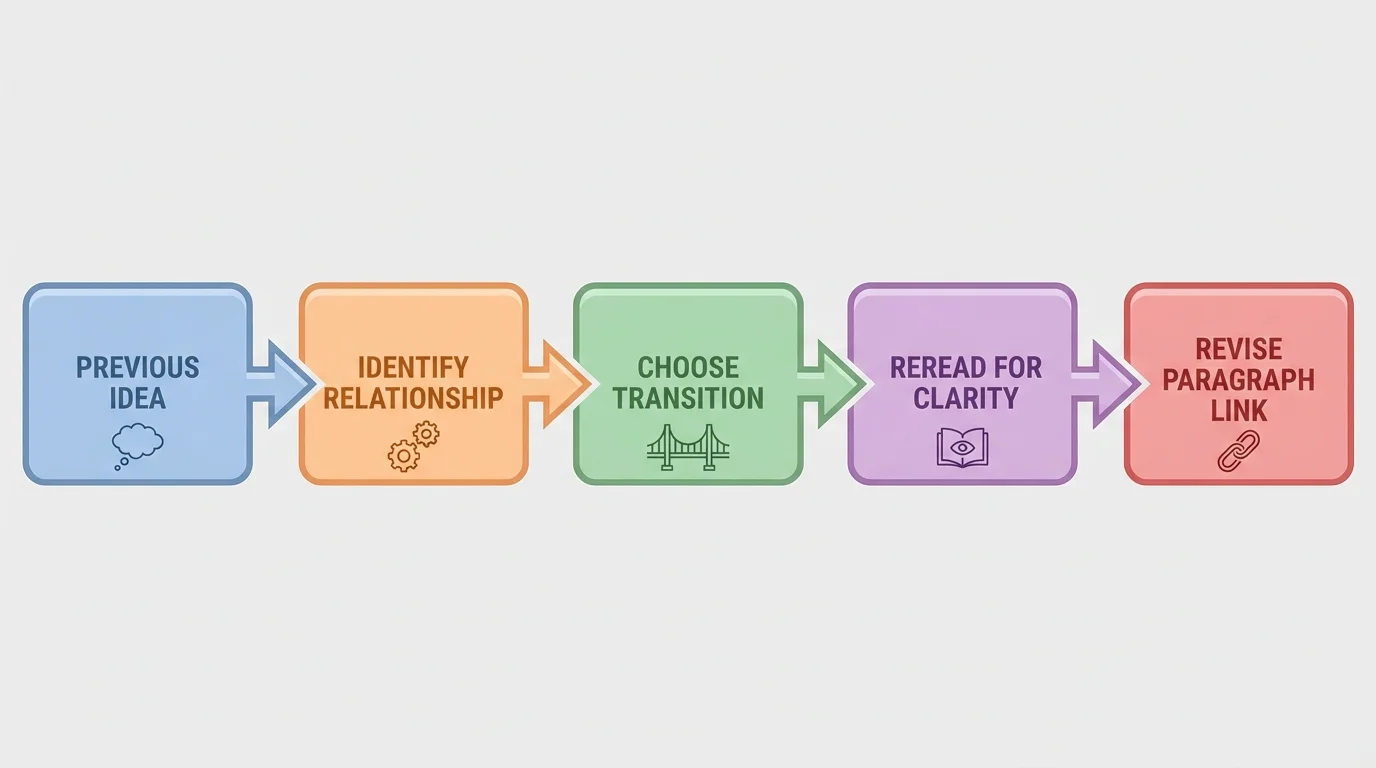
Revision is where many strong transitions are discovered, and [Figure 4] maps out the questions writers can use to test whether each connection in a draft is clear. A first draft often captures ideas quickly. During revision, the writer checks whether readers can follow those ideas easily.
One useful strategy is to read the draft one sentence at a time and ask: What came before this? How is this sentence related to it? Is the relationship addition, contrast, sequence, explanation, or result? If you cannot answer, the connection may need revision.
You can also look at topic sentences. Do they connect to the previous paragraph, or do they start too abruptly? In longer essays, transitions between paragraphs are especially important because readers are moving through bigger chunks of information.
Another revision strategy is to circle every transition in your draft. Then check whether those transitions are accurate and varied. If the same word appears too often, consider whether another transition or a full transition sentence would work better. The goal is not to add more transitions but to choose better ones.
Revising a weak paragraph
Original version: "Recycling programs reduce waste. Next, they save energy. Next, they lower the amount of trash in landfills."
Step 1: Identify the problem.
The transition "Next" suggests a sequence of steps, but the sentences are really listing related benefits.
Step 2: Replace the weak transition with ones that show addition.
Better choices include "in addition" and "also."
Step 3: Revise for smoother flow.
"Recycling programs reduce waste. In addition, they save energy. They also lower the amount of trash in landfills."
The revised version better matches the relationship among the ideas.
Writers do not always need a visible transition in every sentence. Sometimes the best revision is to improve sentence order or combine sentences so the connection becomes naturally clear.
Read this weaker paragraph: "The ancient Egyptians used the Nile River for farming. The river flooded each year. The floods left rich soil. Farmers could grow crops." Each sentence is understandable, but the ideas feel disconnected.
Now read the revised version: "The ancient Egyptians used the Nile River for farming because the river flooded each year. As a result, the floods left rich soil, and farmers could grow crops more successfully." The transitions and sentence structure make the cause-and-effect relationship much clearer.
Here is another example. Weaker version: "Bees help plants reproduce. Some people use pesticides. Bee populations can decrease." Revised version: "Bees help plants reproduce. However, some pesticides can reduce bee populations." The improved version clearly marks the contrast between the importance of bees and the threat they face.
One topic, different relationships
Topic: electric cars
Step 1: Addition
"Electric cars produce no tailpipe emissions. In addition, they are often quieter than gasoline-powered cars."
Step 2: Contrast
"Electric cars reduce air pollution. However, charging stations are not available everywhere."
Step 3: Cause and effect
"Charging technology has improved. As a result, many electric cars can travel farther than earlier models."
These examples show that transition choice depends on the relationship, not just the topic.
Studying model paragraphs helps you notice that good transitions are purposeful. They are small, but they shape the reader's understanding in a big way.
Informative writing for school usually uses a formal style. That means the language is clear, respectful, and precise. Transitions can help support that style. Phrases like "for example," "in contrast," and "as a result" usually fit well in explanatory writing because they clearly signal relationships without sounding too casual.
Some transitions are common in conversation but weaker in formal writing. Words such as "anyway" or "besides" may sound too informal for an academic explanation. A stronger choice might be "moreover" or "in addition," depending on the sentence.
Formal style also means avoiding exaggerated transitions that promise more than the writing delivers. If you write "therefore," the second idea must truly follow from the first. If you write "in conclusion," readers should actually be reaching the ending.
"The best transition is the one that makes the reader think, 'Of course that idea comes next.'"
When writers organize ideas carefully, select accurate transitions, and revise for clarity, their informative writing becomes easier to read and easier to understand. The facts remain important, but the connections between those facts become visible.
