A strong argument can lose power in its very last lines. Think about a sports team that plays an excellent game but forgets to finish the final play, or a speaker who makes a convincing case and then just says, "So, yeah." The ending matters. In argument writing, the conclusion is where a writer brings the whole piece together and leaves the reader with a clear final understanding. It is not just the stopping point. It is the part that shows the writer understands exactly what the argument means.
When you write an argument, you begin with a claim, support it with reasons, and back those reasons with evidence. A conclusion is the final section that grows naturally out of all of that thinking. It shows the reader how the ideas fit together and why they should care.
A concluding statement or a concluding section does more than repeat earlier sentences. It reminds the reader of the main claim, shows how the reasons and evidence support that claim, and creates a sense of completion. Without a strong ending, even a well-written argument may feel unfinished or weak.
A conclusion is the final part of a piece of writing that brings the writer's ideas to a close. In an argument, the conclusion should follow from the claim, reasons, and evidence already presented and should support the overall argument rather than add unrelated ideas.
You can think of a conclusion as the knot at the end of a thread. The thread represents the whole argument. The knot holds everything together. If the knot is loose, the argument may unravel in the reader's mind.
A strong conclusion gathers the main parts of the argument into one final message, as [Figure 1] illustrates. It does not start a brand-new topic. Instead, it grows directly from the claim, the reasons, and the evidence that came before.
First, a strong conclusion restates the claim in a fresh way. This does not mean copying the introduction word for word. It means reminding the reader of the main position using new language.
Second, it connects evidence and reasons by showing how they support the claim. The writer helps the reader see the big picture: not just individual facts, but what those facts prove.
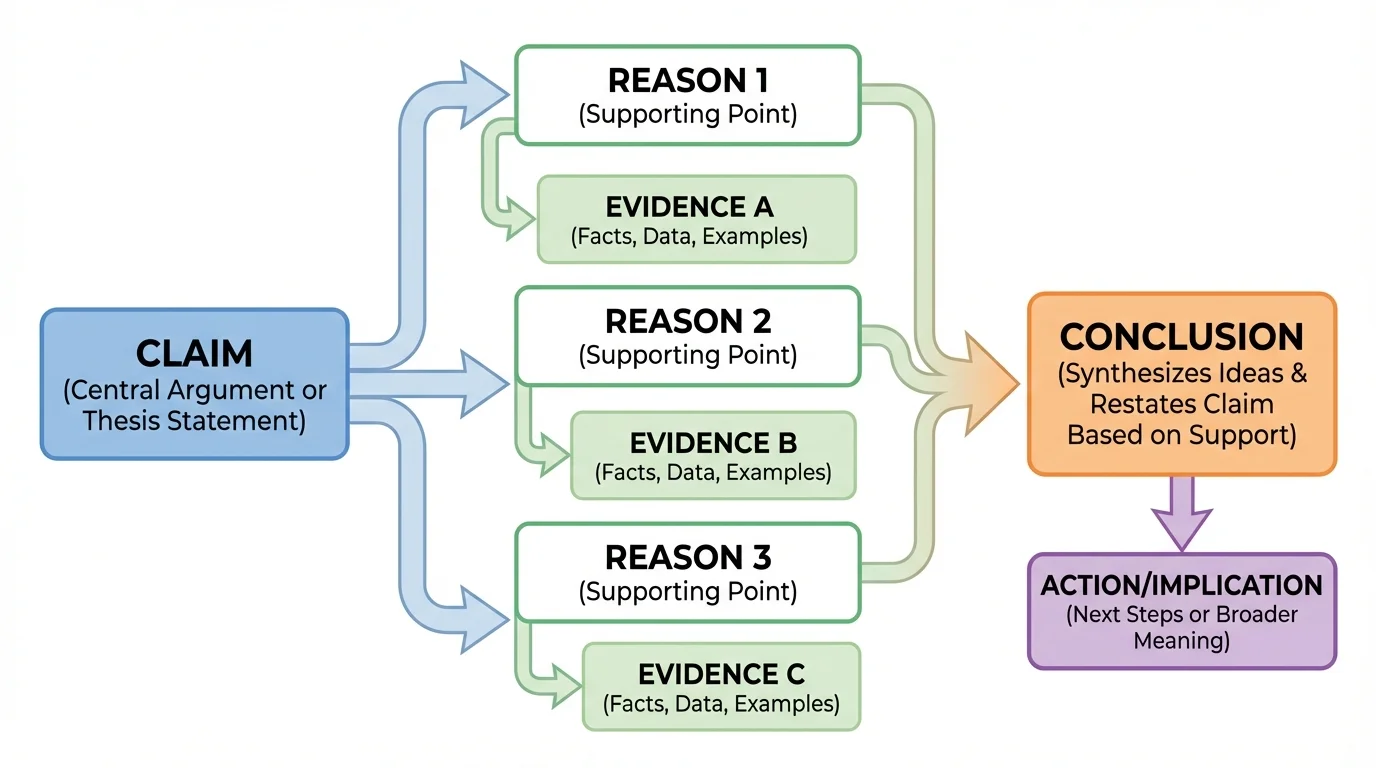
Third, a strong conclusion leaves the reader with a final thought. This thought might explain why the issue matters, suggest what should happen next, or emphasize the importance of the writer's position. The ending should feel supported by the argument.
Suppose a student writes an argument that schools should offer later start times. A conclusion might say: Schools should begin later because students learn better when they are well rested. Research on sleep, attention, and health shows that later start times support stronger learning and safer daily routines. Changing the schedule would help students succeed both in class and outside of school.
Notice what this ending does. It returns to the claim, connects the supporting points, and ends with a meaningful idea. It does not wander away from the topic. Later, when you compare different ending styles, the pattern in [Figure 1] still matters: the conclusion works best when it grows out of the argument's earlier parts.
Following from the argument means that the conclusion makes sense because of what the writer already explained. If the body paragraphs prove that a claim is reasonable, the conclusion should build on that proof. It should sound like the natural final step, not like an unrelated opinion added at the last second.
This idea is especially important in formal writing. Readers expect a conclusion to be connected, logical, and focused. A random ending can make readers doubt the whole piece, even if the body paragraphs are strong.
Writers often make predictable mistakes at the end of an argument, and [Figure 2] helps compare the most common weak patterns with stronger ones. Knowing what to avoid can make your own conclusion much more effective.
One mistake is introducing new evidence in the conclusion. If a fact is important enough to prove your point, it belongs in the body of the argument, where you can explain it. The conclusion is not the place for surprise proof.
Another mistake is repeating the introduction exactly. Readers do not want to feel that the writing has gone in a circle without moving forward. A conclusion should sound familiar because it connects to the argument, but it should also sound fresh and purposeful.
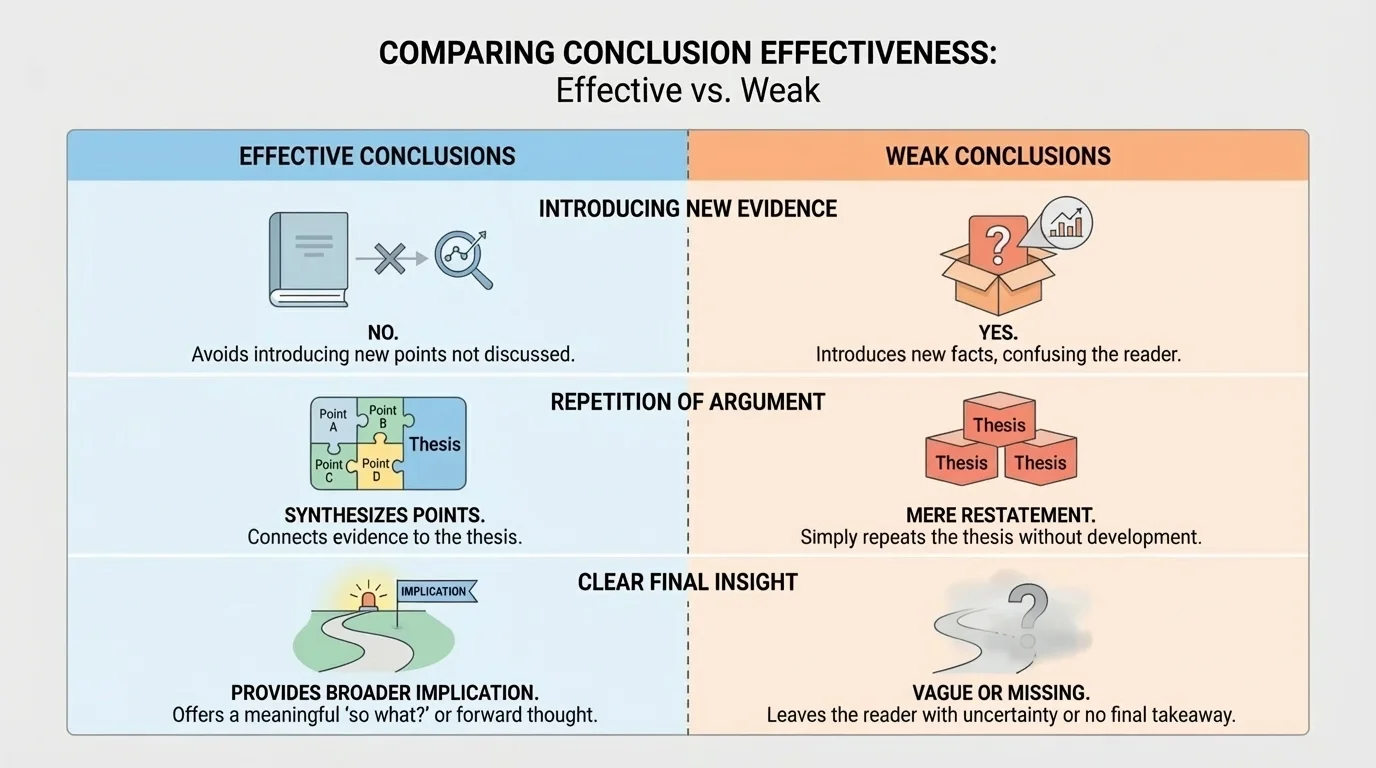
A third mistake is ending too suddenly. Sentences such as That is why I think this or So those are my reasons do not give the reader a satisfying final thought. They stop the writing, but they do not conclude it.
A fourth mistake is becoming too emotional or too informal in a formal argument. For example, an ending like If you disagree, that makes no sense at all sounds rude rather than convincing. A strong argument uses a respectful, steady voice.
Another common problem is making the conclusion far too broad. If the argument is about recycling at school, the conclusion should not suddenly claim that the entire planet will be saved by one classroom change. Good conclusions stay connected to the real scale of the argument.
| Weak ending habit | Why it hurts the argument | Better choice |
|---|---|---|
| Adds new evidence | The reader has no time to understand or evaluate it | Use only ideas already discussed |
| Repeats exactly | Sounds dull and mechanical | Restate the claim in new words |
| Ends abruptly | Feels unfinished | Leave a clear final thought |
| Uses informal or rude tone | Weakens credibility | Keep a respectful formal style |
| Exaggerates | Makes the argument sound unrealistic | Stay accurate and connected to the evidence |
Table 1. Common weaknesses in argumentative conclusions and stronger alternatives.
When you revise, it helps to ask whether the conclusion sounds like the natural end of your reasoning. If not, it may be falling into one of these weak patterns.
Many professional speeches are remembered most for their endings. The final lines often stay in the audience's mind because they bring the main message into one sharp, memorable statement.
That is why strong conclusions matter outside school too. People hear them in speeches, editorials, debates, and public service announcements. A good ending helps an audience remember what the writer or speaker wants them to believe.
Not every conclusion sounds the same, and that is a good thing. Writers can choose different approaches depending on the topic, purpose, and audience. What matters is that the ending still follows from the argument and supports it.
One common strategy is a call to action. This means the writer asks readers to do something based on the argument. For example, in a piece arguing for cleaner parks, a conclusion might urge students and families to join a monthly cleanup day.
Another strategy is to explain the significance of the issue. This tells why the topic matters beyond the immediate example. If a writer argues for school libraries to stay open longer, the conclusion might explain that access to books and study space supports fairness for all students.
A third strategy is to focus on the future. The writer can explain what may happen if people accept the claim or if they ignore it. In an argument about saving water, the conclusion might point out that small choices today protect resources for tomorrow.
A fourth strategy is to offer a final insight. This kind of ending does not tell the reader what to do directly. Instead, it leaves the reader with a thoughtful idea connected to the claim. For example: When communities design spaces for walking and biking, they are not only changing streets; they are changing daily life.
Each of these methods can work well. The key is choosing one that matches your topic. A call to action works especially well when the issue needs a practical response. A significance ending works well when the topic affects many people. A future-focused ending fits problems and solutions. A final insight works well when the goal is to leave the reader thinking.
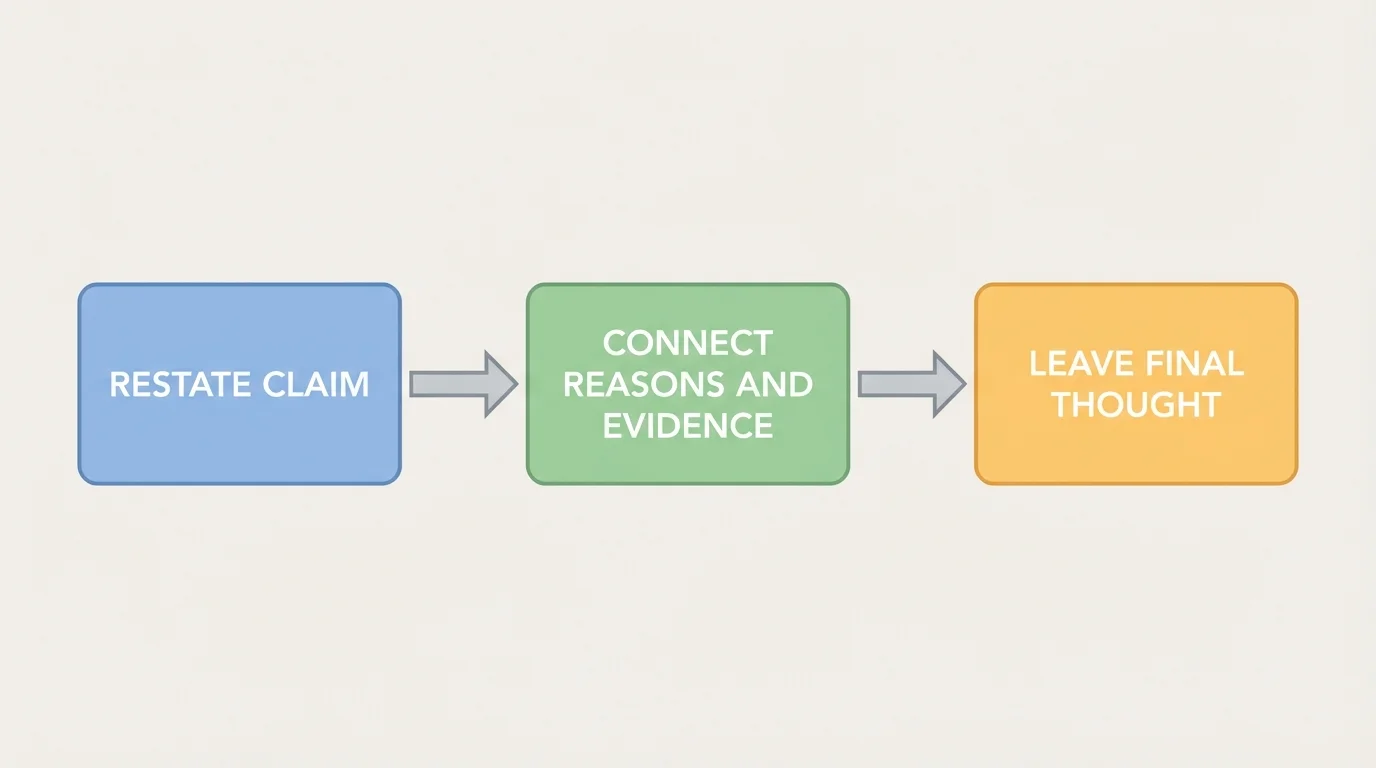
A conclusion becomes easier to write when it is broken into clear parts, as [Figure 3] shows. Many middle school writers do best with a simple three-part structure.
Part 1: Restate the claim in a new way.
Part 2: Bring together the strongest reasons or evidence.
Part 3: End with a final thought that shows why the argument matters.
This structure is not a formula that must sound identical every time. Instead, it is a guide. It helps you avoid weak endings and keeps your conclusion connected to the rest of the writing.
Example: building a conclusion for an argument about community gardens
Topic: The town should create more community gardens.
Step 1: Restate the claim.
The town would benefit from creating more community gardens.
Step 2: Connect reasons and evidence.
These gardens provide fresh food, create shared public spaces, and give families and students chances to learn about growing plants.
Step 3: Add a final thought.
By turning unused land into useful spaces, the town can support both healthier living and stronger neighborhoods.
Put together, those parts create a full conclusion that follows from the argument and supports it.
Notice that each part builds on ideas already presented. Nothing new appears suddenly. That is why the ending feels solid and believable.
The structure in [Figure 3] can also help when revising. If your conclusion is weak, check whether one of the three parts is missing. Often the problem is not that the whole ending is wrong, but that it needs one more clear move.
Seeing a revision side by side helps students notice the difference between merely stopping and truly concluding, and [Figure 4] presents that contrast clearly.
Topic: Schools should require uniforms.
Weak conclusion: That is why schools should have uniforms. Uniforms are good. I think everyone should agree with this.
This ending is weak because it is vague. It does not mention specific reasons, and it does not leave the reader with a meaningful final thought.
Stronger conclusion: Schools should require uniforms because they reduce clothing distractions, can lower social pressure, and help create a more focused learning environment. These benefits show that uniforms are not just about appearance; they are about helping students feel ready to learn. A clear dress policy can support a stronger school community.
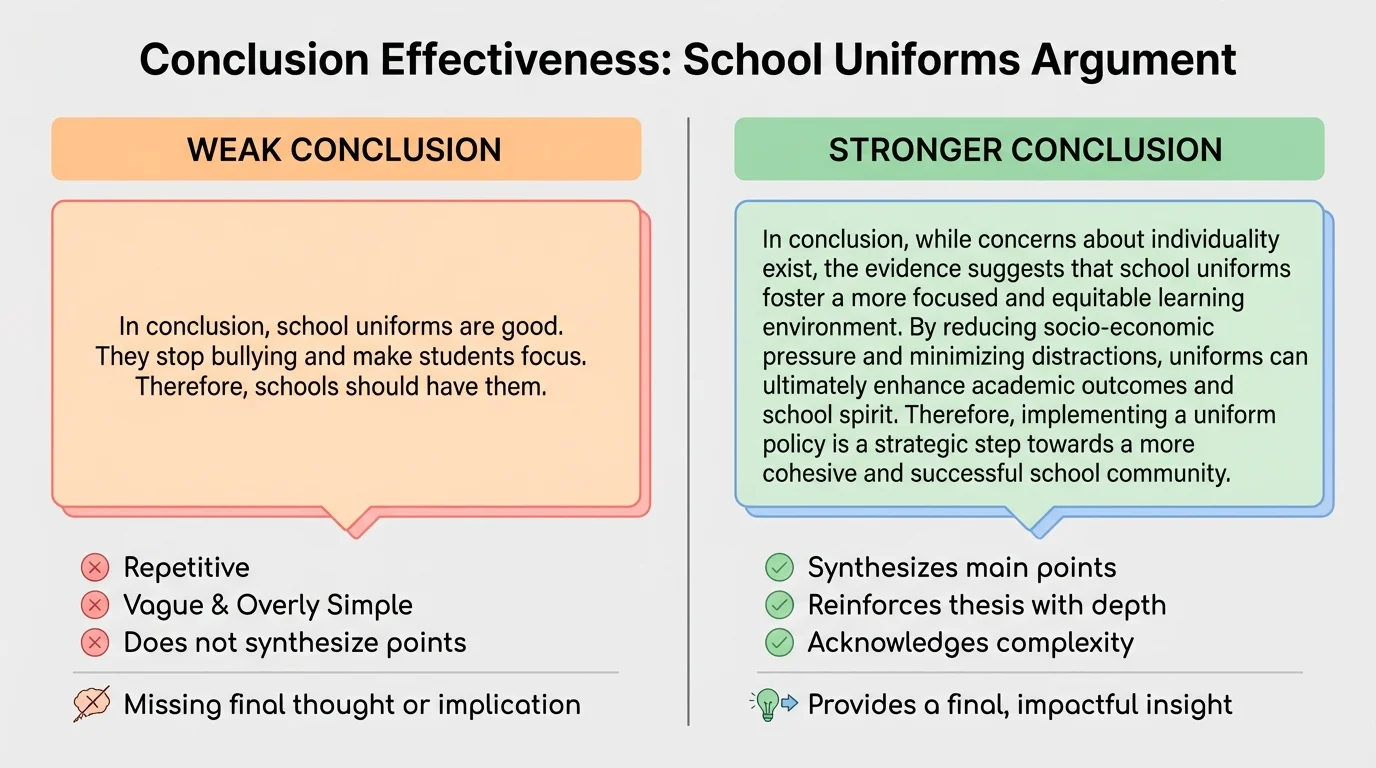
This stronger version works because it restates the claim, refers to the main reasons, and ends with a broader idea tied to the argument.
Here is another example.
Topic: Cities should add more bike lanes.
Weak conclusion: Bike lanes are good and cities need them. That is all.
Stronger conclusion: Cities should add more bike lanes because they make travel safer, reduce traffic, and encourage healthy habits. The evidence shows that bike lanes are a practical improvement, not an extra feature. When cities plan for cyclists, they create streets that work better for everyone.
Now consider a topic about technology.
Topic: Students should learn digital citizenship in school.
Stronger conclusion: Schools should teach digital citizenship because students need to know how to evaluate online information, communicate responsibly, and protect their privacy. These skills are essential in modern life, where so much learning and interaction happens online. Teaching them in school prepares students to make thoughtful choices in a connected world.
Argument writing depends on a clear line of reasoning: claim, reasons, evidence, and explanation. A conclusion is strongest when it reflects that same line of reasoning instead of drifting away from it.
As you can see in the revised examples, a conclusion does not need to be very long. It needs to be purposeful. A few strong sentences can do much more than a long ending filled with repetition.
Much later in the writing process, when you reread your whole piece, the comparison in [Figure 4] remains useful. Ask yourself whether your ending sounds more like the weak model or the stronger one. That question can guide effective revision.
Good writers think about who will read their argument. A conclusion written for a principal, teacher, community leader, or school newspaper should use a formal style. That means choosing clear, respectful language and avoiding slang.
Formal style does not mean sounding stiff or robotic. It means sounding thoughtful and appropriate for the situation. For example, instead of writing This rule is super bad and needs to go now, a writer in formal style might write This rule should be reconsidered because it creates unnecessary problems for students.
Audience also affects the final thought. If your readers are students, you might focus on daily school life. If your readers are adults in the community, you might focus more on cost, fairness, safety, or long-term benefits. The conclusion should still match the evidence already presented, but it can emphasize the parts most important to the audience.
Tone matters because conclusions are often the last thing readers remember. A respectful, confident ending makes the writer sound credible. An overly dramatic or careless ending can weaken trust.
"The end of a piece of writing should sound finished, not just stopped."
This principle is simple but powerful. A stopped piece merely runs out of words. A finished piece leaves the reader with a strong sense that the writer has made a complete case.
Strong conclusions are often revised, not written perfectly on the first try. Good writers reread the ending and test whether it truly supports the argument.
One useful revision question is: Does this conclusion clearly connect to my claim? If the answer is no, the writer may need to restate the claim more clearly.
Another question is: Does this conclusion reflect my strongest reasons and evidence? If the ending sounds too general, it may need a sentence that ties together the main support from the body paragraphs.
A third question is: Does this conclusion add something meaningful without adding something new? This can be tricky. The conclusion should not introduce new facts, but it should deepen the reader's understanding of what the existing facts mean.
A fourth question is: Is the tone formal and appropriate? If the ending sounds too casual, too angry, or too exaggerated, it needs revision.
Here is a quick checklist you can use while revising:
When all of these parts are working together, the conclusion does exactly what it should do: it follows from the argument presented and supports it. It helps the reader see not only what the writer believes, but why that belief is convincing and worth remembering.
