A single extra word can slow down a sentence, and a weak word can blur an idea. Think about the difference between saying, "The animal moved" and "The fox slipped through the grass." Both sentences are correct, but one is much sharper. Strong writers do not just fill space. They choose language that helps readers see, understand, and remember exactly what they mean.
Good writing is not just about having lots of ideas. It is also about presenting those ideas clearly. When writing is precise, the words match the writer's meaning closely. When writing is concise, it says what it needs to say without wasting words. These two qualities work together. Precise language helps readers understand the exact message. Concise language helps them reach that message quickly and smoothly.
Readers notice clear writing right away. A clear sentence saves time, avoids confusion, and sounds more confident. This matters in many kinds of writing: stories, science explanations, arguments, emails, and reports. Whether you are describing a game-winning shot, explaining a lab result, or writing a school announcement, your words should fit your purpose.
Precise language uses exact words that communicate a specific meaning. Concise language expresses an idea clearly in as few words as necessary. Wordiness happens when a writer uses more words than needed. Redundancy happens when a writer repeats the same idea unnecessarily.
Being concise does not mean being short all the time. A long sentence can still be concise if every part has a job. Being precise does not mean using the fanciest word. A precise word is not necessarily harder; it is simply the best fit.
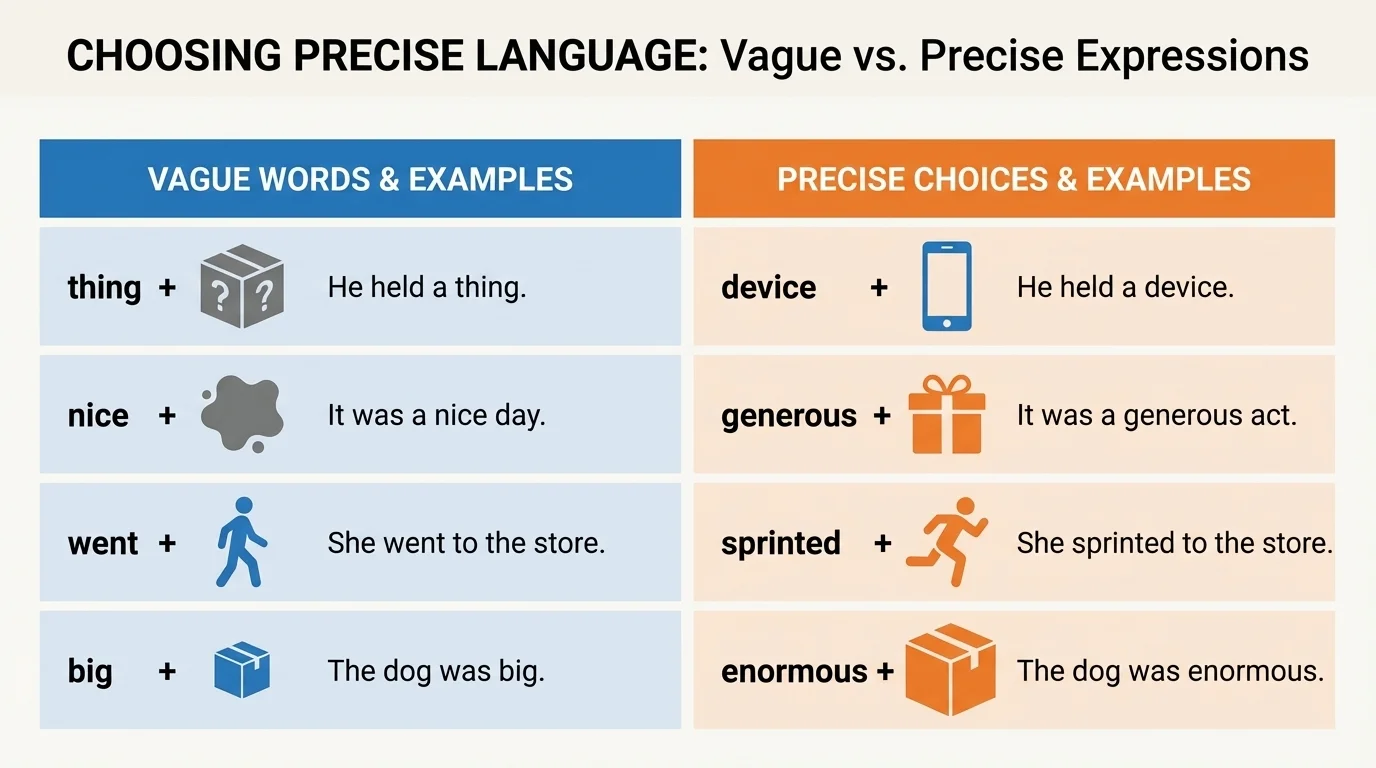
Precise language helps readers picture exactly what happened, what something looked like, or what someone meant. As [Figure 1] shows, a sentence becomes stronger when vague words are replaced with specific ones. Compare the words thing, stuff, nice, and went with more exact choices such as equipment, supplies, thoughtful, and dashed.
Vague words are not always wrong, but they often leave the reader with a fuzzy picture. Look at these examples:
Weak: "She had a nice reaction to the news."
Better: "She smiled and clapped when she heard the news."
In the second sentence, the reader can actually see the reaction. The word nice is replaced by details that show what happened.
Precision also depends on choosing strong verbs. Verbs carry action, so they often make the biggest difference in a sentence. Compare these examples:
Weak: "The rain came down on the field."
Better: "Rain pounded the field."
The second sentence is shorter and more vivid. One strong verb replaces a longer, weaker phrase.
Exact nouns matter too. Instead of saying "bird," a writer might say "hawk." Instead of "vehicle," a writer might say "bus" or "pickup truck." Specific words make writing more informative. In science writing, for example, saying "liquid" may be useful, but saying "salt water" may be more accurate. In history writing, "leader" may be too broad if "emperor," "president," or "general" is more exact.
Specificity builds meaning
Precision is not about making every sentence dramatic. It is about choosing the level of detail that your reader needs. If your reader needs a general idea, a broad word may work. If your reader needs an exact understanding, a more specific word is better. Skilled writers constantly ask, "Is this the best word for what I mean?"
Tone also affects precision. The same event can be described in different ways depending on the writer's purpose. Calling a sound "loud," "deafening," or "energetic" changes how readers feel about it. A precise word gives the correct meaning and the right tone.
Later, when you revise for audience and purpose, the contrast in [Figure 1] still matters: stronger wording does not just sound better; it communicates more exactly.
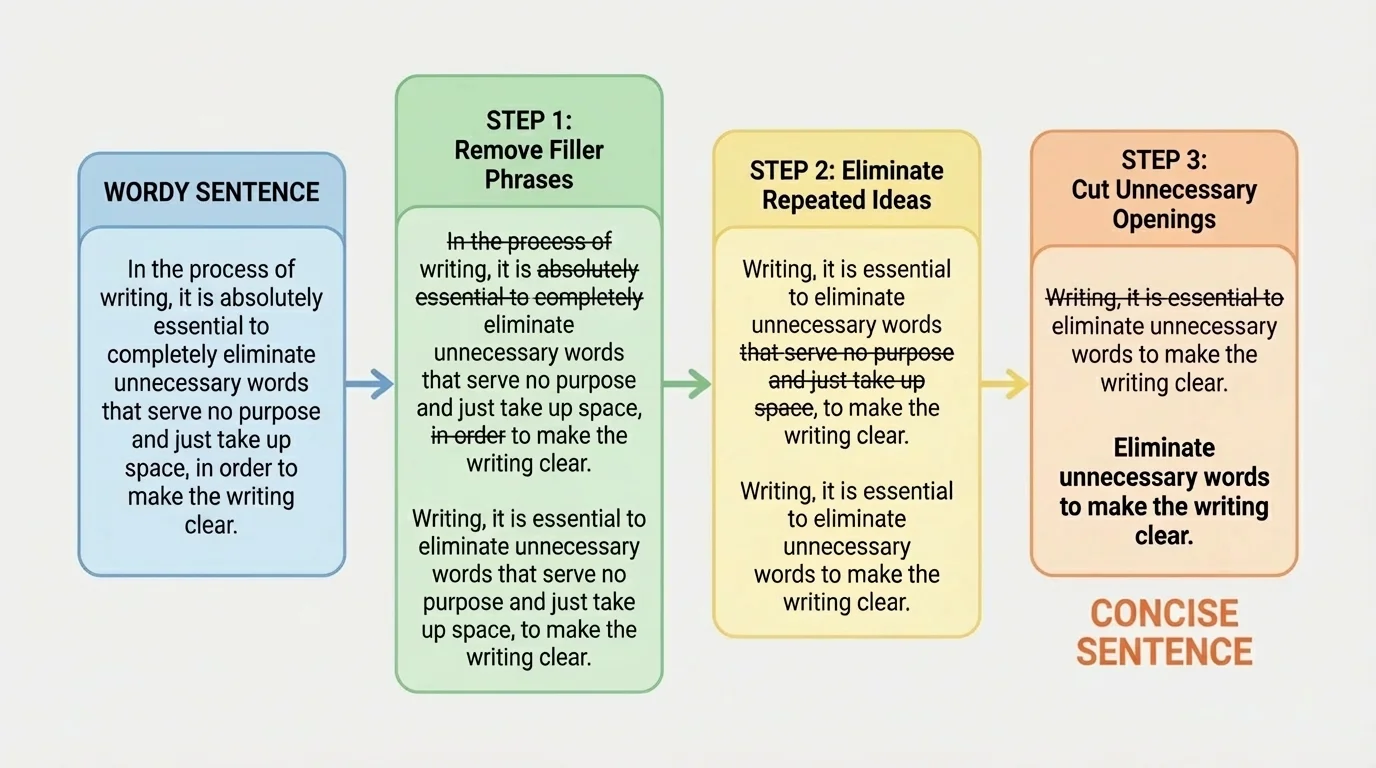
Concise language removes anything that does not help the reader. As [Figure 2] illustrates, editing for concision is often like trimming a branch so the healthy parts can grow. The goal is not to cut important details. The goal is to remove extra words that do not add meaning.
Wordy writing often includes filler phrases such as "in order to," "due to the fact that," "at this point in time," or "there are." These phrases can usually be shortened.
Wordy: "In order to finish the project, we need to work together."
Concise: "To finish the project, we need to work together."
Wordy: "At this point in time, the team is ready to begin."
Concise: "The team is ready to begin now."
Sometimes wordiness comes from unnecessary sentence starters. Phrases like "I think that," "it is important to note that," and "the reason is because" can weaken writing.
Compare these two versions:
Wordy: "I think that our class should probably consider the possibility of starting the fundraiser earlier."
Concise: "Our class should start the fundraiser earlier."
The revised sentence sounds more direct and confident. It keeps the main idea and removes extra language.
Concision also means avoiding long strings of prepositional phrases when shorter wording works better. For example, "the book on the shelf in the corner of the room" may be fine if every detail matters. But if the important idea is simply which book, a shorter phrase may be enough.
Professional editors often cut many words from articles, scripts, and speeches without changing the main message. Strong writing usually becomes stronger, not weaker, when unnecessary words disappear.
Writers sometimes worry that concise writing will sound too plain. Actually, concise writing often sounds more powerful because the important words stand out. The process shown in [Figure 2] reminds us that every word should earn its place.
Redundancy happens when a writer repeats meaning without a good reason. Repetition can be useful for emphasis, but redundancy is accidental repetition that adds clutter instead of strength.
Some redundant phrases are common in everyday speech. For example, "advance planning" is redundant because planning already happens in advance. "Repeat again" is redundant because repeat means to do again. "Past history" is redundant because history is about the past.
Here are more examples:
Redundancy can also happen across a whole sentence or paragraph.
Redundant: "The reason the game was canceled was because rain made the field wet and soggy."
Better: "The game was canceled because rain made the field soggy."
In the first sentence, several parts repeat ideas the reader already understands. The second sentence is cleaner.
Finding redundancy in a sentence
Sentence: "The students collaborated together on the group project."
Step 1: Identify repeated meaning.
The word collaborated already means "worked together."
Step 2: Remove the extra words.
Delete together.
Step 3: Read the sentence again.
"The students collaborated on the group project."
The revision keeps the meaning and improves the flow.
When checking for redundancy, ask yourself whether two nearby words or phrases say nearly the same thing. If they do, you may only need one of them.
Writers do not usually create perfect sentences on the first try. Good writing often comes from revision. Revising for precision and concision means looking closely at what each word contributes.
One useful strategy is to replace weak words with exact ones. Instead of adding several describing words to a weak verb, use one stronger verb. Instead of saying "walked slowly and quietly," a writer might choose "crept."
Another strategy is to cut filler. Search for phrases that delay the main idea. If the sentence can begin with the real point, it often should.
A third strategy is to combine ideas. Sometimes two short, repetitive sentences can become one smoother sentence.
Repetitive: "Maya was nervous. Maya shook her hands before speaking."
Combined: "Nervous, Maya shook her hands before speaking."
A fourth strategy is to read aloud. Wordy or awkward sentences are easier to notice when you hear them. If you run out of breath before you reach the main point, the sentence may need revision.
Editing and revising are not the same. Editing usually focuses on correctness, such as grammar, spelling, and punctuation. Revising focuses on improving meaning, organization, style, and clarity. Choosing precise and concise language is part of revision, though it may also happen during editing.
You can also test a sentence by asking these questions: What is the main idea? Is there a stronger word? Is any part repeating the same meaning? Can I say this more directly? These questions help writers become more deliberate.
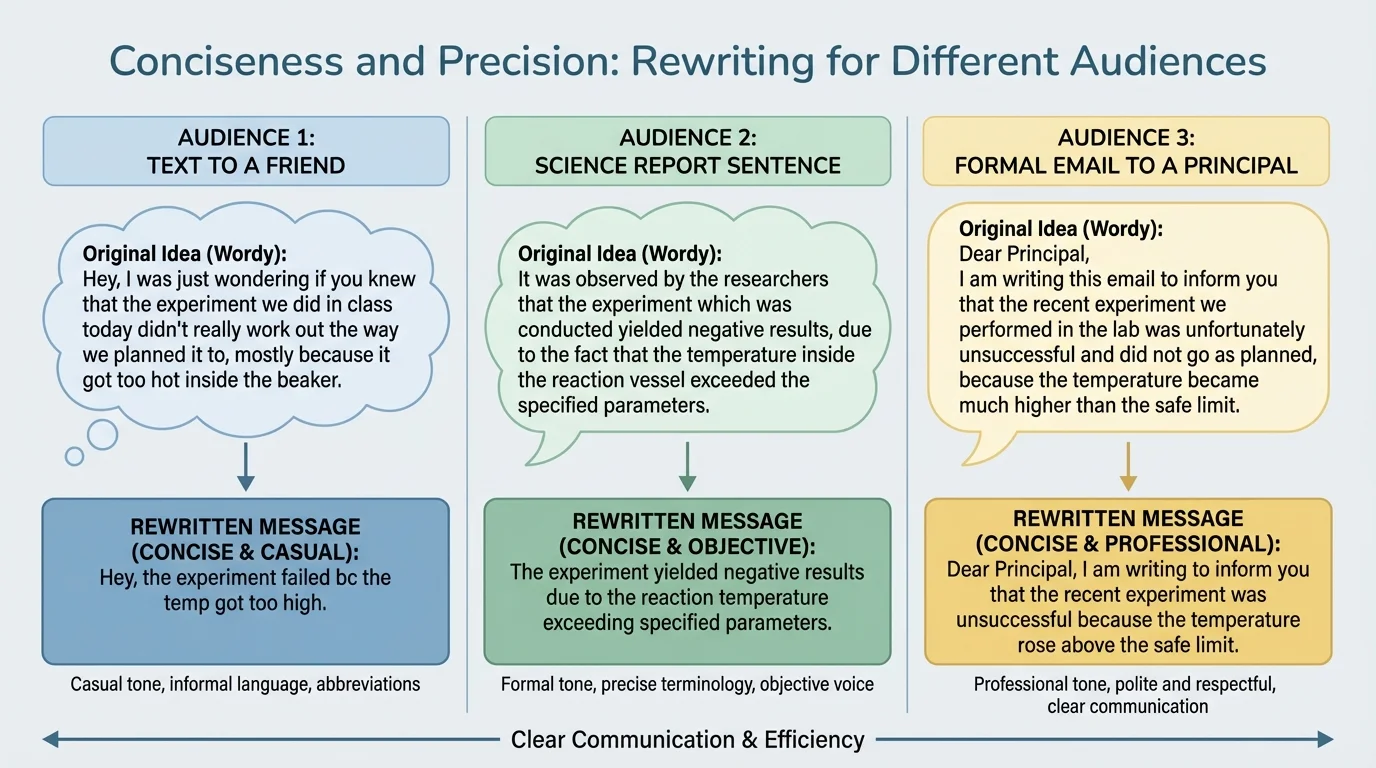
The same information can be expressed in different ways depending on who will read it and why. As [Figure 3] shows, wording that fits a text message may not fit a science report or a formal email. Good writers choose language that matches the task, the purpose, and the audience.
If you are writing to a friend, you might be informal and brief: "The game got postponed because the field flooded." If you are writing a school announcement, you might be more formal: "Today's game has been postponed because heavy rain flooded the field." If you are writing a science explanation, you might be even more exact: "Heavy rainfall saturated the ground, making the field unsafe for play."
All three versions communicate a similar idea, but they are not identical. Each one suits a different situation. Precision includes selecting the right level of formality and detail.
Audience also affects word choice. A younger reader may need simpler words. A teacher reading an essay may expect topic-specific vocabulary. A community audience reading a flyer may need direct, easy-to-follow language. Purpose matters too. If your goal is to entertain, you may choose vivid details. If your goal is to explain, you may focus on accuracy and order.
The comparison in [Figure 3] helps show that good style is not one fixed way of writing. It is the ability to choose the best wording for a specific situation.
Many unclear sentences have the same problems: vague language, filler, repetition, and weak verbs. Looking at revisions can help you notice these patterns in your own writing.
Problem: vague language
Weak: "The speaker said some things about recycling that were good."
Better: "The speaker explained three useful recycling habits."
Problem: unnecessary words
Weak: "There are many students who are interested in joining the robotics club."
Better: "Many students want to join the robotics club."
Problem: repeated meaning
Weak: "The two twins wore identical matching jackets."
Better: "The twins wore matching jackets."
Problem: weak verb
Weak: "The fire was making the logs turn black."
Better: "The fire charred the logs."
Revising a short paragraph
Original paragraph: "At this point in time, our school garden is something that is in need of more care and attention. The reason is because many plants are not growing in a successful way. Students in the science class worked together collaboratively to water the plants and pull out weeds."
Step 1: Remove filler phrases.
Change "At this point in time" to "Now." Remove "something that is."
Step 2: Remove redundancy.
Change "The reason is because" to "because." Change "worked together collaboratively" to "worked" or "collaborated."
Step 3: Replace weak wording with precise wording.
Change "not growing in a successful way" to "struggling to grow."
Step 4: Put the revision together.
"Now our school garden needs more care because many plants are struggling to grow. Students in the science class collaborated to water the plants and pull weeds."
The revised paragraph is shorter, clearer, and more direct.
Notice that the revised paragraph still includes important details. Concise writing does not erase information. It removes clutter so important information can stand out.
Some students think concise writing must sound flat. It does not. Strong style often depends on sharp nouns, strong verbs, and clear details rather than extra wording. "The crowd erupted" is both concise and dramatic. "The crowd made a very loud noise in an excited way" is longer but weaker.
Writers can still create rhythm, mood, and voice while being concise. In stories, precise sensory details make scenes vivid. In arguments, exact claims make reasoning stronger. In informational writing, direct wording builds trust because it sounds knowledgeable and organized.
"The most valuable of all talents is that of never using two words when one will do."
— Thomas Jefferson
This idea does not mean writers should always choose the shortest sentence possible. It means writers should value efficiency. If one word says exactly what you mean, adding two more may only weaken it.
Clear writing is a skill that grows with practice and attention. Each revision is a chance to sharpen meaning, trim away distractions, and guide readers more effectively from one idea to the next.
