Have you ever read a scene in a book one way in your mind, then watched it in a movie and thought, "Wait, that is not how I pictured it at all"? That happens because reading and watching are not the same kind of experience, even when the words come from the same text. A story, a play, or a poem can stay the same on paper, but the way you experience it changes a lot depending on whether you read it, hear it, or see it performed.
When you read, your mind becomes the director, actor, and sound designer all at once. When you listen to an audio version or watch a video or live performance, many of those choices are made for you by someone else. Learning to compare these experiences helps you understand literature more deeply because you notice not only what a text says, but also how a medium shapes meaning.
A written text gives you words. From those words, you build pictures, sounds, and feelings in your mind. An audio version gives you a real voice, pacing, and sound. A video or live version adds faces, costumes, movement, lighting, music, and setting. That means each version can guide your thinking in a different way.
For example, if a story says, "The hallway was dark and silent," a reader may picture a narrow hallway, a wide hallway, an old house, or a school. One reader may imagine a scary silence; another may imagine a peaceful one. But in a movie, the director chooses the hallway's size, color, lighting, and camera angle. In a live play, the stage designer and actors decide how the hallway feels. The words may begin the experience, but the performance shapes it further.
Medium is the form in which a text is experienced, such as print, audio, video, or live performance. Interpretation is the way a reader, narrator, actor, or director understands and presents a text. Tone is the attitude or feeling expressed by the words or voice, and mood is the feeling created for the audience.
This is why two students can agree on the main events of a story but still have very different reactions to a movie version. One student may love how the music builds suspense. Another may feel the film gives away too much and leaves less room for imagination. Neither reaction is automatically wrong. The key is to explain how the experience changes and what details led to that response.
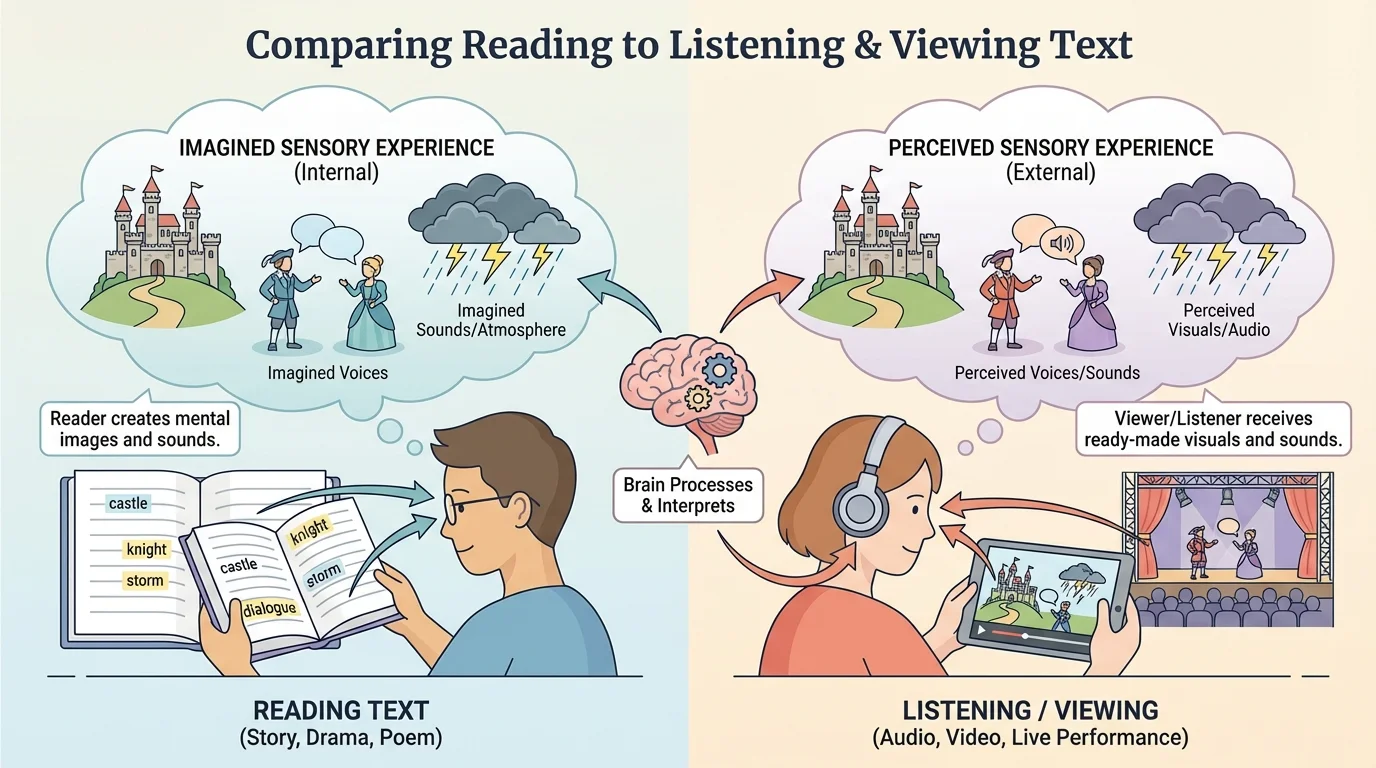
Reading asks your brain to create meaning actively, and [Figure 1] illustrates this idea by showing how printed words turn into mental pictures and sounds. As you read, you imagine the voices of characters, the appearance of places, and the mood of each moment. This process is sometimes called mental imagery, which means the pictures and sounds you form in your mind from words.
Because the text does not usually show you everything directly, reading gives you freedom. You decide whether a character's voice sounds confident, nervous, cheerful, or angry unless the author clearly tells you. You decide how a forest looks, how fast a storm begins, or how dramatic a pause feels. Even when readers use the same exact words, they often build different inner movies.
Reading also lets you control the pace. You can reread a sentence, pause over a powerful line, or slow down during an important scene. If a poem has unusual wording, you can stop and think about it. If a story contains a clue, you can go back and check it. This control matters because it affects understanding.
Another strength of reading is that it draws attention to the author's exact word choice. In a poem, a single repeated word can matter a lot. In a story, a short sentence can speed up tension. In drama, stage directions can suggest movement, silence, or emotion. When you read carefully, you notice these choices in a direct way.
At the same time, reading can be challenging. Since there is no actor's face or narrator's voice to guide you, you must infer a lot. To infer means to figure something out from clues. If a character says, "Fine," reading does not automatically tell you whether that word sounds calm, annoyed, or sarcastic. You must use context to decide.
Many readers discover details in a text that they missed in a movie version because reading slows them down and makes them pay attention to exact words rather than fast-moving visuals.
That is one reason reading is powerful. It invites personal imagination and close attention at the same time.
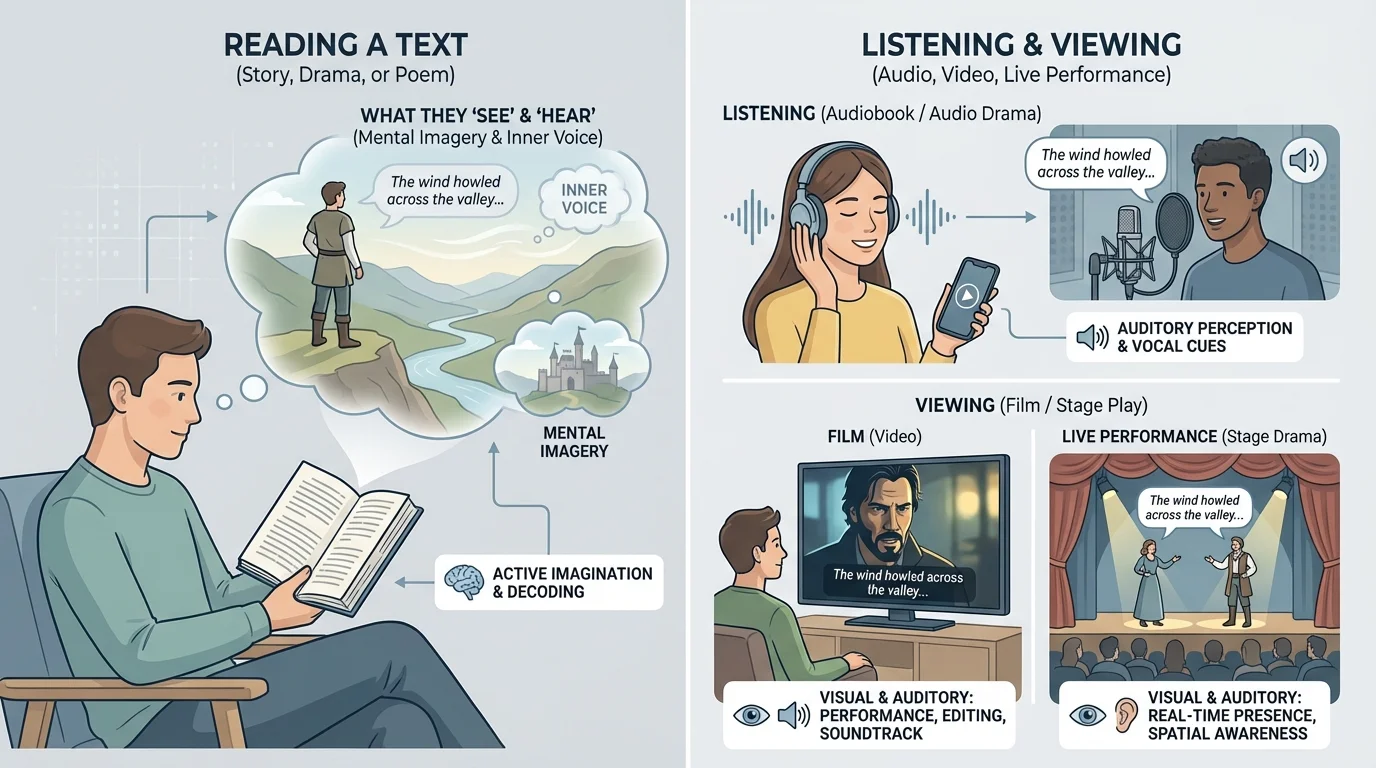
Listening to an audiobook or watching a performance provides actual sound and visible action, and [Figure 2] shows how voice, expression, and staging shape the audience's understanding. A narrator may whisper, pause, or speed up. An actor may roll their eyes, smile sadly, or shout. Music may signal danger. Lighting may make a room feel warm or frightening.
These choices can make the text clearer. If a poem is tricky on the page, hearing it read aloud can help you notice its rhythm and repeated sounds. If a drama is meant to be performed, watching actors move and speak can make the conflict easier to follow. In a story adaptation, visual details can help you understand setting and relationships quickly.
But listening and viewing also reduce some of the freedom you have while reading. You do not choose the actor's face, the narrator's tone, or the setting's appearance. Those are part of someone else's interpretation. This does not make the performance worse; it simply makes it more specific.
For example, suppose a line in a play reads, "I never wanted this." On the page, you may imagine sadness. In performance, an actor could say it angrily, quietly, or with relief. Each choice changes how the audience understands the character. The words stay the same, but the meaning can shift.
Video and live performances also affect pacing, which is the speed and rhythm of events. A film can cut quickly from one scene to the next. A stage play may hold a long silence for dramatic effect. An audiobook narrator may pause after a shocking moment. In reading, you control pacing yourself. In listening and viewing, the performer often controls it.
Sound matters too. In audio and video versions, you hear volume, emphasis, accent, background noise, and sometimes music. A storm in a story becomes thunder you can hear. A crowd becomes cheering or murmuring voices. This can make the experience vivid, but it can also direct your emotions more strongly than print does.
Different types of literature change in different ways across media, and [Figure 3] presents a side-by-side comparison of how stories, dramas, and poems are experienced through reading and performance. A short story, a play, and a poem are all literary texts, but they are built differently, so listening to or watching them affects readers in different ways.
A drama is written to be performed. Because of that, seeing or hearing a play often feels very natural. You can watch actors speak lines, move on stage, and react to one another. Costumes and set design help show the setting. In reading a drama, you rely more on dialogue and stage directions to imagine what is happening.
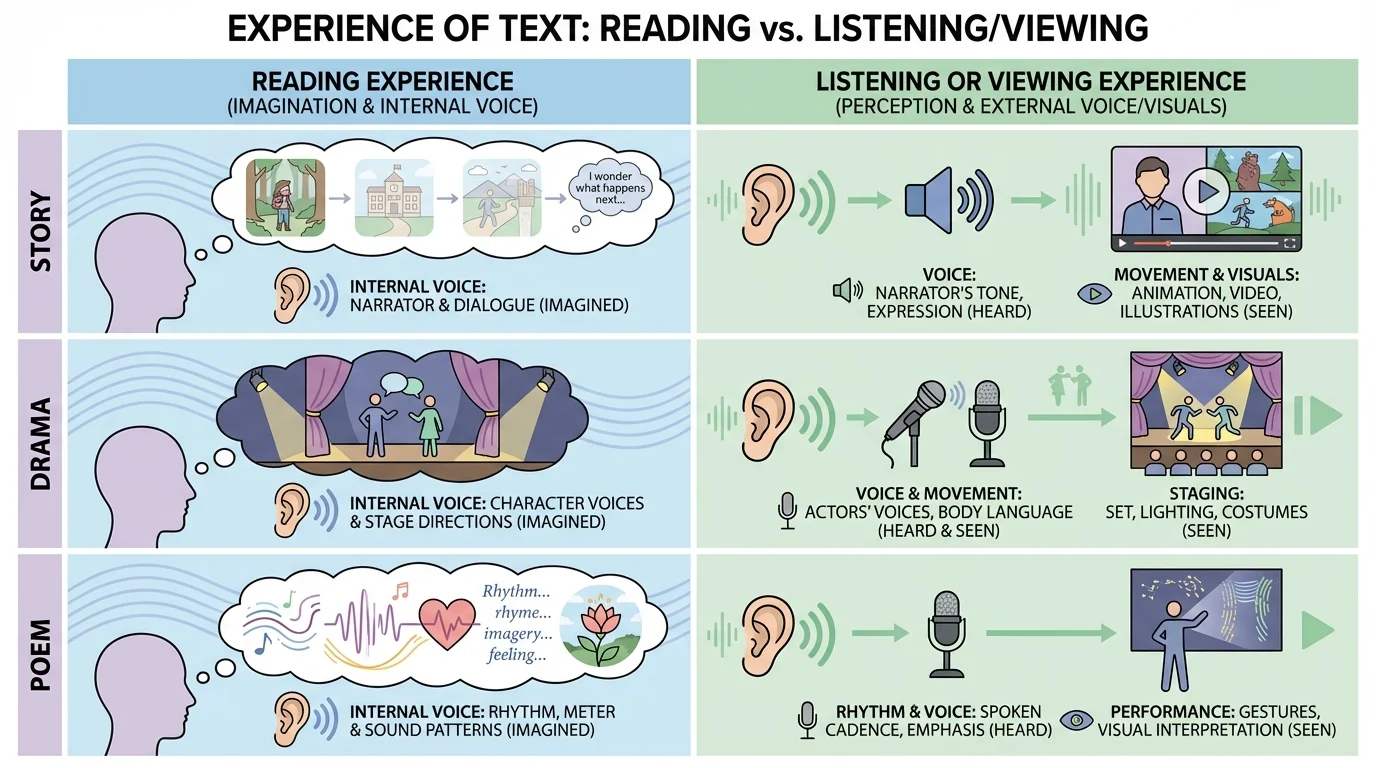
A story, such as a short story or novel excerpt, is usually written to be read. It may include the thoughts of characters, detailed narration, and descriptions that are easy to absorb on the page. In a film or audio adaptation, some of those details may be spoken by a narrator, shown visually, or even removed. That can change what the audience learns and when they learn it.
A poem can change dramatically when read aloud. On the page, you may notice line breaks, spacing, punctuation, and repeated words. When heard aloud, you notice rhythm, stress, pauses, and sound patterns more strongly. A poem that seems simple when read silently can sound emotional, musical, or intense when performed.
So although all three forms can be read, heard, or viewed, each one responds differently to a change in medium. That is why good comparisons pay attention to the kind of text involved.
When people say they "see" something while reading, they usually mean they imagine it. The page itself may only show black words, but your mind creates a scene. You may "hear" a harsh voice, "see" a moonlit street, or "feel" tension during an argument. These are not real sounds or sights in the room. They are mental responses to language.
When you listen or watch, the sounds and images come from outside you instead of inside your imagination. You truly hear the actor's voice. You truly see the costume, lighting, and action. Because of that, the performance can feel more immediate. It can also be more detailed in some ways, since many choices are visible or audible at once.
However, performances sometimes leave less open to imagination. If a movie shows a monster clearly, the audience no longer imagines its appearance. If an audiobook gives one character a very gentle voice, listeners may not imagine that character as fierce. Reading often leaves more room for personal meaning, while performance often gives stronger sensory guidance.
Internal versus external experience
Reading is often an internal experience because the reader creates many of the sights and sounds mentally. Listening and viewing are more external because voices, music, visuals, and movement are presented directly. Strong literary analysis recognizes that both kinds of experience can reveal important meaning.
This difference explains why students sometimes connect more deeply with one version than another. A quiet reader may enjoy the privacy of imagining everything alone. Another student may understand the same text better after hearing expression and emphasis in a spoken performance.
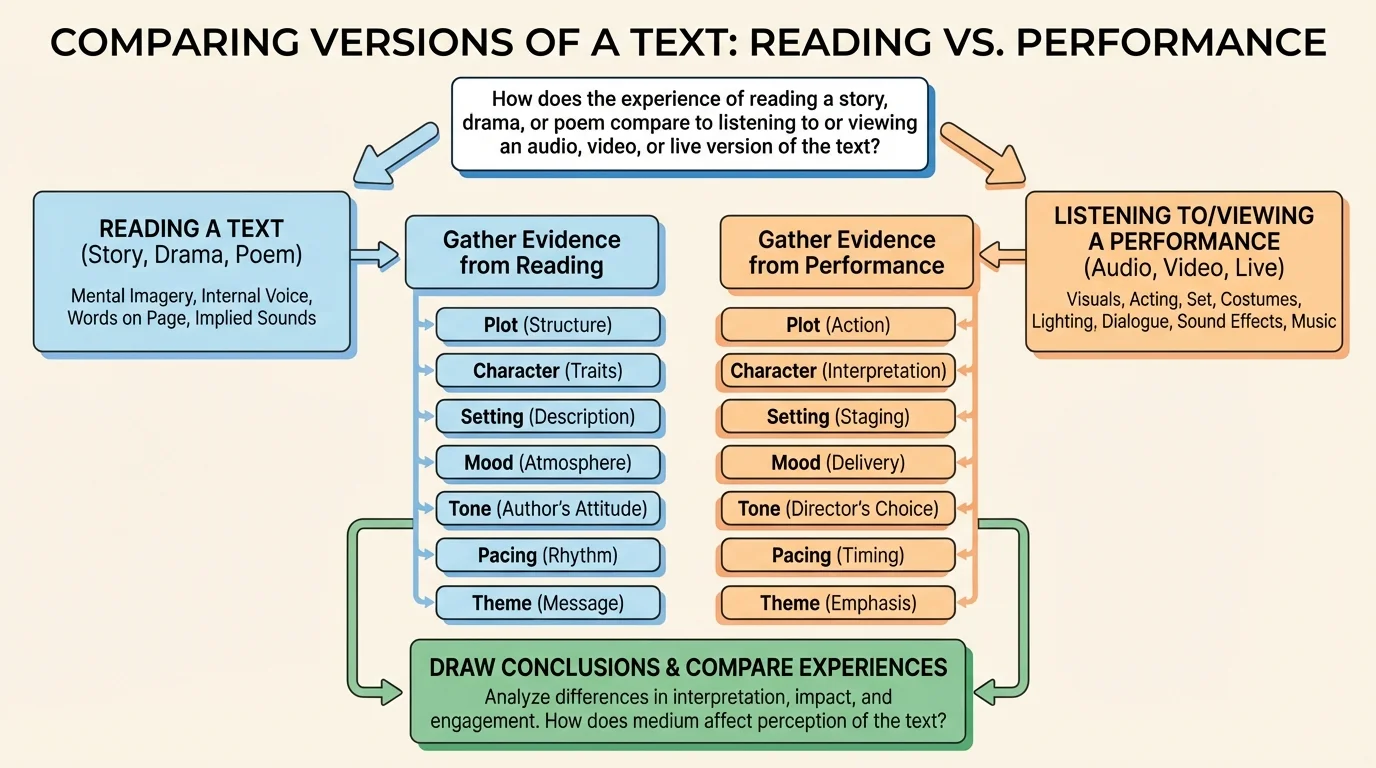
Strong comparisons focus on specific literary elements, and [Figure 4] organizes the main questions readers can ask about plot, characters, setting, mood, tone, pacing, and theme. Instead of saying only "the book was better" or "the movie was more exciting," explain exactly what changed and how that affected meaning.
One helpful way to compare versions is to look at the same elements each time.
| Element | When Reading | When Listening or Watching |
|---|---|---|
| Plot | You follow events through narration and description. | You may see events acted out, shortened, or rearranged. |
| Character | You imagine appearance, voice, and expression. | Actors or narrators provide voice, expression, and movement. |
| Setting | You build the place in your mind from details in the text. | Sets, costumes, props, and camera shots show the place directly. |
| Mood | Word choice helps create feeling. | Music, lighting, sound, and acting strengthen or change feeling. |
| Tone | You infer attitude from language and context. | Voice and delivery make attitude easier to hear. |
| Pacing | You control how quickly or slowly you move. | The narrator, editor, or actors control timing. |
| Theme | You think about the message through reading and reflection. | Performance choices may emphasize certain ideas more strongly. |
Table 1. Comparison of major literary elements in print and performance versions of a text.
These elements do not always change equally. Sometimes the plot stays almost identical, but the mood changes because of music or lighting. Sometimes the characters feel different because actors emphasize humor, fear, or confidence in new ways.
Notice that a comparison should include both similarities and differences. A film might keep the main conflict and theme from a story while changing the setting and pacing. An audio version of a poem might preserve every word but still create a new feeling through the speaker's voice.
Consider a suspenseful story scene in which a character walks into an abandoned house. On the page, the author may describe creaking stairs, dust in the air, and a pounding heartbeat. As a reader, you imagine these details. The tension grows because your mind fills in the missing visuals and sounds.
In a movie version, the same scene may use dim lighting, slow camera movement, creaking sound effects, and sudden music. The fear becomes more immediate because you hear and see it directly. Yet the movie may also remove some mystery, because the house has a fixed appearance rather than the one you imagined.
Now think about a poem about rain. On the page, you may notice repeated soft sounds, short lines, and words that create a calm mood. When someone reads the poem aloud, you may hear gentle pauses and a soothing rhythm. If the speaker reads it quickly and sharply instead, the mood might change completely. This is why hearing poetry can reveal sound patterns, but it can also shape interpretation strongly.
Example: Comparing a poem on the page and aloud
A poem contains the line, "The rain tapped softly at the window."
Step 1: Reading silently
A reader may notice the gentle word softly and imagine a quiet, peaceful sound.
Step 2: Listening to a performance
If the speaker lowers their voice and pauses after tapped, the line sounds calm and reflective.
Step 3: Noticing a difference
If the speaker reads too fast or too loudly, the line may feel more urgent than peaceful, even though the words have not changed.
The comparison shows that vocal delivery can support or shift the mood created by the printed text.
A drama gives another clear example. Reading a play means reading dialogue and stage directions. Watching that play performed adds actors' gestures, facial expressions, and movement across the stage. Later in the lesson, the comparison in [Figure 3] still helps here: drama changes less from page to stage than a story often does, but performance choices still matter a great deal.
Even an audiobook can change a story. A skilled narrator may use different voices for each character, helping listeners follow the dialogue. But that same narration can influence how listeners judge a character. A sarcastic tone may make someone sound meaner than you imagined while reading.
Good comparisons use evidence from both versions. Name the text detail, then name the performance detail. For instance, you might say that the written story creates suspense through description, while the film creates suspense through dark lighting and music. This is more precise than simply saying the film was scarier.
You can also use sentence frames to organize your thinking: "When I read the text, I imagined... but when I watched the scene, I noticed..." or "The audio version emphasizes... because the narrator..." or "Both versions show... however, the performance changes..." These patterns help you compare clearly without losing detail.
As shown earlier in [Figure 4], one of the best ways to stay focused is to choose a literary element and track it across versions. You might compare only character, only mood, or only pacing before connecting those ideas to the whole text.
When analyzing literature, always return to the text itself. Even if a performance is powerful, your explanation should still connect back to the author's words, ideas, and literary elements.
It is also important to avoid weak comparisons. Saying "the movie is more fun" is an opinion, but it is not enough by itself. A stronger statement would explain that the movie feels more exciting because fast editing and loud music increase tension, while the story on the page feels more thoughtful because it includes the character's inner thoughts.
Every performance includes choices. Directors decide what to show. Actors decide how to speak. Narrators decide where to pause. These choices can emphasize one part of the text over another. They can also affect how the audience understands a character or theme.
For example, if a live performance uses bright lights and exaggerated acting in a serious scene, the scene may feel more humorous than it does on the page. If a video adaptation adds sad music to an ending, the audience may focus on loss more than hope. These are not random changes. They are interpretive decisions.
This means comparing versions is not just about spotting differences. It is about asking why those differences matter. What does the change make you notice? What feeling does it create? What part of the text becomes stronger, weaker, clearer, or more complicated?
"Words make the world in your mind; performance gives that world a voice, face, and movement."
When you ask these questions, you become a stronger reader and viewer. You stop being a passive audience member and start noticing how literature works across forms.
Reading, listening, and viewing are all valuable ways to experience literature. Each one reveals something special. Reading often gives you freedom, closeness to language, and space for imagination. Audio versions highlight voice, rhythm, and emphasis. Video and live performances add movement, visuals, and shared emotion. The best comparisons do not simply choose a winner. They explain how each medium creates meaning in its own way, much like the internal images of reading in [Figure 1] differ from the direct sensory cues of performance in [Figure 2].
