Two books can be about bravery, and yet one might feel like a fast movie in your mind while the other feels like a song. That is one of the most exciting parts of reading: different kinds of texts can explore the same big idea in completely different ways. A poem about loss may be short and powerful, while a story about loss may unfold through events and characters. A fantasy adventure and a historical novel may both be about friendship, loyalty, or justice, but they build those ideas in different worlds.
When readers compare texts, they do more than notice that two pieces are alike or different. They look at how each text presents its ideas. This helps readers understand meaning more deeply. If two texts share a theme, such as courage, kindness, freedom, or growing up, a comparison can reveal what makes each text unique.
Comparing texts also helps you become a stronger thinker. Instead of reading one text by itself, you begin to ask bigger questions. Why did one author choose rhyme and rhythm? Why did another author choose dialogue and action? Why does one text feel serious while another feels mysterious or hopeful? These questions help you see that authors make choices on purpose.
You can compare texts in the same genre, such as two realistic stories, or in different genres, such as a poem and a story. You can also compare different forms of writing. Form means the type of writing a text is, such as prose, poetry, or drama. Genre means a category of literature, such as fantasy, mystery, historical fiction, or realistic fiction.
Theme is the deeper message or central idea in a text, such as the importance of hope or the challenge of making difficult choices.
Topic is the subject a text is about, such as war, friendship, family, school, or nature.
Form is the overall type of text, such as a poem, story, or play.
Genre is a category within literature, such as fantasy, historical fiction, realistic fiction, or science fiction.
A topic is usually easier to spot right away, while a theme often requires deeper thinking. For example, two texts might both have the topic of a journey. But one text may have the theme that perseverance leads to growth, while another may suggest that people need others to help them succeed.
When you compare literature, certain words help you explain your thinking clearly. Theme and topic are essential, but other ideas matter too. Tone is the author's attitude toward the subject. A text can have a hopeful, dark, playful, serious, or suspenseful tone. Point of view means who is telling the story or from whose perspective the reader experiences it.
Another helpful word is structure. Structure is the way a text is organized. A story may move from beginning to middle to end, while a poem may be organized into lines and stanzas. Structure affects how the reader experiences the text.
Readers also pay attention to imagery, which is language that creates pictures in the reader's mind. Poems often use imagery heavily, but stories use it too. Comparing imagery can show how two texts create different feelings about a similar idea.
Remember that a comparison needs both similarities and differences. Saying that two texts are both about friendship is only the beginning. Strong analysis explains how each text presents friendship in its own way.
For example, one author might present friendship through quiet acts of support, while another shows it through dramatic risk and sacrifice. The shared theme is friendship, but the approach is different.
A short story and a poem can both explore courage, but they often do it in different ways. A story usually develops courage through events. A character faces a problem, makes choices, and changes over time. A poem may focus less on actions and more on feelings, images, and a single powerful moment.
[Figure 1] Suppose a short story tells about a girl who must speak in front of her class even though she is afraid. The story might show her nervous thoughts, the reactions of classmates, and the moment she finally begins to speak. In that case, courage is shown through plot and character development. The reader sees courage as action.
Now suppose a poem describes a shaky voice, trembling hands, and a heart beating "like drums before a storm." The poem might never explain a full sequence of events. Instead, it zooms in on the feeling of fear and the instant of overcoming it. In that case, courage is shown through emotion, sound, and image. The reader feels courage from the inside.
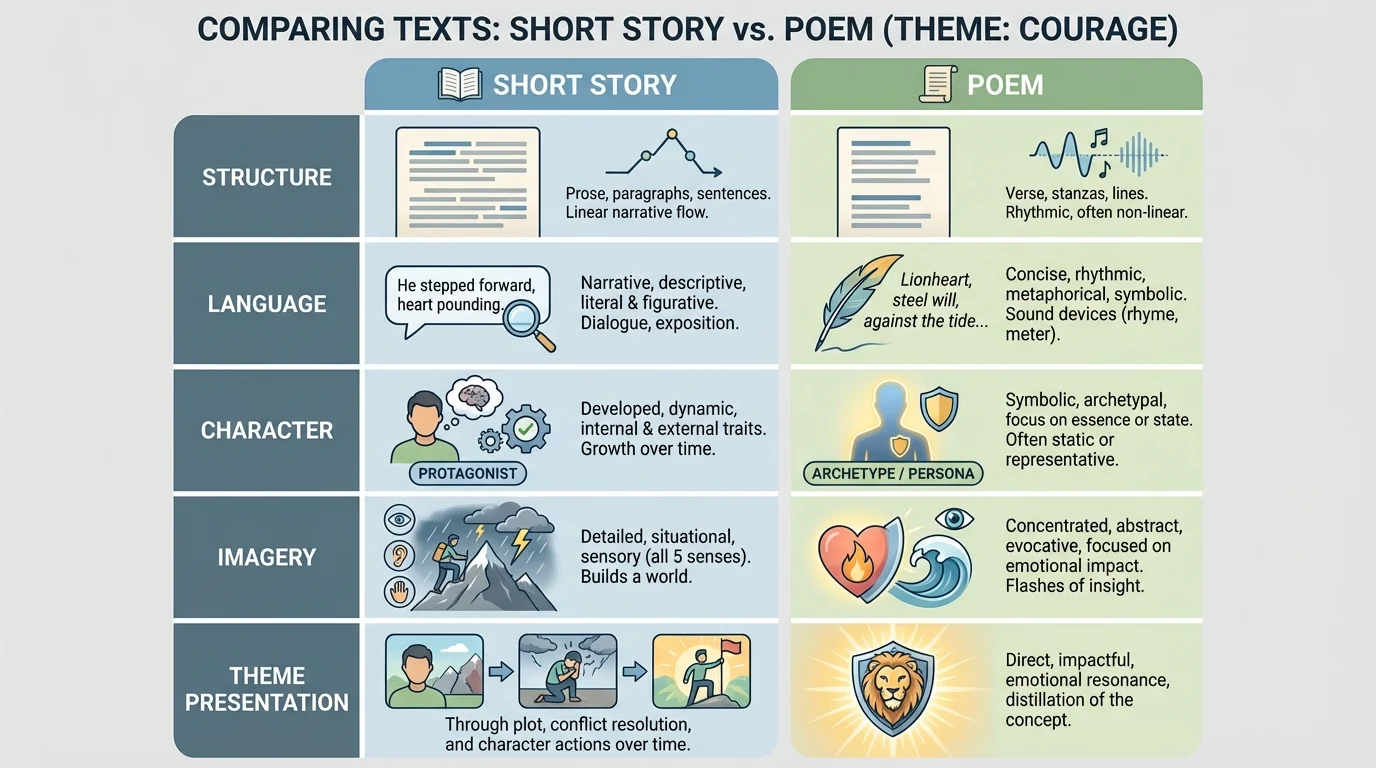
Both texts may share the same theme, but their forms shape the reader's experience. The story may answer questions like what happened next? The poem may answer questions like what did that moment feel like? Neither approach is better; they simply create meaning in different ways.
This is why comparing form matters. In prose stories, readers often follow a sequence of events. In poetry, readers often pay closer attention to rhythm, repetition, line breaks, and image patterns. When we return to the comparison in [Figure 1], we can see that the same theme becomes more action-based in the story and more condensed and emotional in the poem.
Case study: courage in two forms
Step 1: Identify the shared theme.
Both texts explore courage.
Step 2: Notice how the story develops the theme.
The story uses a character, a problem, rising action, and a decision.
Step 3: Notice how the poem develops the theme.
The poem uses sensory details, strong imagery, and a focused emotional moment.
Step 4: Form a comparison statement.
Both texts show that courage means acting despite fear, but the story explains courage through events while the poem expresses it through feelings and images.
A strong comparison like that goes beyond a simple statement. It tells what is similar, what is different, and how the text form creates that difference.
Genre shapes a text in major ways. A historical novel and a fantasy story may both deal with danger, friendship, or justice, but the worlds they build are not the same.
[Figure 2] A historical novel is fiction set in a real time and place from the past. It often includes realistic details about clothing, daily life, important events, and social rules of that period. If a historical novel explores courage, the characters may face challenges connected to real historical conditions such as war, migration, or unfair laws.
A fantasy story includes elements that do not exist in the ordinary real world, such as magic, mythical creatures, or invented lands. If a fantasy story explores courage, the character may face a dragon, break a curse, or protect a kingdom. Even though the setting is imaginary, the feelings and themes can still connect to real life.
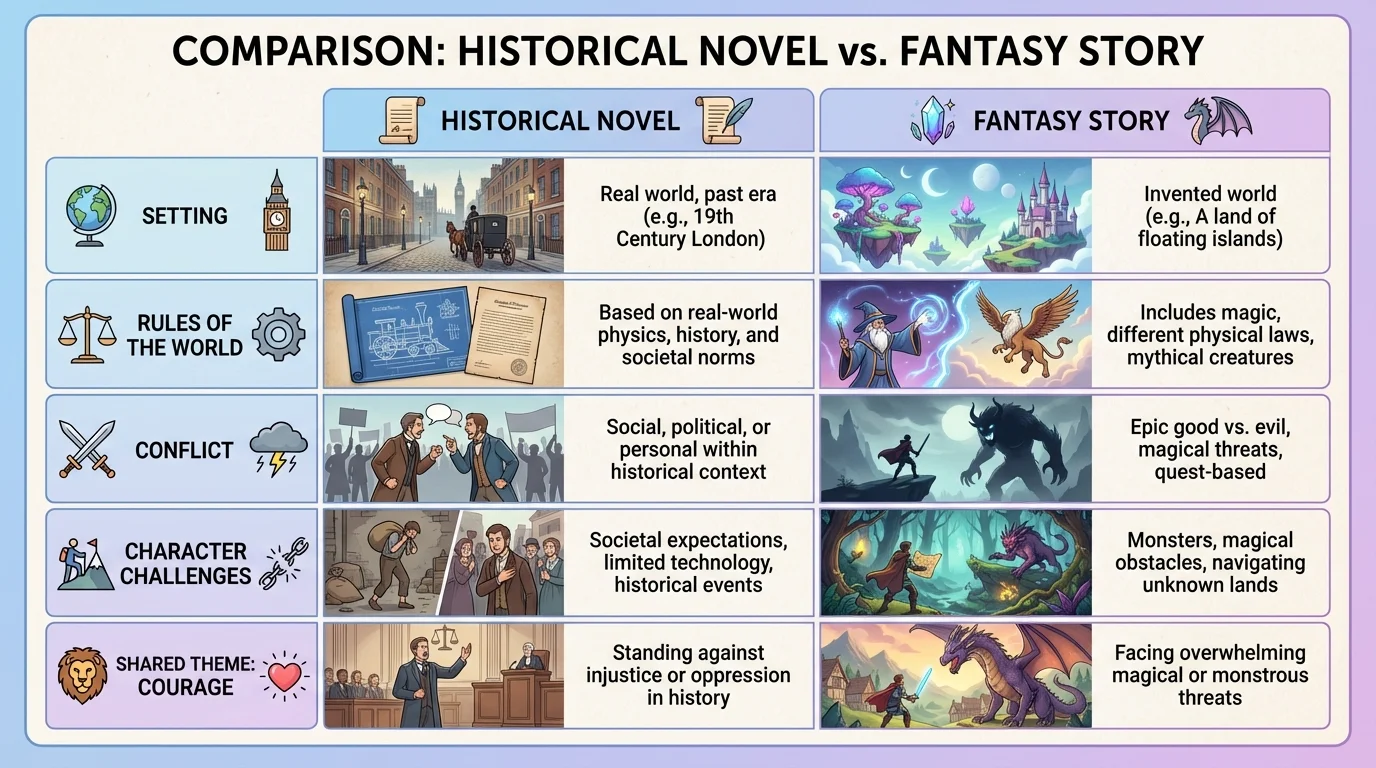
Imagine two texts with the theme of loyalty. In a historical novel, loyalty might mean protecting family during a dangerous journey in the past. In a fantasy story, loyalty might mean standing by a friend during a quest through an enchanted forest. The settings and events are different, but both texts may suggest that loyalty requires sacrifice.
The key difference is in the genre's rules. A historical novel tries to feel believable within real history. Fantasy builds its own world and asks readers to accept magical possibilities. Still, both genres can explore human experiences such as fear, hope, friendship, and fairness. Looking back at [Figure 2], we can see that genre changes the surface details, but the deeper ideas may remain closely connected.
Many fantasy stories borrow ideas from real history, legends, and cultures. That means a fantasy world may feel imaginary on the outside but still reflect real human struggles and values.
When comparing genres, ask yourself whether the genre affects the conflict, the setting, the mood, and the kinds of choices characters must make. Those differences help explain why the same theme can feel fresh in many kinds of texts.
To compare texts well, readers look at several literary elements working together. Theme does not appear by magic. It grows out of plot, characters, setting, language, and structure.
[Figure 3] Plot is the sequence of events. In a story, plot often plays a large role in building meaning. A poem may have little or no plot, but it still creates meaning through images and ideas. If one text uses a dramatic rescue and another uses a quiet reflection, each builds the theme differently.
Character matters because readers often learn the theme through a character's choices. Ask: Who changes? Who struggles? Who learns something? In some texts, a character changes a lot. In others, the character may not change much, but the reader's understanding changes.
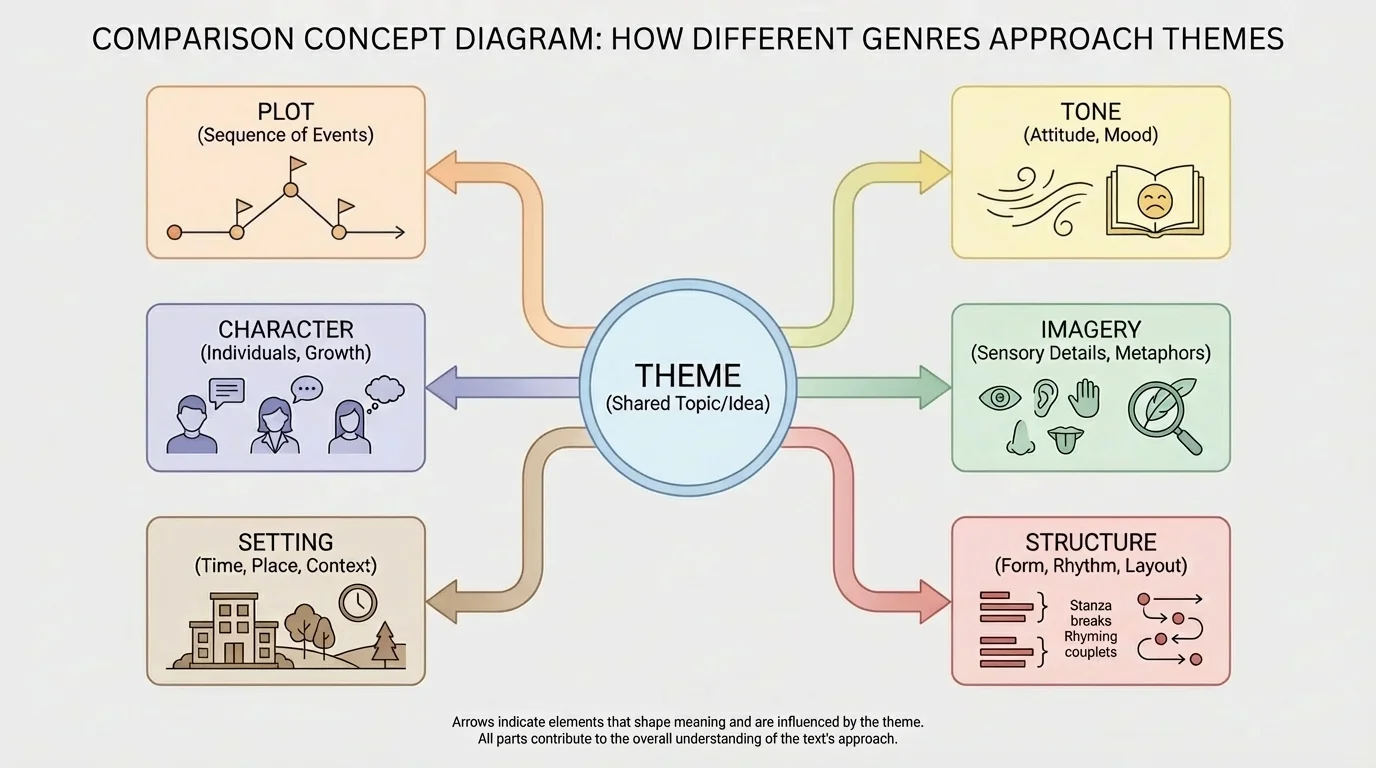
Setting includes time and place. A mountain during a storm creates a different feeling from a peaceful kitchen at sunrise. Setting can shape a conflict and support a theme. A harsh historical setting may make courage feel dangerous and costly, while a magical setting may make courage feel epic and legendary.
Mood is the feeling created for the reader, and it is closely connected to tone. A text about hope can still feel sad, tense, or joyful depending on how the author presents it. Mood affects how the reader experiences the theme.
Structure also matters. A poem with short lines may feel sharp and urgent. A story with many chapters may build suspense slowly. As the relationship map in [Figure 3] makes clear, these elements connect to one another rather than working alone.
| Element | Questions to Ask | How It Helps in Comparison |
|---|---|---|
| Theme | What message or idea is the text exploring? | Shows the deeper connection between texts |
| Plot | What happens, and in what order? | Reveals whether meaning comes through action |
| Character | Who changes or makes important choices? | Shows how people carry the theme |
| Setting | Where and when does the text take place? | Explains how context shapes events and ideas |
| Tone and Mood | How does the text sound and feel? | Shows the emotional difference between texts |
| Structure | How is the text organized? | Explains how form shapes meaning |
Table 1. Questions readers can use to compare literary elements across texts.
When two texts share a theme, the author's choices make the biggest difference. One author may use simple, direct language. Another may use figurative language, symbolism, and repetition. These choices affect how the reader understands the text.
Symbolism happens when an object, person, or place stands for a bigger idea. For example, a broken bridge might symbolize separation or a difficult path toward healing. If one text uses symbolism and another uses direct explanation, they may communicate the same theme in different ways.
Figurative language includes similes, metaphors, and personification. A poem might describe hope as "a small flame in the wind." A story might show hope by having a character continue trying after many failures. The poem conveys the feeling through imagery, while the story shows it through events.
Showing versus stating a theme
Some texts state a message more directly, while others show it through actions, images, or patterns. A direct approach can make the message clear right away. An indirect approach can make the reader think and infer. Both approaches are valuable, but they create different reading experiences.
Pacing matters too. A short poem may deliver its message in a few lines. A novel may take hundreds of pages to develop the same idea through many scenes. That difference does not change the theme itself, but it changes the path the reader takes to understand it.
A strong comparison begins with a clear idea about what the texts share. Then it explains how they differ in their approach. Readers need to support their ideas with evidence from the texts, such as events, quotations, descriptions, and details.
Useful comparison words include both, similarly, however, in contrast, while, and whereas. These words help connect ideas smoothly. For example: "Both texts explore loss; however, the poem focuses on emotion while the story focuses on how loss changes a character's actions."
Notice that this kind of statement is more powerful than saying, "They are different." It tells how they are different and links those differences to meaning.
Building a comparison paragraph
Step 1: Name the shared theme or topic.
Both texts explore the theme of belonging.
Step 2: Identify one important similarity.
In each text, the main character feels separated from others at first.
Step 3: Identify one important difference in approach.
The story presents belonging through a series of events at a new school, while the poem presents it through memories and images of home.
Step 4: Add evidence-based explanation.
The story uses dialogue and conflict with classmates to show change over time. The poem uses repetition and sensory imagery to emphasize longing.
The best comparisons stay focused. Instead of listing many tiny details, choose the differences and similarities that matter most to the theme or topic.
One common mistake is comparing only surface details. For example, saying that both texts have a child in them is not very meaningful unless that detail connects to a bigger idea. Another mistake is naming a theme without explaining how the text develops it.
A second mistake is forgetting to mention differences. A real comparison needs both sides. If you only list what is similar, you are not fully analyzing the texts. If you only list differences, you may miss the important connection that makes the comparison worthwhile.
A third mistake is making claims without evidence. If you say a poem feels more hopeful than a story, explain why. Is it because of bright imagery? Calm rhythm? A positive ending? Specific details make your thinking stronger.
"Readers do not just notice what texts say. They notice how texts say it."
This idea is at the center of literary comparison. Theme and topic matter, but form, genre, structure, language, and literary elements help explain why two texts leave different impressions on the reader.
When you compare a story and a poem, or a historical novel and a fantasy story, you are looking for more than a list. You are tracing the choices that shape meaning. That is what careful readers do: they notice patterns, ask questions, and explain how different texts can speak to the same human experiences in different voices.
