Have you ever read a sentence with one tricky word in it and still understood almost everything? That is one of the most useful strengths of reading. Strong readers do not stop at every unfamiliar word. They use the words around it, the sentence it appears in, and the paragraph's main idea to figure out what it probably means.
That skill is called using context clues. It is like being a detective while you read. Instead of waiting for someone to tell you a definition, you gather evidence from the text itself. Sometimes the author gives a direct explanation. Sometimes the clue is more subtle, and you have to infer the meaning by thinking carefully.
Readers meet unknown words all the time in stories, science articles, social studies texts, and even game instructions. If you can use context, you can keep reading smoothly and stay focused on the main idea. This matters because stopping for every unknown word can break your concentration.
Context also helps when a word has more than one meaning. The word bat might mean an animal or a piece of sports equipment. The right meaning depends on what is happening around the word. If the sentence says, "The bat slept upside down in the cave," the context points to the animal. If it says, "She swung the bat and hit a line drive," the context points to baseball.
Context is the group of words, sentences, and ideas around a word or phrase. Context clues are hints in that surrounding text that help readers determine meaning.
Good readers use context because language works as a system. Words do not appear alone. They connect to nearby words, to sentence patterns, and to the bigger topic. When you pay attention to those connections, unknown words become less mysterious.
A context clue can be very direct. An author might write, "A glossary, or mini-dictionary at the back of a book, helps readers learn new terms." In that sentence, the phrase "or mini-dictionary at the back of a book" explains the word right away.
A context clue can also be indirect. For example, read this sentence: "After hiking for six hours without water, the campers felt exhausted and dropped their heavy packs to the ground." Even if you did not know the word exhausted, the details about hiking for six hours, having no water, and dropping heavy packs help you understand that it means very tired.
Sometimes one sentence is not enough. You may need to read the next sentence or the whole paragraph. That is why strong readers do not accept the first possible meaning and move on too quickly. They test their idea against the larger passage.
Writers leave different kinds of clues in their sentences, as [Figure 1] illustrates. Learning to notice these clue types helps you read more confidently because you know what to look for.
One common type is a definition clue. This happens when the author directly tells what the word means. Example: "A habitat is the natural home of a plant or animal." The phrase after the word gives the meaning clearly.
Another kind is a synonym clue, where a nearby word or phrase has almost the same meaning. Example: "The path was narrow, or very thin, between the rocks." The phrase "very thin" restates the meaning.
An antonym clue uses contrast. Example: "Unlike his timid younger brother, Marco was bold and eager to speak." Because the sentence contrasts timid with bold, you can infer that timid means shy or not brave.
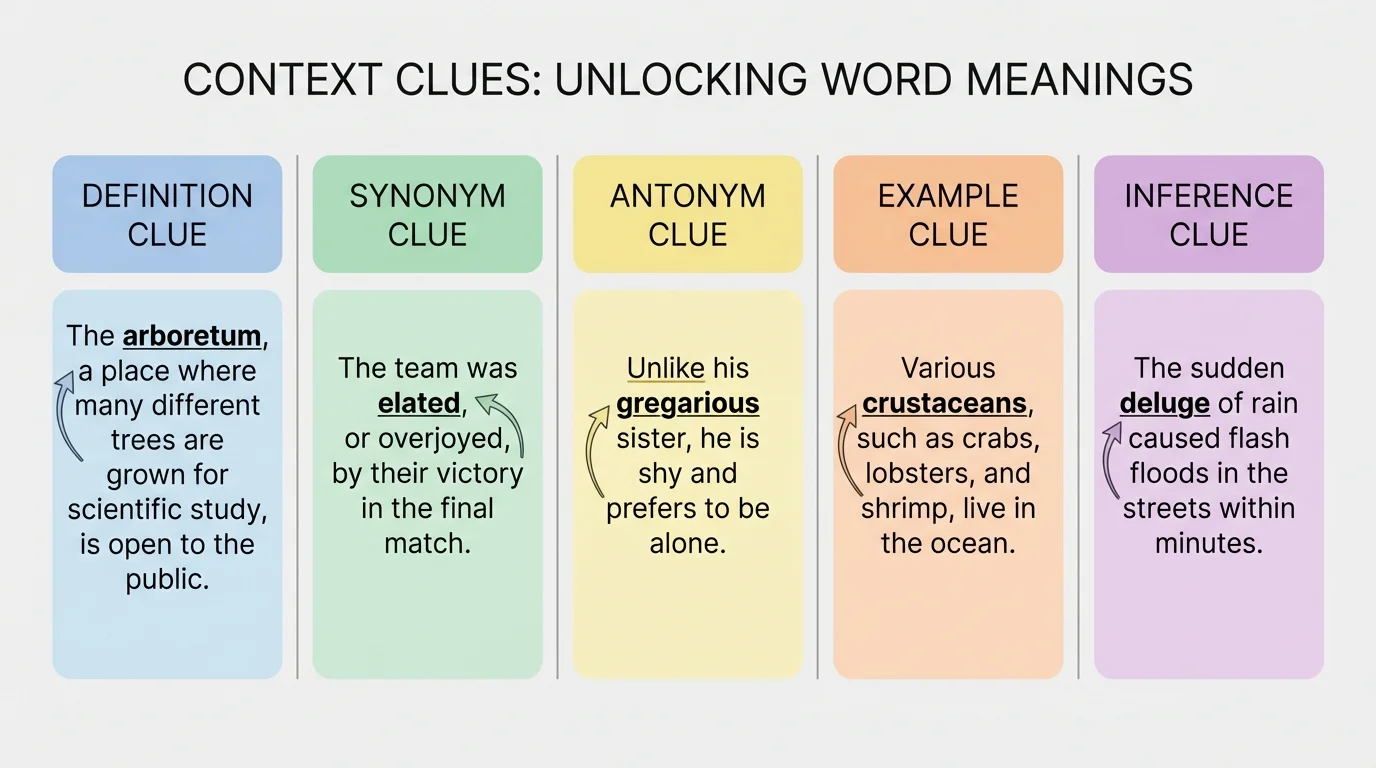
An example clue gives examples that reveal meaning. Example: "Celestial objects, such as stars, planets, and moons, fill the night sky." The examples show that celestial objects are things in space.
An inference clue does not explain the word directly. Instead, you combine details to form a likely meaning. Example: "Jada glanced at the dark clouds, grabbed her jacket, and hurried inside before the storm began." If the unknown word were glanced, you could infer that it means looked quickly because of the actions around it.
The most powerful clue is often the overall meaning of the sentence or paragraph. Even when the exact dictionary definition is not obvious, you can often figure out a useful working meaning. That is enough to keep reading and understanding.
A sentence may point you in the right direction, but the paragraph often gives stronger evidence. Suppose you read: "The desert was not completely lifeless. A few sparse plants clung to the dry ground." You might guess that sparse means few or scattered. Then the paragraph continues: "The cacti stood far apart, and large stretches of sand lay empty between them." Now your guess becomes stronger, because the paragraph repeats the idea of not many plants spread out over a large area.
Here is another example: "The principal's speech was brief. In less than two minutes, she thanked the students and ended the assembly." The second sentence confirms that brief means short in time.
Sometimes a paragraph can correct a wrong guess. If you read only one sentence, you might misunderstand. That is why careful readers reread nearby lines before deciding. Context is not just the word next door; it includes the bigger message the author is building.
Think local, then think global. First, look closely at the words right around the unknown term. Then step back and ask what the whole sentence and paragraph are mostly about. The best guess is the one that fits both the nearby details and the larger idea.
This approach is especially helpful in science and social studies. A passage about volcanoes, government, or ecosystems often repeats related ideas. Those repeated ideas guide you toward the meaning of difficult terms.
Context is not only about meaning. A word's grammar can also help, as [Figure 2] shows. If you know whether an unknown word is acting like a noun, verb, adjective, or adverb, you can narrow the possibilities.
A part of speech is the job a word does in a sentence. A noun names a person, place, thing, or idea. A verb shows action or a state of being. An adjective describes a noun. An adverb describes a verb, adjective, or other adverb. Even if you do not know the exact word, its job can tell you what kind of meaning to expect.
Read this sentence: "The class will draft a plan for the recycling project." Because draft comes after will, it is acting as a verb. It probably means create or write a first version of something.
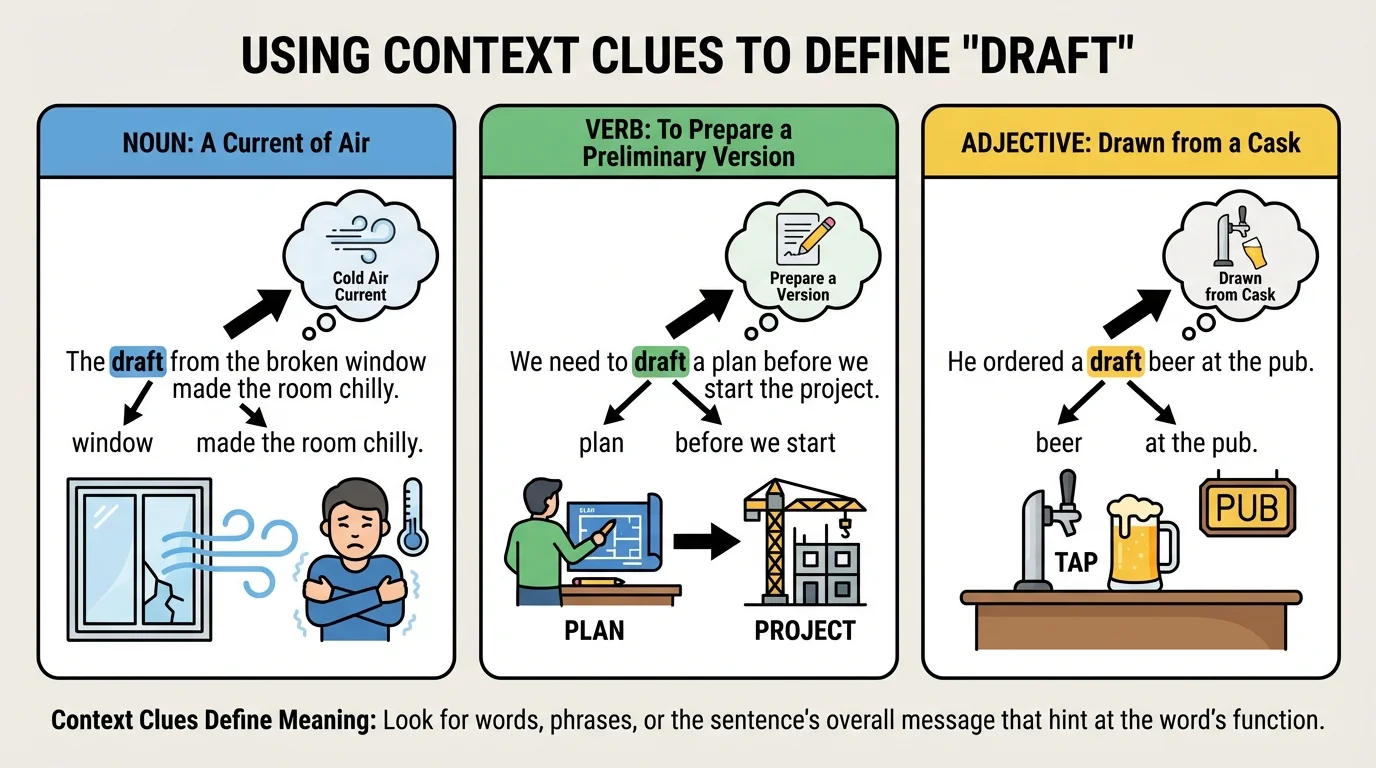
Now read: "The first draft of her story needed more detail." Here, draft follows the word first and is the thing that needed more detail, so it acts as a noun. In this sentence, it means an early version of writing.
Here is another example with the word light. In "Please light the candle," it is a verb meaning to start a flame. In "The backpack is light," it is an adjective meaning not heavy. The surrounding words and the word's position tell you which meaning fits.
Looking at prefixes, suffixes, and roots can also help, but grammar gives a different kind of clue. If a word ends in -ly, it is often an adverb. If it comes before a noun and describes it, it may be an adjective. These patterns help you make smarter guesses.
Many English words have more than one meaning. Context helps you choose the correct one. Consider the word current. In science, it can mean the flow of electricity or water. In everyday language, it can mean happening now. In "The river's current pushed the canoe downstream," the sentence is about moving water. In "Students discussed current events," the phrase means events happening in the present.
The word scale also changes meaning. In "A fish has shiny scales," it refers to small plates on skin. In "Use the scale to weigh the package," it means a measuring tool. In "The map has a scale of one inch to ten miles," it means a size relationship. The nearby words tell you which meaning belongs.
This is one reason context matters so much. Reading is not only about memorizing definitions. It is about choosing the meaning that makes sense in a specific situation.
Some of the most common words in English are also some of the most flexible. Words such as run, set, and right have many meanings, so context is often the only way to understand them correctly.
When you notice a multiple-meaning word, slow down for a moment. Ask yourself what the sentence is about. Sports? Nature? A classroom? News? The topic often points directly to the right meaning.
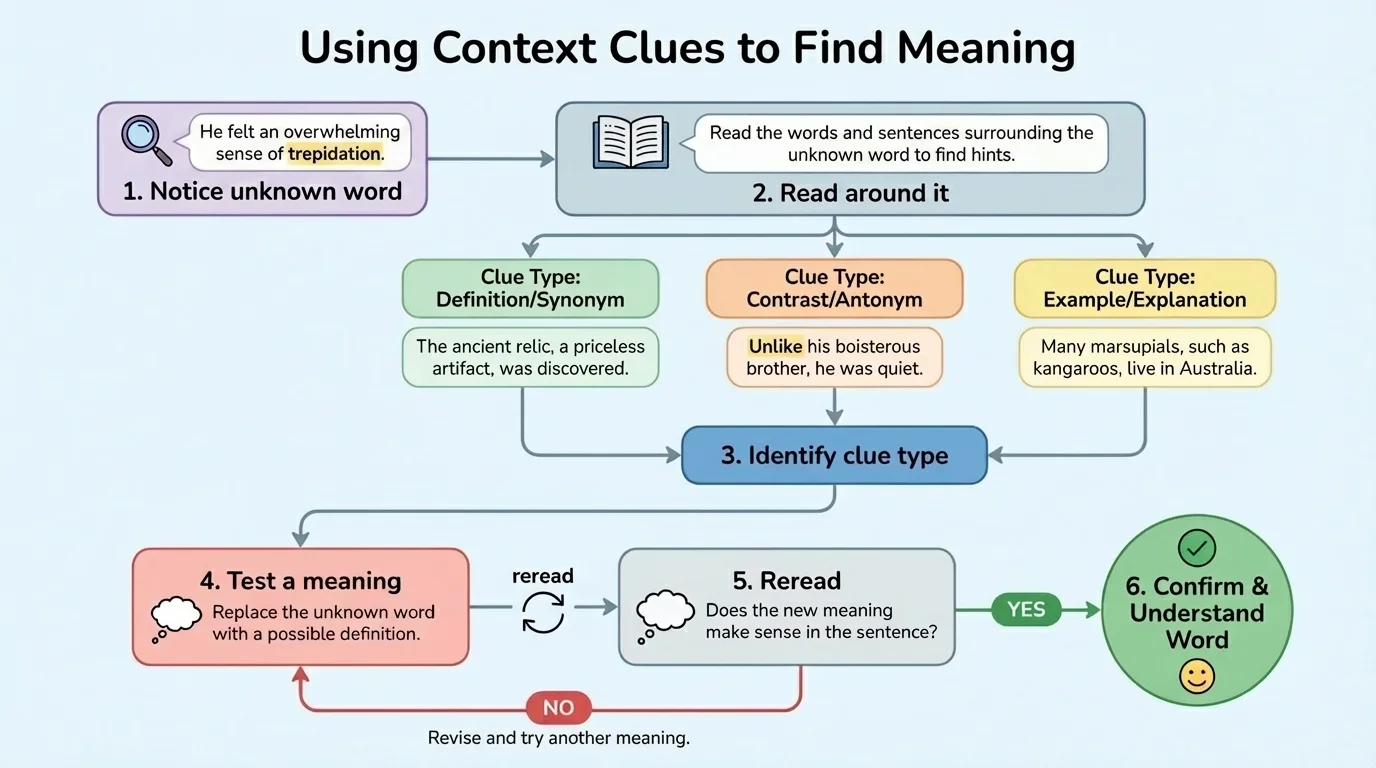
You can approach unfamiliar words in an organized way. The process moves step by step, as [Figure 3] shows, and it becomes faster with practice.
First, notice the unknown word or phrase but do not panic. Next, read the words before and after it. Then read the whole sentence. If the meaning is still unclear, read the next sentence or the whole paragraph. Look for a clue type: definition, synonym, antonym, example, or overall idea. Notice the word's part of speech. Make a reasonable guess, then reread the sentence using your guessed meaning. If the sentence makes sense, your guess is probably close enough.
Worked example 1
Sentence: "The surface of the pond was murky; the water was so cloudy that we could not see the fish below."
Step 1: Read the nearby clue.
The phrase "so cloudy that we could not see the fish" describes the water.
Step 2: Connect the clue to the unknown word.
If the water is cloudy and hard to see through, murky must mean dark, cloudy, or not clear.
Step 3: Test the meaning.
"The surface of the pond was cloudy" makes sense in the sentence, so the guessed meaning fits.
The same method works with phrases, not just single words. If a character says something "under her breath," the surrounding actions may help you infer that she is speaking quietly, not literally talking under something.
Worked example 2
Sentence: "Because the puppy was reluctant to enter the bath, Mia had to gently pull him toward the tub."
Step 1: Look at what happens.
The puppy does not want to enter the bath, and Mia has to pull him.
Step 2: Infer the meaning.
Reluctant likely means unwilling or hesitant.
Step 3: Reread with the guess.
"Because the puppy was unwilling to enter the bath" fits perfectly.
Notice that neither example gives a direct dictionary definition. Instead, the meaning grows out of the action and details. That is why context is such a powerful reading tool.
Worked example 3
Sentence: "The comedian's remarks were not serious; they were playful and meant to amuse the crowd."
Step 1: Find the contrast or explanation.
The sentence says the remarks were "not serious" and were "meant to amuse."
Step 2: Determine the likely meaning.
Playful means joking, lighthearted, or fun.
Step 3: Check the full sentence.
The guessed meaning matches the sentence's tone and purpose.
Sometimes context gives only an approximate meaning. That is still useful. If you are reading a story and infer that crestfallen means sad or disappointed, you probably understand the scene well enough to continue. You may not know the exact shade of meaning, but you have enough to follow the text.
At other times, especially in textbooks, you may need a precise meaning. A science term or history term may be too important to leave uncertain. In those cases, context helps you make a first guess, and then you can check a glossary, dictionary, caption, or note. The first sentence in a section often introduces a term, and later sentences explain it more fully.
That is why flexible readers use more than one strategy. Context is often the first tool, but not always the only tool.
When you break words into parts such as prefixes, roots, and suffixes, you get one kind of clue. When you read nearby words and ideas, you get another kind of clue. The strongest readers combine both strategies.
Even when you check a definition, context still matters. A dictionary may list several meanings, and you must use the sentence to choose the one that fits. So context remains important before, during, and after looking up a word.
When you read a novel, an article about space, or instructions for a new game, you do not need to know every word immediately. You need to stay alert, gather evidence, and test your thinking. Earlier, [Figure 1] organizes the main clue types, and that same chart can remind you that authors may help readers in many different ways.
Grammar also continues to matter. As we saw with [Figure 2], the same word can act as a different part of speech and take on a different meaning. Paying attention to sentence structure keeps you from making wild guesses.
And when the reading gets challenging, the step-by-step process in [Figure 3] helps you slow down and reason carefully. You notice the word, study the sentence, use the paragraph, identify the kind of clue, and test your idea. That is exactly what experienced readers do.
Using context clues is not guessing wildly. It is thoughtful reading based on evidence. The more you practice, the faster and more accurate you become, and the more independent you are as a reader.
