A single idea can change a city, a scientist can change the way people think, and one event can launch a movement that lasts for years. Informational texts are full of these chains of influence. When you read closely, you begin to see that texts are not just collections of facts. They are stories of connection: people act on ideas, events reshape beliefs, and beliefs inspire new actions.
To analyze interactions means to look closely at how different parts of a text affect one another. Instead of only asking, "What happened?" you also ask, "Why did it happen?" "Who influenced it?" and "What changed because of it?" This kind of reading helps you understand the text at a deeper level.
Writers of informational texts often organize their information around relationships. A biography might show how a leader's beliefs shaped a protest. A science article might explain how new evidence changed old ideas. A history text might show how one law led to public reaction and then to another law. Strong readers notice these links and use details from the text to explain them.
When readers pay attention to relationships in a text, they move beyond memorizing facts. They begin to understand how a topic works. For example, if a text says that a drought happened, that fact matters. But if the text explains that the drought caused crop failure, which led families to move, which then changed local economies, the reader understands much more than one isolated event.
This skill also helps you judge what is most important. Some details are interesting, but others are powerful because they show influence. If a person in the text changes an important idea, or if an event leads to a major decision, that interaction is often central to the author's message.
Interaction is the way two or more parts of a text affect one another. In informational reading, interactions often occur between individuals, events, and ideas. An individual is a person or sometimes a group acting as a unit, an event is something that happens, and an idea is a belief, concept, argument, or plan.
[Figure 1] Understanding interactions is especially useful when texts become more complex. In middle school, you often read articles, speeches, essays, science explanations, and historical accounts that contain many details. Looking for influence helps you organize all of that information into a meaningful pattern.
One helpful way to read an informational text is to track three major elements: individuals, events, and ideas. Texts become clearer when readers map how these parts connect through arrows linking each kind of element to the others.
Individuals are the people involved in the text. They may be scientists, activists, inventors, political leaders, athletes, or ordinary citizens. Sometimes the "individual" is actually a group, such as voters, workers, or students, if the text describes them acting together.
Events are the things that happen. An event might be a discovery, a protest, a storm, a law being passed, a speech being given, or a disease spreading. Events usually take place at a certain time and often lead to other events.
Ideas include beliefs, theories, plans, principles, arguments, and values. In a text about medicine, an idea might be that handwashing prevents disease. In a text about government, an idea might be that citizens should have a voice in decisions. In a text about the environment, an idea might be that communities should reduce waste.
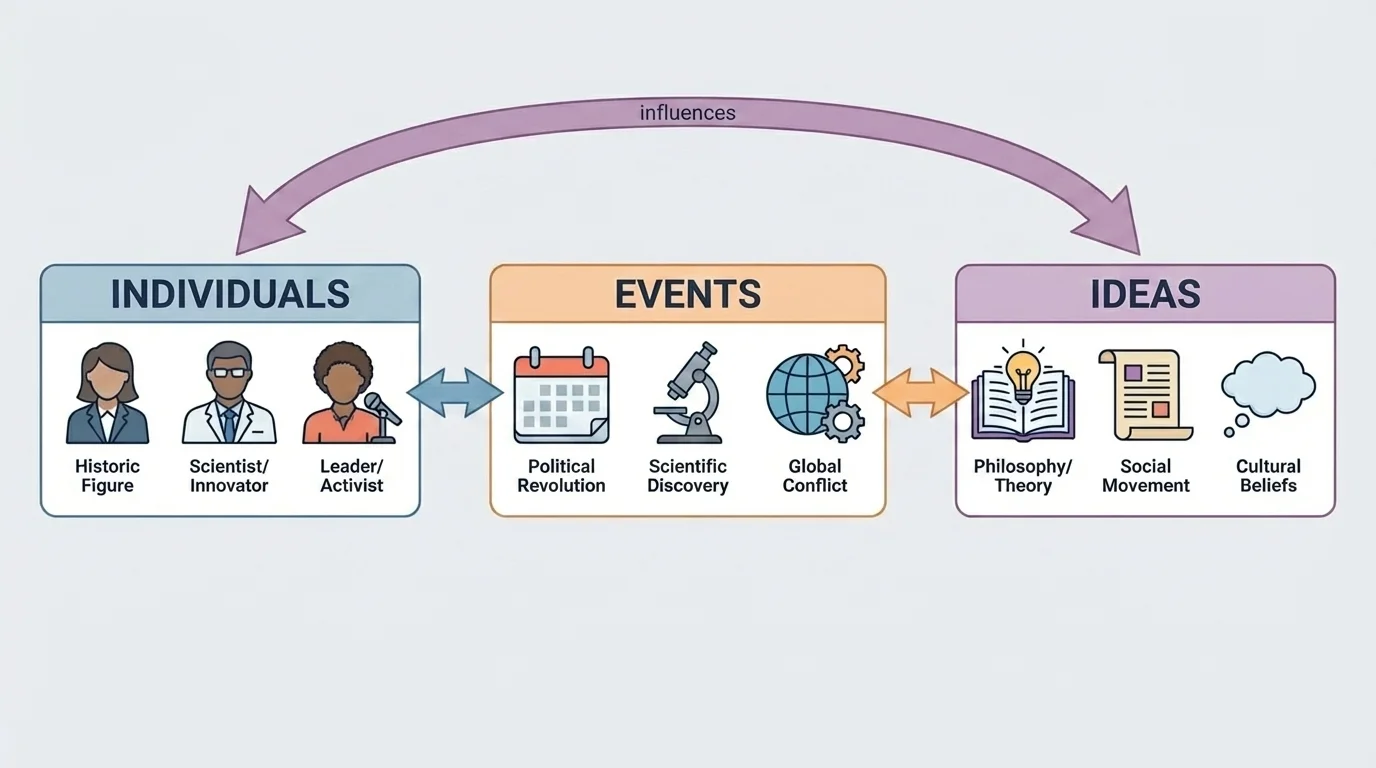
These three parts rarely stay separate. A scientist develops an idea. That idea leads to an experiment. The experiment becomes an event in the text. The results then influence other people. Once you see that chain, the text makes more sense.
For example, in an article about seat belt laws, the idea that seat belts save lives may influence lawmakers. Those lawmakers are the individuals. They create a new law, which is the event. Then the event changes public behavior, and the idea becomes more widely accepted. A strong analysis explains that full relationship, not just one part of it.
[Figure 2] Readers should look for repeated patterns of influence in a text, and several of the most common ones can be organized clearly. Once you know these patterns, it becomes easier to explain what the author is doing.
One common pattern is idea to individual. An idea can persuade, inspire, or challenge a person. For instance, the idea of equal rights influenced many reformers in history. In a science text, the idea that germs cause disease influenced doctors to change how they treated patients.
Another pattern is individual to event. A person's decision or action can cause something to happen. If an inventor creates a new machine, that action may start an industrial change. If a mayor orders an evacuation before a hurricane, that decision becomes a major event.
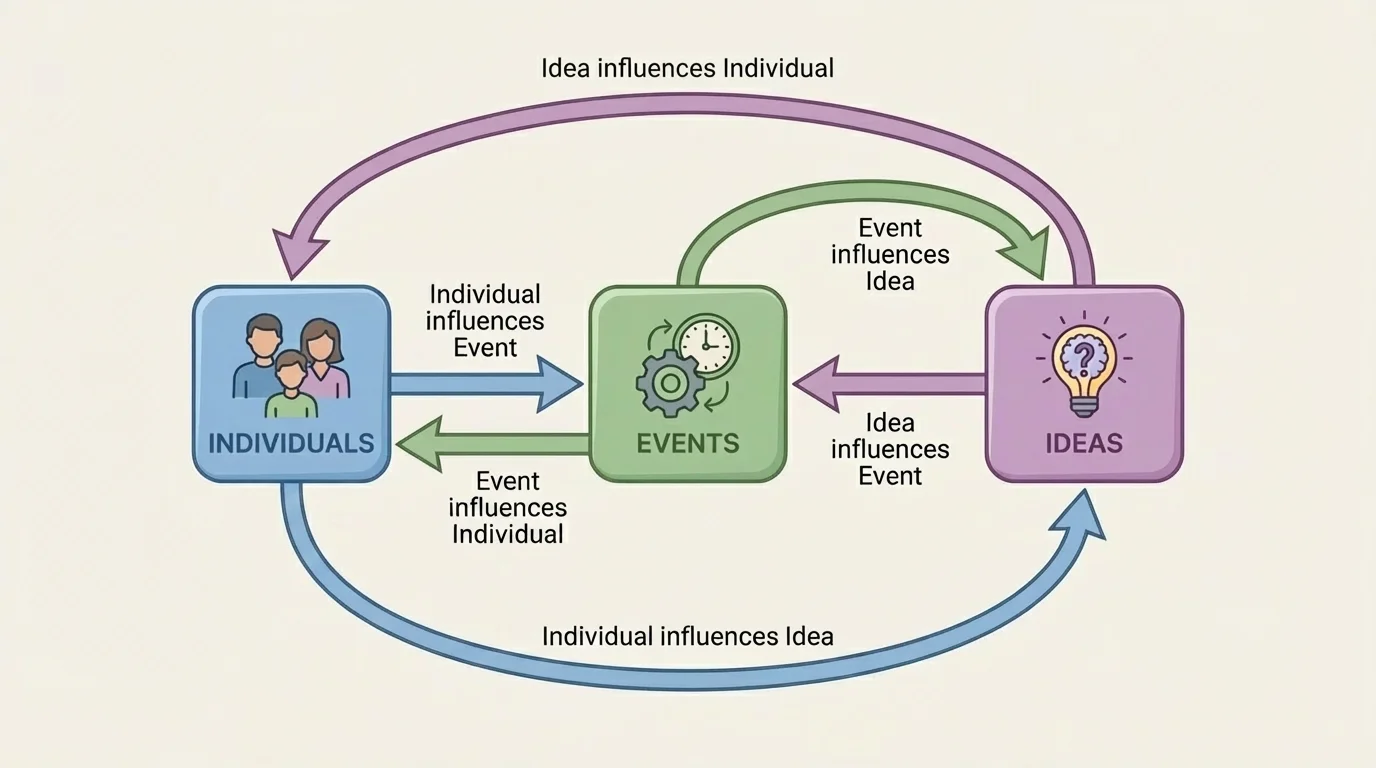
A third pattern is event to idea. Events can reshape the way people think. After a natural disaster, communities may begin to value emergency planning more seriously. After a scientific experiment succeeds, people may accept a new theory.
There are also individual to idea interactions. A writer, speaker, or leader can spread an idea and make it more powerful. There are event to individual interactions, too. An event may change a person's choices, beliefs, or future actions. Finally, there are idea to event interactions, where a belief or plan directly causes something to happen.
Many texts contain several of these patterns at once. In fact, the most interesting informational texts often show a chain such as this: an idea influences a person, the person causes an event, and the event changes society's ideas. That is why readers should think in terms of networks, not single facts.
A famous example from public health is that doctors once disagreed about how disease spread. As evidence increased, new ideas about germs changed medical practice, hospital design, and daily habits like handwashing.
This matters in modern life too. News articles about technology often show how one invention changes habits, business decisions, laws, and even ethical debates. The same interaction skill you use in class also helps you understand the world outside school.
Writers usually leave clues when they want readers to notice relationships. These clues often appear in signal words and phrases. Look for words such as because, therefore, as a result, led to, in response, influenced, caused, changed, and inspired. These are signs that one part of the text is affecting another.
Sequence also matters. If a text tells you what happened first, next, and later, it may be showing a chain of influence. The order of events can reveal cause and effect. However, sequence by itself is not always enough. Just because one thing happened after another does not mean it caused it. Strong readers look for evidence in the text that the author truly connects them.
Another useful strategy is to ask, "What changed?" If a person changes actions, an idea changes popularity, or an event changes public policy, the text is probably showing interaction. Change is often the clearest signal that one thing has influenced another.
Pay attention to quotations, data, and examples, too. Authors often use these details as evidence for a relationship. If an article quotes a student saying a speech changed her mind, that quote helps prove that an individual was influenced by an idea. If a chart shows fewer accidents after a new law, that evidence suggests an event had an effect.
Good readers do not wait for meaning to appear automatically. They ask questions that uncover relationships. These questions turn reading into investigation.
Here are some useful question stems: Who is affected by this idea? What event caused this response? How did this person shape what happened next? Which details show that the author sees a connection? How did the event change beliefs, decisions, or behavior? Why did the author place these details near each other?
Summary versus analysis
A summary tells what a text says. Analysis explains how parts of the text work together. If you write, "The article describes a student protest and a school rule," you are summarizing. If you write, "The school rule led students to organize the protest, so the event grew out of conflict over the idea of fairness," you are analyzing interactions.
Notice how the second statement does more. It connects people, actions, and beliefs. That is the goal of this reading skill. You are not only listing details; you are explaining their relationship.
Some interactions appear in a single paragraph, but many develop across an entire article or chapter. Readers should trace relationships across time with a timeline that moves from a problem, to action, to broader change.
Often the beginning of a text introduces a problem, person, or idea. The middle shows reactions and developments. The end explains results or long-term effects. If you track what changes from beginning to end, you can often see the author's main point.
For example, a text about recycling in a town might begin with overflowing trash bins and public concern. Then it might introduce a student group with the idea that recycling should be easier. The group campaigns for change, which leads the town council to add more recycling centers. Later, the text may explain that residents begin to think differently about waste. This is not just a sequence of facts. It is a series of interactions among people, events, and ideas.
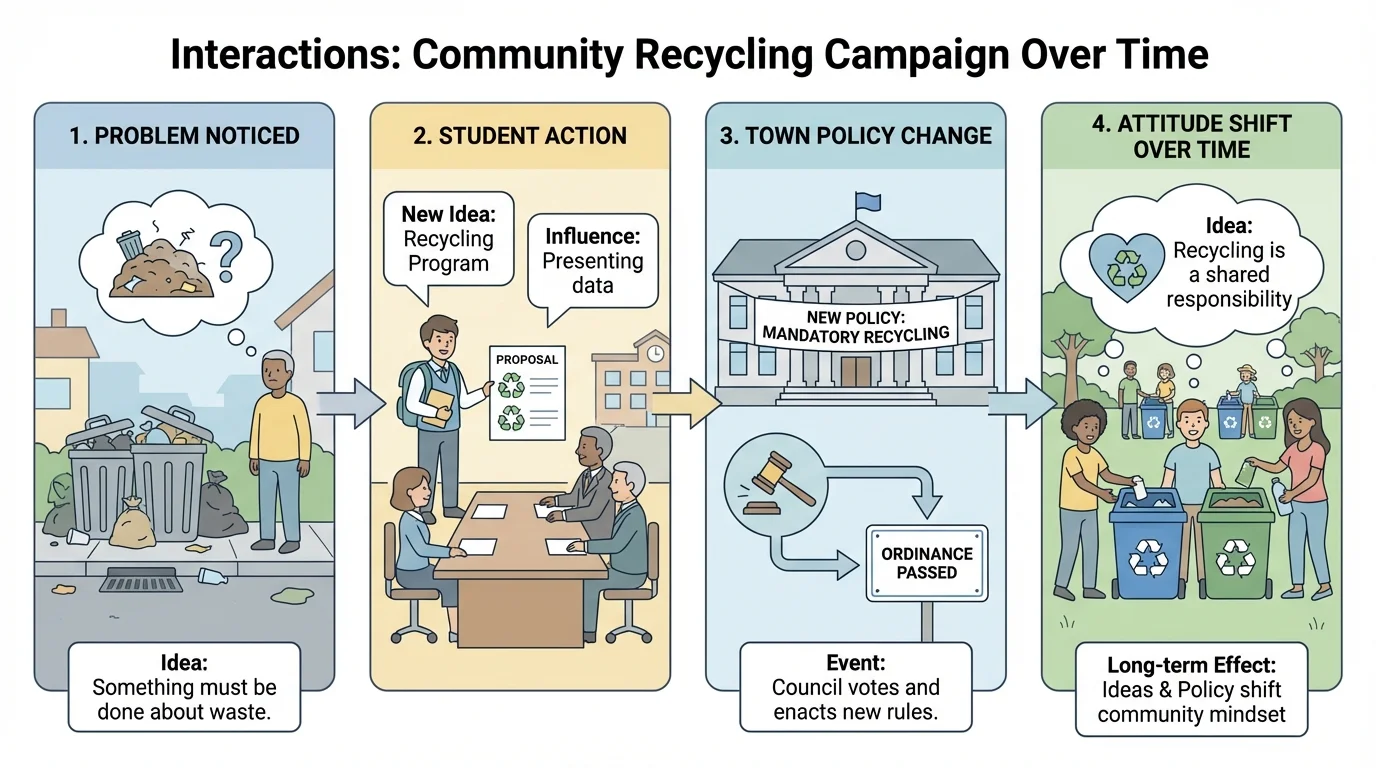
Looking across the whole text also helps you see whether an idea stays the same or changes. Sometimes an author shows that a belief grows stronger as evidence increases. Sometimes an event challenges an old belief and creates a new one. This longer view is important because complex texts often build meaning gradually.
Later in a text, earlier details can become more important. The opening problem in the recycling example matters more once the reader sees the final policy change. That is why it helps to think back to earlier sections. As we saw in [Figure 3], the end of a text often makes the full chain of influence visible.
[Figure 4] Consider an informational passage about a doctor who notices that many patients in one neighborhood become sick after using polluted water. The doctor studies the pattern, publishes the findings, and city leaders respond by improving the water system. Illness rates then drop. The chain of influence in this example is clear and lays out the sequence from observation to healthier conditions.
In this passage, the doctor is the individual. The polluted water problem and later city repairs are events. The belief that disease can spread through contaminated water is the idea. The text is not only reporting facts. It is showing how the doctor's observations support an idea, how the idea influences leaders, and how leaders create an event that changes public health.
A strong reader might explain the interaction like this: the doctor's research gave evidence for a new understanding of disease, and that idea led city officials to act. Because of that action, people became safer. Notice that this explanation connects all three parts instead of discussing them one at a time.
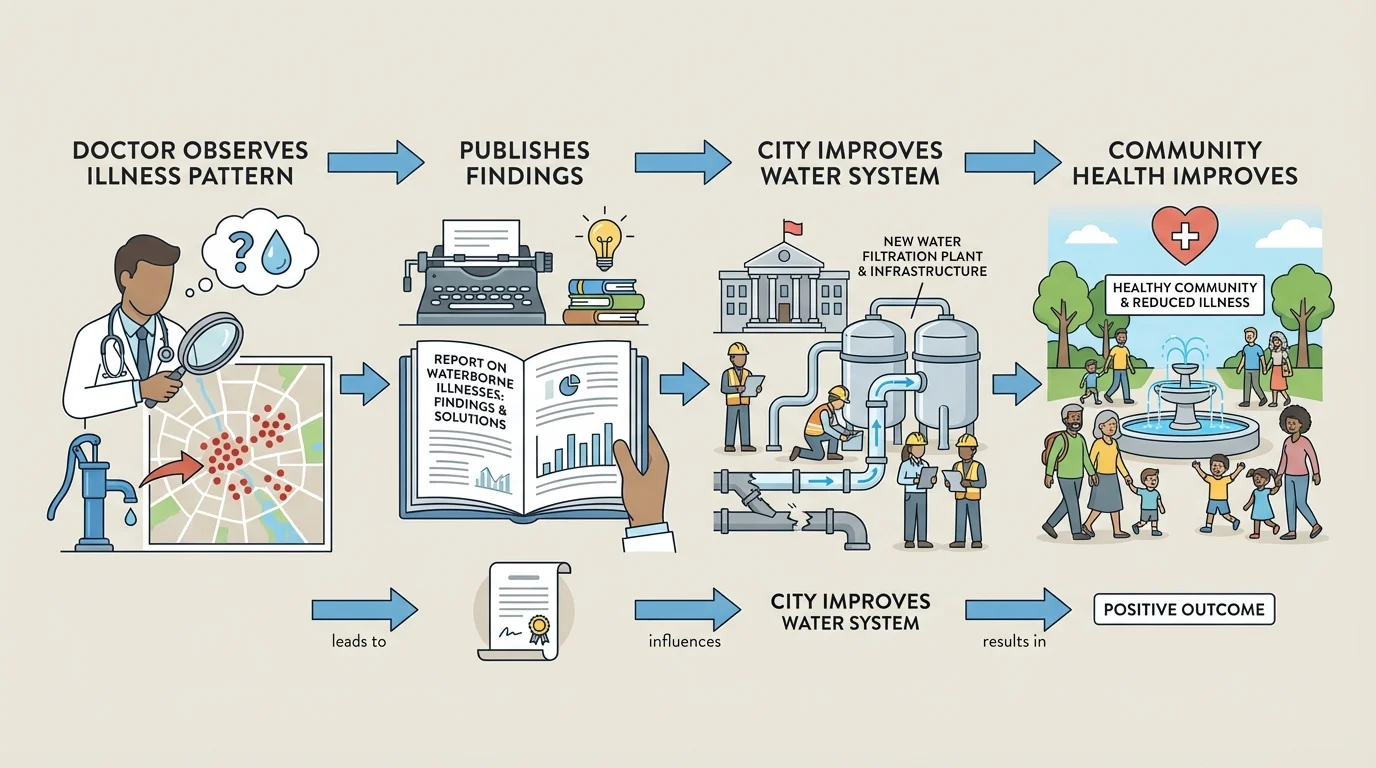
This example also shows why evidence matters. The city leaders do not act just because the doctor has an opinion. They act because the text presents a pattern, findings, and results. That evidence supports the relationship between idea and event.
Analyzing the public health passage
Step 1: Identify the parts.
The doctor is the individual, the illness outbreak and city repair are events, and the belief about contaminated water is the idea.
Step 2: Ask what influences what.
The doctor's research strengthens the idea. The idea influences leaders. The leaders' decision causes an event: repairing the water system.
Step 3: Explain the result.
The event changes conditions in the city, and improved conditions reduce illness. The interaction shows how evidence-based ideas can shape action.
This is analysis because it traces relationships and effects.
The same pattern appears in many science and history texts. Evidence leads to new understanding, people respond, and the response changes later events. When readers notice that pattern, they can better understand how authors build explanations.
Now think about an article describing a middle school student who notices that her community park is full of litter. She believes young people can improve public spaces, so she organizes a cleanup team, speaks at a town meeting, and posts information online. Soon more volunteers join, the town adds more trash cans, and local attitudes toward the park begin to improve.
Here, the student is the individual. The cleanup day, town meeting, and town response are events. The idea is that young people can create change in their community. The text may also introduce another idea: public spaces belong to everyone and should be cared for.
The student's belief influences her actions. Her actions create events. Those events influence the town's decisions and even shape community attitudes. This is a strong example of how one person can affect both events and ideas.
Notice that the article might also show a reverse interaction. Once other volunteers join and the town responds, those events may strengthen the student's original belief. In other words, interactions can move in more than one direction. Individuals shape events, but events can also shape individuals.
This kind of analysis helps when reading biographies, news features, or social issue articles. A text is often really asking the reader to see how change happens. To see change, you must track who acts, what happens, and what beliefs are involved.
One common mistake is confusing interaction with topic. If a text is about climate change, for example, climate change is the topic. But the interaction might be how scientists' research influences public policy, or how extreme weather events change people's views. Topic tells what the text is about; interaction tells how parts of the text affect each other.
Another mistake is making claims without evidence. You might think one event caused another, but unless the text supports that idea, your explanation is weak. Always use details from the passage: quotations, dates, actions, explanations, and results.
A third mistake is oversimplifying. In complex texts, more than one influence may be at work. A new law may result from public pressure, scientific evidence, and economic concerns all at once. Good analysis allows for more than one cause when the text suggests it.
When you studied central idea and supporting details, you learned to identify what matters most in a text. This skill builds on that knowledge. Now you use those important details to explain relationships, causes, and effects.
It is also important not to confuse interaction with opinion. Saying "I think the leader was brave" may be interesting, but it does not analyze the text unless you connect that person's actions to events or ideas using evidence from the passage.
[Figure 5] When you write about interactions, a simple structure helps. A strong response often follows a clear pattern: name the relationship, cite details, and explain the effect. This structure keeps your answer focused and evidence-based.
Start by naming the relationship clearly. For example: "The author shows that the scientist's research influenced government action." Or: "The article explains how the protest changed public opinion about the issue."
Next, include details from the text. Mention what the person did, what event followed, or what idea changed. Be specific. Instead of writing "things changed," write "city officials replaced the old pipes after reading the doctor's report." Specific evidence makes your explanation believable.
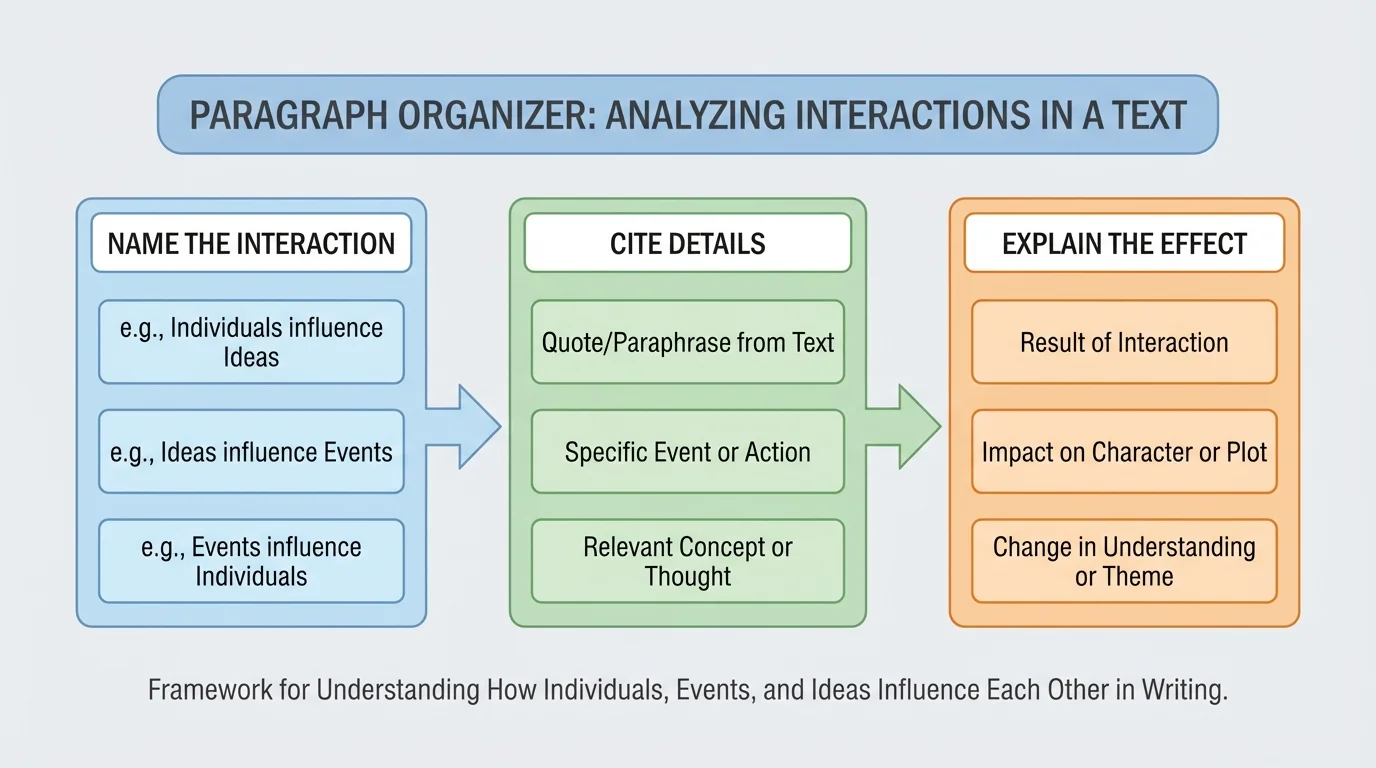
Finally, explain why the interaction matters. What result came from it? How did it shape the author's main point? This final part turns a basic answer into a strong analysis.
For example, compare these two responses:
Weak response: "The article is about a doctor and people getting sick."
Strong response: "The article shows that the doctor's research changed city leaders' understanding of the illness. Because they accepted the idea that polluted water was causing disease, they repaired the water system, and public health improved."
The second response is stronger because it explains interaction. It shows how an individual, an idea, and an event connect. As the writing organizer in [Figure 5] reminds us, strong analysis moves from claim to evidence to explanation.
Once you develop this skill, informational texts become much richer. You stop reading them as lists of separate facts and start reading them as systems of connected causes, choices, and consequences. That is one of the most powerful ways to understand what an author is really saying.
