Why does one story feel tense and dangerous while another feels calm and hopeful, even before anything major happens? Usually, the answer is not just one element. A stormy night, a nervous character, a hidden secret, and a warning in the dialogue all work together. Strong readers notice that stories and dramas are built like connected systems. When one part changes, the others often change too.
When you analyze literature, you do more than identify parts such as setting or character. You look at how those parts affect one another. A brave character may act differently in a battlefield than in a classroom. A peaceful setting may reduce conflict, while a harsh one may increase it. A plot twist may reveal a character's true values. This kind of close reading helps you understand not only what happens, but why it happens.
In literature, an element is one part of the text, such as setting, character, plot, conflict, mood, tone, or theme. These are not separate boxes. They are connected. For example, a story's setting may place characters in a drought, on a spaceship, or in a crowded middle school. Each of those places creates different problems, choices, and emotions.
Characterization is the way an author develops a character through actions, words, thoughts, appearance, and the reactions of others. Characterization matters because plot grows out of people making choices. If a character is stubborn, generous, fearful, or dishonest, those traits shape what happens next.
Interacting literary elements are story or drama parts that influence one another. For example, setting may shape conflict, conflict may reveal character, and character choices may drive plot.
Analysis means closely examining these relationships and explaining them with evidence from the text.
Think of a story as a row of standing dominoes. One push affects the next. If the setting becomes more dangerous, the conflict often becomes more intense. If a character learns a secret, the mood may shift from relaxed to suspenseful. If the plot forces a difficult decision, the theme may become clearer.
Readers should ask questions like these: What does the setting allow or prevent? How do the character's traits affect the conflict? Which event changes the mood? How do the events support the theme? These questions help uncover the hidden connections inside the text.
The setting is more than a backdrop. It often shapes both character behavior and plot, as [Figure 1] illustrates. Setting includes place, time, and sometimes the social world, such as rules, traditions, or historical conditions. A scene in a silent library creates different possibilities than a scene during an evacuation before a hurricane.
Suppose a character named Lena needs to tell the truth about a stolen wallet. If she is in a safe kitchen with her grandmother, she may speak honestly. If she is in a hallway full of students who might laugh at her, she may stay quiet. The setting affects her comfort, fear, and decision. That decision then affects the plot.
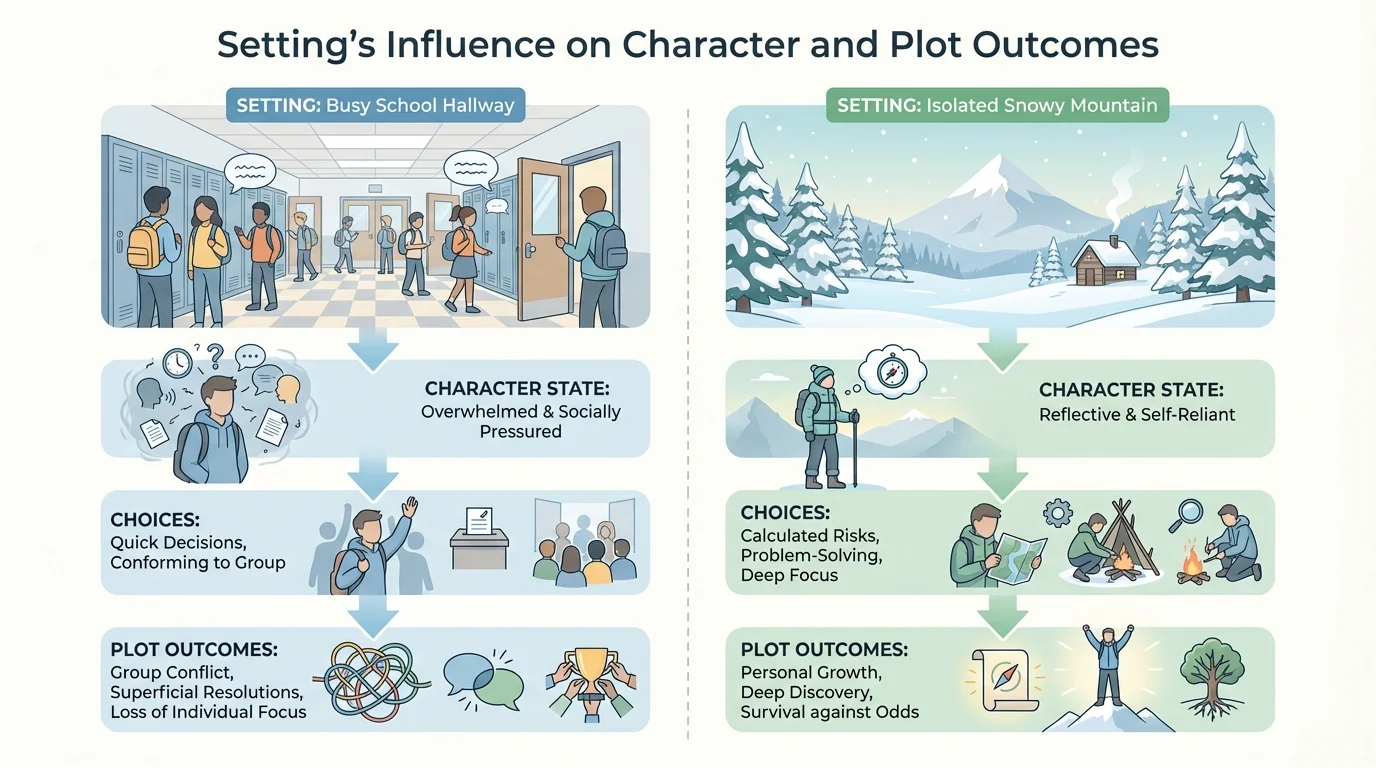
Time period also matters. In a historical story set long ago, a character may not have a phone, fast travel, or legal rights that exist today. That changes what solutions are possible. In a science fiction story, advanced technology may solve one problem but create another. Setting is not decoration; it creates conditions.
Weather can function as part of setting too. A blazing heat wave may make characters irritable and exhausted. A blizzard may trap people together and increase tension. Fog may hide danger. Bright spring sunlight may support a hopeful mood. Notice that setting can influence both external events and internal feelings.
Case study: Setting shapes plot
Compare the same basic problem in two different settings: a lost backpack containing an important key.
Step 1: Place the problem in a quiet small town.
The character can ask neighbors, retrace steps safely, and get help quickly. The plot may focus on memory, trust, and community.
Step 2: Place the problem in a giant airport during a storm delay.
The character faces crowds, noise, time pressure, and confusing directions. The plot becomes more urgent and stressful.
Step 3: Compare the result.
The same lost object leads to different actions, emotions, and outcomes because the setting changes the situation.
As seen earlier in [Figure 1], even one character can seem almost different when the environment changes. That is why good analysis does not just say, "The story takes place in winter." It explains what winter causes: isolation, danger, delay, fear, or survival.
Motivation is the reason a character acts. Characters want things: safety, friendship, freedom, respect, power, or truth. Those desires create movement in the story. When a desire meets an obstacle, conflict begins.
Conflict can be external, such as character versus character, society, nature, or technology. It can also be internal, such as guilt, fear, jealousy, or uncertainty. Character traits and motivations determine what kind of conflict appears. A curious character may uncover secrets. A jealous character may create problems. A loyal character may take risks for a friend.
Consider a drama in which two siblings disagree about selling the family store. If one sibling values tradition and the other values financial security, the conflict is not random. It grows from their beliefs. Their dialogue, choices, and emotional reactions reveal who they are. In this way, conflict develops character, and character creates conflict.
Characters are revealed under pressure
Readers often understand characters best when they face difficult choices. A person may seem kind during easy moments, but a crisis reveals whether that kindness lasts when something important is at risk. Because of this, conflict is one of the most powerful tools for characterization.
Characters also affect each other. A cautious friend may slow down a reckless one. A dishonest character may pull a truthful character into trouble. An inspiring coach, teacher, or parent may help someone grow. In many stories, relationships act like engines that keep the plot moving.
When you analyze character interaction, focus on evidence. Ask: What does the character want? What stands in the way? How do words and actions reveal personality? How do those traits change events? Strong analysis connects traits to consequences.
The plot is the sequence of events in a story, and it works best when those events connect through cause and effect, as [Figure 2] shows. Good plots do not feel random. One event leads to another because of choices, conditions, or discoveries.
For example, a student finds an unsigned note warning that the school greenhouse will be damaged. Because she doubts adults will believe her, she investigates alone. Because she investigates alone, she misses an important clue. Because she misses the clue, the wrong person is blamed. Each event grows out of the one before it. That chain is plot interaction.
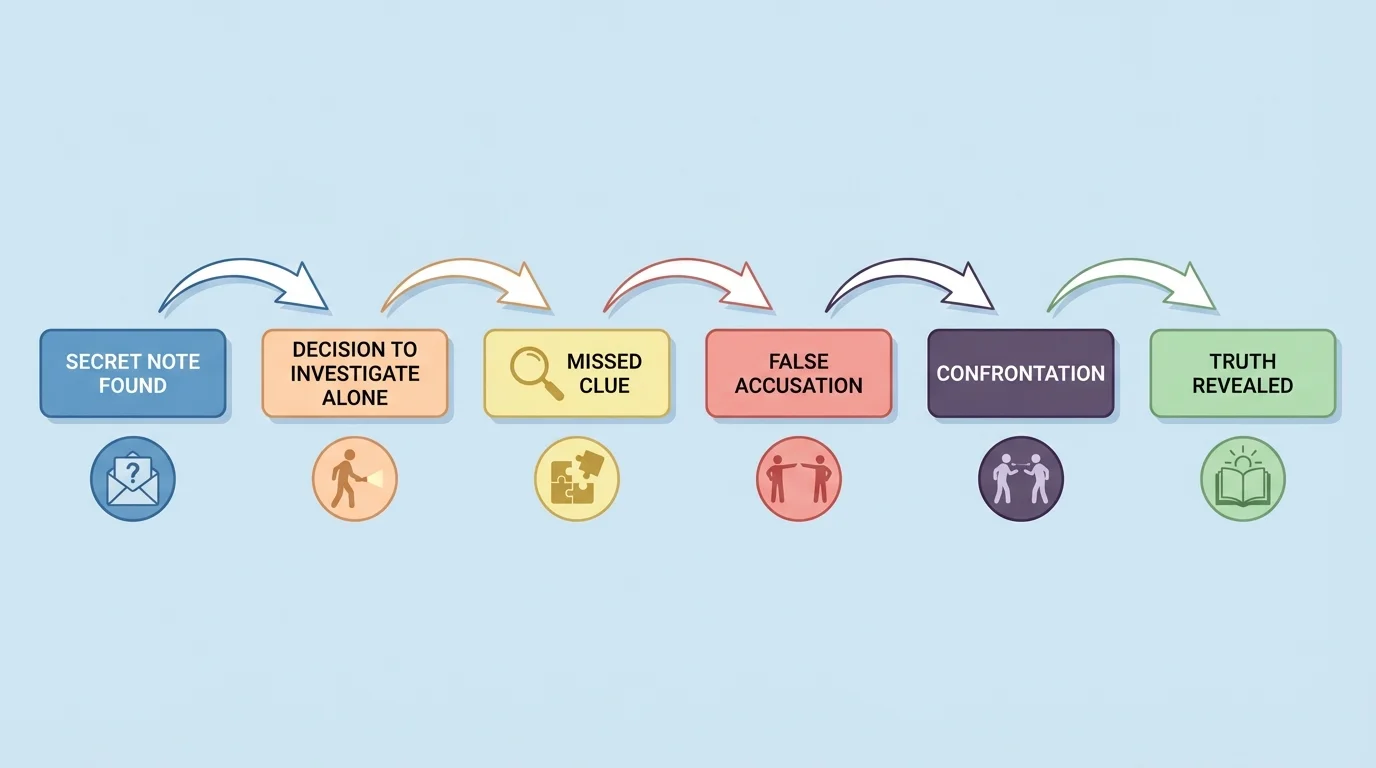
This is why analysis often uses words like because, therefore, as a result, and which leads to. Those phrases show relationships. Instead of saying, "The character went to the greenhouse," a stronger analysis says, "Because she feared no one would listen, she went to the greenhouse alone, which increased the danger and moved the plot toward the false accusation."
Plot is also shaped by pacing. Short, urgent scenes may increase suspense. Slower scenes may allow reflection or build emotional depth. The order of events matters too. A flashback can change how readers understand a character's actions. A delayed reveal can create mystery.
Some of the most memorable plot twists feel surprising at first but seem inevitable afterward. That usually happens because the author has quietly connected details all along, so the ending grows naturally from earlier elements.
Later events can also change the meaning of earlier ones. If a character seems selfish at first but is later revealed to be protecting someone, readers reinterpret past actions. In that way, plot and characterization work in both directions: character shapes plot, and plot reshapes how readers see character.
The chain in [Figure 2] reminds us that a single decision can spread through an entire story. A secret kept too long, a warning ignored, or a promise broken can become the turning point that changes everything.
Mood is the feeling a text creates for the reader, such as tension, comfort, sadness, excitement, or wonder. Tone is the author's or narrator's attitude toward the subject, which may feel serious, playful, bitter, or hopeful. These are affected by setting, diction, imagery, conflict, and pacing.
A theme is the larger message or insight a text explores about life, people, or society. Theme is not usually stated as one word like "friendship." It is more complete, such as "True friendship requires honesty during difficult times." Theme grows from the interaction of all the literary elements.
Earlier reading skills still matter here: summarize events accurately, notice important details, and pay attention to who is speaking. You cannot analyze how elements interact unless you first understand what the text literally says.
Suppose a story takes place in an abandoned amusement park at night. The broken lights, rusted rides, and echoing sounds create an uneasy mood. If the main character is hiding from someone, the plot becomes suspenseful. If the character finally chooses courage over fear, the theme may involve facing the past. Setting, mood, plot, and theme all work together.
In another story, a summer neighborhood block party might create a warm mood. If a lonely character slowly joins the celebration, the setting supports a theme about belonging. The same basic idea applies: details are not random. Authors choose them to guide meaning.
| Element | What it does | How it may affect another element |
|---|---|---|
| Setting | Creates time, place, and conditions | Can limit choices, increase danger, or shape mood |
| Character | Provides traits, goals, and actions | Can create conflict and move the plot |
| Conflict | Introduces struggle or problem | Can reveal character and sharpen theme |
| Plot | Organizes events | Can change mood and reveal meaning |
| Mood | Creates reader feeling | Can strengthen theme and reader response |
| Theme | Expresses a larger message | Grows from all the other elements together |
Table 1. This table shows how major literary elements influence one another in stories and dramas.
A drama is a story written to be performed. In drama, literary interaction appears not only in plot and character but also in stage elements, as [Figure 3] illustrates. These include dialogue, stage directions, lighting, props, costume, and movement.
In a play, setting can be shown through scenery and sound. A single kitchen table under dim lighting may suggest stress, poverty, or loneliness. Bright lights, music, and rapid entrances may create energy. Because plays rely on performance, the audience often learns about character through voice, pauses, gestures, and position on stage.
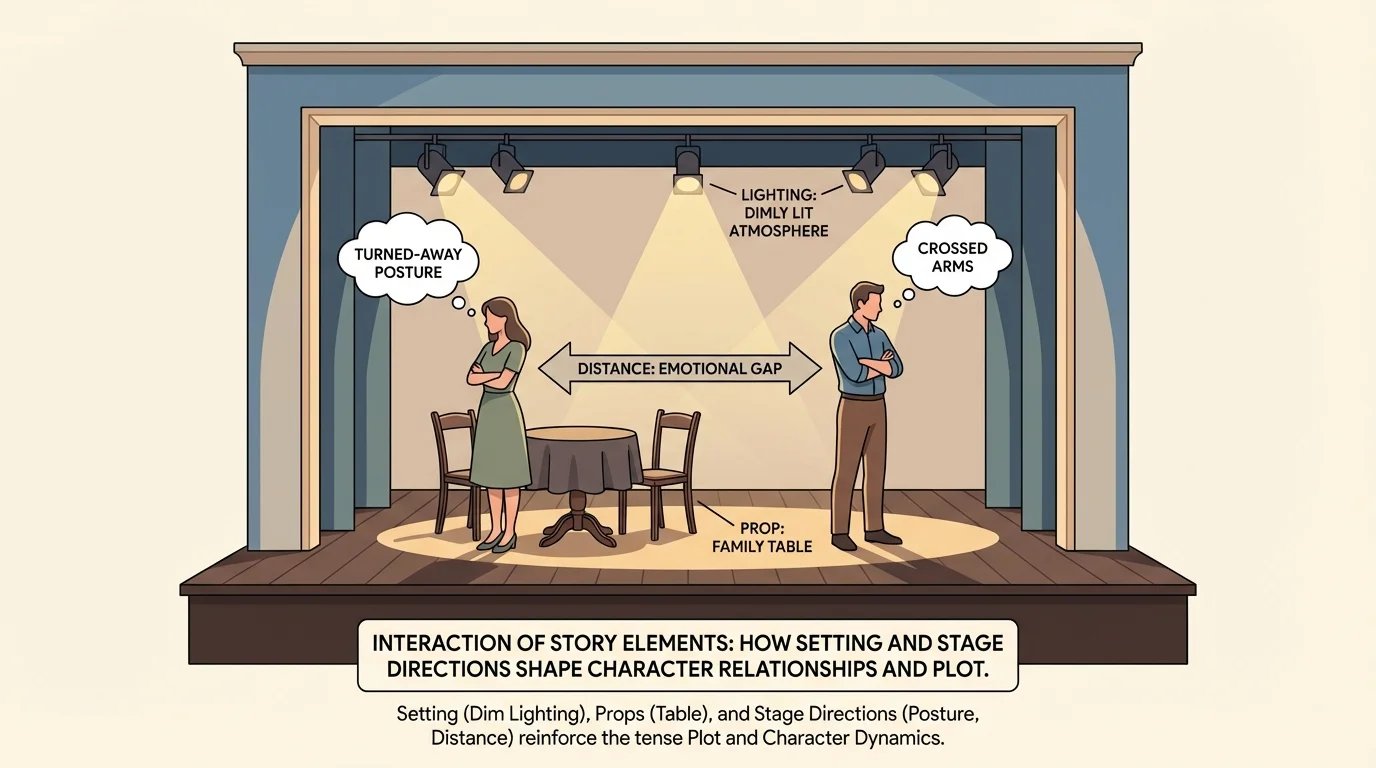
Dialogue is especially important in drama. A character may say, "I'm fine," while slamming a door or refusing eye contact. The words suggest calm, but the stage directions reveal anger or hurt. This interaction between speech and action deepens characterization.
Stage directions can also shape plot. If a script notes that a character hides a letter before another enters, that action may trigger later conflict. A prop such as a key, photograph, or empty chair can become symbolically important. In drama, visual details often work with spoken details to guide the audience's understanding.
Mini drama analysis
In a scene, a boy stands near the exit while his mother remains center stage holding an unopened envelope.
Step 1: Notice position.
The boy near the exit suggests he wants to leave, physically and emotionally.
Step 2: Notice the prop.
The unopened envelope suggests a secret, decision, or news that has not yet been faced.
Step 3: Connect elements.
The stage picture creates tension before the characters even speak. Setting on stage, movement, and objects interact with conflict and plot.
As shown in [Figure 3], the distance between characters can matter almost as much as their words. In a drama, readers and viewers should ask not only "What do they say?" but also "How are they placed, lit, and directed?"
When you write or speak about literature, avoid treating elements like isolated labels. Instead of saying, "The setting is a forest" and stopping there, continue the thought: how does the forest affect fear, movement, secrecy, or danger? Analysis becomes stronger when it explains relationships.
A useful method is to move through four steps. First, identify an important element. Second, find another element it affects. Third, explain the connection using cause-and-effect language. Fourth, support the idea with specific evidence from the text.
A strong analytical sentence
A clear literary analysis often follows this pattern: the author uses one element to influence another, which helps create meaning. For example: "The stormy coastal setting isolates the family, which increases conflict and supports the theme that fear can divide people."
Here are some sentence starters that help: "The setting shapes the character by...," "Because the character wants..., the conflict becomes...," "This event changes the mood from... to...," and "These details support the theme that...." Such patterns help you move from simple observation to real analysis.
Always use evidence. If you claim that a setting creates tension, point to details like darkness, silence, closed doors, or harsh weather. If you say a conflict reveals character, point to exact choices, dialogue, or reactions. Evidence turns an opinion into an argument.
Consider a story about a seventh-grade student who transfers to a new school in the middle of the year. The setting already creates pressure: unfamiliar hallways, existing friend groups, and classroom routines the student does not know. That setting affects the character's feelings of isolation and caution.
Now add a plot event: the student overhears a rumor about a class competition and misunderstands the rules. Because the student feels insecure, they do not ask for help. That choice creates conflict with teammates, who think the student ignored instructions. The setting of a new school shapes character feelings, which shape a choice, which shapes the plot.
Next, imagine the same student later helping a teammate during a science presentation. That event can shift the mood from awkwardness to trust. It can also reveal a theme such as "Belonging grows through action, not instant acceptance." Again, the elements interact.
"Stories are not made of parts that sit still; they are made of parts that push, reveal, and transform one another."
In a mystery, the interaction may look different. A gloomy mansion setting creates suspense. A secretive narrator affects what information readers receive. The plot may hide clues in ordinary objects. The mood of uncertainty supports a theme about appearance versus reality. Different genres use different tools, but the principle stays the same: meaning grows from connections.
In realistic fiction, interactions may be quieter but still powerful. A dinner table conversation can reveal family tension, cultural expectations, and personal goals all at once. No explosion or chase is needed. A carefully chosen setting, a pause in dialogue, and one difficult question may push the plot forward.
Strong readers notice these interactions wherever they appear. They see that literary elements are active, not static. When authors build texts carefully, every important detail helps shape something else.
