A movie shows a queen giving a dramatic speech before battle. A novel describes children working on a castle wall. A video game lets players walk through an ancient city. These stories can make the past feel alive, but they can also change it. That is why strong readers do more than enjoy historical fiction: they compare it with historical accounts and ask what is accurate, what is changed, and why those changes matter.
When you compare fiction and history, you are doing two important kinds of reading at once. You are reading for story, and you are reading for claims about what is true about the past. This helps you understand not only a historical period, but also how authors shape readers' ideas. A fictional writer may use real events, real places, and real people, yet still invent scenes, combine characters, or change details to create suspense, emotion, or a clearer theme.
A fictional portrayal is a representation of a person, time, or place in a made-up story. It may be based on real history, but it is still fiction. A historical account is a description of the past based on evidence such as documents, artifacts, letters, photographs, diaries, or research by historians. These two kinds of texts can overlap, but they are not the same.
Fiction often helps readers feel what life in the past may have been like. It can show fear, hope, conflict, and everyday details in powerful ways. Historical accounts, on the other hand, focus on evidence and accuracy. They explain what historians know, what they think happened, and sometimes what is still uncertain. Reading both gives a fuller picture. Fiction can make history vivid, while history can test the story's claims.
Fictional portrayal means the way a story represents a real historical time, place, or person through invented scenes, dialogue, or actions.
Historical account means a factual explanation of the past based on evidence from sources.
Primary source means a source created during the time being studied, such as a diary, speech, law, or letter.
Secondary source means a later source that explains or interprets the past, such as a textbook, documentary, or biography.
Comparing these texts helps you become a more careful reader. Instead of accepting every scene as true just because it "feels historical," you learn to ask questions. What details match historical evidence? What details are added by the author? What ideas about the past does the story encourage readers to believe?
One major difference is purpose. A historical account usually aims to inform, explain, and support its conclusions with evidence. A fictional work usually aims to tell a compelling story. It may also teach, question, or criticize, but it does not have to report every event exactly as it happened.
Another difference is the treatment of characters. In fiction, a character may speak long conversations that were never recorded. The author may tell us what the character thinks or feels, even when no one could truly know that. In history writing, responsible historians are more careful. They may suggest what a person likely believed, but they usually base that claim on letters, actions, or other evidence.
A third difference is structure. Stories often follow a clear plot with rising action, conflict, and resolution. Real history is messier. Events overlap. People disagree. Causes are complex. Fiction sometimes simplifies history so the reader can follow one main storyline.
Some of the most famous ideas people hold about the past come more from novels and films than from historians. A powerful story can shape public memory for years, even when some of its details are inaccurate.
This does not mean fiction is "bad history." In fact, historical fiction can reveal truths about fear, injustice, courage, or power. But those truths are often emotional or thematic rather than strictly factual. A story may capture the feeling of a period while changing specific details.
[Figure 1] shows the main categories readers should examine when comparing a fictional work with a historical account. Instead of asking only, "Is this true?" ask a fuller set of questions about the setting, the characters, the events, the language, and the message.
Start with setting. Does the story describe the time period and location in ways that match historical evidence? Look at clothing, homes, technology, jobs, customs, food, laws, and social roles. Even small details matter. If a novel set in the Middle Ages shows people using objects that did not exist yet, that change affects accuracy.
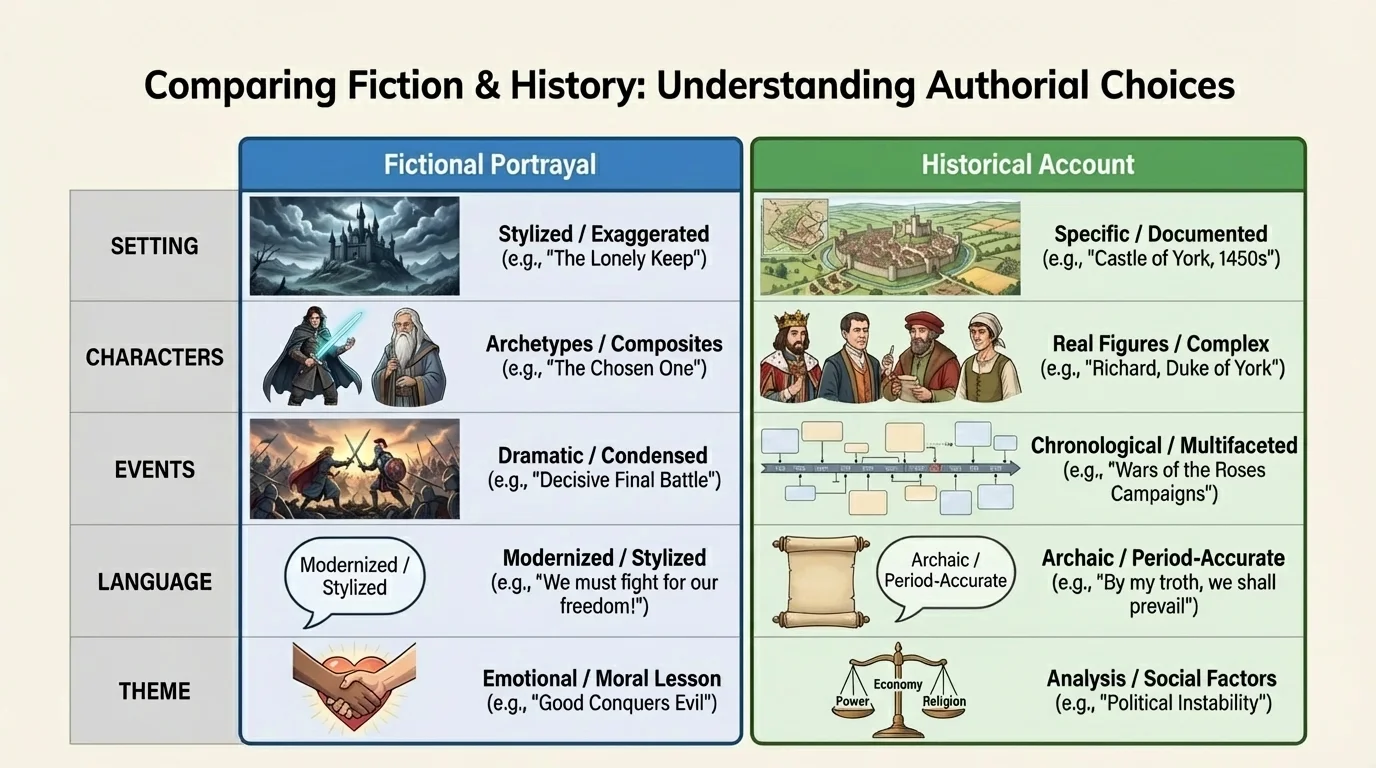
Next, compare the characterization of important people. If the character was a real historical figure, ask whether the story presents that person in a way supported by evidence. Does the author make the person braver, kinder, crueler, or more confident than historical records suggest? If the character is invented, ask whether the character's experiences seem believable for that time and place.
Then compare events. Which events really happened? Which are changed, moved in time, combined, or invented? A writer may place two historical events next to each other even if they actually happened years apart. This is one way fiction can create a stronger plot.
Also notice point of view. A story told by one young character may give a narrow but emotional perspective. A historical account often includes multiple viewpoints, especially when historians want to show disagreement or uncertainty. The point of view affects what the reader sees and what gets left out.
Finally, think about theme. What larger idea does the author want readers to understand? A novel about war may focus on friendship, survival, or loss. A historical account may focus more on causes, leaders, and consequences. Both can be valuable, but they emphasize different truths. If you look back at [Figure 1], you can see that good comparison includes more than checking dates; it includes studying how literary elements and factual evidence connect.
| Feature to Compare | Questions to Ask |
|---|---|
| Setting | Does the time and place match known historical details? |
| Characters | Are real people portrayed accurately? Are invented people believable? |
| Events | Which events are factual, changed, combined, or invented? |
| Language and Dialogue | Do the words sound appropriate for the period, even if they are modernized for readers? |
| Point of View | Whose perspective is centered, and what perspectives are missing? |
| Theme | What larger message about the past does the text communicate? |
Table 1. Questions readers can use when comparing a fictional portrayal with a historical account.
Authors do not always change history by accident. Often, they do it on purpose for artistic reasons. One reason is creating a composite character. A writer may combine traits from several real people into one fictional character. This helps simplify the story and keep the reader focused.
Another reason is time compression. Real change often happens slowly, but stories need movement. An author may take events that happened over many years and present them as if they happened in a few weeks. This makes the plot easier to follow, but it can distort the pace of history.
Writers also invent dialogue because historical records rarely preserve every conversation. They may create scenes that reveal conflict or emotion, even though no evidence proves the scene happened exactly that way. Sometimes this deepens a reader's understanding. Sometimes it creates false impressions.
Author's choices shape historical meaning. Fiction writers choose which details to keep, which to leave out, and which to invent. These choices affect how readers judge a period, place, or person. A story that highlights cruelty may make an era seem darker. A story that highlights heroism may make one person seem more powerful than the evidence supports.
Authors may also alter history to connect with modern readers. They may use more familiar language, focus on a younger narrator, or highlight issues that still matter today, such as inequality, freedom, leadership, or identity. These choices can make a story more relevant, but they can also shift the reader's understanding of the past.
[Figure 2] introduces a contrast between fictional and historical portrayals of Ancient Egypt. Many fictional stories and films show pyramid building as a world of whips, chains, and huge crowds of enslaved workers pulling stones under constant punishment.
That image is dramatic, but historians and archaeologists have found evidence that many pyramid workers were not enslaved in the way popular fiction often suggests. Excavations near pyramid sites show worker villages, food supplies, tools, and organized labor systems. This evidence suggests that many workers were skilled laborers or recruited workers supported by the state.
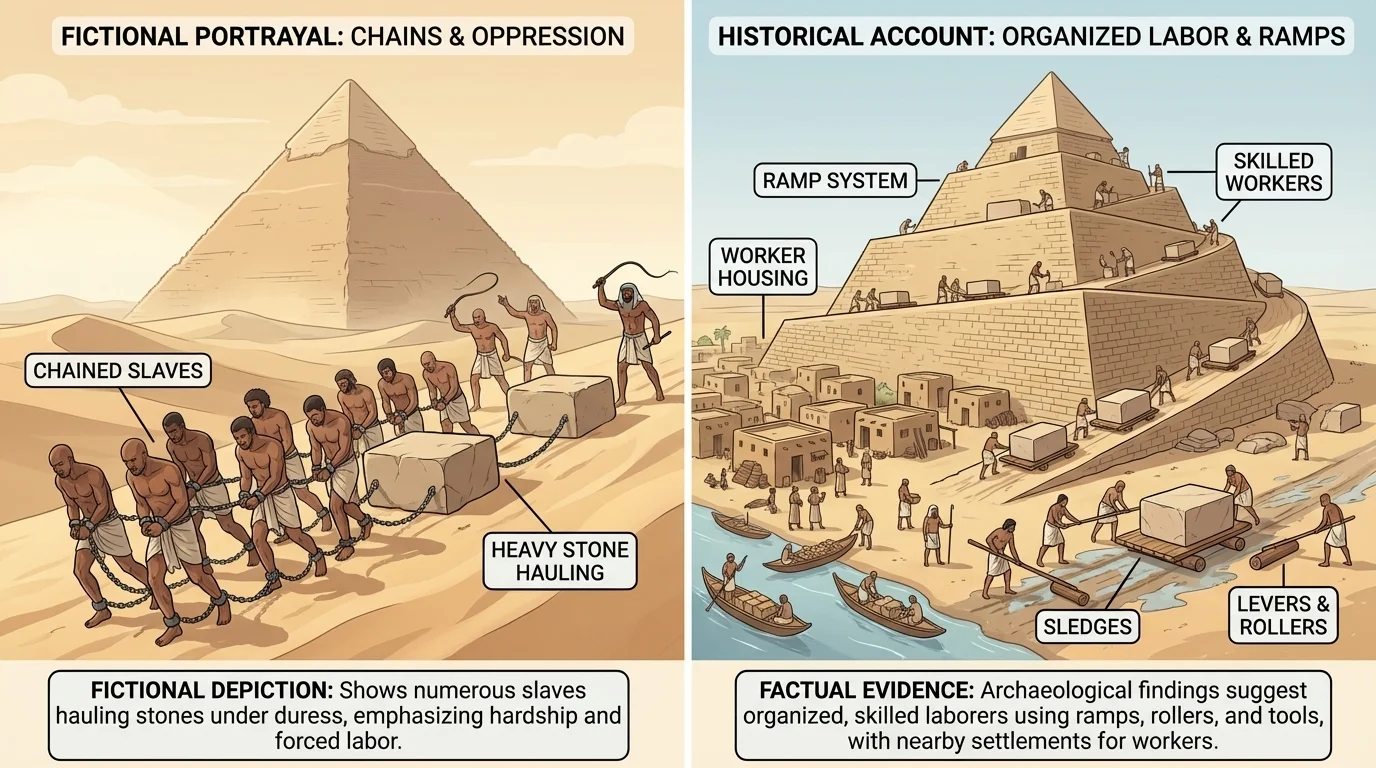
A fictional story about a boy forced to drag stones all day might still reveal something meaningful about hard labor, power, or fear. But if it presents all pyramid workers as enslaved prisoners without explaining the historical debate, it changes the reader's view of Egypt. The story may be emotionally powerful, yet historically incomplete.
A historical account would likely discuss evidence more carefully. It might explain what archaeologists found, what historians infer from those findings, and what scholars still debate. This is a key difference: fiction often presents one clear version, while history often includes uncertainty.
The contrast in [Figure 2] helps show why readers must separate dramatic tradition from historical evidence. A repeated image in movies or novels can feel true simply because people have seen it many times.
Case study comparison: Ancient Egypt
Step 1: Identify the fictional claim.
A novel shows pyramid workers as chained slaves who work only because soldiers threaten them.
Step 2: Check the historical account.
A historical article describes archaeological evidence of worker housing, planned food distribution, and organized labor near pyramid sites.
Step 3: Compare the two texts.
Both texts agree that pyramid labor was difficult, but they differ on who the workers were and how the labor system functioned.
Step 4: Explain the author's purpose.
The novel may exaggerate suffering to heighten conflict and make the story more dramatic.
A strong comparison does not just say one text is "right" and the other is "wrong." It explains how and why the fictional text changes history.
This kind of analysis respects both forms of writing. The historical account offers evidence-based knowledge. The fictional story offers a crafted experience shaped by author choices.
Now think about a real person such as Cleopatra, Joan of Arc, or Harriet Tubman. In fiction, these figures may be turned into larger-than-life heroes or villains. A novelist may give them dramatic speeches, private thoughts, or perfect timing in every decision. These details make the character vivid, but they may go beyond the evidence.
For example, a story about Harriet Tubman might present every rescue mission as a steady march of confidence and certainty. A historical account, however, may show a more complex reality: planning, danger, secrecy, changing routes, help from others, and moments of uncertainty. The fictional version may focus tightly on one hero, while history shows a wider network of people and conditions.
This difference matters because readers can begin to believe that history is made only by extraordinary individuals. Historical accounts often reveal that change also depends on communities, systems, geography, timing, and many unnamed people. Fiction sometimes narrows that complexity to create a stronger central character.
"The past is never dead. It's not even past."
— William Faulkner
That idea matters here because stories about historical figures shape how people in the present think about courage, justice, and power. A fictional portrayal can inspire readers, but it should also be tested against historical evidence.
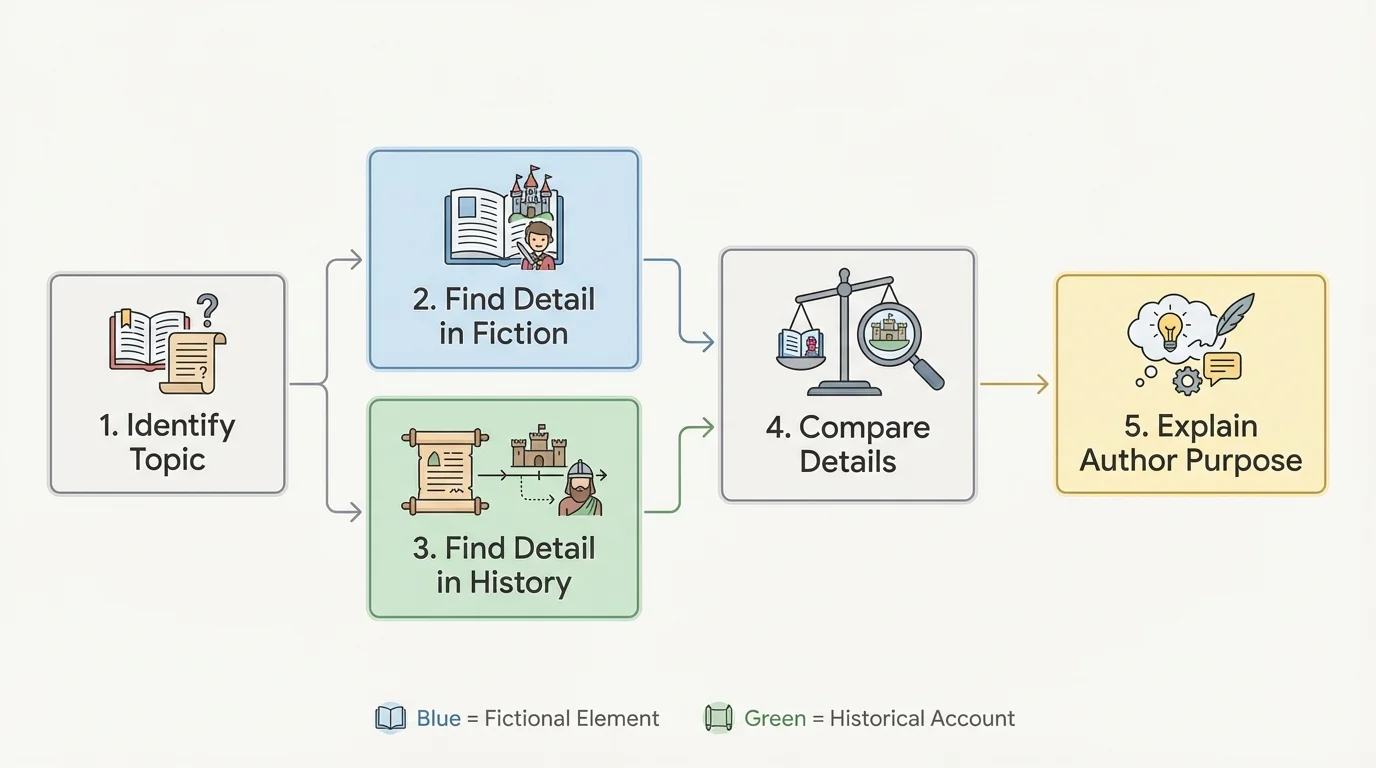
[Figure 3] presents a clear process for building evidence into a comparison. You should gather details from the fictional text and from one or more historical sources. Then connect them with a clear explanation of similarity, difference, and author purpose.
One useful method is to make a claim in this pattern: the fictional text portrays a person, place, or period in a certain way; the historical account presents it differently or similarly; the difference shows how the author uses or alters history for a purpose. This keeps your response analytical rather than just descriptive.
Evidence can come from primary sources and secondary sources. A primary source might be a speech, diary, law, or image from the time period. A secondary source might be a historian's article or textbook chapter. Fiction should be compared with evidence, not only with another piece of fiction.
Suppose a novel describes a medieval town as dirty, violent, and miserable all the time. A historical account might confirm that sanitation problems existed, but it may also include markets, religious festivals, craft work, trade, family life, and local laws. A good reader notices that the novel selected one side of life to support a mood or theme.
Later, when you return to the process shown in [Figure 3], the final step is the most important: explain the reason for the difference. Maybe the author wanted suspense. Maybe the author wanted readers to admire a hero. Maybe the author wanted to criticize injustice by emphasizing suffering.
Evidence-based reading means quoting or paraphrasing specific details and then explaining what those details show. A strong comparison needs both parts: the evidence and the interpretation.
Without that explanation, a comparison remains shallow. Listing differences is not enough. Readers must connect those differences to literary elements such as character, setting, conflict, tone, and theme.
One common mistake is assuming that if a text is fiction, everything in it must be false. That is not true. Historical fiction often includes accurate settings, customs, and major events. The key is to identify which parts are grounded in evidence and which parts are imagined.
Another mistake is assuming that historical accounts are perfectly complete and free from interpretation. Historians also make choices about what evidence to include and how to explain it. However, their work is expected to be accountable to evidence in a way fiction is not.
A third mistake is focusing only on factual errors and ignoring meaning. Sometimes the most important question is not "What did the author get wrong?" but "What view of the past does the author create?" A small factual change can lead readers to a much bigger idea about justice, leadership, gender roles, class, or conflict.
It is also important not to confuse modern values with historical context. Readers should notice when fiction deliberately uses modern attitudes in older settings. Sometimes authors do this to make characters relatable. Sometimes it creates an inaccurate picture of what people in that period believed or could realistically do.
This skill matters far beyond school. People learn history from novels, films, television series, museum exhibits, social media posts, and games. Some of those sources are carefully researched. Some are not. If you can compare a portrayal with a historical account, you are less likely to be misled by a dramatic version of the past.
This skill also helps you appreciate literature more deeply. Instead of seeing historical fiction as either true or false, you can see it as a crafted work that uses history in purposeful ways. You begin to notice how authors build mood, shape heroes, create conflict, and guide readers' emotions by selecting and altering historical material.
In other words, comparing fiction with history helps you understand both the past and the power of storytelling. It teaches you to read with imagination and with judgment at the same time.
