Some of the most important decisions in school, sports, science, and even government happen through discussion. A team plans a strategy. A group of engineers solves a design problem. Students work together on a project. In all of these situations, success does not depend only on having smart ideas. It also depends on whether people can talk with one another in a focused, respectful, organized way.
That is why strong discussion skills matter. In grade 7, you are expected not only to share your own ideas clearly, but also to listen carefully, build on others' ideas, follow agreed-upon rules, keep track of goals, meet deadlines, and take on roles that help the group succeed. These skills turn a group conversation from random talking into real teamwork.
A class discussion is not just talking. It is a form of shared thinking. When people discuss a topic well, they compare ideas, test evidence, ask questions, solve problems, and improve their understanding. A strong discussion can help everyone in the group learn more than they would have learned alone.
These skills also matter outside school. Athletes discuss plays before a game. Doctors discuss patient care. Game designers discuss how a level should work. Community leaders discuss how to improve neighborhoods. In each case, people need to communicate clearly, stay organized, and work toward a common result.
Many careers value collaboration as much as individual talent. A person may know a lot, but if they cannot work productively with others, the whole team can slow down.
Because discussions are shared work, they need shared expectations. That is where rules, goals, deadlines, and roles become important.
A collegial discussion is a respectful, thoughtful conversation in which participants work together as partners. The word does not mean that everyone agrees all the time. Instead, it means that people treat one another with respect, listen seriously, and focus on learning or solving a problem together.
Collegial discussions usually center on a text, topic, question, or issue. For example, a class might discuss whether a character made the right choice in a novel, how to improve a science investigation, or what evidence best supports a claim in social studies. The goal is not to "win" the conversation. The goal is to understand the topic better and contribute to the group's progress.
Collegial discussion means a respectful, cooperative academic conversation in which people listen, respond thoughtfully, and work toward shared understanding or a shared goal.
Deadline means the time by which a task should be finished.
Role means a specific job or responsibility a person has in a group.
Casual conversation and academic discussion are not the same. Casual conversation can jump from topic to topic. A collegial discussion stays focused, uses evidence, and follows rules that help everyone participate.
Every good discussion depends on clear rules. These rules are not there to make conversation stiff or unnatural. They help the group stay productive, as [Figure 1] shows through the difference between cooperative behavior and distracting behavior. Without rules, a discussion can quickly turn into interruptions, side conversations, repeated ideas, or confusion.
One important rule is turn-taking. That means speakers do not talk over one another. People wait for an appropriate moment, listen fully, and then respond. Another important rule is active listening. Active listening means paying attention, looking at the speaker, thinking about the message, and showing that you are engaged.
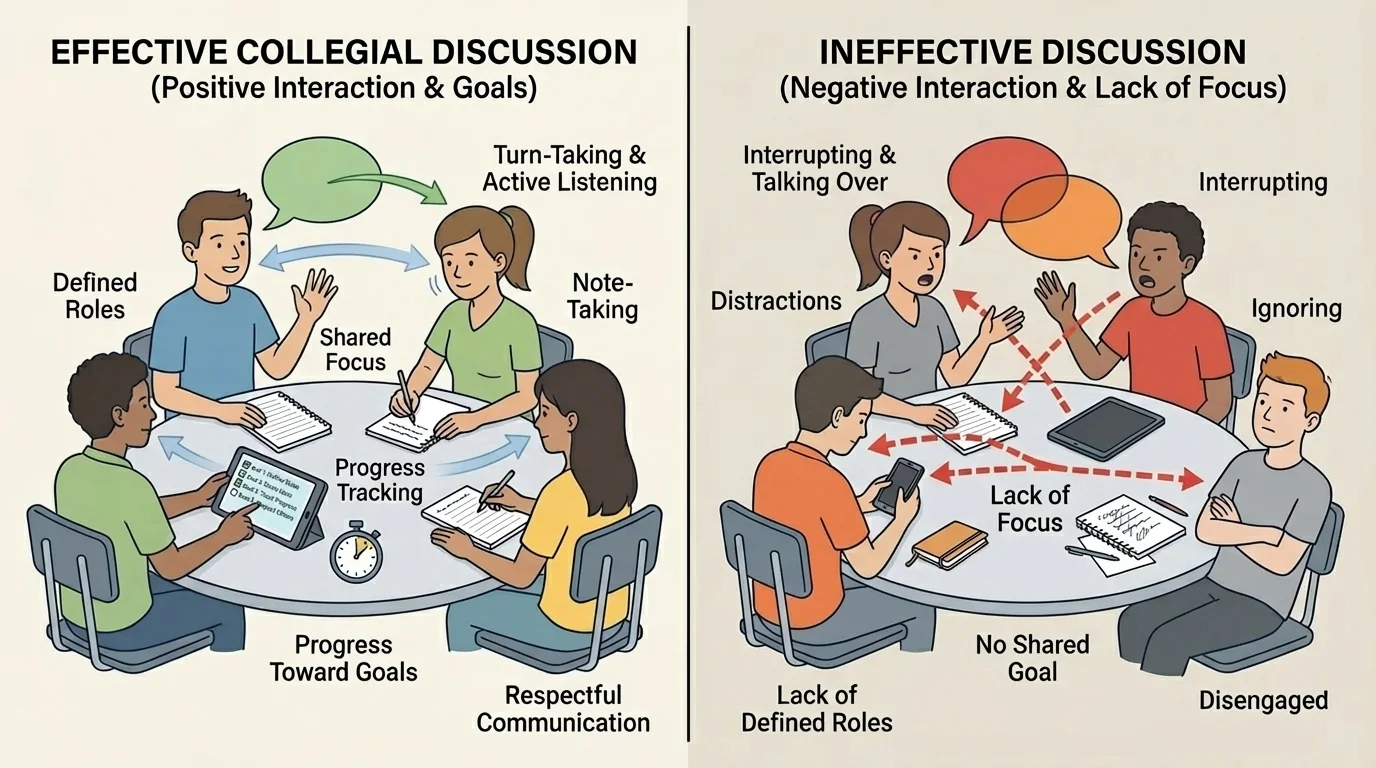
A third rule is staying on topic. If the class is discussing the causes of a historical event, the group should not drift into unrelated stories. Staying on topic helps the group use time well and make progress toward its goal.
A fourth rule is using evidence. In academic discussion, opinions matter, but they should be supported. A student might say, "I think the main character is brave because she returns to help her friend, even when it is risky." That response is stronger than simply saying, "She is brave." Evidence can come from a text, an experiment, notes, or reliable sources.
A fifth rule is respect. Respect includes not mocking others, not rolling your eyes, not dismissing an idea without thought, and not taking over the entire conversation. Respectful disagreement is part of strong discussion. A student can say, "I see your point, but I interpret the evidence differently," instead of "That makes no sense."
These rules create a safe and organized space for learning. Later, when groups face problems such as unfair participation or confusion, the same habits seen in [Figure 1] help restore order and focus.
A good discussion is not a series of unrelated speeches. It is a connected exchange of ideas. That means students need to respond to what others say, not just wait for their own turn to speak.
One way to do this is by using clear discussion moves. For example, you can agree and add on: "I agree with Maya, and I want to add that the setting also affects the character's choices." You can respectfully disagree: "I understand your point, but I think the evidence suggests a different conclusion." You can ask for clarification: "Can you explain what you mean by 'unfair' in this situation?" You can connect ideas: "That relates to what Jordan said earlier about the experiment's results."
These moves help a discussion feel connected and thoughtful. They also show that students are listening carefully. Building on ideas does not mean repeating them. It means extending them, questioning them, comparing them, or using them to move the discussion forward.
Discussion is shared thinking. In a productive discussion, each comment should do something useful: add evidence, ask a question, clarify an idea, challenge a claim respectfully, or connect one person's thought to another's. The strongest discussions grow from interaction, not from isolated comments.
Clear speaking matters too. Students should try to use complete thoughts, precise words, and explanations that others can follow. If an idea is complex, it helps to break it into parts and explain each part in order.
Many group discussions are tied to a task: preparing a presentation, solving a problem, planning an investigation, or creating a product. For that reason, discussions need more than good manners. They need clear direction. A group works much better when it knows exactly what it is trying to accomplish.
[Figure 2] A weak goal sounds like this: "We need to work on our project." That is too vague. A stronger goal sounds like this: "By the end of class today, we will choose our topic, write our main claim, and divide the research tasks." This goal is specific because it tells what must be done and by when.
Groups often work better when a large task is broken into smaller parts. For example, suppose a group must give a presentation about renewable energy next Friday. Instead of saying, "We will finish it later," the group can create steps: choose sources by Tuesday, outline the presentation by Wednesday, create slides by Thursday, and rehearse on Friday morning.
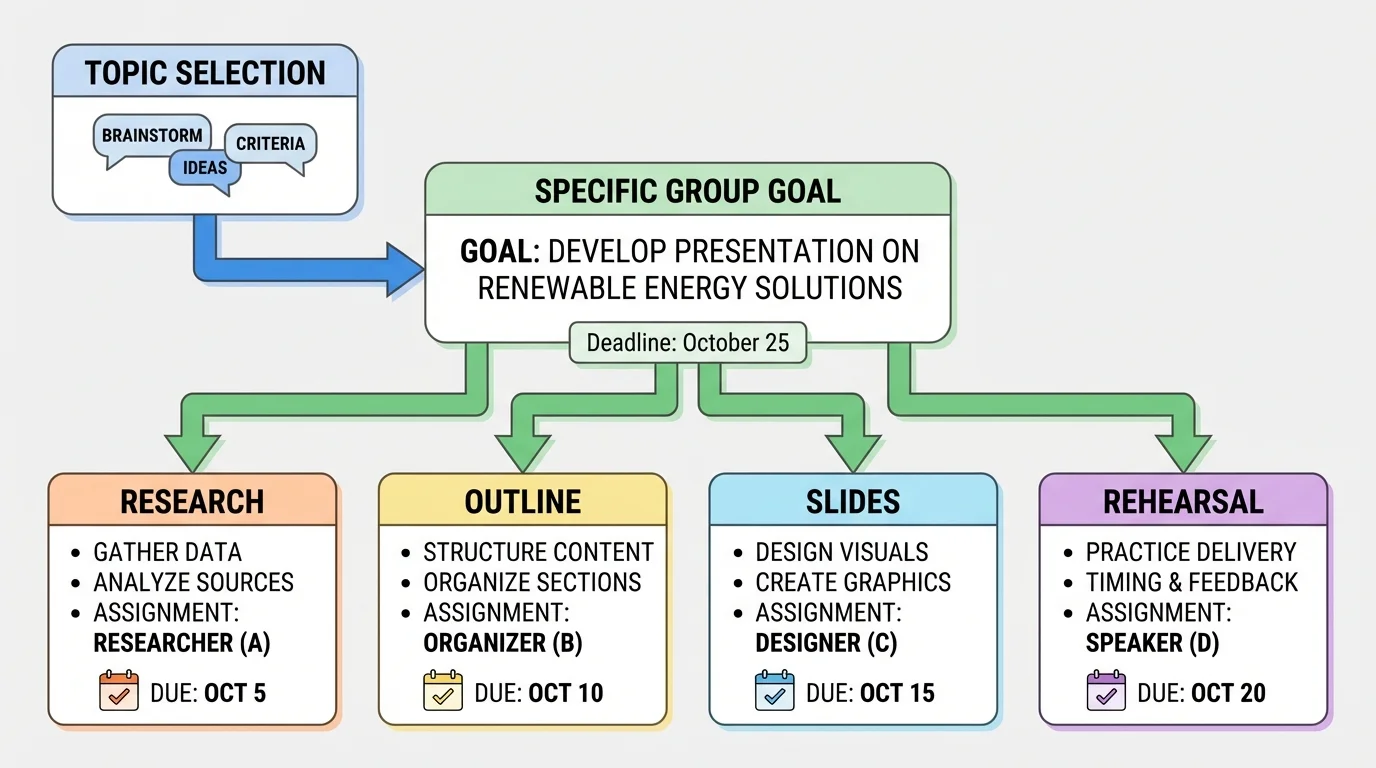
Deadlines matter because they create urgency and order. Without deadlines, people may delay work until the last minute. Then the group rushes, quality drops, and stress rises. With deadlines, the group can pace itself and notice problems early.
Specific goals are often easier to reach when they are realistic. A group should not plan to complete ten major tasks in a short time if that is impossible. Good goals are challenging but manageable.
Case study: turning a vague group plan into a specific one
A group is assigned to create a class presentation on how plastic waste affects oceans.
Step 1: Identify the vague plan
The group first says, "Let's just do the slides sometime this week." This does not explain who will do what, what information is needed, or when each part is due.
Step 2: Make the goal specific
The group changes the plan to: "Today we will choose three main points, assign research jobs, and agree on our sources."
Step 3: Add deadlines
The group sets mini-deadlines: research notes due Tuesday, slide draft due Wednesday, final edits Thursday, and rehearsal Friday morning.
Step 4: Connect tasks to people
One student gathers statistics, one finds images, one designs slides, and one organizes speaking parts.
The second plan gives the group a much better chance of succeeding because the work is clear, timed, and shared.
When goals are specific, it becomes easier to check progress honestly. The group can ask, "Did we finish the outline?" instead of "Are we doing okay?"
Progress monitoring means checking how well the group is moving toward its goal. This can happen during a single class period or over several days. It is an important part of collaboration because groups do not automatically stay on track. They have to stop, check, and adjust.
A group can track progress in simple ways. It might keep a checklist, write tasks in shared notes, use a planning chart, or pause every few minutes to review what has been completed. The method matters less than the habit. The key idea is that progress should be visible.
For example, if a group's goal is to finish three tasks by the end of class but only one is done halfway through, the group needs to notice that. It may decide to shorten discussion time, divide work more efficiently, or move a less urgent task to later.
Tracking progress also helps with fairness. If one student has completed a job and another has not started, the group can address that early instead of waiting until the final deadline. This keeps problems from growing.
When you set a goal, ask two questions: What exactly are we trying to finish? and How will we know whether we are on time? Those questions make progress easier to measure.
Groups should be honest during check-ins. Pretending that everything is fine does not help. A strong team can admit, "We are behind," and then create a better plan.
Even in a cooperative group, people often work best when responsibilities are clear. Knowing who is responsible for what reduces confusion, saves time, and helps everyone participate. In role-based teamwork, different jobs support the same discussion goal.
[Figure 3] Common discussion and project roles include the facilitator, recorder, timekeeper, researcher, and presenter. Not every group needs every role every time, but these roles can help a group stay organized.
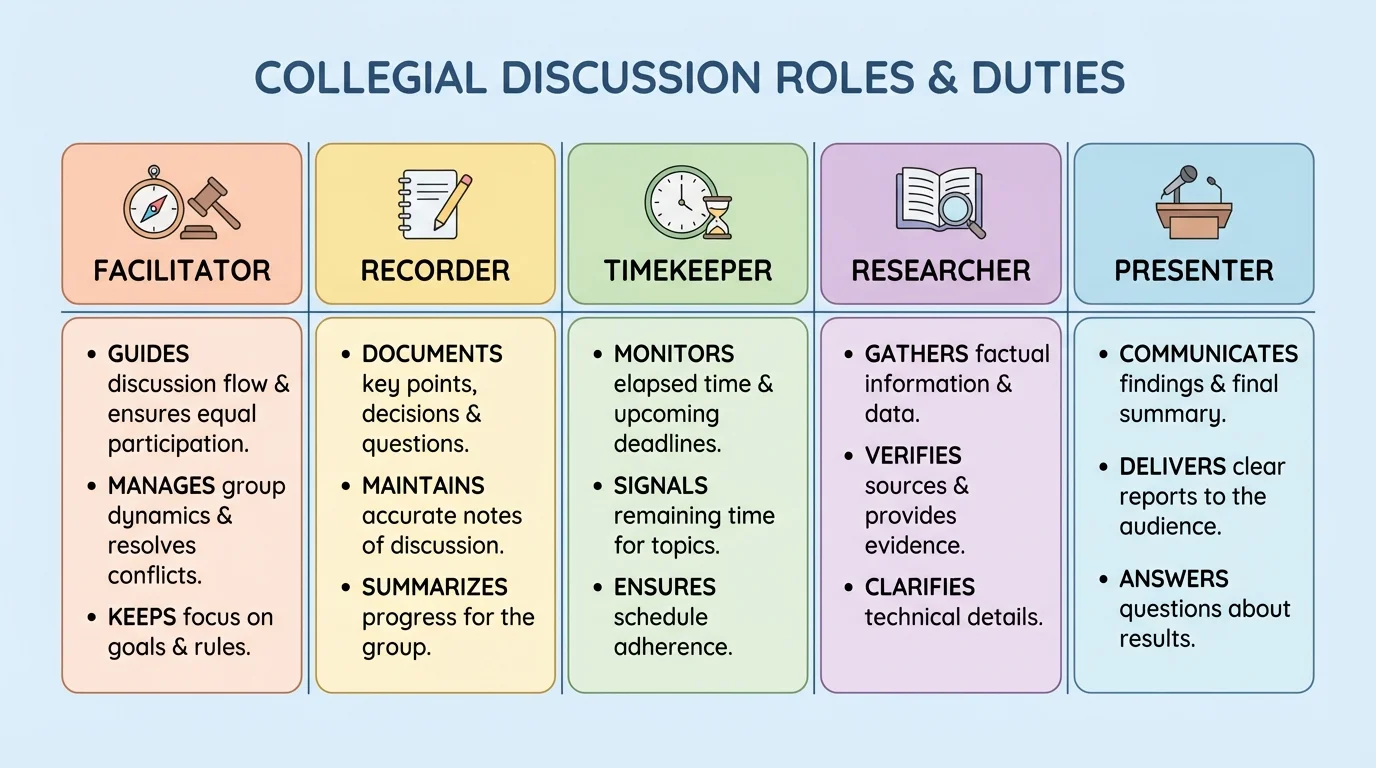
The facilitator helps guide the discussion. This person encourages participation, keeps the group focused, and helps the group return to the main question when talk begins to drift. The facilitator is not the "boss." The role exists to support the group's process.
The recorder writes down key ideas, decisions, or evidence. Good notes help the group remember what has already been decided. The recorder may also track assigned tasks and due dates.
The timekeeper watches the clock and reminds the group how much time remains. This role becomes especially important when a group has several tasks to complete before a deadline.
The researcher gathers information from texts, notes, or approved sources. The presenter shares the group's ideas with the class, though in some groups every member may present part of the final work.
Roles should fit the task. A short text discussion may only need a facilitator and recorder. A more complex project may need several roles. Groups may also rotate roles so that different students practice different skills. The role chart in [Figure 3] is useful when deciding which job best matches the group's needs at a particular moment.
Example: matching roles to a science discussion
A group must plan a simple investigation about plant growth.
Step 1: The facilitator opens the discussion by asking what question the group wants to investigate.
Step 2: The recorder writes the chosen question and the group's proposed steps.
Step 3: The timekeeper reminds the group that they have only ten minutes left to finalize materials.
Step 4: The presenter prepares to explain the group's plan to the class.
Because the roles are clear, the group spends less time wondering what to do and more time actually planning.
Sometimes roles need to change. If one student finishes early, that person may help another role. If a group is stuck, the facilitator may ask the researcher to gather one more source. Flexibility is part of effective teamwork.
Even strong groups run into problems. What matters is how they respond. One common problem is unequal participation. Sometimes one person speaks constantly while another barely speaks at all. A collegial group notices this and adjusts. The facilitator might invite quieter students in by asking, "What do you think?" At the same time, frequent speakers should practice making space for others.
Another problem is interruption. If students talk over one another, ideas get lost. Returning to rules like active listening and turn-taking can quickly improve the discussion.
A third problem is drifting off topic. This often happens when the group loses sight of its goal. Looking back at the goal and deadlines, especially the kind shown earlier in [Figure 2], can bring attention back to the task.
A fourth problem is missed deadlines. If a student does not complete a task, the group should address the issue directly but respectfully. The group might ask what happened, decide whether the task can still be finished, and adjust roles or the timeline if necessary.
Conflict can also happen when people disagree. Disagreement is not automatically bad. In fact, respectful disagreement can improve thinking. The key is to criticize ideas, not people. Students should use evidence, calm language, and questions that seek understanding rather than attack.
"Strong groups do not avoid problems. They respond to problems with clarity, respect, and action."
When groups solve problems in this way, they become more effective over time.
Discussion skills look a little different depending on the setting. In a one-on-one discussion, each person has more time to speak, so listening carefully and responding directly become especially important. There is less chance to hide, so preparation matters.
In a small-group discussion, students must balance speaking and listening with several people. This setting often requires the clearest use of turn-taking, role-sharing, and progress monitoring.
In a teacher-led discussion, students still need to participate actively, but the teacher may guide the flow, ask questions, or redirect the class. Students should still build on classmates' ideas instead of speaking only to the teacher.
The same principles apply in all three settings: respect, focus, evidence, clear goals, and responsibility.
These discussion skills are not only school skills. In real life, people work in teams all the time. A robotics team assigns jobs and checks deadlines. A news team divides research, writing, and editing tasks. A hospital team discusses patient care and tracks what still needs to be done. A company planning a new product holds meetings where people must share ideas, respond to concerns, and make decisions together.
Even in everyday life, these skills help. Friends planning an event need a goal, a timeline, and fair responsibilities. Families making decisions need listening and respect. Clubs and student councils need organized discussion to get anything done.
Good collaboration combines communication and organization. A group can have excellent ideas but still fail if it does not manage time, define responsibilities, or monitor progress. Productive discussion is both about what people say and how the group works together.
When you follow discussion rules, track progress toward goals and deadlines, and define roles when needed, you help your group think more clearly and work more effectively. Those are skills that matter in every subject and in many parts of life.
