Some of the most powerful true stories ever written do not sound like textbooks at all. A speech can move a nation. A memoir can make one ordinary moment feel unforgettable. A magazine article can read with the tension of a novel while staying completely factual. That is part of what makes literary nonfiction so interesting: it is true, but it is also carefully crafted. To read it well, especially at the high end of the grades 6–8 complexity band, you need more than basic decoding. You need to notice how the writing works, why the author made certain choices, and how those choices shape what you understand.
Literary nonfiction presents real people, events, and ideas, but it uses many of the same techniques found in literature. It may include scenes, dialogue, strong description, reflection, symbolism, and carefully shaped structure. Instead of simply listing facts, literary nonfiction often tells a true story or develops an idea in a vivid, memorable way.
Literary nonfiction is nonfiction that uses literary techniques such as imagery, narrative structure, characterization, and reflection to present real events, people, and ideas. Common forms include memoir, personal essay, speech, biography, autobiography, and narrative journalism.
A memoir, for example, does not aim to tell a person's whole life story. It focuses on meaningful experiences and reflects on what they mean. A speech may present an argument, but it may also use repetition, emotional appeal, and carefully chosen examples. Narrative journalism reports facts, yet it may open with a dramatic scene, build suspense, or shift between action and reflection.
Reading this kind of writing well means paying attention to both what happened and how the author tells it. If you focus only on facts, you may miss the deeper meaning. If you focus only on style, you may miss the author's central claim or purpose.
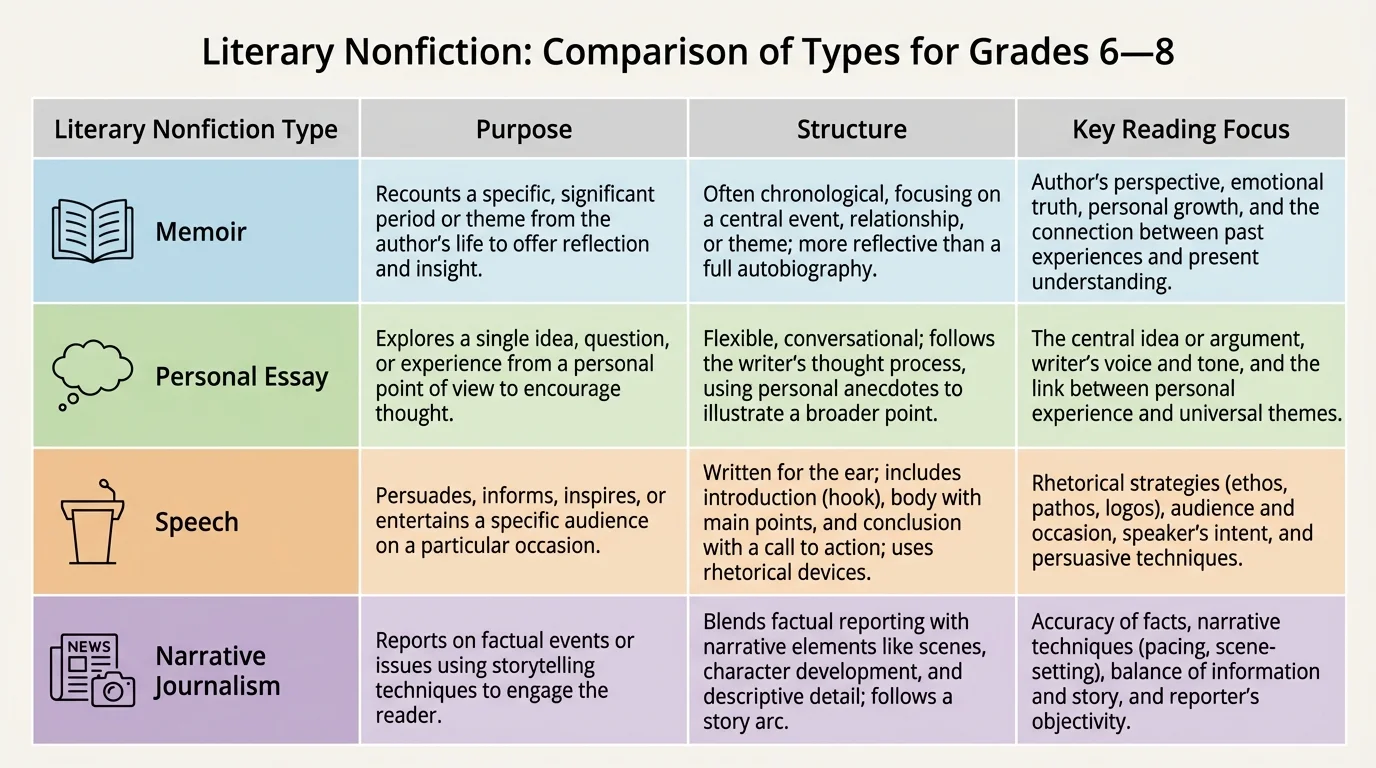
Texts at the upper end of the grade 6–8 band often become harder not because the words are longer, but because the ideas are layered. Different forms organize ideas in different ways, as [Figure 1] shows, and readers must track not only events but also shifts in time, tone, and perspective. A text may begin in the middle of an event, move backward into memory, and then return to the present to explain why the memory matters.
Complex literary nonfiction may include subtle tone, indirect meaning, cultural references, and sentences that ask the reader to infer rather than be told directly. An author might describe a family dinner in great detail, but the real subject may be conflict, identity, or loss. In that case, the dinner is not just an event. It is a vehicle for a larger idea.
| Form | Main Purpose | Common Structural Features | What Readers Should Notice |
|---|---|---|---|
| Memoir | Reflect on lived experience | Scenes, memories, reflection | How the experience shapes the writer |
| Personal essay | Explore an idea through experience | Anecdote, commentary, insight | How examples connect to the central idea |
| Speech | Persuade or inspire an audience | Repetition, appeals, direct address | How language creates impact |
| Narrative journalism | Report facts through storytelling | Scenes, interviews, chronology shifts | How evidence and storytelling work together |
Table 1. Comparison of common kinds of literary nonfiction and the reading focus each requires.
Another source of complexity is the relationship between explicit meaning and implied meaning. An author may state one idea directly but suggest another through imagery, structure, or selection of details. For example, a writer describing a long bus ride to school may be discussing transportation on the surface, while also revealing social inequality, determination, or resilience beneath the surface.
Vocabulary can also make a text demanding. In literary nonfiction, difficult words often matter because of their connotations, not just their dictionary definitions. If an author describes a room as "sterile" rather than "clean," the word suggests more than appearance. It may imply coldness, discomfort, or emotional distance. Skilled readers notice that difference.
Many famous speeches and essays become memorable because readers and listeners remember the rhythm of the language as much as the information. Sound, repetition, and pacing can make nonfiction feel powerful long after the exact facts fade.
Text complexity also rises when authors assume background knowledge. A speech from the civil rights movement, for instance, may refer to laws, court cases, religious traditions, or earlier speeches without explaining each one. Strong readers stop, infer, connect, and, when necessary, reread to build understanding.
Strong readers do not just start at the first line and hope for the best. They use a repeatable process, as [Figure 2] illustrates, to prepare for and monitor understanding. Before reading, ask: What kind of text is this? Who wrote it? What seems to be the topic? What do I expect the author wants me to think about?
Previewing matters. Look at the title, subtitles, dates, opening paragraph, and any notes about the author. If the text is a memoir excerpt, knowing that the author is reflecting years later changes how you read the voice. If the text is a speech, knowing the audience and historical moment can help explain the urgency of the language.
Set a purpose before you read. Your purpose may be to understand the author's central idea, trace how an experience changes the writer, or analyze how details create tone. Reading with a purpose helps you focus your attention. Otherwise, difficult passages can feel like a blur of words.
While reading, pause to paraphrase. In your own mind, restate what just happened or what idea the author just developed. If you cannot paraphrase, that is a sign to slow down or reread. Independent readers monitor their comprehension. They notice confusion instead of ignoring it.
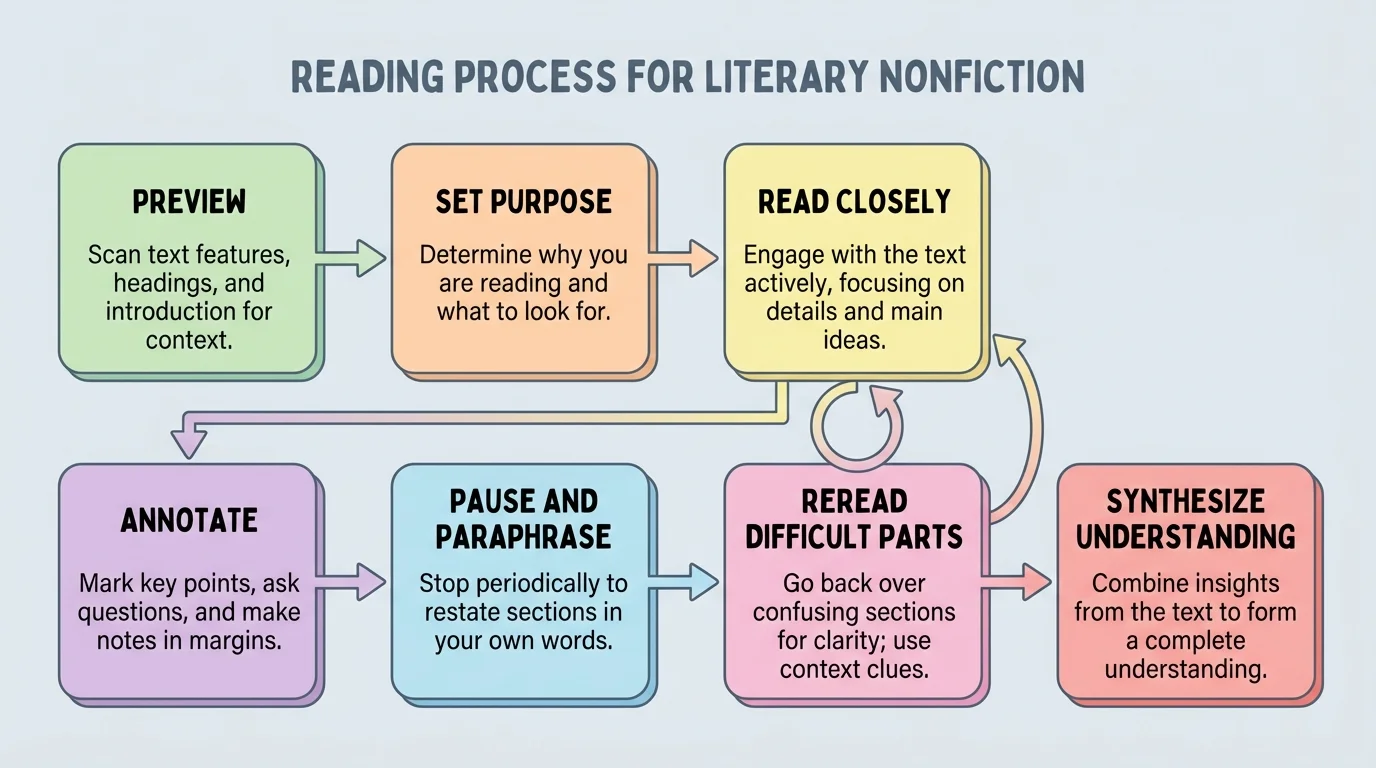
Annotation can be simple and powerful. You might underline a sentence that reveals the author's point of view, circle a repeated image, or write a short margin note such as "shift in tone" or "example supports claim." Annotation is not decoration. It is a visible record of thinking.
Good readers also adjust pace. Some passages should be read quickly to track the flow of events. Others require slow reading because each word matters. A reflective paragraph in a memoir may carry more meaning than three pages of action. Independence means knowing when to speed up, slow down, or reread without waiting for someone else to tell you.
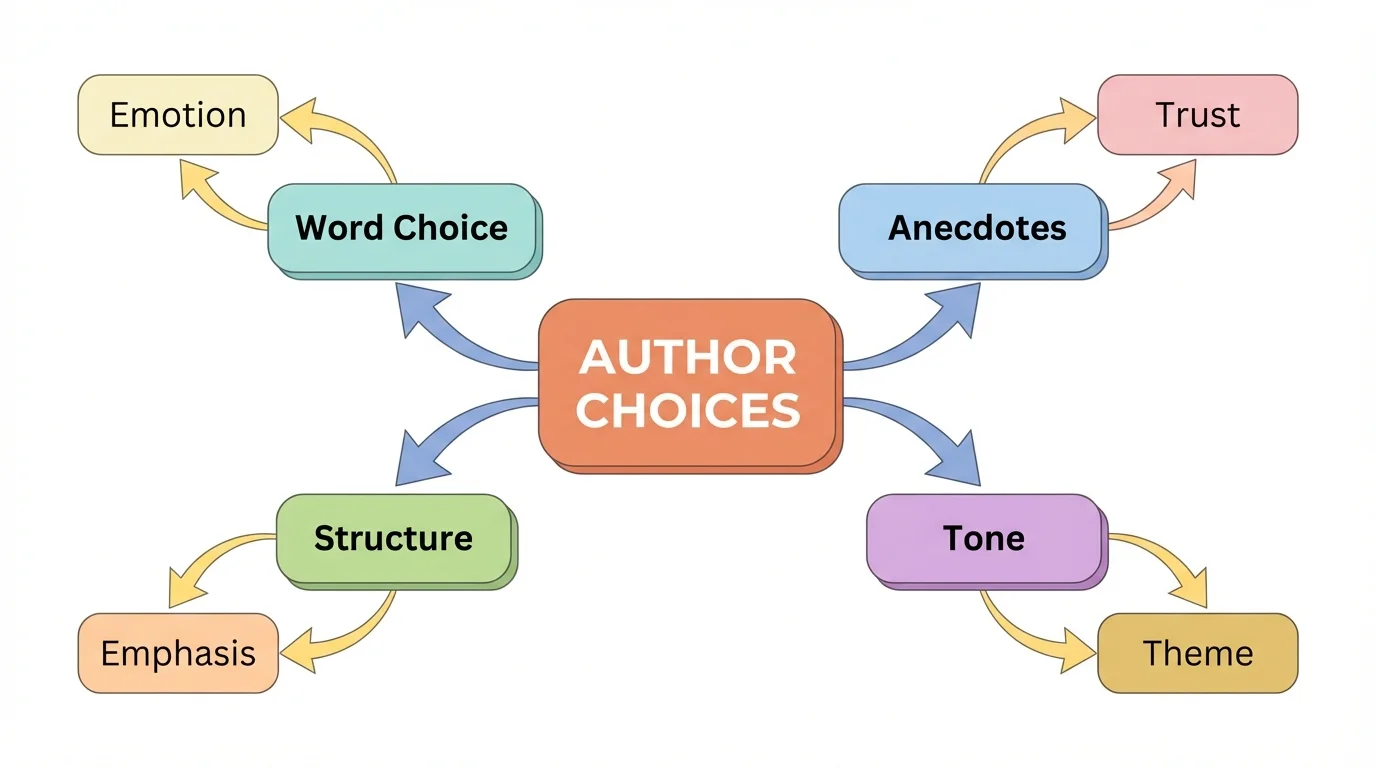
Literary nonfiction is built from deliberate choices, and [Figure 3] helps show how those choices affect readers. Authors choose where to begin, which details to include, what kind of language to use, and when to reflect. These decisions shape meaning just as much as the facts themselves.
One important choice is structure. A writer may tell events in chronological order to make growth easy to follow. Another may begin with a dramatic moment and only later explain how it happened. That kind of structure can create suspense or emphasize the importance of a single turning point.
Word choice matters too. Specific, vivid language can create mood and reveal attitude. If an author writes, "The hallway buzzed with whispers," the verb "buzzed" suggests anxiety, secrecy, or tension. If the author instead writes, "The hallway filled with conversation," the emotional effect is milder. Both could describe the same event, but the feeling changes.
An author's perspective also shapes the text. Perspective includes the writer's experiences, beliefs, and position in relation to the events. Two writers describing the same protest, storm, or school policy might present it differently because they value different things or were affected in different ways.
Another crucial choice is the use of anecdote. A single short true story can stand for a broader issue. In a personal essay about immigration, one moment in an airport may reveal fear, uncertainty, and hope all at once. The anecdote is not random. It is selected because it captures the larger meaning of the experience.
When you analyze literary nonfiction, ask questions such as: Why does the author open here? Why include this detail and not another one? Why does the tone shift from humorous to serious? Why does the author repeat this phrase? These questions move you from basic understanding to deeper interpretation.
Text analysis case study
Consider a memoir passage in which the writer describes learning to ride a bicycle with a parent running beside them.
Step 1: Identify the surface event.
The passage is literally about a child trying not to fall while learning a skill.
Step 2: Notice the author's choices.
The writer uses short sentences during the wobbly ride, includes the parent's shouted encouragement, and then slows down to reflect after the ride ends.
Step 3: Infer the deeper meaning.
The bicycle lesson may represent trust, growing independence, or the changing relationship between child and parent.
The event is real, but the author's craft turns it into more than a simple memory.
The same is true of speeches. Repetition can create emphasis and rhythm. Direct address can make the audience feel personally involved. A carefully placed contrast, such as hope versus fear or justice versus silence, can sharpen the message. As you saw earlier in [Figure 1], each form of literary nonfiction tends to rely on different craft moves, so your reading should adapt to the form.
Even skilled readers reach parts of a text that feel confusing. The goal is not to avoid difficulty. The goal is to know what to do when difficulty appears. One useful strategy is to break a passage into smaller units. Read one sentence, then ask what it adds. Read the next, then ask how it connects.
Context clues help with unfamiliar language. If you meet an unknown word in a paragraph about a crowded city street, the surrounding details may tell you whether the word suggests motion, noise, or danger. You do not always need a dictionary right away. Often, meaning becomes clear when you keep reading and gather evidence from the sentence and paragraph.
Inference is especially important in literary nonfiction. An inference is a conclusion you draw from evidence and reasoning. If a writer says, "My father folded the letter twice before putting it away," the action may suggest worry, disappointment, or careful control of emotion. The author may never say this directly. The reader must infer it.
Reading below the surface means connecting details, patterns, and omissions. Sometimes what an author leaves unsaid matters as much as what appears on the page. Silence around a topic can signal pain, uncertainty, or a decision to let readers infer the truth from surrounding details.
It also helps to track patterns. Repeated images, repeated words, or repeated situations usually matter. If water appears again and again in a memoir, it may symbolize danger, freedom, or change. If a writer repeatedly returns to one object, such as a photograph or pair of shoes, that object may represent memory, identity, or loss.
When comprehension breaks down, rereading is not a weakness. It is evidence of strong reading habits. Many complex texts reveal more on a second read because the first reading builds the basic path through the text, while the second reveals tone, pattern, and implication. The process shown in [Figure 2] remains useful here: pause, paraphrase, and return with a sharper purpose.
Because literary nonfiction is true writing shaped by a real author, readers should think about both artistry and reliability. An author may be honest and still limited. Memory can be selective. Perspective can be narrow. A writer may emphasize moments that support a theme and leave out others that complicate it.
Credibility refers to how trustworthy and believable a text or author seems. In literary nonfiction, credibility can come from specific detail, consistency, fair acknowledgment of complexity, and clear connection to real events. A writer who includes precise scenes, admits uncertainty, and avoids exaggerated claims often seems more reliable than one who makes dramatic statements without support.
At the same time, readers should watch for bias. Bias is not always dishonest; it often reflects a person's experiences or values. A narrator writing about a school rule they disliked may present events in a way that highlights unfairness while minimizing the reasons the rule existed. Recognizing bias does not mean dismissing the text. It means reading thoughtfully.
In speeches and essays, look for claims and support. Does the author use examples, facts, personal experience, or emotional appeal? Are those choices effective for the audience and purpose? A moving anecdote may be powerful, but one anecdote alone does not prove a broad claim. Readers should appreciate the craft while still asking whether the reasoning is sound.
From earlier reading work, remember the difference between central idea and supporting detail. In literary nonfiction, supporting details often do double duty: they support the idea and also create mood, reveal character, or shape tone.
This balance is important. Literary nonfiction asks you to be both a literary reader and a critical thinker. You are not just asking, "What is the author saying?" You are also asking, "How is the author saying it?" and "How much should I trust this presentation?"
By the end of the year, reading independently and proficiently means you can handle a range of challenging texts without depending on constant guidance. That includes memoir excerpts with shifts in time, speeches with dense rhetoric, essays with subtle claims, and narrative journalism with multiple sources and perspectives.
Proficiency does not mean every sentence feels easy. It means you can persist through difficulty, apply strategies, and arrive at a clear, supported understanding. You can identify the central idea, explain how the author develops it, analyze important literary elements, and evaluate the author's choices with evidence from the text.
For example, in a speech, you should be able to explain how repetition strengthens a call to action. In a memoir, you should be able to explain how one scene reveals a larger life lesson. In a narrative article, you should be able to explain how factual reporting and storytelling techniques work together. Those are signs that you are not just reading the words. You are comprehending the text at a high level.
"The strongest readers are not the fastest readers. They are the ones who notice, question, connect, and return to the text."
Texts at this level may challenge you with unfamiliar settings, historical context, or implied meaning, but they reward close attention. The relationship map in [Figure 3] still applies across all of these forms: author choices produce reader effects, and understanding those effects is part of real comprehension.
Independence grows from habits. Keep track of confusion instead of hiding it. Mark passages that seem important. Ask questions as you read. Notice when the text shifts from narrative to reflection or from description to argument. These habits help you stay active instead of passive.
Stamina matters too. Complex literary nonfiction often asks for sustained attention. If you stop mentally after the first difficult paragraph, you lose the thread. But if you keep working, paragraph by paragraph, the structure usually begins to reveal itself. Ideas connect. Patterns emerge. Meaning becomes more precise.
Confidence should come from evidence, not guessing. When you make a claim about a text, support it with details from the passage. If you think the tone changes, point to the words that create the change. If you think an anecdote represents a larger theme, explain how. Independent reading is not reading alone without thought. It is reading with enough skill to guide your own understanding.
Over time, the goal is to become the kind of reader who can enter a challenging true text, recognize its form, adjust strategies, analyze craft, evaluate ideas, and leave with a deeper understanding of both the subject and the writing itself. That is what it means to read literary nonfiction independently and proficiently.
