Two texts can tell about loss, courage, or change and still feel completely different. One may move step by step like a straight road. Another may begin with the ending, jump backward, and slowly reveal what happened. That difference is not just decoration. It changes what readers notice, what they feel, and what the author emphasizes. When readers compare structure, they begin to see how writers build meaning instead of only what writers say.
Text structure is the way a writer organizes ideas, events, details, or perspectives in a piece of writing. It acts like the framework of a building: readers may first notice the windows and color, but the framework holds everything together. In literature, structure can control suspense, reveal character, highlight conflicts, or create surprise. In informational writing, structure can guide explanation, show relationships among ideas, or make an argument easier to follow.
When you compare two texts, you should not stop at saying one is "different." Strong analysis explains how they are different and why that difference matters. For example, if one text tells events in order and another uses flashbacks, the first may feel clear and steady while the second may feel mysterious or reflective. The structure shapes both meaning and style.
Meaning is the message, idea, or understanding a reader takes from a text. Style is the way a writer expresses ideas, including tone, word choice, pacing, and organization. Compare and contrast means to explain similarities and differences in a clear, specific way.
That is why structure belongs in literary analysis. It helps readers move beyond plot summary and into an author's craft. Instead of saying, "Both texts are about friendship," you can say, "Both texts explore friendship, but one uses a framed narrative to show memory while the other uses a linear sequence to show growth over time." That kind of statement shows deeper reading.
Structure includes the order of events, the placement of details, the use of sections or stanzas, the shifts in time, and the arrangement of points of view. In a short story, structure may involve exposition, rising action, climax, and resolution. In a poem, structure may depend on line breaks, repeated phrases, or contrasting stanzas. In an essay, structure may be cause and effect, problem and solution, or comparison and contrast.
A writer's choices about structure are rarely accidental. If an author places a shocking event at the beginning, readers ask questions immediately. If a memoir circles between present and past, readers experience memory as layered and emotional. If an article begins with a problem before giving evidence and solutions, readers focus first on urgency. The structure tells readers how to travel through the text.
Remember that theme is not the same as structure. Theme is the central idea about life or human experience. Structure is the arrangement of the text. Two texts can have a similar theme but a very different structure.
Also, structure is not exactly the same as genre. A mystery novel and a historical novel are genres, but each can use different structures. A mystery may begin with the crime and move forward, or it may begin after the crime and reveal clues through flashbacks. Genre gives expectations; structure shapes the path.
Readers can compare texts more effectively when they know the names of common organizational patterns, as [Figure 1] shows through a side-by-side visual of major structures. Some texts use one main pattern, while others combine several. Authors often mix structures on purpose to create complexity.
Chronological structure presents events in time order. This structure often creates clarity and a sense of progression. Flashback interrupts the present action to show an earlier event. This can reveal motives, explain a conflict, or create suspense by delaying information. Framed narrative places one story inside another, often making the inner story feel like a memory, lesson, or confession.
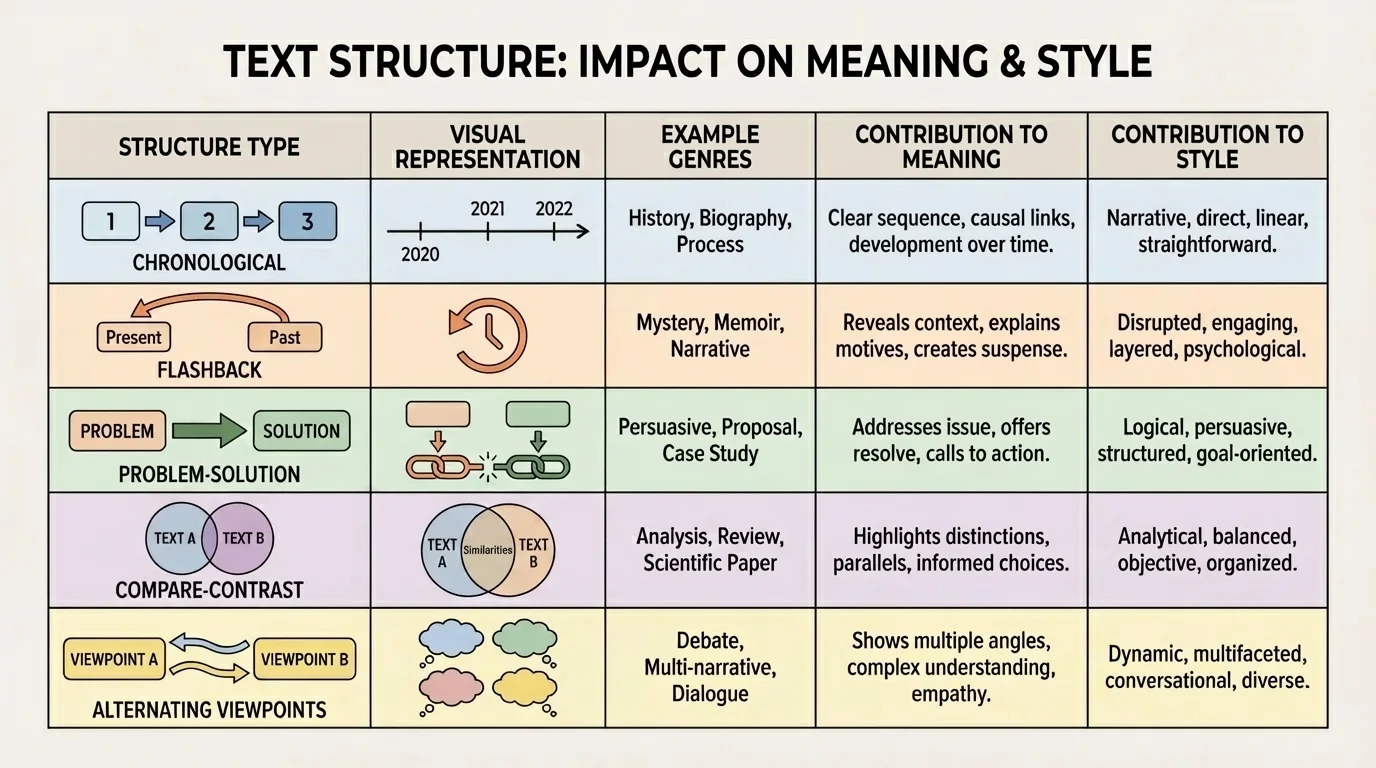
Alternating viewpoint shifts between different narrators or perspectives. This structure can reveal that truth looks different depending on who is speaking. Parallel plots follow two or more storylines that echo, contrast, or eventually connect with one another. Circular structure ends where it began, often giving readers a sense of reflection, change, or irony.
Informational texts also rely on recognizable structures. Cause and effect explains why something happens and what results from it. Problem and solution introduces an issue and then explores ways to address it. Compare and contrast places subjects side by side to show similarities and differences. Description focuses on characteristics or features, while sequence explains steps or stages in order.
One text may blend literary and informational patterns. For example, a nonfiction article about a wildfire might begin with a dramatic chronological scene from the fire, shift into cause and effect to explain why the fire spread, and finish with problem and solution to discuss prevention. That mixture creates both emotional impact and clear explanation.
The order in which a writer gives information changes what readers understand and when they understand it. The sequence itself can create meaning, as [Figure 2] illustrates by arranging the same event in two different ways. If a story opens with a teenager standing alone outside a courtroom, readers immediately sense seriousness and mystery. If the same story begins weeks earlier at a family dinner, the meaning shifts. The first version emphasizes consequences; the second emphasizes causes.
Writers use structure to control revelation. A delayed detail can turn an ordinary scene into a surprise. A flashback can show that a character's anger comes from fear or grief. Alternating viewpoints can reveal misunderstanding between characters. A poem that repeats one line at the end of each stanza may make the idea feel haunting or unavoidable.
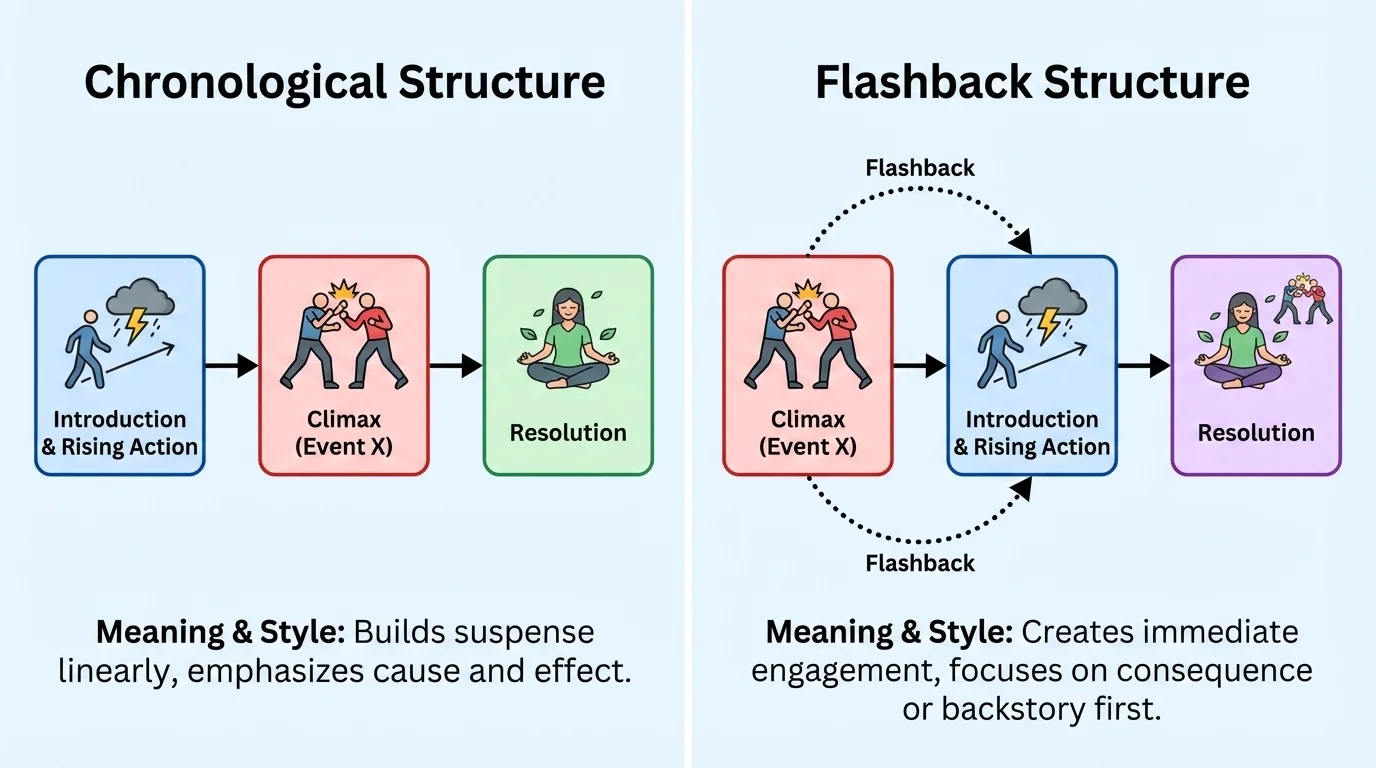
Consider two short narratives about a storm. Text A begins with dark clouds, then rising wind, then flooding, then rescue. Text B opens with the rescue boat in the middle of chaos and only later explains how the storm developed. Text A gives readers a sense of steady buildup. Text B creates urgency first and explanation second. The basic event is similar, but the meaning changes because the emphasis changes.
Meaning also comes from what a structure highlights. In a memoir that returns again and again to one childhood object, the repeated structure suggests that memory is not random; it circles around moments that still matter. In a speech that begins with a personal story before presenting facts, the structure signals that the issue is both human and political.
Structure as emphasis
Authors cannot underline every important idea, so they use structure to guide attention. Beginnings, endings, repeated patterns, and sudden shifts tell readers where to focus. If a text saves a crucial detail for the end, the author makes that detail feel powerful. If a text opens and closes with the same image, the author creates a sense of completion, change, or contrast.
Because of this, a strong comparison asks not only "What structure does each text use?" but also "What idea becomes more important because of that structure?"
Style is not only about fancy words. The shape of a text affects how it sounds and feels. A linear narrative may feel calm, direct, and traditional. A fragmented narrative with short sections and jumps in time may feel tense, modern, or emotionally unsettled. The structure influences pacing, which is the speed and rhythm with which a text unfolds.
For example, short scenes that cut back and forth between two characters can create quick pacing and tension. Long descriptive sections between major events can slow pacing and make readers reflect. A poem with abrupt line breaks may feel sharp or restless, while a poem with repeating long lines may feel musical and controlled.
Structure also affects tone, the author's attitude toward the subject. A speech that builds in a clear pattern from problem to evidence to call for action often sounds confident and purposeful. A personal essay that drifts among memories may sound thoughtful or intimate. When comparing texts, notice how the structure supports the emotional effect of the language.
Some famous novels were originally published in parts over time. That publication structure influenced the writing itself, because authors often ended sections with suspense to keep readers waiting for the next installment.
As a result, structure and style work together. One is the arrangement; the other is the effect of that arrangement combined with language. Readers who notice both can explain why two texts on the same subject feel so different.
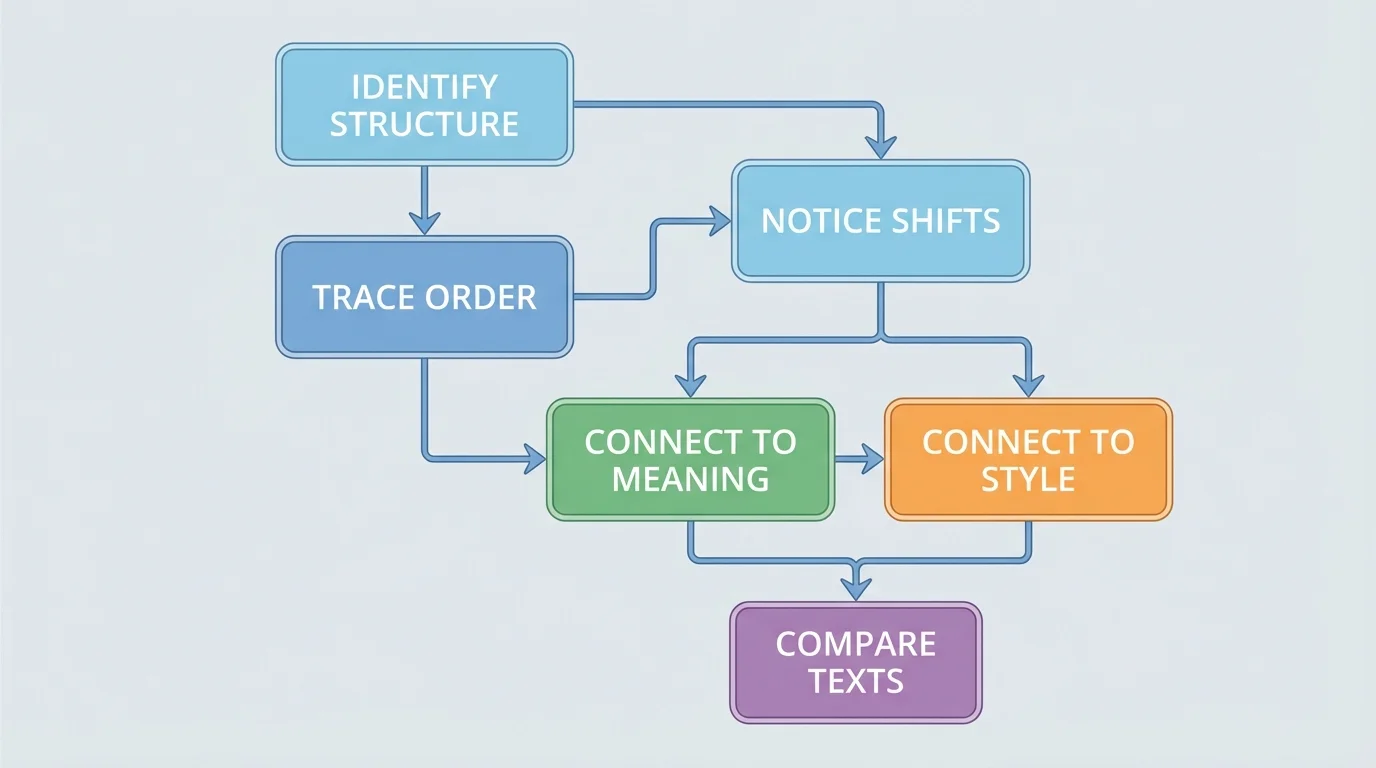
When comparing structures, readers need a method, and [Figure 3] lays out a useful sequence of moves. Start by identifying how each text is organized. Then trace how the text moves from one part to another. After that, connect those choices to meaning and style. This process keeps analysis focused and specific instead of vague.
Ask these questions: Does the text move in time order, or does it jump? Does it focus on one perspective or several? Does it repeat any images, lines, or ideas? Where does it begin, and why? Where does it end, and what effect does that ending create? The answers help you compare how each author builds the text.
Comparison method with two fictional texts
Suppose Text A is a memoir excerpt about learning to swim, and Text B is a poem about water and fear.
Step 1: Identify each structure.
Text A uses chronological order, moving from the first swimming lesson to eventual confidence. Text B uses repeated images and shifting memories rather than a straight timeline.
Step 2: Notice what each structure emphasizes.
The memoir emphasizes growth over time. The poem emphasizes the emotional experience of fear, because it circles around the same feeling instead of moving steadily forward.
Step 3: Connect structure to style.
The memoir feels clear and reflective. The poem feels intense and layered. Their different structures create those different styles.
Step 4: Write the comparison.
A strong statement might be: "Both texts explore fear connected to water, but the memoir's chronological structure highlights gradual progress, while the poem's repetitive, non-linear structure makes fear feel ongoing and hard to escape."
This method works for stories, poems, speeches, articles, and essays. The goal is not merely to label a structure but to explain its effect.
Now consider two short fictional prose texts about a neighborhood blackout. Text One begins before sunset, shows the lights going out, follows families through the evening, and ends when power returns at dawn. Text Two opens with a child staring at a dark apartment window and then shifts through flashbacks about earlier blackouts and memories of a grandparent. Both texts describe a blackout, but they are built differently.
Text One uses a mostly linear structure. That makes the event feel shared and immediate. Readers experience the blackout as it unfolds. The meaning centers on community and adaptation: people respond together in real time. The style feels steady, realistic, and grounded in action.
Text Two uses a layered structure. The blackout becomes more than one event; it triggers memory. The meaning focuses less on the outage itself and more on how present experiences connect to the past. The style feels reflective and intimate. We can see, as in [Figure 2], that rearranging time changes the reader's emotional path through the same basic situation.
Here is another comparison: a poem and an editorial both address pollution in a river. The poem is organized through repeated images of stained water, dead fish, and silence along the bank. The editorial uses problem and solution: it identifies pollution, presents evidence, and argues for stronger regulation. The poem's structure creates mood and emotional pressure. The editorial's structure creates logic and urgency. Both aim to persuade in a way, but they do so through very different structural choices.
| Text Pair | Structure of Text A | Structure of Text B | Effect on Meaning | Effect on Style |
|---|---|---|---|---|
| Memoir and poem about water | Chronological | Repetitive, non-linear | Growth versus ongoing fear | Clear reflection versus intensity |
| Two blackout narratives | Linear sequence | Flashbacks and memory shifts | Community event versus personal memory | Steady realism versus introspection |
| Poem and editorial on pollution | Image-based repetition | Problem and solution | Emotional impact versus logical argument | Lyrical mood versus direct persuasion |
Table 1. Comparison of different text structures and their effects on meaning and style.
Notice that in every pair, topic alone is not enough. If you only say that both texts are about water, blackout, or pollution, you miss the author's craft. Structure reveals how the author wants readers to think and feel.
To analyze structure deeply, ask questions that move beyond labels. Where does the text begin, and what does that beginning make readers expect? What does the author hold back? What repeats? What shifts? Does the ending resolve the text, circle back to the opening, or leave readers unsettled? Why might the author have chosen that pattern instead of another one?
Strong readers also compare the reader's experience across texts. Which text creates suspense faster? Which text feels more balanced or more fragmented? Which one makes the reader discover meaning slowly, and which one states ideas directly? This comparison process remains useful here because it reminds readers to connect observation to effect.
"The beginning is the most important part of the work."
— Often attributed to Plato
This quotation matters because beginnings often reveal structural intention. A text that begins at the climax tells readers to focus on consequences and questions. A text that begins far earlier may be more interested in causes, growth, or background.
One common mistake is confusing structure with plot. Plot is what happens. Structure is how the author arranges what happens. Two stories can have nearly identical plots but different structures. Another mistake is using structure words without explaining their effects. Saying "Text B uses flashback" is only the start. A stronger analysis explains that the flashback reveals character motivation or delays key information to build suspense.
A third mistake is comparing texts too generally. Statements like "Both texts are organized differently" or "One is better" are weak because they are vague or unsupported. Clear comparison names the structures, points to evidence, and explains the result. You should be able to show where the text shifts and what that shift does.
Weak analysis vs. strong analysis
A weak response might say: "The texts have different structures, and that changes the story."
A stronger response would say: "Although both texts describe a family argument, the first text uses chronological order to show how tension builds across the evening, while the second begins after the argument and uses flashbacks to reveal regret. This makes the first text feel immediate and the second feel reflective."
Specificity is the difference between basic observation and real analysis.
When you write about structure, begin with a claim that names both texts and identifies a meaningful difference or similarity. Then include evidence from each text: a repeated phrase, a shift in time, a change in narrator, the placement of a scene, or the order of ideas. Finally, explain how those details affect meaning and style.
A useful sentence frame is: "While both texts address ________, Text A uses ________ structure to emphasize ________, whereas Text B uses ________ structure to emphasize ________. As a result, Text A feels ________, while Text B feels ________." This kind of sentence helps connect structure to interpretation.
You do not need to use complicated vocabulary to sound insightful. Clear thinking matters more than fancy words. Still, certain terms can help when they are accurate: chronological order, flashback, framed narrative, and alternating viewpoint. Use them when they truly describe the text.
As you continue reading, remember that structure is one of the author's strongest tools. It can hide or reveal, speed up or slow down, divide voices or blend them, create order or confusion. When you compare the structure of two or more texts, you begin to see not only what each text says, but how each text is built to say it in a particular way.
