Two articles can discuss the same event, the same person, or the same scientific issue and still leave readers with very different ideas. One article may say a historical leader was a hero, while another says the same person caused serious harm. One report may claim a disaster happened because of human error, while another blames technology. Learning to notice those conflicts is one of the most powerful reading skills you can build, because real-world reading is not just about understanding one text. It is about comparing many texts and deciding what to trust.
When you analyze conflicting information, you do more than spot a disagreement. You figure out what the texts disagree about, whether the disagreement is about a provable detail or about meaning, and what evidence each author uses. This kind of reading matters in news, science, history, discussions of health, and everyday online life. It helps you avoid being misled by strong language, missing evidence, or one-sided claims.
Conflicting information happens when two or more texts present different claims about the same topic.
Fact means a detail that can usually be checked or verified, such as a date, number, location, or action.
Interpretation is an explanation of what something means, why it happened, or how it should be understood.
Claim is the main point or argument an author wants readers to accept.
A strong reader understands that not all conflicts are equal. Sometimes one text says an event happened in one year and another says it happened in a different year. That is a conflict about fact. Other times both texts agree on the event itself, but one author says it was caused by greed while another says it was caused by fear. That is a conflict about interpretation. The first can often be checked directly. The second usually requires examining reasoning and evidence.
Texts conflict for many reasons. Authors may use different sources. They may write at different times, after new evidence has appeared. They may have different purposes, such as informing, persuading, or entertaining. They may also carry bias, which means they favor one side, idea, or group more than another. Bias does not always mean a text is false, but it can shape what the author includes, leaves out, or emphasizes.
Suppose two texts discuss school uniforms. One text focuses on studies showing uniforms can reduce distractions. Another text focuses on student voices arguing that uniforms limit self-expression. These texts might not disagree on every detail. In fact, they may both agree that uniforms exist in many schools. The conflict appears in what they emphasize and in the conclusion they want readers to draw.
Even professional historians and scientists sometimes disagree for years. The disagreement is not always a problem; sometimes it is how knowledge improves, because people keep testing ideas against better evidence.
Another reason for conflict is that authors sometimes define the topic differently. For example, if two articles discuss whether social media is "harmful," one may focus on sleep loss and anxiety, while another measures only the ability to stay connected with friends. Because they are using different ideas of harm, they may seem to disagree even before they present any evidence.
To compare texts well, you need to separate facts from interpretations. A claim is what the author argues. A fact is a detail that can be checked. An interpretation explains the significance of those facts. Skilled readers ask, "What is the author saying happened?" and also, "What is the author saying it means?"
Consider these two statements about the same protest: "About 2,000 people attended the protest" and "The protest showed growing public frustration." The first statement is a fact claim that can be checked using reports, photos, or official counts, though even those sources may vary. The second statement is an interpretation. It explains the event's meaning. It cannot be verified in exactly the same way, but it can still be supported or challenged with evidence.
Same evidence, different meaning
Sometimes two authors use many of the same facts but reach different conclusions. For example, both may mention a rise in the use of electric cars. One author may interpret that as proof of environmental progress, while another may interpret it as evidence of pressure on mining and power systems. When this happens, the disagreement is less about the facts themselves and more about how the facts are framed and connected.
You should also watch for mixed cases. A text may include both factual disagreement and interpretive disagreement. One author might say a law passed in 2019, while another says it passed in 2020. That is factual. Then one may call the law a major success while another calls it mostly symbolic. That is interpretive. In real reading, both kinds of disagreement often appear together.
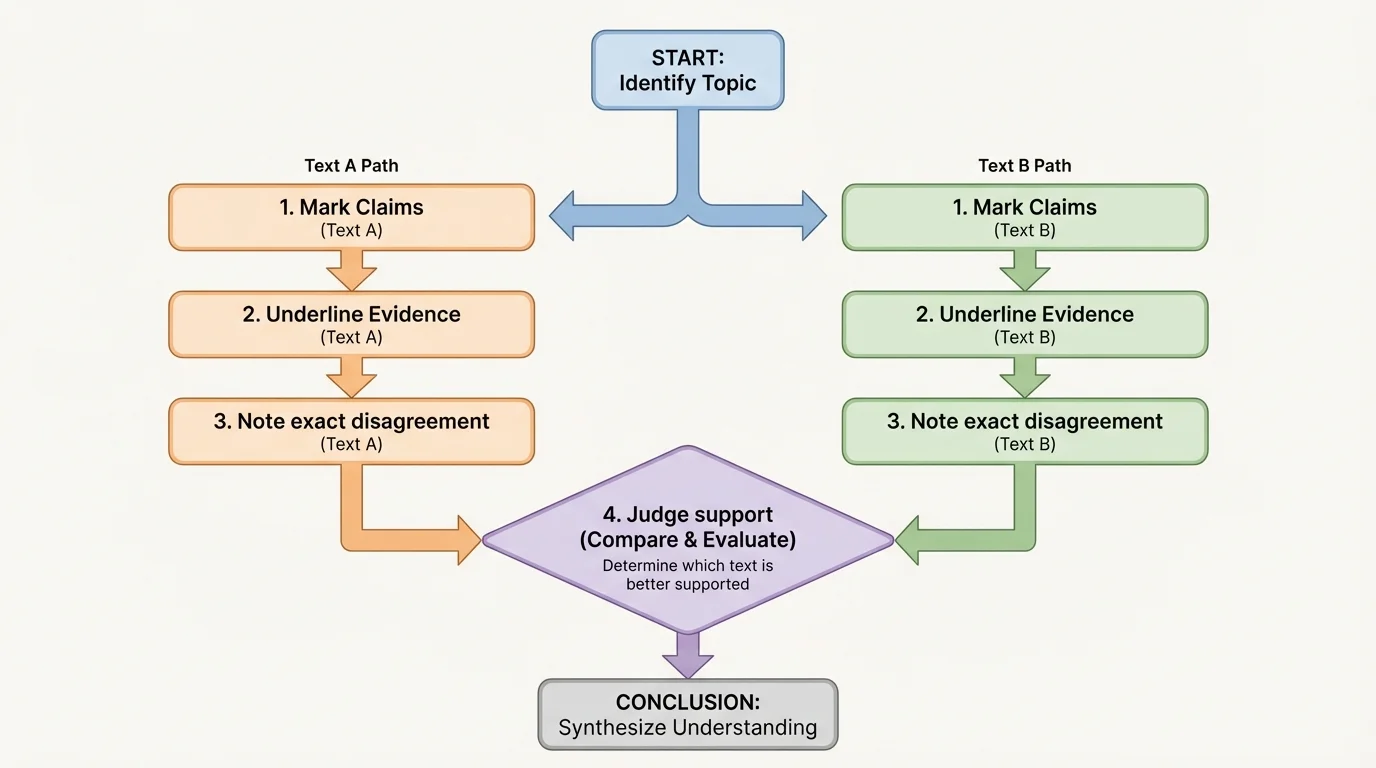
[Figure 1] When comparing two texts, a clear routine helps you track where the conflict appears through a simple comparison process. First, make sure both texts are truly about the same topic. Then identify each author's main point. After that, look for the exact sentences where the authors make claims about cause, effect, importance, or evidence.
Next, underline or note details such as dates, statistics, quotations, names of experts, and descriptions of events. These details help you decide whether the disagreement is about fact or interpretation. If Text A says a medicine was tested on 500 patients and Text B says it was tested on 300, the conflict is factual. If both agree on the number of patients but disagree about whether the medicine was successful, the conflict is about interpretation.
One useful method is to ask five comparison questions: What topic do both texts discuss? What does each author claim? What evidence does each author use? Where do the claims or details differ? Which differences are factual, and which are interpretive? This process slows your reading in a good way. Instead of reacting to the loudest voice, you become a careful investigator.
Another helpful strategy is to compare not only what the texts say, but what they leave out. If one article about climate change discusses temperature records and scientific studies, while another focuses only on short-term weather changes in one city, the second text may not directly refute the first. It may simply ignore stronger evidence. Missing evidence can create a misleading sense of disagreement.
You should also pay attention to whether the authors are discussing the same time period and the same group. A text about "teen screen time" in one country may not be directly comparable to a text about "all screen users" worldwide. If the subject changes, what looks like a conflict may actually be a mismatch in scope.
[Figure 2] History often includes disagreement because authors select different causes and assign different levels of importance to them. Consider two short texts about the sinking of the Titanic. Text A says the ship sank quickly mainly because it struck an iceberg that tore open too many compartments. Text B agrees that the iceberg caused the damage, but argues that poor decisions by the crew and the ship's speed in icy waters were the more important reasons for the disaster.
At first, these texts may seem to say the same thing, because both mention the iceberg. But the disagreement becomes clearer when you line up the claims side by side. Text A emphasizes physical damage to the ship. Text B emphasizes human decision-making before the collision. The basic event is shared, but the main cause is interpreted differently.
Now look more closely. If Text A states that six compartments flooded and Text B states that five compartments flooded, the texts disagree on a matter of fact. That detail can be checked against reliable historical records. But if Text A says the sinking was "mostly unavoidable" and Text B says it was "largely preventable," the disagreement is interpretive. Each text is explaining responsibility and meaning, not just reporting a number.
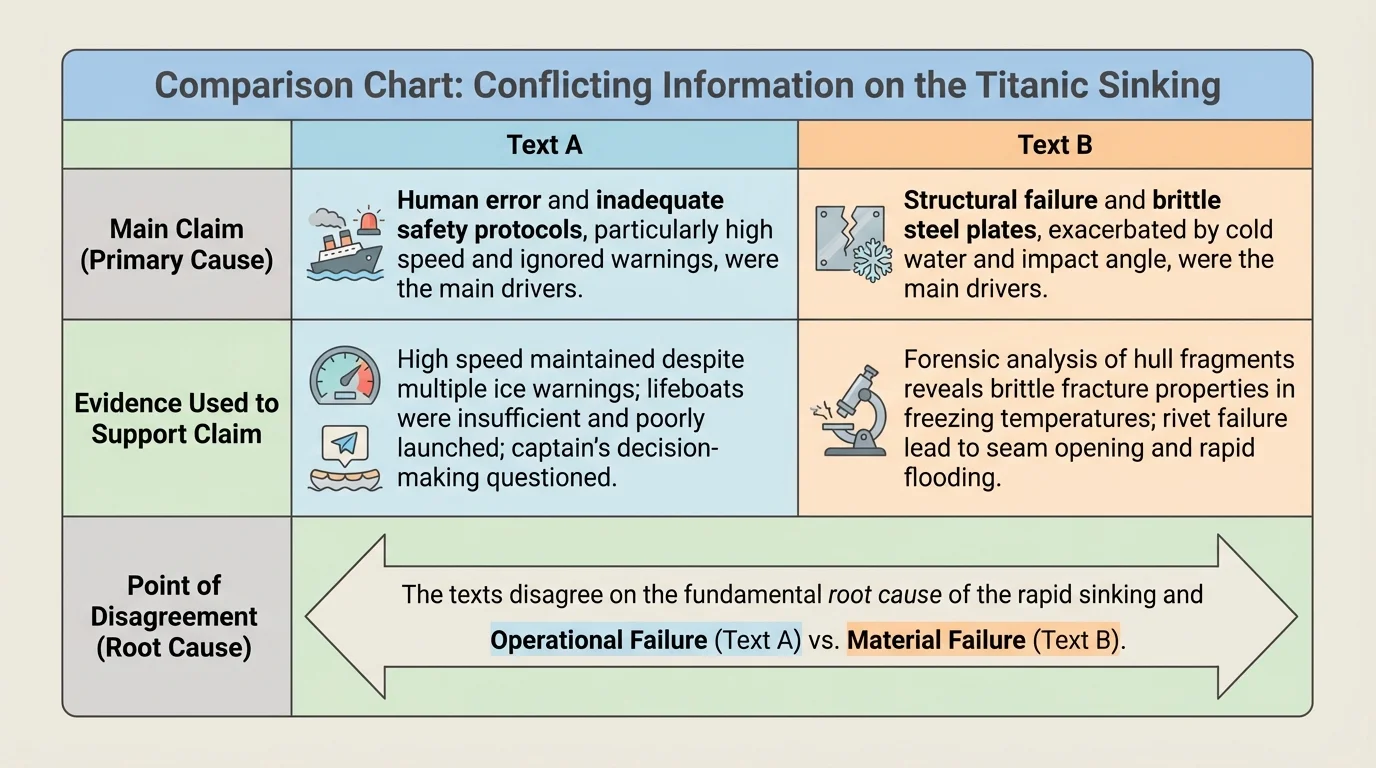
Suppose Text A uses engineering reports and diagrams of the ship's compartments, while Text B uses survivor accounts and records of warnings about ice. In that case, the texts are not just disagreeing; they are building their ideas from different kinds of evidence. This matters because different evidence types answer different questions. Engineering reports may explain how the ship filled with water. Survivor reports may explain what people knew and how they reacted.
Case analysis example
A student compares the two Titanic texts and wants to identify the disagreement clearly.
Step 1: State the shared topic.
Both texts discuss why the Titanic sank so quickly after hitting an iceberg.
Step 2: Identify each text's main claim.
Text A claims the main reason was the ship's physical damage. Text B claims the more important reason was human decision-making, especially speed and ignored warnings.
Step 3: Separate factual disagreement from interpretive disagreement.
If the texts give different numbers of flooded compartments, they disagree about fact. If they disagree about whether the disaster was unavoidable or preventable, they disagree about interpretation.
Step 4: Name the evidence used.
Text A relies more on technical evidence, while Text B relies more on records of choices and warnings.
A strong analysis might say: "The texts agree that the iceberg caused the damage, but they disagree about the most important cause of the fast sinking. Text A emphasizes structural damage, while Text B emphasizes human error."
This kind of analysis is precise because it does not simply say, "The texts are different." It explains exactly how they differ. That precision is what strong readers and strong writers aim for.
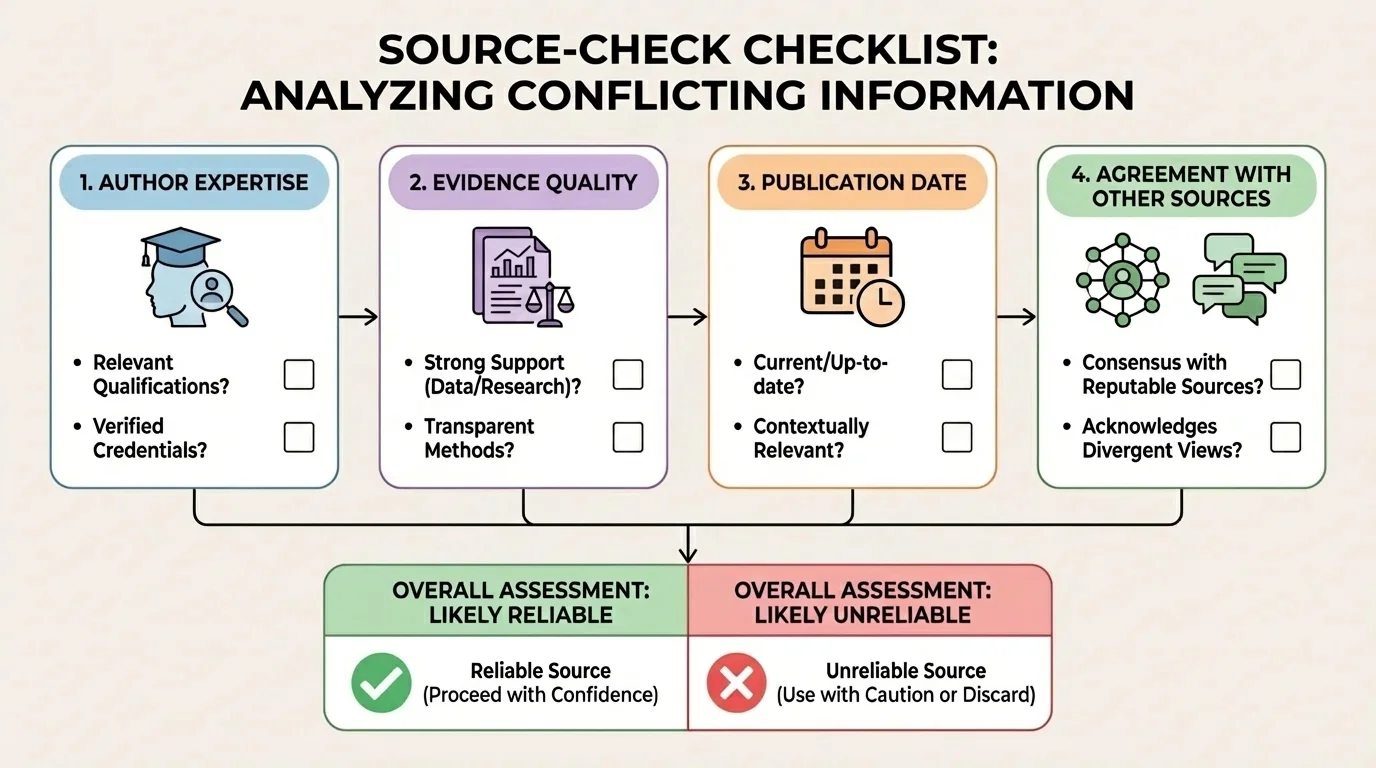
[Figure 3] Once you have identified the conflict, the next question is whether one text is better supported. A source-check routine helps readers judge reliability by focusing on four main areas: author expertise, quality of evidence, date, and corroboration. Corroboration means checking whether other trustworthy sources support the same idea.
Start with the author. Is the writer a historian, scientist, journalist, witness, or anonymous poster? Expertise matters, though it is not the only factor. Next, look at evidence. Does the author cite documents, studies, interviews, or direct observations? Are sources named? Then consider the date. On some topics, newer evidence may be stronger because knowledge changes. Finally, compare the text with other reliable sources. If one article stands alone while several credible sources support a different view, that tells you something important.
Reliable texts also tend to acknowledge complexity. They may admit uncertainty, discuss counterarguments, or explain limits in the evidence. A weak text often sounds completely certain while giving little proof. Confidence is not the same as quality.
Think back to the Titanic example. If a museum archive, a naval historian, and multiple historical records support the number of flooded compartments given in Text A, while Text B gives a different number without naming any source, then Text A is stronger on that factual point. But Text B might still offer a thoughtful interpretation about human error if it uses warning records and testimony well. One text can be stronger on facts while another raises a valuable interpretation. Careful readers can hold both ideas at once.
When you evaluate evidence, remember skills you already use in close reading: identify the author, note the purpose, trace the source of details, and ask whether the evidence truly supports the conclusion.
This is also where corroboration becomes especially useful. Checking across several reliable sources helps you avoid choosing a side too quickly. If multiple trustworthy texts agree on a fact, that fact becomes more dependable. If reliable texts still disagree in interpretation, you may need to explain both views rather than pretend there is only one.
Authors do not only disagree through facts and evidence. They also shape readers' responses through word choice. Compare these two sentences about the same inventor: "She was a stubborn dreamer who ignored realistic limits," and "She was a determined innovator who challenged accepted limits." The factual core may be similar, but the framing is very different. One sounds negative; the other sounds admiring.
Bias often appears in this kind of language. Words such as reckless, brave, wasteful, essential, radical, or responsible can push readers toward a judgment before the evidence is fully examined. This does not mean emotional or strong language is always wrong. It means readers should notice when language is doing persuasive work.
Framing changes interpretation
Framing is the way an author presents a topic so readers see it from a certain angle. Two texts can include many of the same facts yet guide readers toward very different conclusions by changing emphasis, sequence, and tone. That is why comparing wording matters as much as comparing details.
For example, two texts might agree that a city replaced old streetlights with LEDs. One text may frame this as a smart energy decision that saves money and reduces pollution. Another may frame it as an expensive project that changed the city too quickly. The disagreement is not just in facts. It is in the meaning attached to those facts.
When you explain disagreement between texts, your job is to be accurate and fair. Begin by stating the shared topic. Then name each text's main claim. After that, point to the exact place where they disagree. Finally, identify whether the disagreement is factual, interpretive, or both.
Strong analysis uses sentence patterns such as these: "Both texts discuss ___, but they disagree about ___." "Text A claims ___, while Text B argues ___." "The texts differ on the fact of ___." "The texts interpret ___ differently because Text A emphasizes ___ and Text B emphasizes ___." These patterns help you stay focused and avoid vague statements.
Model analytical paragraph
Both texts examine the impact of wolves returning to a national park, but they disagree about how positive that impact has been. One text argues that the wolves restored balance by reducing deer populations and overgrazing, while the other argues that the return of wolves created new problems for ranchers near the park. The texts do not mainly disagree about whether wolves returned; they disagree about how the results should be interpreted. The first author emphasizes ecosystem evidence, while the second emphasizes economic effects on people.
Notice what makes that paragraph strong. It identifies the common topic, separates fact from interpretation, and names the evidence each side emphasizes. It does not insult either author or choose a side without support. It explains the disagreement clearly.
One common mistake is saying two texts disagree when they simply focus on different parts of a big topic. If one text discusses the causes of a war and another discusses its aftermath, they may not actually conflict. Another mistake is treating all details as equally important. Sometimes two texts differ in small details but agree on the main idea. Other times they share many facts but clash over a major interpretation.
A third mistake is confusing evidence with conclusion. A student might write, "The texts use different evidence, so they disagree." Different evidence does not always mean disagreement. Authors may use different evidence to support the same claim. What matters is whether their claims or meanings conflict.
Finally, avoid assuming that the louder, more dramatic text is stronger. Careful support, trustworthy sourcing, and fair reasoning matter more than dramatic wording. The best readers stay calm, compare closely, and follow the evidence.
"The important thing is not to stop questioning."
— Albert Einstein
That idea fits this reading skill perfectly. When texts conflict, questioning is not a sign of confusion. It is a sign that you are reading actively and intelligently. Instead of accepting the first version you see, you investigate what each author says, how each author supports it, and where the disagreement truly lies.
