Some of the most powerful writing you read online, in books, in speeches, or even in school publications did not begin as polished work. It began as a messy first draft. Skilled writers are not people who magically get every sentence right the first time. They are people who know how to build writing: by planning, revising, editing, rewriting, and sometimes completely changing direction when the first approach is not working.
That matters because writing is not just about putting words on a page. It is about making choices for a specific reason and for a specific reader. A text message to a friend, a letter to a school administration, an opinion article, and a literary analysis may all discuss important ideas, but they do not sound the same. Strong writers learn to ask: What am I trying to accomplish? Who needs to understand this? What matters most?
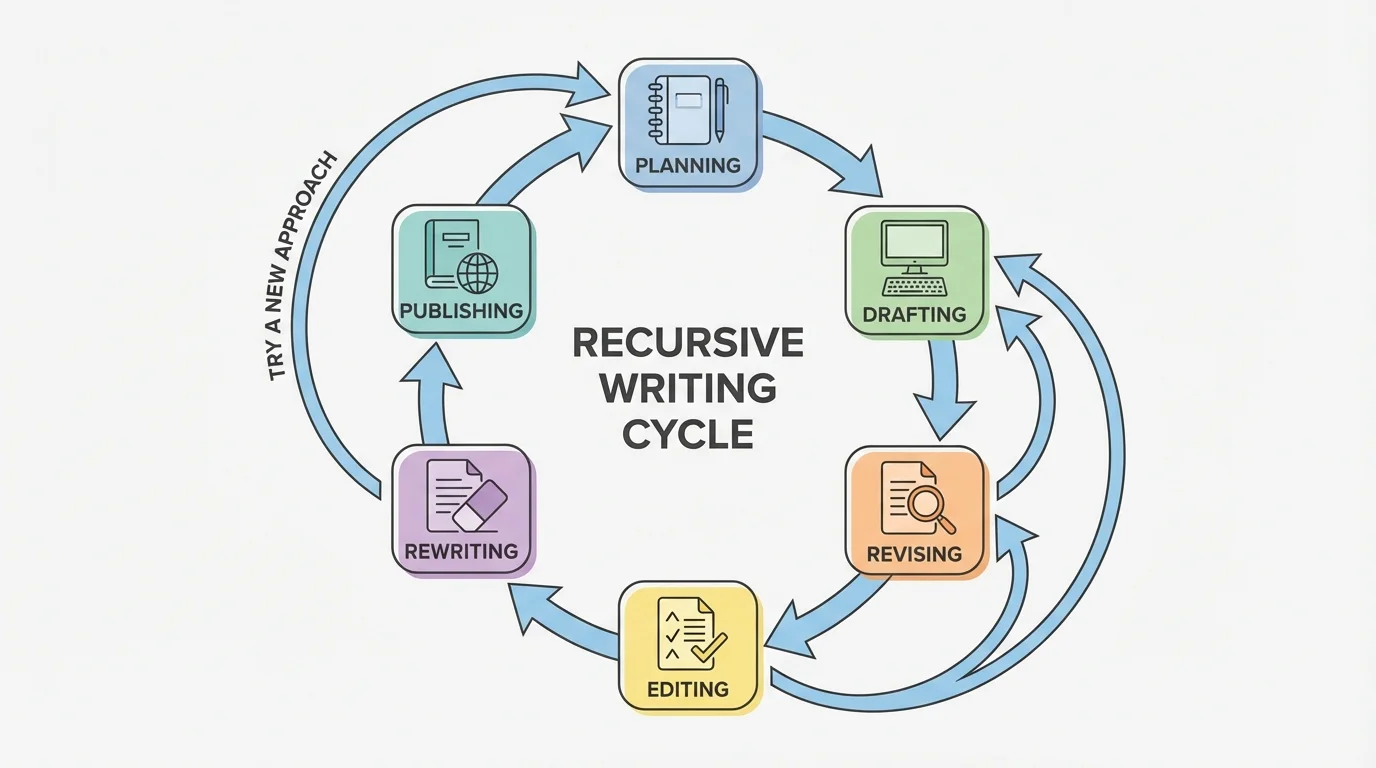
Writing improves through a process, not through luck. A first draft helps a writer discover ideas. A second draft helps shape them. Later drafts help sharpen, clarify, and correct them. This is why effective writing is often called a recursive writing process: writers return to earlier stages when needed instead of moving in a perfect straight line.
For example, a student writing an argument about later school start times might begin by listing reasons, draft an introduction, realize the evidence is weak, return to research, reorganize the paragraphs, cut repeated points, and then edit grammar at the end. That writer is not "doing it wrong." That writer is doing what real writers do.
Planning means preparing ideas, goals, evidence, and structure before or during drafting. Revising means improving the content, organization, and clarity of a piece. Editing means correcting errors in grammar, punctuation, spelling, and formatting. Rewriting means creating part or all of a draft again in a stronger form. A new approach means changing the strategy, structure, perspective, or genre when the current one does not fit the purpose or audience.
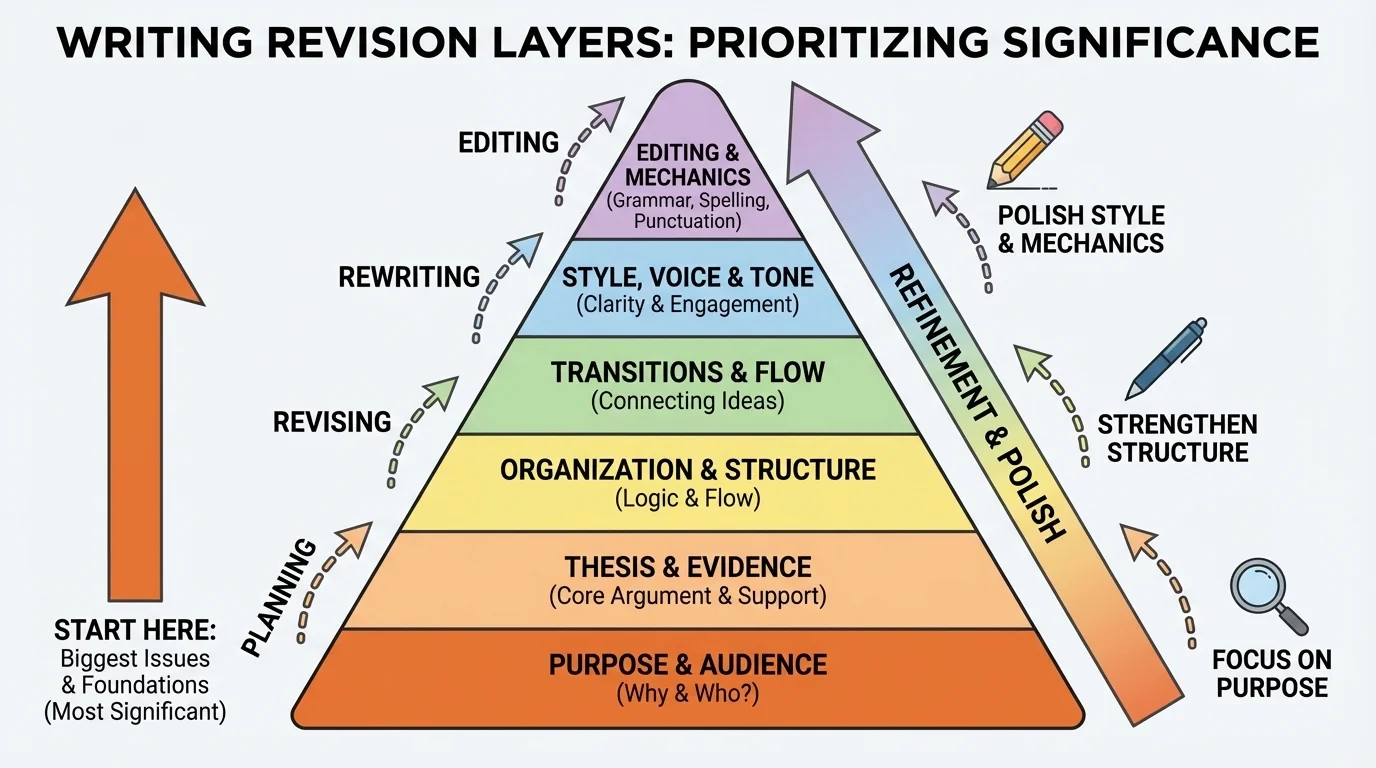
One of the most important habits in writing is understanding that not all problems are equally important. If a draft is confusing, unfocused, or unsupported, fixing a few commas will not solve the real issue. Writers must learn to identify the changes that have the biggest effect first.
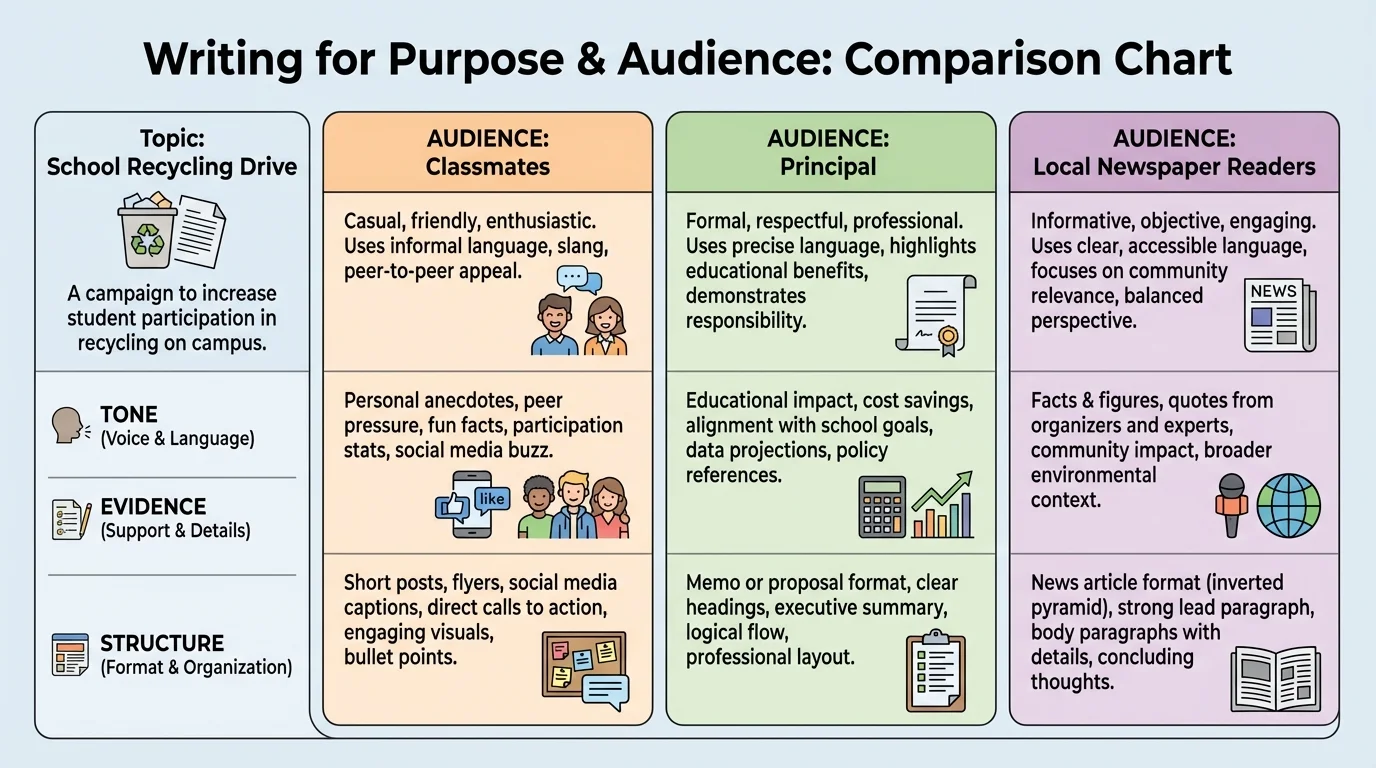
As [Figure 1] shows, a writer's purpose is the reason for writing. A writer's audience is the group of readers the writer wants to reach. The same topic can change dramatically depending on who will read it and what the writer wants the writing to do.
Common purposes include informing, explaining, persuading, analyzing, reflecting, and entertaining. Sometimes a piece has more than one purpose, but usually one purpose is most important. If you are writing to persuade, your draft should focus on claims, reasons, evidence, and counterarguments. If you are writing to explain, your draft should focus on clarity, sequence, and accurate detail.
Audience affects tone, word choice, examples, and background information. Writing for classmates may allow shared school references and a more direct tone. Writing for a principal may require a respectful, formal tone and stronger evidence. Writing for a public audience may require more context because readers do not automatically know your school or experience.
| Writing Situation | Purpose | Audience | Likely Choices |
|---|---|---|---|
| Editorial on cafeteria waste | Persuade | School community | Facts, proposed solution, respectful tone |
| Lab report reflection | Explain | Teacher and classmates | Precise details, clear sequence, formal vocabulary |
| Personal narrative | Reflect | General readers | Specific scenes, voice, meaningful insight |
| Literary analysis | Analyze | Academic audience | Textual evidence, clear thesis, logical structure |
Table 1. How purpose and audience influence writing choices in different situations.
When writers ignore audience, the result can feel awkward or ineffective. A serious argument that sounds like a casual chat may lose credibility. A personal narrative overloaded with formal language may sound stiff. Addressing purpose and audience is not decoration; it is central to making writing work.
Planning gives writing direction. It does not trap a writer; it helps a writer begin with purpose. The process is recursive, as [Figure 2] illustrates, so planning can happen before drafting and again during revision when ideas change.
Good planning often begins with choosing and narrowing a topic. "School issues" is too broad. "How the school could reduce single-use plastic bottles" is more focused. Once the topic is narrowed, the writer can identify a main point or thesis. In argumentative or analytical writing, the thesis gives the paper direction. In narrative writing, the plan may center more on an experience, conflict, or insight.
Writers also gather material during planning. That might include examples, quotations, facts, observations, scenes, or memories. Then they organize those ideas. Some writers use outlines. Others use lists, note cards, or visual maps. What matters is that the structure supports the purpose.
For example, if you are writing an argument about community service requirements, a plan might include an introduction with the claim, two body paragraphs giving reasons, one paragraph addressing an opposing view, and a conclusion that calls for action. If you are writing a narrative, your plan might include the setting, turning point, emotional change, and ending reflection.
Planning focuses attention on significance. Strong planning does not just collect ideas; it ranks them. Writers ask which details truly help the reader understand the main point. A planned draft is more likely to stay focused because the writer has already begun separating important material from distractions.
Planning is especially important in shared writing projects. When several students contribute to the same presentation, article, or report, planning helps the group agree on purpose, audience, division of tasks, and consistent style. Without that, the final product can sound like several unrelated pieces pasted together.
Drafting is where ideas take visible form. A draft is not supposed to be perfect. Its job is to exist so it can be improved. Many students get stuck because they try to make every sentence polished before moving on. That often slows thinking. In early drafting, it is better to focus first on getting the ideas down in a workable structure.
This does not mean anything goes. Even in a rough draft, writers should keep the purpose in mind. A strong draft has a direction, even if the wording is still rough. It should present the main idea, develop supporting points, and create enough material to revise thoughtfully later.
Drafting with flexibility means being willing to change the plan. A writer may discover a better order, a stronger example, or a more interesting opening while writing. That is normal. Planning guides the draft, but drafting can also help the writer discover what the piece should become.
Professional authors, journalists, and speechwriters often produce multiple drafts, and many famous passages were heavily revised before publication. What readers admire as "good writing" is often the result of repeated decision-making.
One useful way to think about drafting is this: first drafts are for finding the piece, not finishing it. A rough first draft is still useful if it gives the writer material to shape. A blank page cannot be revised, but a rough paragraph can.
Revision is the stage where writers improve meaning, structure, and impact. As [Figure 3] illustrates, revision should begin with the largest issues first: focus, organization, evidence, development, and clarity. Small corrections matter, but they come later.
Revising often begins with questions such as these: Is the main point clear? Does every paragraph support it? Are the ideas arranged logically? Is there enough explanation and evidence? Are any sections repetitive, off-topic, or underdeveloped? Does the conclusion feel earned rather than rushed?
Consider an argument paragraph that says, "School lunches should be healthier because that would be better for students. Also, students need better food. It is important for health." The point is repetitive and vague. Revision might strengthen it by adding specific evidence and explanation: "School lunches should include more fresh options because nutrition affects concentration, energy, and long-term health. When students eat balanced meals, they are better able to focus during afternoon classes."
Revising also involves improving organization. Sometimes a paragraph belongs in a different place. Sometimes the introduction promises one focus while the body discusses another. Sometimes the strongest point is buried in the middle and needs to move forward. Good organization helps readers follow the thinking without confusion.
Writers should pay close attention to development. A claim without evidence is weak. An example without explanation is incomplete. A quotation dropped into a paragraph without context leaves readers unsure why it matters. Revision is the stage where a writer adds depth, not just more words.
Voice and tone matter in revision too. A literary analysis should sound thoughtful and precise. A public speech should sound direct and persuasive. A narrative may use a more personal voice. Returning to audience helps writers make those choices. The comparison in Figure 2 remains useful here because revision often involves adjusting the tone and level of detail for the intended reader.
Revising a weak sentence into a stronger one
Original sentence: "Social media is bad and schools should do something."
Step 1: Identify the problem.
The sentence is too broad, too vague, and not clearly aimed at a specific audience or purpose.
Step 2: Clarify the claim.
Decide what specific issue matters most: distraction, misinformation, privacy, or mental health.
Step 3: Rewrite with focus and audience in mind.
"Schools should teach digital literacy because students need practical strategies for evaluating misinformation, protecting privacy, and managing the impact of social media on attention and well-being."
The revised version is more specific, more thoughtful, and better suited to an academic argument.
Sometimes revision means cutting strong sentences that do not fit the main idea. That can feel frustrating, but effective writers are willing to remove material that distracts from the purpose. A sentence can be interesting and still not belong.
Editing is different from revision. Revision changes the content and structure. Editing corrects errors and polishes the language so the final piece is clear and credible. Editing usually happens after major revision, because there is little point in perfecting sentences that may later be deleted.
Editing includes checking grammar, punctuation, capitalization, spelling, verb tense, pronoun agreement, sentence boundaries, and word usage. It also includes making sure formatting is consistent. In research writing, editing may involve checking quotations, citations, and works cited entries for accuracy and consistency.
At this stage, writers should read closely for patterns of error. Maybe sentences are too long and run together. Maybe commas are used incorrectly. Maybe the writer shifts from formal language to slang. These are not just rule issues; they affect how seriously the reader can take the writing.
| Problem | Weak Version | Edited Version |
|---|---|---|
| Run-on sentence | The policy seems fair many students disagree. | The policy seems fair, but many students disagree. |
| Vague word choice | Things got better. | Attendance improved after the schedule changed. |
| Shift in tone | The proposal lacks evidence, and that is kind of a problem. | The proposal lacks sufficient evidence to be convincing. |
| Inconsistent tense | The author argues this point and then explained it badly. | The author argues this point and then explains it poorly. |
Table 2. Common editing problems and examples of stronger corrected versions.
Reading aloud can help during editing because your ear often catches awkward wording that your eyes skip over. Another useful strategy is reading backward sentence by sentence to focus on correctness rather than meaning. That makes it easier to spot spelling or punctuation mistakes.
Earlier writing instruction often separates complete sentences from fragments and run-ons. That knowledge still matters here. Even sophisticated ideas lose force if sentence structure makes them difficult to follow.
Editing should support readability, not flatten the writing. The goal is not to make every sentence sound identical. The goal is to make the writing accurate, smooth, and appropriate for its audience.
Sometimes a draft does not just need small adjustments. It needs a major change. This is where rewriting or trying a new approach becomes important. Strong writers recognize when the current version is not accomplishing the purpose, even if they have already spent time on it.
A writer might rewrite an introduction that begins too broadly or too weakly. A narrative may need to start at a more dramatic moment. An argument may need to shift from emotional examples to stronger evidence. An analysis may need a sharper thesis. In some cases, the writer may even change the genre or structure.
For example, suppose a student is writing about teen sleep deprivation and begins with a list of facts. The information may be accurate, but the opening feels flat. A new approach could begin with a brief real-life scene: a student struggling to stay awake in first period, then connect that scene to the larger issue. The facts remain important, but the structure now gives readers a stronger entry point.
Trying a new approach is not failure. It is strategic thinking. The recursive process in [Figure 2] helps explain why writers sometimes move backward in order to move forward. Returning to planning, changing organization, or rewriting whole sections can be the smartest path to a better final piece.
"Writing is rewriting."
— A common principle among authors and editors
Writers should ask themselves whether the current approach creates the effect they want. If the answer is no, then revision may not be enough. Rewriting gives the piece a real chance to succeed.
Feedback is most useful when the writer knows how to sort it. Not every suggestion deserves equal weight. A strong writer listens carefully, looks for patterns, and then decides which changes best improve the piece's purpose and audience fit.
Peer feedback can reveal where readers are confused, unconvinced, or disengaged. If several readers ask the same question, the draft probably needs clarification. Teacher feedback often helps identify deeper issues in reasoning, evidence, or structure. Both kinds of feedback can be valuable, but the writer still has to make thoughtful decisions.
In collaborative writing, feedback is even more important. Group members need a shared standard for tone, evidence, organization, and formatting. One paragraph written in a formal style and another written casually can make the piece feel uneven. Planning, revision, and editing should happen at the group level as well as the individual level.
Useful feedback is specific. "This is good" is encouraging but not very helpful. "Your second paragraph introduces an important point, but it needs evidence and a clearer connection to your thesis" gives the writer something concrete to improve.
Writers should avoid making changes just to please every reader. If one comment would weaken the purpose or distort the meaning, it does not have to be accepted. Good writing is shaped by feedback, not controlled by it.
Writing does not always end when a paper is turned in. Many writing projects are published, shared, posted, presented, or updated. A class blog post, digital article, presentation script, community letter, or group report may continue to evolve after an initial version is completed.
This is especially true in digital spaces. Online writing can be updated as new information appears, broken links are fixed, or audience responses reveal confusion. That means writers should think of publication not only as an ending but also as part of an ongoing process of responsibility and improvement.
Reflection helps writers grow over time. After finishing a piece, a writer can ask: What improved most during revision? Where did editing catch repeated mistakes? Did the final version fit the audience? What would I do differently next time? Reflection turns one assignment into better habits for future writing.
Many news organizations update articles after publication when new facts emerge or when earlier wording needs clarification. That same habit of reviewing and improving writing applies in school and professional settings.
When students understand writing as a process of creation, response, and refinement, they become more independent. They stop seeing revision as punishment and start seeing it as control over their own ideas.
Consider a student assigned to write an argumentative paragraph on whether schools should provide financial literacy classes. The first draft says: "Schools should teach money because students need it later in life. It would help a lot, and many people don't know enough about it." The topic is promising, but the writing is broad and underdeveloped.
During planning, the writer narrows the focus to specific skills: budgeting, saving, credit, and avoiding debt. During revision, the writer strengthens the claim and support: "Schools should require financial literacy classes because students need practical skills such as budgeting, understanding credit, and evaluating loans before they enter adult life." That sentence is clearer and more specific.
Next, the writer adds evidence and explanation. The paragraph now includes examples of young adults making costly financial mistakes because they lack instruction. Then the writer edits for grammar and style, removing repetition and correcting punctuation. If the paragraph still sounds too generic, the writer may try a new approach by opening with a concrete example of a first paycheck or a student loan decision. That shift makes the writing more engaging while keeping the same purpose.
This example shows that strong writing grows through layers. First, the writer identifies what matters most. Then the writer improves the ideas, structure, and evidence. Only after that does the writer polish the details. The priorities shown in [Figure 3] help explain why this order matters: fixing surface errors cannot rescue a weak argument, but deep revision can transform it.
