Have you ever noticed that a whole group can learn something new from one book at the same time? When children read together, they do more than look at pages. They listen for ideas, watch the words, study the pictures, and talk about what the book teaches. Group reading helps everyone learn together.
Sometimes a class reads a literary text for enjoyment. Sometimes a class reads an informational book to learn about the world. An informational book gives facts. It may teach about rain, pets, trees, or how a seed grows. When we read together, we have a purpose. A purpose is the reason we are reading.
Reading purposes can be simple. We may read to find out what penguins eat. We may read to learn what plants need. We may read to answer a question. Good readers think, What am I trying to learn? That helps them pay attention.
Group reading is when children and a teacher read or look at a book together. Purpose means the reason for reading. Understanding means thinking about what the book is teaching.
When children know the purpose, they can listen for the most important parts. If the class is reading about weather, children can listen for words like rain, wind, clouds, and sun.
During group reading, children use their eyes and ears together. They look at the book, listen to the reader, and follow the print, as shown in [Figure 1]. The book has a title on the front. Inside, the words go in order on the page. Readers learn that print has meaning.
Good readers hold a book right-side up, begin at the front, and turn pages one at a time. They watch as reading moves from left to right and from the top of the page to the bottom. They join in when it is their turn and listen when someone else is reading.
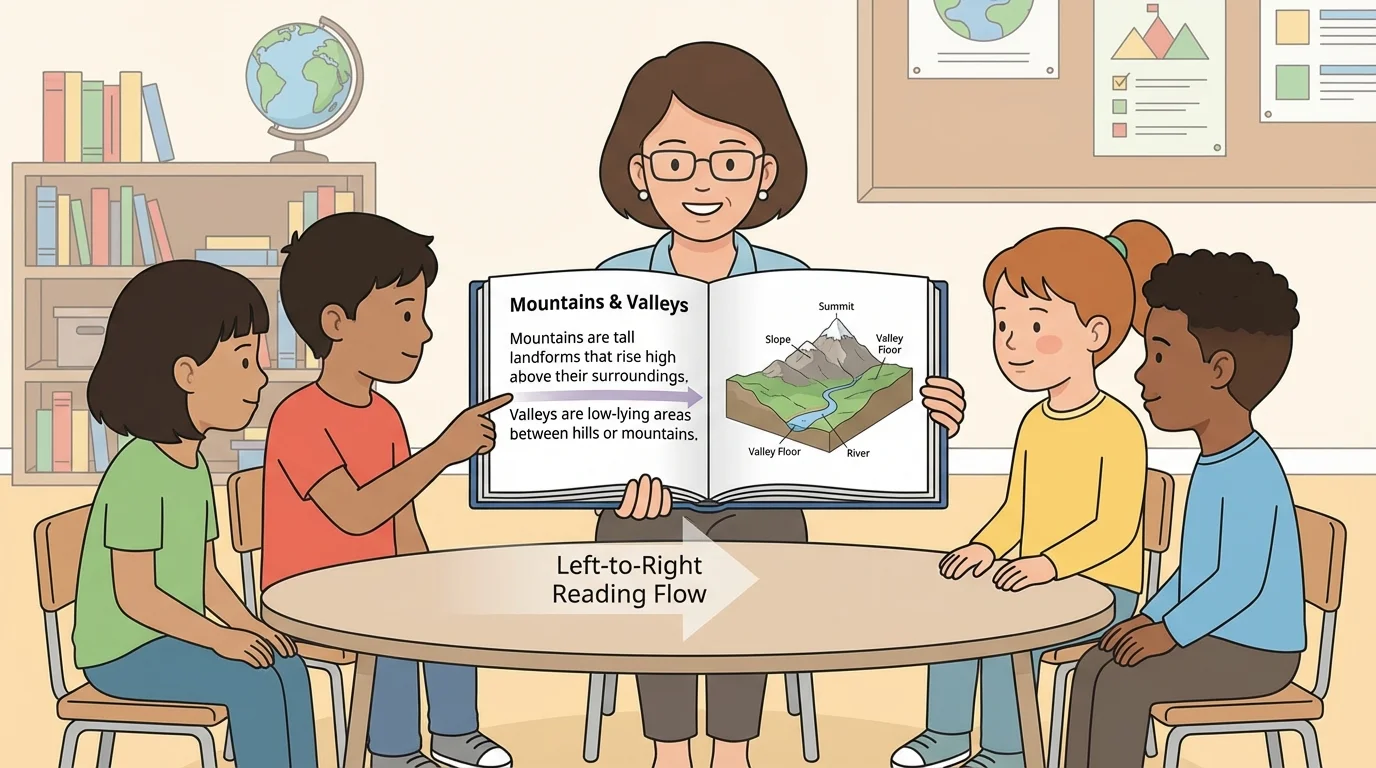
Children also notice the difference between letters, words, and pictures. A letter is one mark. Words are made of letters. The words tell the message. The pictures help the reader understand more.
You already know that books have a front and back, pages, and words. Group reading uses those same book parts, but now you use them with classmates while learning new information.
In a group, everyone has a job. One child may answer a question. Another may point to a picture. Another may listen quietly and think. All of these jobs help the group learn.
When we read informational text, we read to learn something real. If the book is about frogs, we might listen for where frogs live, what frogs eat, or how frogs grow. That is reading with purpose.
Readers can think about one big question while they listen. For example, the question might be, What does a plant need? Then, as the teacher reads, children listen for facts such as sunlight, water, air, and soil. These details help answer the question.
Reading to learn means paying attention to information that teaches something true about the world. A reader does not only say the words. A reader also thinks, listens for important details, and connects ideas.
A child might say, "I learned that some bears rest during winter," or "I learned that buses have drivers and many seats." These are facts from the text. Saying what you learned shows understanding.
Sometimes the teacher asks, "What is this page mostly about?" Children can answer with a main idea in simple words, such as "This page is about what bees do," or "This page is about parts of a tree."
Pictures in informational books are very important. They help readers understand the words. A picture may show wings on a butterfly, stripes on a fish, or roots under a plant. The words tell facts, and the pictures help those facts make sense.
As shown in [Figure 2], sometimes a page has a label. A label names a part of the picture. For example, a plant picture may have labels for leaf, stem, flower, and root. Looking carefully at labels helps children learn new information words.
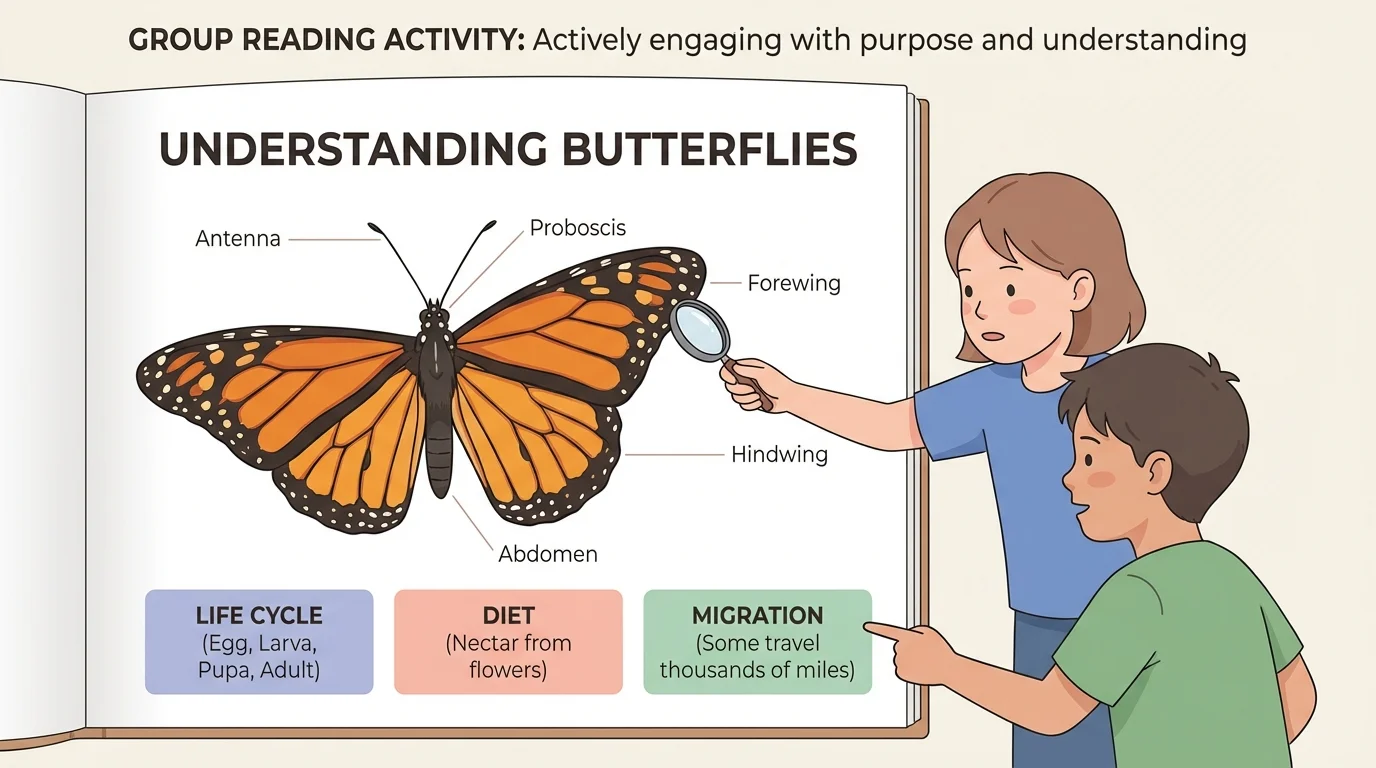
If the words say, "The caterpillar changes," the picture can help a reader see what that means. If the words say, "Birds use wings," the picture helps show where the wings are. Readers use both visual clues and word clues.
Some informational books use real photographs instead of drawings. Photographs can help readers see what an animal, place, or object really looks like.
Later, when children talk about the book again, they can remember the picture and the words together. As in [Figure 2], noticing details in a picture helps readers explain what they learned.
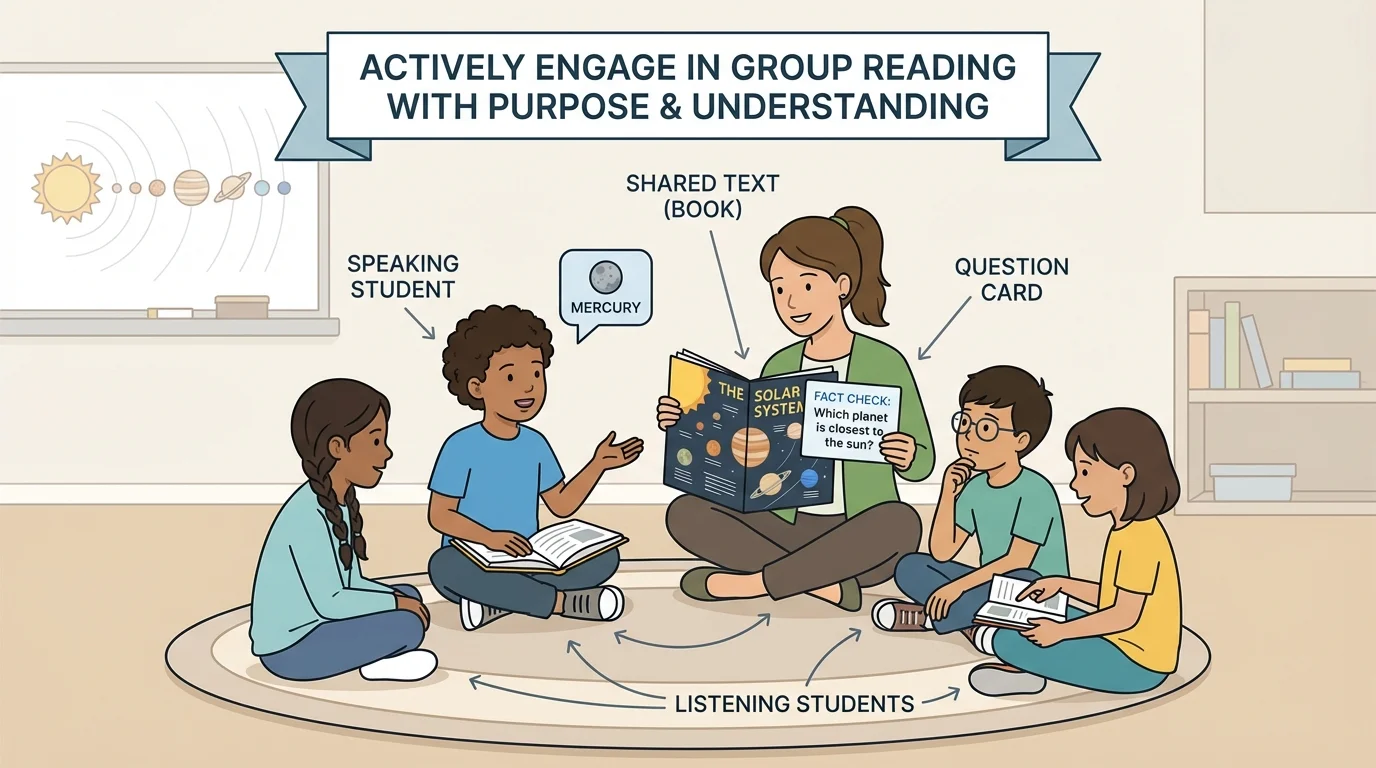
Reading in a group also means talking together. Children ask and answer questions about the book. A teacher may ask, "What did we learn?" "What animal was on this page?" or "How do you know?" These questions help children think about the text.
As shown in [Figure 3], good readers listen to the question, think, and answer with words from the book or ideas from the pictures. They stay on the topic. If the book is about farms, they talk about animals, crops, tractors, or barns, not something unrelated.
Children can also retell some facts in order. For example: "First we learned about the seed. Next we learned about the sprout. Then we saw the flower." Retelling helps show that the reader understands the information.
Example: Talking about a book on penguins
The class reads a short informational book about penguins.
Step 1: Listen for the purpose
The class wants to learn where penguins live and how they move.
Step 2: Notice important facts
The book says penguins live in cold places and use their feet and flippers to move.
Step 3: Answer a question
A child answers, "Penguins live where it is cold, and they waddle and swim."
This answer shows the child listened for facts and understood the text.
When readers take turns speaking, everyone gets a chance to share. Looking back at ideas like the reading circle in [Figure 3] reminds us that listening is just as important as talking.
A strong reading group works together respectfully. Children keep their bodies calm, eyes on the book or speaker, and voices ready for the right time. They wait for turns. They do not talk over others. They help make the group a good place to learn.
Being helpful also means encouraging classmates. If one child is thinking, others can wait. If someone shares a fact, the group can listen. Respect helps everyone understand more.
Sometimes children may not understand a page right away. That is okay. They can look again at the picture, listen again to the words, and think about the purpose for reading. Understanding can grow when readers stay patient and keep trying.
| What readers do | How it helps |
|---|---|
| Look at the title | It tells what the book may be about. |
| Watch the words | It helps readers follow the text. |
| Study the pictures | It gives clues and details. |
| Listen for facts | It helps readers learn true information. |
| Answer questions | It shows understanding. |
| Take turns | It helps the whole group learn together. |
Table 1. Helpful actions during group reading and how each action supports understanding.
When children read together with purpose and understanding, they are not just sitting with a book. They are learning how print works, how informational texts teach facts, and how talking with others can make ideas clearer.
