Have you ever noticed that cat, hat, and bat sound alike at the end? Your ears are doing something powerful. They are hearing little parts inside words. When we listen closely, a short word is not just one big sound. It can be broken into smaller sound parts, and those parts help us read and spell.
We will work with single-syllable words. A single-syllable word is a word we say with one beat, like dog, sun, fish, and map. These are good words for hearing sound parts.
When children learn to hear parts in words, they become stronger readers. They can notice that many words belong to the same word family. For example, cat, hat, and sat all share the same ending sound part. That helps the brain recognize patterns quickly.
You already know that words can rhyme. Rhyming words often have the same ending sound. Hearing rhymes helps you hear the rime in a word.
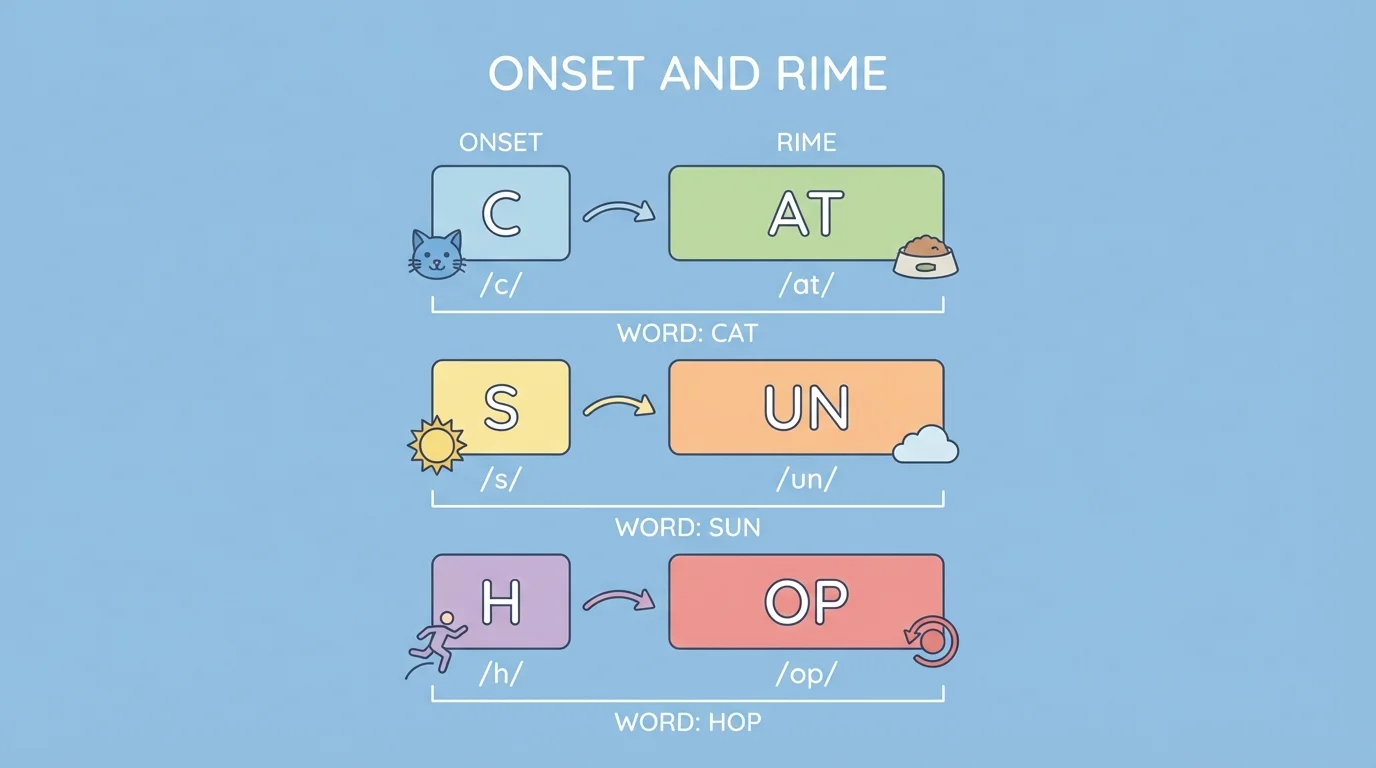
We can listen to a word in two main parts, as [Figure 1] shows: the first sound or sounds, and the rest of the word. This is an important listening skill for early reading.
A spoken word has parts. The onset is the sound or sounds at the beginning of a one-syllable word. The rime is the rest of the word, starting with the vowel sound.
Onset means the beginning sound or sounds in a one-syllable word.
Rime means the vowel and the sound or sounds that come after it in a one-syllable word.
Listen to the word cat. The onset is /c/. The rime is /at/. Listen to sun. The onset is /s/. The rime is /un/. Listen to hop. The onset is /h/. The rime is /op/.
The onset comes first. The rime comes after it. If two words have the same rime, they usually rhyme. Cat, bat, and mat all have the rime /at/.
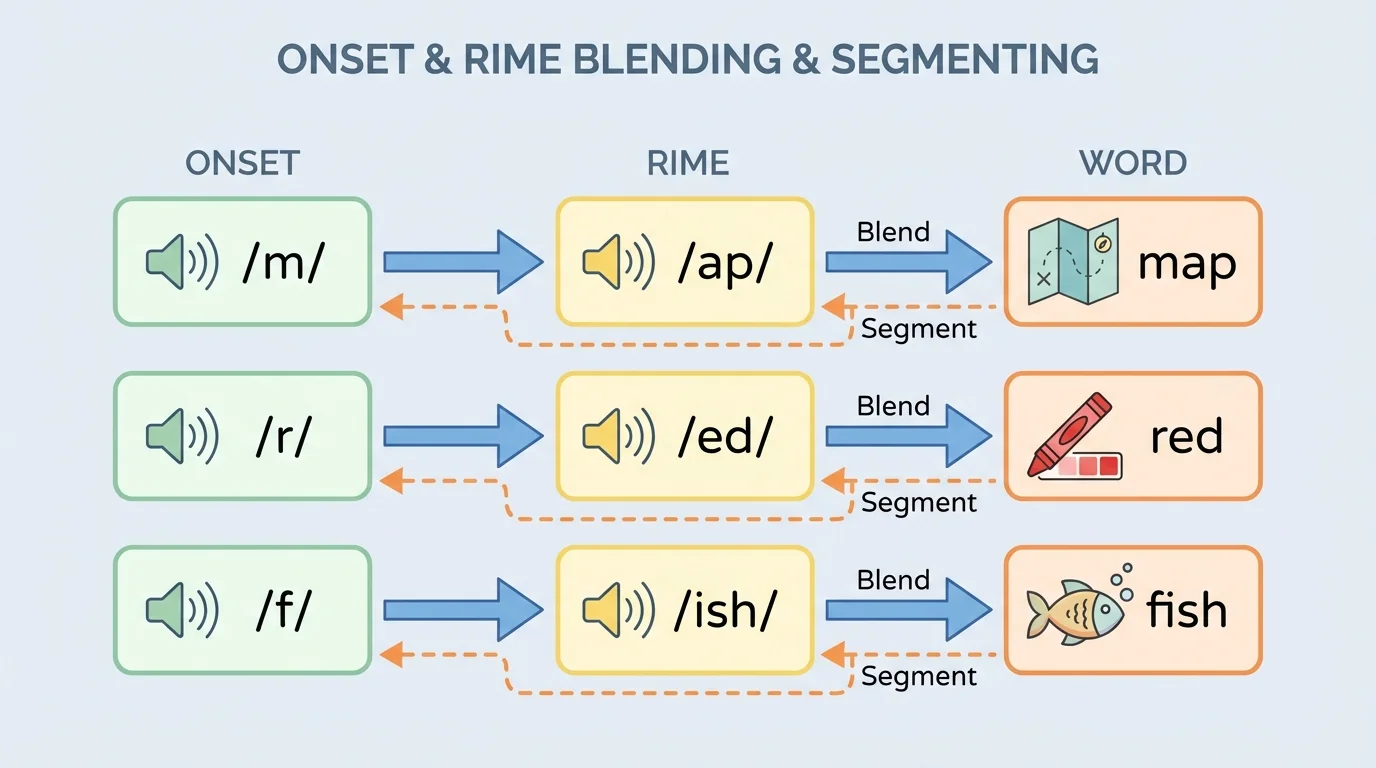
Blending means putting sound parts together to make a whole word. When you hear an onset and a rime, you can slide them together in your mind.
If you hear /m/ and /ap/, you blend them to say map. If you hear /r/ and /ed/, you blend them to say red. If you hear /b/ and /ug/, you blend them to say bug.
How blending works
As [Figure 2] illustrates, your ears listen to the first sound part, then the ending part. Your brain joins them into one smooth word. This is one reason knowing word families like -at, -op, and -ig is so useful.
Blending can happen with many different onsets and the same rime. For example, /c/ + /an/ makes can, /m/ + /an/ makes man, and /p/ + /an/ makes pan. The rime stays the same, but the onset changes.
We can also blend longer beginning parts. In flag, the onset is /fl/ and the rime is /ag/. In stop, the onset is /st/ and the rime is /op/. Even when the onset has more than one sound, we can still blend it with the rime.
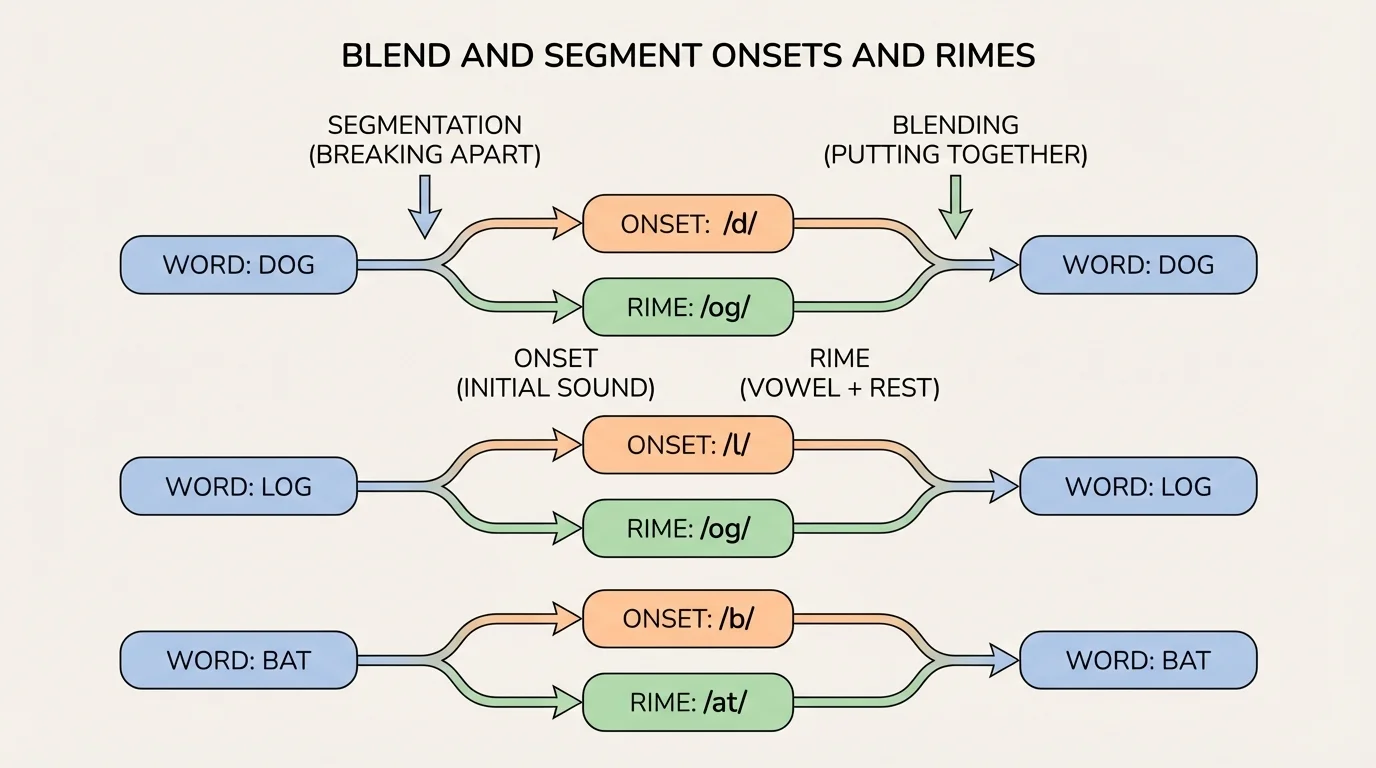
Segmenting means taking a spoken word apart into smaller sound parts. Instead of pushing parts together, we pull the word apart.
Listen to the word dog. The onset is /d/. The rime is /og/. Listen to pig. The onset is /p/. The rime is /ig/. Listen to fan. The onset is /f/. The rime is /an/.
Hearing the parts in spoken words
Step 1: Say the whole word.
Say bat.
Step 2: Listen for the first sound.
The onset is /b/.
Step 3: Say the rest of the word.
The rime is /at/.
Bat segments into /b/ and /at/.
Segmenting helps children notice patterns. If you can take log apart into /l/ and /og/, then you may hear that dog and frog share part of that ending sound pattern too.
Sometimes children mix up the first sound with the whole first letter name. We are listening for sounds, not letter names. We say /b/ in bat, not the letter name bee.
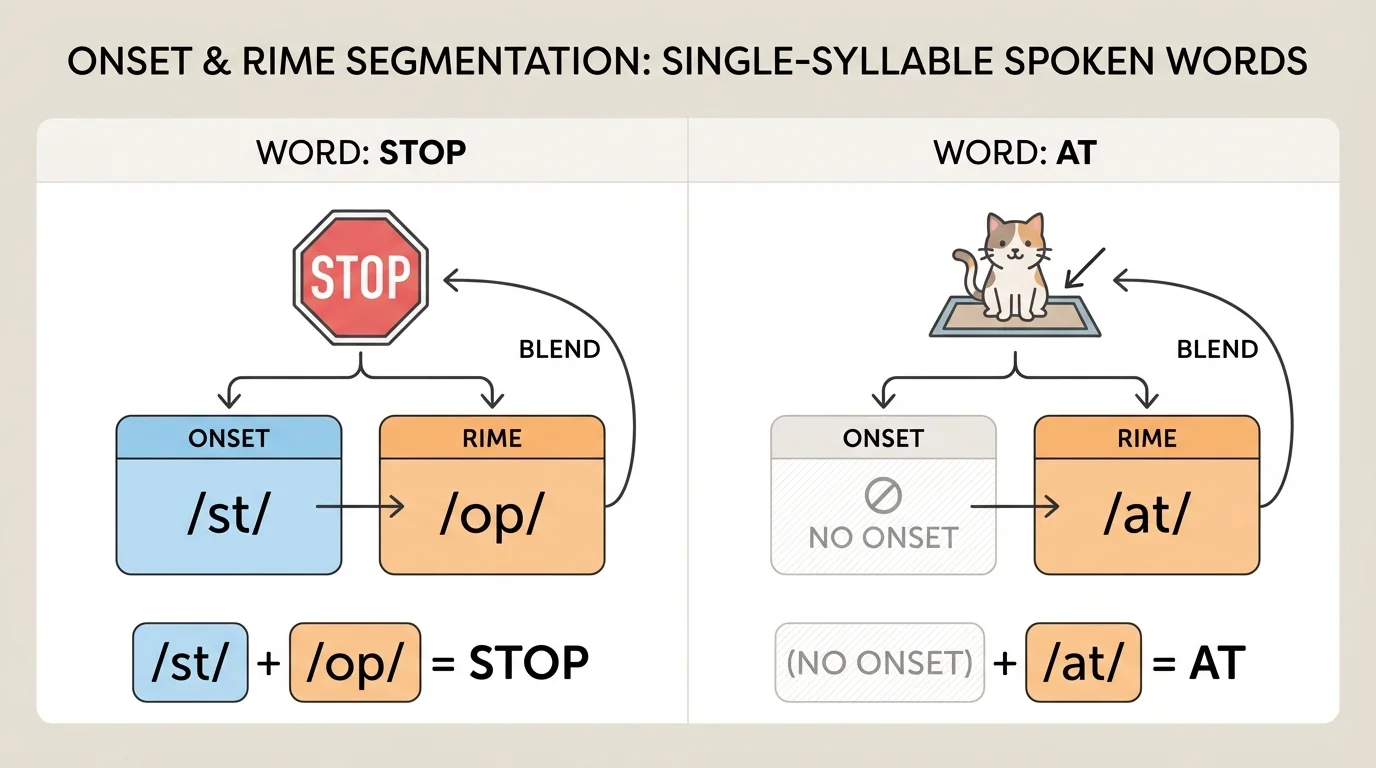
As [Figure 4] helps us compare, some words are a little different. A word can begin with more than one sound, or it can begin right away with the vowel sound.
In the word stop, the onset is /st/. That onset has two sounds working together at the beginning. The rime is /op/. In flag, the onset is /fl/ and the rime is /ag/.
Some short words have no onset at all. The word starts right with the vowel sound. That means the whole word is the rime.
Listen to at. There is no sound before /a/. So at has no onset, and the rime is /at/. Listen to in. It has no onset, and the rime is /in/. Listen to up. It has no onset, and the rime is /up/.
This matters because not every word follows the exact same pattern. Good listeners need to stay flexible. They can hear one beginning sound, two beginning sounds, or no onset at all.
When children hear onsets and rimes, they can read new words more easily. If you know hat, then you may read bat, cat, and sat faster because the rime /at/ stays the same, just as we saw earlier in [Figure 1].
Blending also helps when a child hears parts and needs to say the whole word. Segmenting helps when a child says a whole word and needs to hear its parts. These are partner skills. One puts sound parts together, and one takes them apart.
| Word | Onset | Rime |
|---|---|---|
| cat | /c/ | /at/ |
| sun | /s/ | /un/ |
| flag | /fl/ | /ag/ |
| stop | /st/ | /op/ |
| at | none | /at/ |
Table 1. Examples of single-syllable spoken words with their onsets and rimes.
Notice how many words can share the same rime. Pig, big, and wig all have /ig/. Top, mop, and hop all have /op/. Families of words like these help reading feel more organized.
When segmenting a word such as dog, the process is the opposite of the blending pattern shown in [Figure 2]. You start with the whole word and listen carefully for the first part and the rest. When you work with a word like stop or a word like at, the comparison in [Figure 4] reminds you that onsets are not always just one sound.
