A tiny crayon can do a big job. With one small tool, a child can make a dot, a swirl, a picture, or the first letter of a name. Writing begins when children explore how tools move and what kinds of marks they can make.
A writing tool helps us make marks. A mark can be a line, a dot, a curve, a scribble, a shape, or an early letter. When children use a writing tool to make marks, they are beginning early writing work. These marks may not be words yet, but they still show thinking and ideas.
Writing tool means something we hold to make marks, such as a crayon or pencil. Material means the thing we write on, such as paper or cardboard. Mark-making means creating lines, dots, shapes, and other visible marks.
Children often begin with broad scribbles. Later, those marks may become circles, straight lines, pretend writing, symbols, and letter-like forms. This growth is important because written communication starts with exploring how marks look and feel.
Different tools make different marks, and [Figure 1] shows how one hand movement can look different with a crayon, marker, pencil, chalk, or paintbrush. A thick crayon may make a bold, waxy line. A marker may make a smooth, bright line. A pencil may make a thinner gray line. Chalk can make dusty marks, and a paintbrush can glide with color.
Each tool feels special in the hand. Some are soft and thick. Some are skinny and firm. Some slide easily. Some need a little more push. When children try many tools, they learn that tools can be chosen for different purposes.
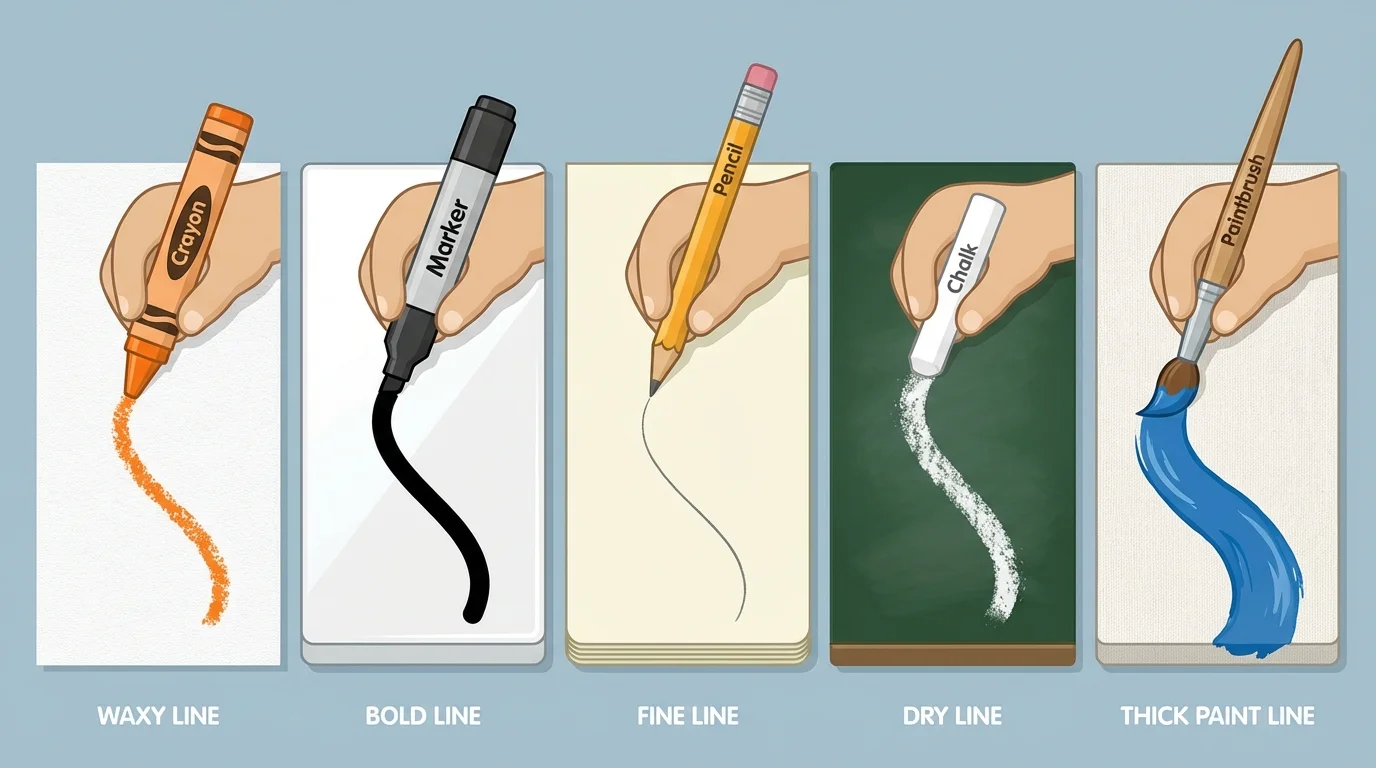
A crayon is good for strong color and easy gripping. A marker can make clear lines and bright shapes. A pencil is useful for light lines and simple early letter forms. Chalk works well on chalkboards or sidewalks. A paintbrush can spread paint in long strokes or tiny dabs.
Some children start by pressing very hard, while others make very light marks. Both are part of learning how tools respond to the hand.
As children keep exploring, they notice choices. A child may pick a blue marker for a wavy line or a fat crayon for a large circle. That kind of choice shows growing control and confidence. The variety of tools in [Figure 1] helps us see that writing and drawing tools are not all the same.
Writing tools need places to work, and [Figure 2] shows that paper on a table, paper on an easel, a chalkboard, and a sidewalk all give a different experience. A smooth piece of paper may help a marker glide. Thick cardboard may feel sturdy under a crayon. Chalk is especially good on rough outdoor ground or a board made for chalk.
Children learn by trying different materials. On a flat table, the hand may rest while making short lines. On an easel, the arm moves up and down in bigger motions. Outdoors, a child might make extra-large circles with sidewalk chalk. These changes build strength and flexibility.
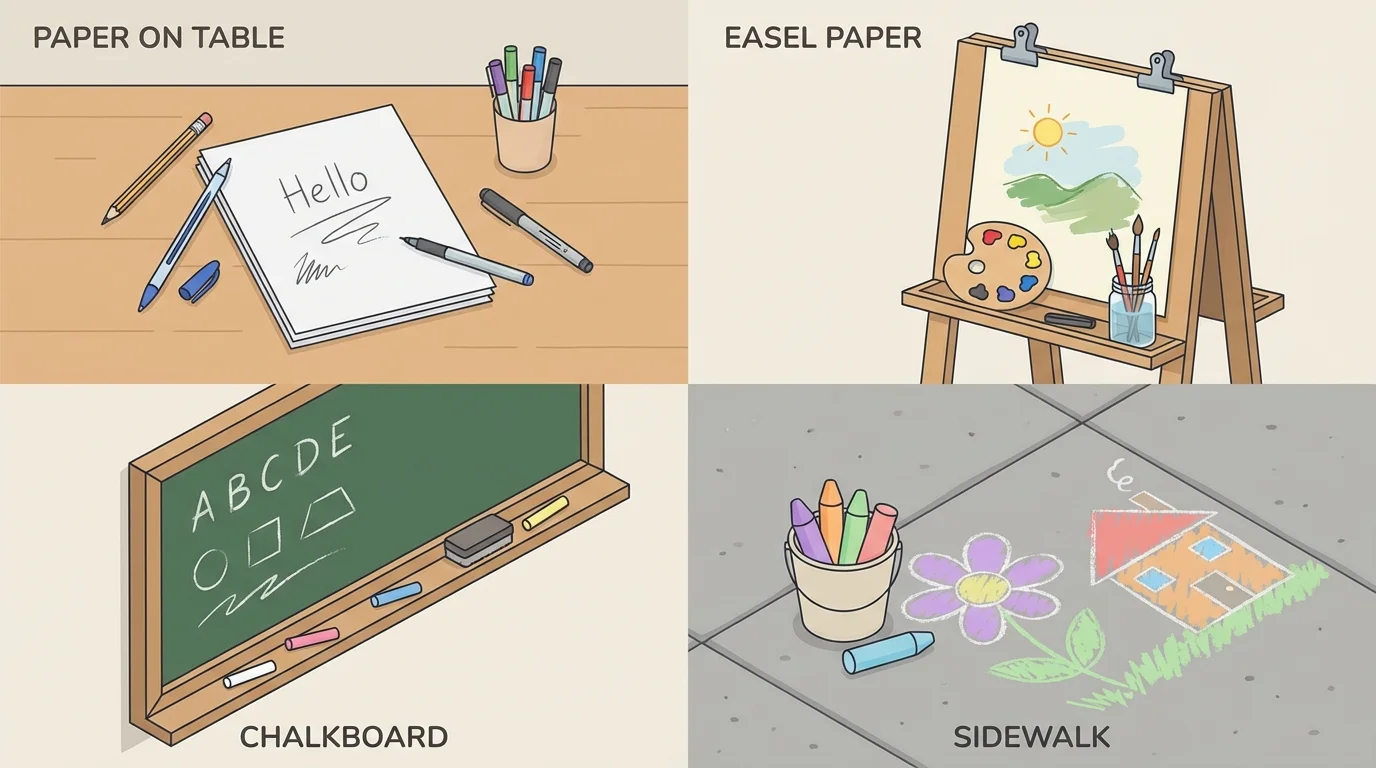
Materials can also have different sizes, colors, and textures. Small paper invites small marks. Large paper invites big arm movements. Dark paper can make light chalk stand out. Recycled boxes and cardboard can be interesting surfaces for experimenting too.
Tools and materials work together
A tool does not work the same way on every surface. Chalk may not show well on plain white paper, but it shows clearly on a chalkboard. A marker may be bright on paper but may soak through very thin paper. Children learn by noticing which combinations work best.
When a child says, "This marker is too slippery," or "This chalk is good outside," the child is learning about matching tools to materials. That awareness supports later writing because children begin to choose what they need for the marks they want to make.
Hands and fingers do important work during mark-making, and holding and moving a tool creates dots, lines, zigzags, and curves. Young children may hold a tool with the whole fist at first. Later, they often begin to use more finger control.
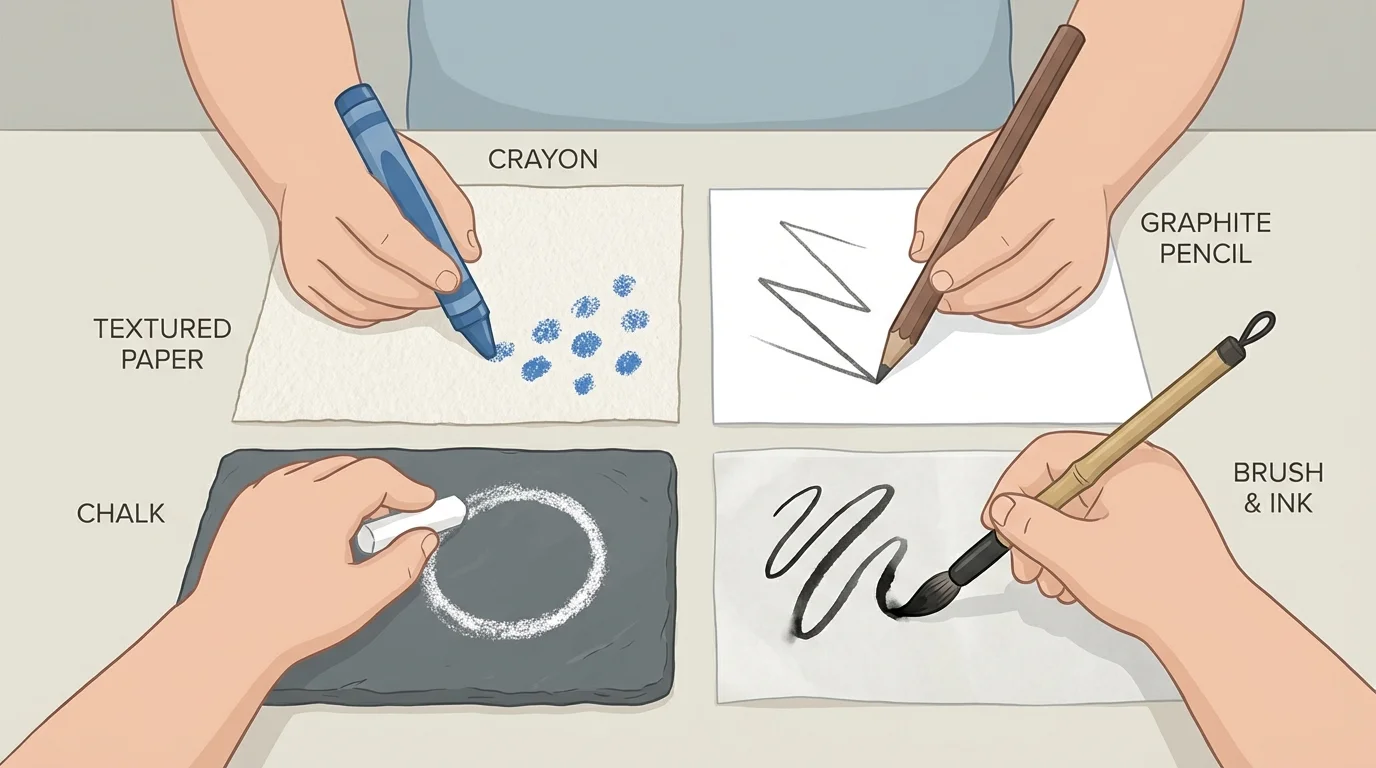
[Figure 3] Children can move tools in many directions: up, down, across, around, and back and forth. These motions create long lines, short lines, circles, loops, and crosses. Learning these motions helps prepare children for making symbols and letters.
Pressure matters too. Pressing hard may make a darker or thicker mark. Pressing softly may make a lighter mark. Fast movements can make quick scribbles, while slow movements can make careful shapes. Exploring pressure and speed helps children understand control.
Grip develops over time. There is not just one beginning grip that every child uses right away. What matters most is that the child can hold the tool, move it, and keep experimenting. Over time, the hand becomes steadier and movements become more purposeful.
Example of changing a mark
A child uses one crayon in different ways to see what happens.
Step 1: Hold the crayon gently.
The mark looks light and soft.
Step 2: Press harder.
The mark looks darker and stronger.
Step 3: Move in a curve, then in a straight path.
The child sees that hand movement changes the kind of mark.
This simple experiment helps children connect hand motion with the results they see on the page.
Later, children may repeat favorite motions again and again. Repeating circles, lines, or zigzags is useful because practice helps build control. The kinds of marks shown in [Figure 3] remind us that every stroke teaches the hand something new.
Early writing is more than making random lines. A child may say, "This says mom," or "This is my name," while pointing to scribbles or letter-like shapes. That is a big step in understanding that marks can carry meaning.
Children often move from scribbles to symbols, pictures, and shapes that stand for something. A circle with lines may stand for a sun. A row of repeated marks may be pretend writing. Some children begin to notice the shapes of letters in books, signs, and their own names.
Children already know that pictures can show ideas. Writing grows from that same understanding: marks on a surface can represent something real, remembered, or imagined.
An early letter may be backward, large, or mixed with scribbles. That is part of learning. What matters is that the child is connecting spoken language, ideas, and visual marks. When children make symbols, pictures, and early letters, they are practicing communication.
Name writing is often especially meaningful. The letters may not all be correct, but trying to write a name helps children see that letters belong in a special order and can represent a person. This builds familiarity with written conventions over time.
Writing tools work best when children use them safely and carefully. Caps go back on markers so they do not dry out. Pencils, crayons, and brushes are for paper and other writing surfaces, not for poking. Chalk dust and paint are easier to manage when children wash hands after use.
Being careful with materials also teaches responsibility. Children can carry tools gently, use just enough space, and help put materials away. These habits support independence and respect for classroom or home supplies.
"Our hands can make marks, and our marks can share ideas."
When children explore tools and materials in safe ways, they learn that writing is both physical and meaningful. A simple line can begin as play and grow into a message.
