What if two children look at the same butterfly picture and one says, "It is big," while the other says, "It is tiny"? Who is right? Sometimes we need to stop and ask good questions. Good questions help our brains slow down, look carefully, and think better. They help us understand words, ideas, and facts.
When we learn, we do more than listen. We think. We can ask questions to help our thinking grow stronger. Questions can help us know what someone means, what matters most, what fits the topic, and what is true. That makes us better learners at school, at home, and when learning with friends.
Asking questions is part of learning about the world. When children look at a book, a class picture, a plant, or a block tower, they are doing a kind of inquiry. Inquiry means looking closely, wondering, and asking. Questions help us learn from people and from things we use, like books, photos, and classroom charts.
Sometimes a person talks fast. Sometimes a picture is hard to understand. Sometimes a friend says something that does not fit the topic. Sometimes we are not sure if something is true. Good questions help in all of these moments.
Clarity means something is easy to understand.
Significance means something is important.
Relevance means something matches the topic.
Accuracy means something is correct and precise.
These four ideas help us become careful thinkers. We do not need big, hard words to use them. We can ask simple questions with a strong purpose.
There are four helpful types of questions, and [Figure 1] shows them as a set we can remember together. We can ask: "What do you mean?" for clarity, "What is most important?" for significance, "Does this go with our topic?" for relevance, and "Is this right?" for accuracy.
These questions are like four little tools for the mind. One tool helps us understand. One tool helps us choose what matters. One tool helps us stay on the topic. One tool helps us check if something is true.
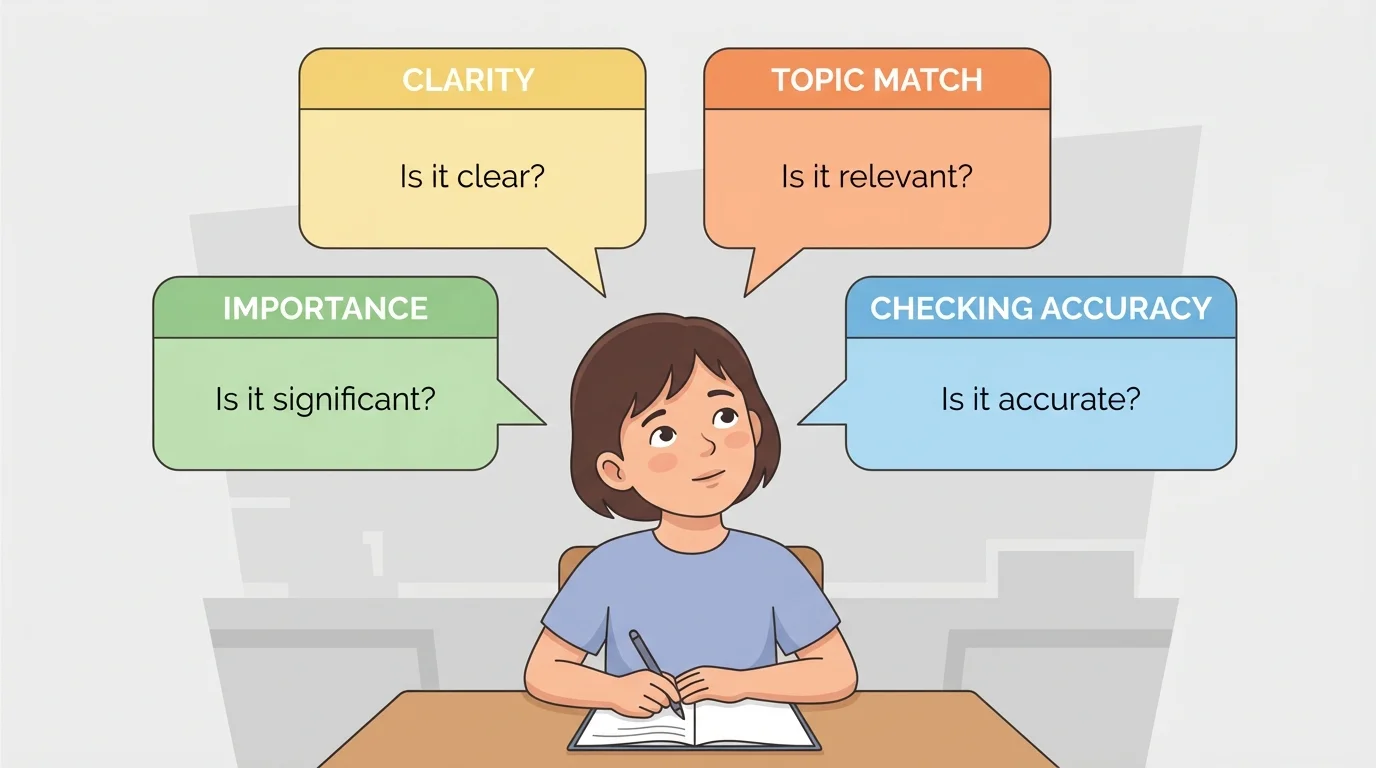
When children use these questions again and again, they become better at listening, talking, reading pictures, and sharing ideas. A careful thinker does not just say the first thing that comes to mind. A careful thinker asks a helpful question.
Clarity is about making ideas easier to understand. If someone says, "The animal is special," we may ask, "What makes it special?" That question helps the speaker say more. Maybe the animal has bright feathers, a long neck, or a funny sound.
Questions for clarity can sound like this: "Can you say more?" "What do you mean?" "Can you show me?" "Which one?" These are useful learning questions because they help us see the idea better.
Suppose the class is studying weather. A child says, "The cloud is scary." Another child can ask, "Why is it scary?" Then the answer may become clearer: "It is dark, and I think it might rain." Now the thought is easier to understand.
Example: Asking for clarity
Step 1: Hear the idea
A friend says, "This seed is different."
Step 2: Ask a clarity question
"How is it different?"
Step 3: Listen for a clearer answer
"It is smaller and smoother than the others."
The question helps everyone understand the idea better.
Clarity matters when we talk with classmates, listen to a teacher, or look at a picture in a book. If we do not understand, asking kindly is a smart choice.
Significance helps us notice what matters most. Sometimes we hear many details, but not all details are equally important. Good thinkers learn to ask, "Which part is most important?" or "What should we remember?"
If the class is learning about plants, one child may say, "The flower pot is red, the dirt is dark, and the plant needs water." The color of the pot may be interesting, but the important part for plant growth is that the plant needs water. A question about significance helps us focus on the big idea.
When we ask about importance, we are not saying the other details are bad. We are trying to find the part that helps us learn the most right now.
Important ideas stand out. Asking about significance helps children sort ideas. It helps them decide what belongs in the center of their thinking. This is useful during read-alouds, science observations, and class talks because children hear many facts at once and need help choosing the biggest one.
Later, when we look again at the four question tools in [Figure 1], significance is the tool that points to the biggest idea, not just any detail.
Relevance means something fits the topic. If the class is talking about how birds build nests and someone starts talking about ice cream, that idea does not match the topic. We can gently ask, "Does that go with what we are learning?"
Relevance helps conversations stay focused. It is important in group learning because many children have lots of ideas. That is wonderful, but the group learns best when ideas connect to the same subject.
Imagine the class is looking at shells. A child says, "This shell has lines." That is relevant because it is about the shell. Another child says, "My socks are blue." That may be true, but it is not relevant to the shell discussion.
Example: Checking relevance
Step 1: Know the topic
The topic is frogs.
Step 2: Hear an idea
"Frogs can jump."
Step 3: Ask if it fits
This matches the topic, so it is relevant.
Step 4: Compare another idea
"I ate toast today." This does not match the frog topic, so it is not relevant.
Relevance is not about being unkind. It is about helping everyone stay with the shared learning goal.
Accuracy means being correct. Sometimes people guess. Sometimes they remember only part of something. Good thinkers ask, "Is that right?" or "How do we know?" These questions help us check before we believe or repeat something.
If a child says, "All bugs can fly," we can ask an accuracy question. Then we may remember that ants and beetles are bugs, but not all of them fly all the time. The first sentence was too big and not fully correct.
Children can check for accuracy in simple ways. They can look again. They can listen carefully. They can ask a teacher. They can use a book, a labeled picture, or another trusted classroom resource. This is part of learning how to find good information.
Some questions sound very small, but they do very big work. Asking "How do you know?" can turn a guess into careful learning.
Accuracy also matters in stories people tell about what they saw. If one child says, "There were five ducks," a careful checker might count again. Looking closely helps our words match what is really there.
Learning is often something we do together, and [Figure 2] shows children using friends, books, and a teacher to ask and answer one question. When students work with others, they can take turns asking for clarity, significance, relevance, and accuracy. One child might ask, "What do you mean?" Another might ask, "Is that the most important part?"
Resources help too. A resource can be a picture book, a classroom poster, a nature photo, a labeled diagram, or a trusted adult. If the class is wondering whether a penguin can fly, they can ask the teacher, look in a book, or study a picture and talk about what they notice.
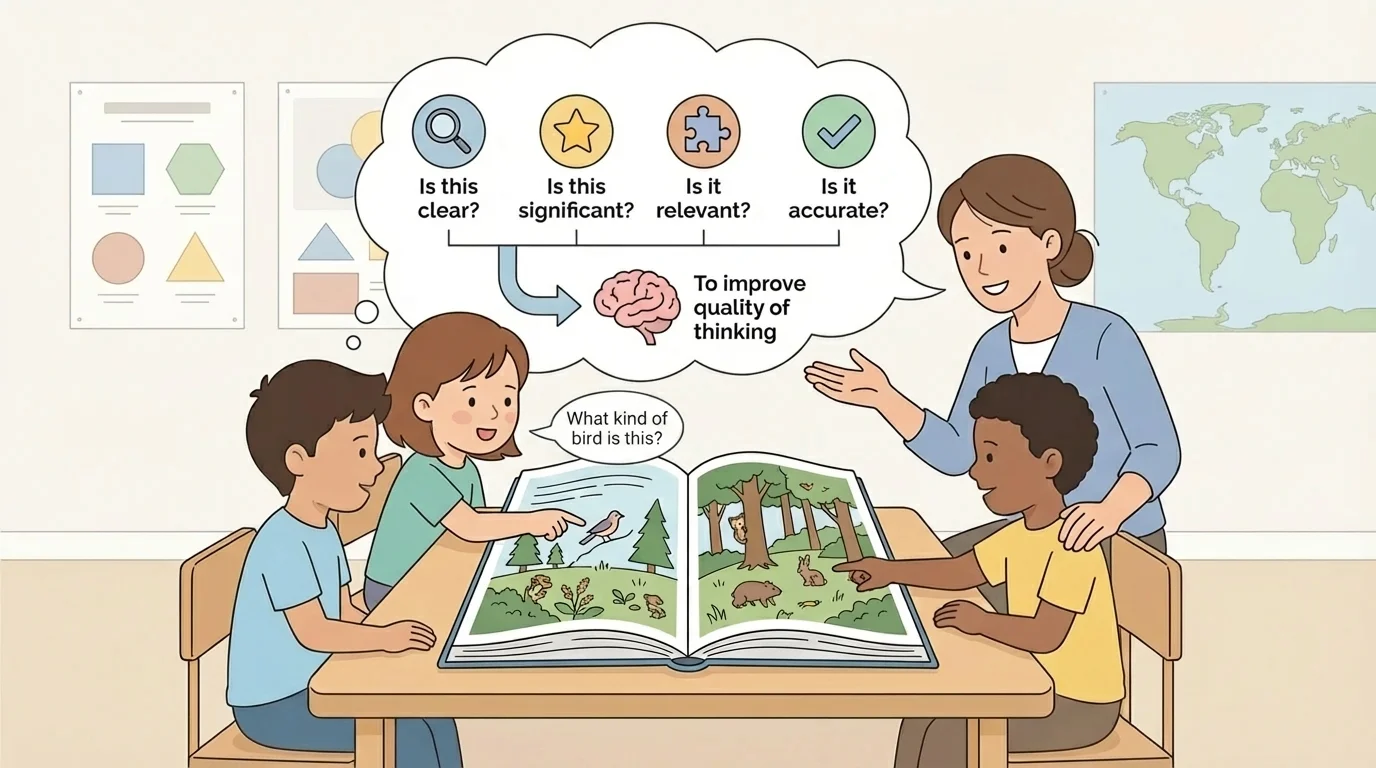
Working together helps children hear different ideas. One classmate may notice an important detail. Another may ask whether the detail fits the topic. Another may help check if it is correct. Collaboration makes thinking stronger because many careful minds work on the same question.
As children talk kindly and listen carefully, they learn that questions are not for getting someone in trouble. Questions are for helping everyone learn.
These four helpful question types can be used during read-aloud time, while building with blocks, when looking at leaves outside, or when talking in a group. During a story, a child can ask for clarity: "Who is she?" During a science observation, a child can ask about significance: "What should we notice most?" During discussion, a child can ask about relevance: "Are we still talking about the caterpillar?" During a fact check, a child can ask about accuracy: "Can we look again?"
When we return to the teamwork scene in [Figure 2], we see that good learning is not only about having answers. It is also about asking careful questions together. And when we remember the four tools in [Figure 1], we can choose the question that helps our thinking most.
Good thinkers are curious, careful, and kind. They ask questions to understand better, to focus on what matters, to stay on topic, and to check what is true. Those habits help children become strong learners in every subject.
