Two countries can be neighbors, trade partners, and even share many cultural ties, yet be governed in very different ways. In the Western Hemisphere, one country may choose its president through open elections, another may have a prime minister under a monarch, and another may limit political competition so strongly that citizens have little real choice. That makes this region a powerful place to study government: it shows that the way a nation is ruled affects everyday life, from schools and roads to free speech and voting.
A government is the system or group of people that makes and enforces laws, provides services, and makes decisions for a country or community. Without government, there would be no organized way to collect taxes, build roads, protect rights, settle conflicts, or defend the country. Governments help answer important questions: Who has power? How is that power limited? What can citizens do if they disagree?
In civics, it is important to remember that governments are not all built the same way. Some are based on broad citizen participation and regular elections. Others keep power in the hands of a smaller group. In the Western Hemisphere, which includes North America, Central America, the Caribbean, and South America, countries show several different forms of government and many different expectations for citizens.
Government is the institution through which a state makes and enforces laws.
Citizen is a legal member of a country who has certain rights and responsibilities.
Democracy is a system in which people have the power to choose leaders, usually through free and fair elections.
Authoritarian government is a system in which power is concentrated in one leader or a small group, and political freedoms are limited.
A government also needs authority, meaning the recognized right to rule. If people see a government as fair and lawful, it has stronger legitimacy. If citizens believe leaders are corrupt, abusive, or not truly chosen by the people, trust falls. This is one reason citizen participation matters so much.
The Western Hemisphere includes several major political systems, as [Figure 1] shows by comparing who leads, how leaders are chosen, and how much power citizens have. The most common type is democracy, but not all democracies are organized the same way, and not every country in the region is fully democratic.
Many countries in the Americas are republics, meaning the people choose representatives, and the head of state is not a monarch. The United States, Mexico, Brazil, Argentina, and Colombia are examples. In these countries, citizens usually vote for leaders and lawmakers, and the constitution sets rules for government power.
Some countries are constitutional monarchies. In these systems, a king or queen is the official head of state, but elected leaders run the government according to a constitution. Canada and several Caribbean countries, such as Jamaica and The Bahamas, follow this model. The monarch does not usually make everyday political decisions; that job belongs to elected officials.
Other countries have more limited political competition and fewer freedoms. In a authoritarian government, leaders may control elections, silence critics, limit the press, or reduce opposition parties. Cuba is widely described as a one-party state, while countries such as Nicaragua and Venezuela have faced serious concerns about weakened democratic institutions and restricted political rights.
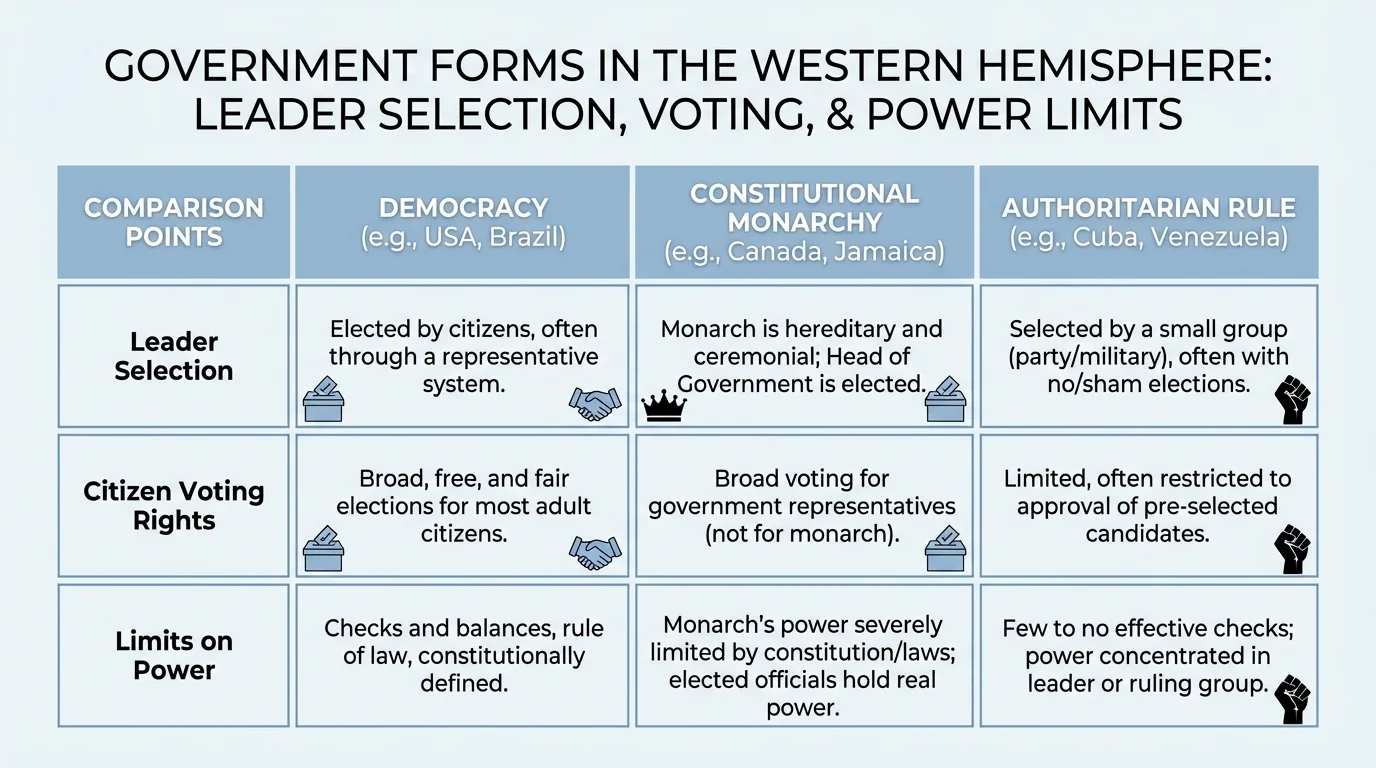
When students hear the word "government," they sometimes think only about one leader. But government is really a structure. It includes rules, courts, legislatures, elections, constitutions, and the role citizens are allowed to play. That is why two countries can both call themselves republics but still give citizens very different levels of freedom.
One useful way to compare governments is to ask three questions: Who has power? How do they get it? How can they be removed? In a healthy democracy, leaders gain power through elections, are limited by law, and can lose office peacefully. In authoritarian systems, leaders may stay in power by controlling courts, media, or security forces.
Another key question is whether citizens can criticize the government without fear. In democratic systems, free speech, independent newspapers, and peaceful protest are important protections. In less free systems, people may face punishment for speaking out. That changes the role of citizens from active participants to carefully controlled subjects.
| Government form | Who leads? | How leaders are chosen | Citizen role |
|---|---|---|---|
| Presidential system | President | Direct election or electoral process | Vote, debate issues, hold leaders accountable |
| Parliamentary democracy | Prime minister | Legislature chooses government after elections | Vote for parties or representatives |
| Constitutional monarchy | Monarch plus elected prime minister | Monarch inherits role; government is elected | Participate through democratic institutions |
| Authoritarian system | One leader or small ruling group | Limited or controlled political process | Participation is restricted |
| One-party state | Ruling party leadership | Only one legal party dominates | Limited political choice |
Table 1. Comparison of major government forms and the roles citizens usually play in each.
The hemisphere is politically diverse, as [Figure 2] shows on a regional map, but democracies remain the most common form of government. In democratic countries, citizens have the right to vote, leaders must follow laws, and power is usually divided among branches so that no single person controls everything.
The United States is a presidential system. The president serves as both head of state and head of government. Citizens vote in elections, and power is divided among the executive, legislative, and judicial branches. Mexico, Brazil, Chile, and Argentina also have presidential systems, though each country has its own constitution and election rules.
Democracies depend on more than just elections. They also need fair courts, honest vote counting, peaceful transfers of power, and protections for civil liberties. If elections exist but are unfair or opponents are silenced, the system is not fully democratic. That is why civics focuses not only on voting but also on rights, laws, and institutions.
A strong democracy allows people to disagree without violence. Citizens can support different parties, join campaigns, write to leaders, and criticize public decisions. This can be messy and noisy, but it is part of how democratic societies solve problems.
Some of the oldest continuous constitutional traditions in the Western Hemisphere are found in countries that have changed leaders many times without changing their basic democratic structure. Peaceful transfers of power are one sign that institutions are stronger than any single politician.
Canada and several Caribbean nations remind us that democracy does not always look exactly like the United States. Different democratic systems can still protect citizen rights, hold elections, and limit government power.
In a constitutional monarchy, the monarch is a symbolic national figure, while elected leaders make most political decisions. Canada is one of the best-known examples in the Western Hemisphere. The country recognizes the British monarch as head of state, but the prime minister and Parliament govern the country.
This system is also linked to parliamentary democracy. In a parliamentary system, citizens vote for representatives in the legislature, and the leader of the majority party or coalition usually becomes prime minister. This is different from a presidential system, where citizens separately choose a president.
For citizens, the role is still active and important. They vote, contact representatives, follow public issues, and participate in community life. The presence of a monarch does not remove democratic rights. Instead, the monarch's role is mostly ceremonial, while elected officials are accountable for policy decisions.
How presidential and parliamentary systems differ
In a presidential system, the executive leader is chosen separately from the legislature and usually serves a fixed term. In a parliamentary system, the executive leader comes from the legislature and may stay in office only while holding legislative support. Both systems can be democratic, but they organize power differently.
Several Caribbean countries, including Belize, Jamaica, and Saint Lucia, are independent states with parliamentary systems. This shows that even within one region, historical experience can shape government structure.
Not all countries in the Western Hemisphere give citizens the same political freedom. Cuba is often described as a one-party state, meaning one political party dominates the government and political competition is very limited. Citizens may vote in some ways, but they do not have the same range of party choices found in multiparty democracies.
In authoritarian systems, leaders may limit freedom of the press, weaken courts, or arrest critics. Elections may exist, but they may not be fair or competitive. In these situations, citizens often have fewer ways to influence policy, especially if protest is restricted or dangerous.
Nicaragua and Venezuela have been widely discussed in recent years because critics say democratic institutions there have weakened. Opposition leaders have faced restrictions, and international observers have raised concerns about election fairness and civil liberties. These examples help students see that government forms are not always fixed; a country can become more democratic or less democratic over time.
Citizen roles change sharply in such systems. Instead of openly debating leaders, people may self-censor out of fear. Instead of many parties competing, one group may dominate public life. This is why rights like free speech and free elections are so important in civics.
"The price of freedom is eternal vigilance."
— often attributed to Thomas Jefferson
The quote matters because rights do not always disappear all at once. Sometimes governments reduce freedom step by step. Citizens who understand civic institutions are better able to notice those changes.
Government can also differ in how power is divided inside a country. Some nations spread power across national and regional governments, while others keep most authority in the center, as [Figure 3] makes clear through a side-by-side structure. This is the difference between federal systems and unitary systems.
In a federal system, power is shared between the national government and smaller regional governments such as states or provinces. The United States, Canada, Mexico, Brazil, and Argentina are examples. States or provinces may control education, transportation, or local policing, while the national government handles issues like defense and foreign relations.
In a unitary system, most political power belongs to the central national government. Local governments may exist, but they usually receive their authority from the center. Chile and Peru are examples of countries with more unitary structures.
This difference affects citizens directly. In a federal system, a person may vote for leaders at local, state or provincial, and national levels. In a unitary system, local decisions may depend more strongly on the central government. The organization of power affects which level of government citizens should contact when they want to create change.
Case study: One issue, two levels of government
A student group wants safer roads near schools.
Step 1: Identify where the power may be located.
In a federal system, the city might control local traffic signs, the state or province might set transportation standards, and the national government might fund major highways.
Step 2: Decide whom to contact.
Citizens may need to speak to local officials, school boards, regional lawmakers, or national representatives, depending on who has legal authority.
Step 3: Participate in civic action.
Students and families can attend meetings, gather signatures, or present evidence to the correct government level.
This shows that understanding government structure helps citizens act effectively.
Knowing whether a country is federal or unitary helps explain why laws and services may differ from one place to another.
Citizenship is more than holding a passport. The active role of citizens, as [Figure 4] shows through many forms of participation, is one of the biggest differences between free and less free governments. In democracies, citizens are expected not only to enjoy rights but also to take responsibilities seriously.
One major role is voting. Citizens help choose leaders and sometimes decide public questions directly. Voting is powerful because it gives people a peaceful way to influence government. If many citizens do not vote, a smaller group ends up making choices for everyone.
Another role is obeying laws. In democratic societies, laws are created through public institutions, and following them helps keep order. Citizens also often pay taxes, which fund schools, roads, hospitals, police, parks, and other public services.
Citizens can also serve on juries in countries that use jury trials, such as the United States and Canada in certain legal settings. Jury service allows ordinary people to help the justice system work fairly. This is a direct example of citizens participating in government, not just watching it.
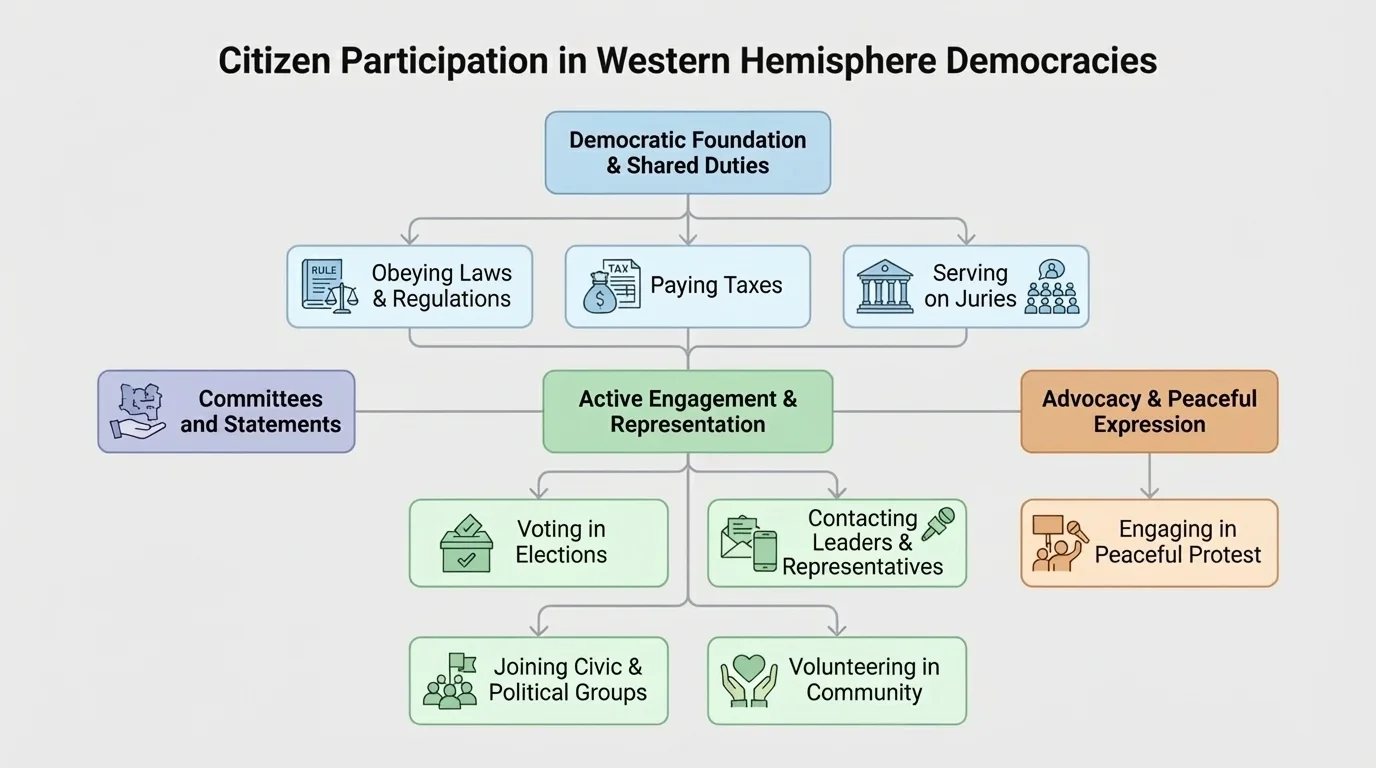
Participation goes beyond official duties. Citizens can join community groups, volunteer, attend town meetings, contact elected officials, write opinion pieces, and engage in peaceful protest. A healthy civic culture needs people who are informed and willing to speak up.
Citizens also have a role in protecting the rights of others. Free speech matters not just when people agree, but also when they disagree. Respecting election results, listening to different views, and rejecting political violence are all part of democratic citizenship.
Rights and responsibilities go together. A right is a freedom protected by law, such as speech or voting. A responsibility is a duty expected of citizens, such as following laws and helping the community.
As shown earlier in [Figure 4], citizen action can happen through many paths, not just elections. A student who writes to a city council member about playground safety is practicing civics in a real way.
Government may seem distant, but it appears in daily life constantly. School rules are influenced by laws and policies. Public buses, libraries, and sports fields may be funded by taxes. Clean water, emergency services, and vaccination programs depend on public decision-making. Citizens may not notice every connection, but government shapes many ordinary experiences.
Technology has also changed citizenship. People can now read political news instantly, contact leaders online, and organize events through social media. This creates opportunities, but it also creates problems when false information spreads quickly. Responsible citizens check sources, compare evidence, and avoid sharing rumors as facts.
Young people who are not yet old enough to vote still have civic roles. They can learn how institutions work, discuss public issues respectfully, join service projects, and observe how leaders make decisions. Future citizens are built through current habits.
In many countries, local governments have the most direct effect on daily life because they deal with services people use often, such as sanitation, local roads, parks, and community safety.
This means civics is not only about presidents and prime ministers. It is also about neighborhoods, schools, and local problems that citizens can help solve.
Even in democracies, citizen participation is not always easy. Some people face barriers such as long travel distances to polling places, lack of trustworthy information, language obstacles, or unfair treatment. In some countries, corruption reduces trust because citizens believe leaders serve themselves instead of the public.
Low voter turnout is another challenge. If citizens feel that politics is pointless or confusing, they may stop participating. But when fewer people take part, government becomes less representative. Strong democracies depend on informed, active citizens.
In more authoritarian systems, the barriers are much more serious. Fear, censorship, and political repression can make open participation dangerous. This is why the same word citizen can describe very different real-life experiences depending on a country's form of government.
Understanding these challenges helps students avoid a simple mistake: assuming that if a constitution mentions rights, those rights are always protected in practice. Real citizenship depends on how laws are enforced, how leaders behave, and whether institutions truly work.
Governments influence citizens, but citizens also influence governments. In democracies, public participation can remove leaders, pass reforms, defend rights, and improve local communities. In constitutional monarchies with parliamentary systems, citizens still shape policy through elections and representation. In authoritarian systems, reducing citizen voice often weakens accountability and freedom.
The Western Hemisphere shows this clearly. The United States, Canada, Mexico, Brazil, Chile, Cuba, Venezuela, Jamaica, and many other countries share a broad region, but they do not all organize power in the same way. Their governments differ in leadership, elections, rights, and the amount of public influence allowed.
Studying forms of government is really a way of studying power and responsibility. It helps explain why some citizens can organize freely while others cannot, why some governments change leaders peacefully while others do not, and why civic participation matters so deeply to freedom.
