Evaluate how regional differences and perspectives in the Western Hemisphere impact human and environmental interactions.
Evaluate How Regional Differences and Perspectives in the Western Hemisphere Impact Human and Environmental Interactions
Describe the location and major regions of the Western Hemisphere.
Explain how different physical environments (like mountains, plains, and rainforests) affect how people live and use resources.
Identify how people's perspectives and cultures lead to different choices about the environment.
Compare examples of human–environment interactions in different regions of the Western Hemisphere.
Evaluate which human actions help the environment and which ones harm it, using real regional examples.
Have you ever wondered why some kids travel to school by canoe on a river, while others ride a subway under a huge city, and others walk across snowy ice? All of these ways of life exist in the Western Hemisphere, and they are shaped by where people live and how they think about the environment around them.
Where Is the Western Hemisphere?
The Western Hemisphere is one half of Earth. If you draw an imaginary line from the North Pole to the South Pole, passing through Greenwich, England, that line is called the Prime Meridian. The half of Earth to the west of that line is the Western Hemisphere.
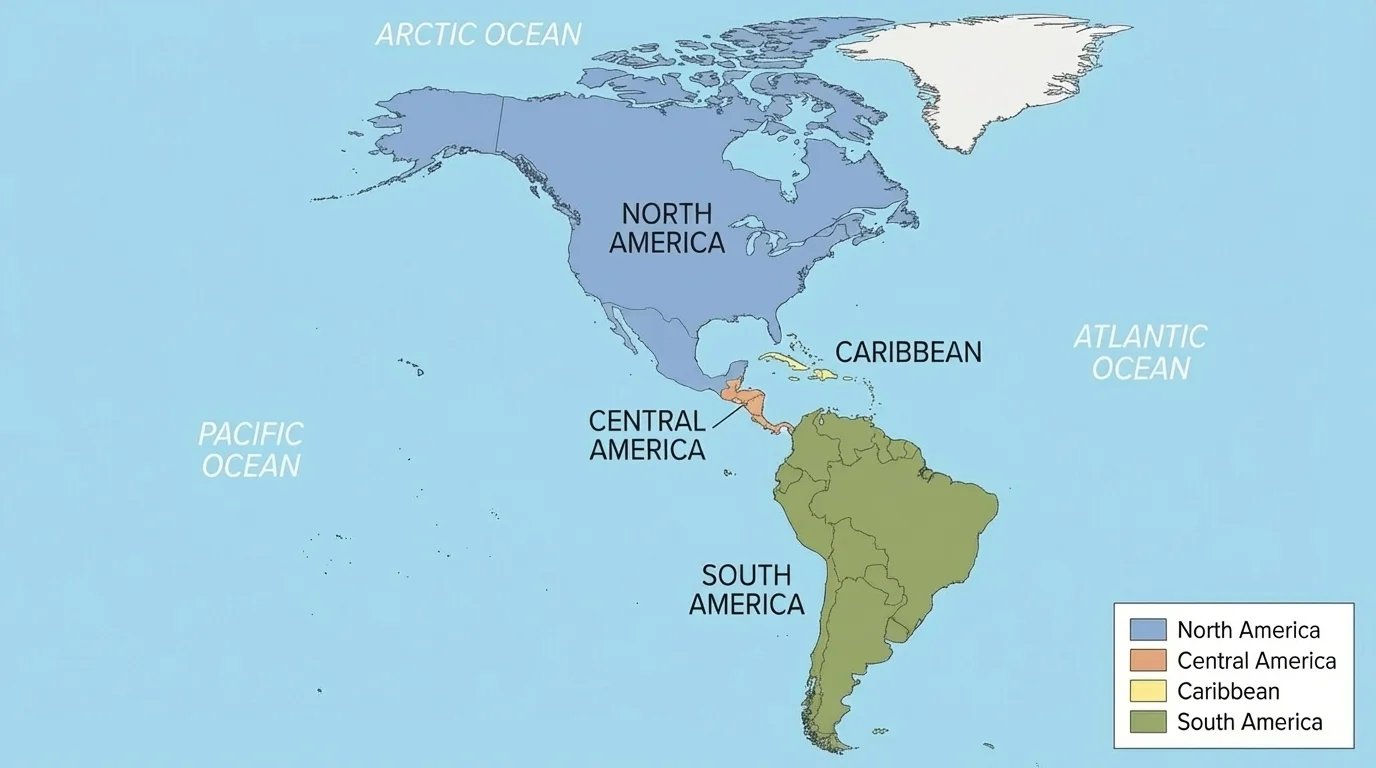
As shown in [Figure 1], the Western Hemisphere includes most of North and South America, Central America, and the Caribbean Islands, along with parts of the Arctic and the Pacific and Atlantic Oceans.
We can divide the Western Hemisphere into several major regions:
North America – Includes countries like the United States, Canada, and Mexico.
Central America – The narrow strip of land between North and South America (for example, Guatemala, Honduras, Costa Rica).
The Caribbean – Island nations such as Cuba, Jamaica, and Haiti.
South America – Includes Brazil, Argentina, Colombia, and others.
Arctic regions – Northern areas of Canada and Greenland covered with snow and ice for much of the year.
Each region has its own physical features, climate, cultures, and ways that people interact with the environment. When we "evaluate" these interactions, we look carefully at how they help or harm people and nature.
Figure 1: Map of the Western Hemisphere with major regions labeled: North America, Central America, Caribbean, South America, Arctic Ocean, Pacific Ocean, Atlantic Ocean
Physical Geography: How Land and Climate Shape Choices
The physical geography of a place describes natural features like mountains, rivers, plains, deserts, and climate. These features strongly influence how people use land and resources.
Some key landforms and environments in the Western Hemisphere include:
Mountains – The Rocky Mountains in North America and the Andes in South America are long, high mountain ranges.
Plains and prairies – Large flat or gently rolling areas, like the Great Plains in the central United States and Canada, are often used for farming.
Rainforests – The Amazon Rainforest in South America is one of the largest rainforests on Earth.
Deserts – The Atacama Desert in Chile is one of the driest places on Earth.
Coastal areas – Cities like Rio de Janeiro, New York City, and Havana are on or near coasts and depend on the ocean.
Climate is another important part of physical geography. Areas near the equator, like the Amazon, tend to be hot and wet. Areas farther north or south can be cooler or even very cold, like the Arctic coast of Canada.
Because of these differences:
Farmers in warm, wet areas may grow crops like bananas, coffee, or sugarcane.
Farmers in temperate plains might grow wheat, corn, or soybeans.
People in cold Arctic areas often depend more on fishing, hunting, and herding animals that can live in icy conditions.
These examples are all forms of human–environment interaction, which means the ways people use, change, or adapt to the natural world.
Human–environment interaction is the relationship between people and their surroundings: how people depend on the environment, how they change it, and how they adapt to it.
Region is an area that shares common features, such as climate, landforms, or culture.
In the Western Hemisphere, human–environment interactions are very different from one region to another, because the land and climate are so different.
Different Regions, Different Ways of Using the Environment
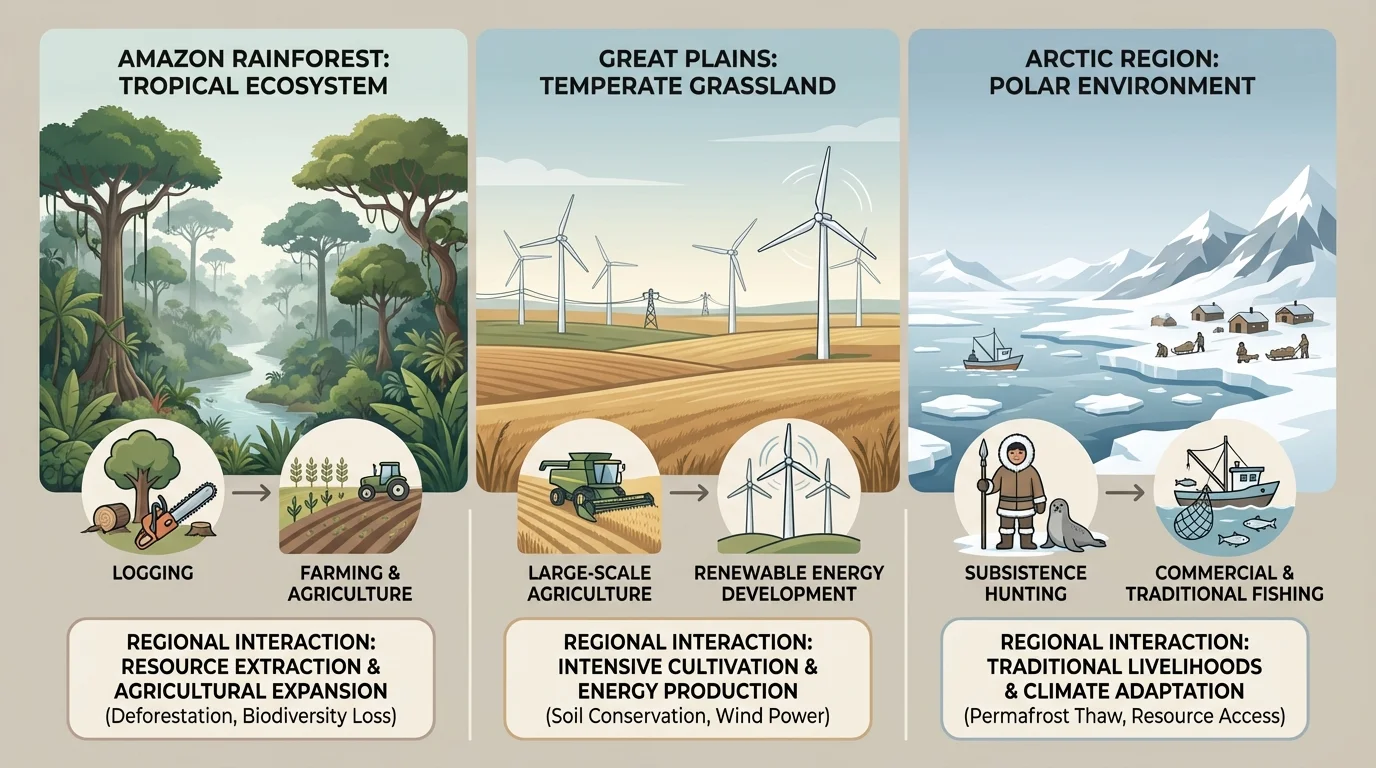
Let's look more closely at several regions and how people there interact with the environment. These examples, compared in [Figure 2], show how geography leads to very different lifestyles.
Amazon Rainforest (Brazil and Neighboring Countries)
The Amazon Rainforest in South America is hot, humid, and filled with thousands of plant and animal species. It is sometimes called the "lungs of the Earth" because its trees help produce oxygen and absorb \(\textrm{CO}_2\), a greenhouse gas.
People interact with the Amazon in many ways:
Traditional use – Many Indigenous peoples live in and near the forest. They hunt, fish, and gather fruits and nuts. Some practice small-scale farming that clears only small areas of forest and allows it to grow back.
Logging and cattle ranching – Some businesses cut down large areas of trees for lumber or to create land for cattle. This can cause deforestation, which means the removal of forests.
Mining and roads – Mining for minerals and building roads brings money and jobs but can also damage habitats and pollute rivers.
Here, different perspectives matter a lot. Some people see the Amazon mainly as a source of money and resources. Others see it as a home that must be protected for future generations.
Great Plains (Central United States and Canada)
The Great Plains are wide, mostly flat grasslands with rich soil. They have cold winters and warm to hot summers.
Human–environment interactions here include:
Large-scale farming – Farmers use machines and technology to grow huge amounts of wheat, corn, and other crops.
Use of water – In some areas, farmers pump water from underground aquifers for irrigation. If water is used faster than it is replaced, aquifers can shrink.
Wind energy – Strong winds across the plains mean that wind turbines can produce clean electricity.
Here, the environment is mainly used for food production and energy. People have changed the land by plowing the natural grasslands and replacing them with crops.
Arctic Regions (Northern Canada and Greenland)
Far to the north, the climate is very cold. Sea ice, snow, and frozen ground (called permafrost) are common for much of the year.
In Arctic regions:
Traditional hunting and fishing – Indigenous groups such as the Inuit hunt seals, fish, and other animals. These practices are closely tied to their culture.
Oil and gas drilling – Some companies search for oil and natural gas, which can bring jobs and money but also risks of spills and damage to fragile habitats.
Climate change impacts – Warming temperatures are melting sea ice and thawing permafrost, changing where animals live and how safe the land is for buildings and roads.
Here, human–environment interactions are shaped by extreme cold and by rapid changes in climate.
These three examples—the Amazon, the Great Plains, and the Arctic—show very different ways that people use land and resources. Geography strongly shapes human choices.
Figure 2: Side-by-side comparison panels of three regions: Amazon rainforest with trees and logging/farming icons; Great Plains with flat farmland and wind turbines; Arctic with ice, a small settlement, and hunting/fishing icons
Perspectives: How People Think About Nature
People do not all think about the environment in the same way. A perspective is a point of view or a way of seeing something.
In the Western Hemisphere, different groups can have very different perspectives on the environment:
Indigenous communities – Often see land, water, animals, and plants as relatives or sacred. They may focus on living in balance with nature and protecting it for future generations.
Farmers and ranchers – May see land mainly as a place to grow crops or raise animals to support their families and communities.
Business owners and companies – Often look at forests, minerals, and oil as resources that can be used to create products, jobs, and profit.
City residents – Might think more about air quality, green parks, and safe drinking water than about farming or forests far away.
Governments – Have to balance many needs: jobs, money, health, and nature protection. Different countries and leaders make different choices.
These perspectives sometimes agree and sometimes conflict. For example, in the Amazon Rainforest, Indigenous groups who want to protect the forest may disagree with companies that want to cut trees for profit.
"We do not inherit the Earth from our ancestors; we borrow it from our children."
— Anonymous proverb often linked to Indigenous values
When we evaluate human–environment interactions, we have to think about whose perspective is being used and who is helped or harmed by a decision.
Human Impacts on the Environment Across Regions
Humans can change the environment in good and bad ways. Looking at different regions of the Western Hemisphere helps us compare these impacts.
Deforestation and Land Use
In the Amazon and other forests, cutting down trees for farms, cattle, or logging can cause:
Loss of habitat for animals and plants.
Increased \(\textrm{CO}_2\) in the atmosphere, which adds to climate change.
Soil erosion, where rain washes away unprotected soil.
However, there are also efforts to use land more carefully. Some farmers practice sustainable development, trying to meet people's needs without destroying the forest. For example, they might grow forest-friendly crops like nuts or fruits that do not require cutting all the trees.
Water Use and Pollution
In the Great Plains and many parts of North and South America, people depend on rivers and underground water for farming and drinking.
Heavy use of water for irrigation can lower river levels or shrink underground aquifers.
Fertilizers and pesticides from farms can wash into rivers and lakes, harming fish and other life.
Cities that grow quickly can produce sewage and trash that pollute nearby water if not treated properly.
Some regions have improved things by cleaning up rivers, treating sewage, and protecting wetlands. These positive actions show that people can reduce their negative impacts when they plan carefully.
Urban Growth and Air Quality
Large cities like Mexico City, São Paulo, and Los Angeles are centers of jobs, culture, and technology. But they also have environmental challenges, such as:
Car and factory emissions that produce smog and unhealthy air.
Heat islands, where paved streets and buildings make cities hotter than the countryside.
Large amounts of trash and waste that must be managed.
Some cities in the Western Hemisphere have built subway systems, bike lanes, and parks to reduce traffic and pollution. Others are planting trees and using cleaner forms of energy, like solar and wind power.
Climate Change and Regional Differences
Climate change affects different Western Hemisphere regions in different ways:
Arctic regions – Sea ice is melting, making it harder for animals like polar bears and seals to survive and changing traditional hunting routes.
Caribbean islands – Some islands face stronger hurricanes, rising sea levels, and coastal flooding.
Western North America – Some areas experience more frequent and intense wildfires and droughts.
Amazon Rainforest – Changing rainfall patterns and higher temperatures can make forests more likely to catch fire.
These differences show that one global problem—climate change—has many regional effects. People's perspectives affect how seriously they treat the problem and what solutions they support.
Some scientists estimate that the Amazon Rainforest stores hundreds of billions of trees, each helping to remove \(\textrm{CO}_2\) from the air and keep our planet's climate more stable.
When thinking back to [Figure 1], you can picture how far apart these regions are, yet how closely connected they are through shared environmental issues.
Adapting, Protecting, and Planning for the Future
Although humans have caused many environmental problems, people across the Western Hemisphere are also working on solutions. These solutions often combine local knowledge, science, and different perspectives.
Conservation and Protected Areas
Many countries in the Western Hemisphere have created conservation areas, such as national parks and wildlife reserves. These areas protect forests, wetlands, mountains, and animals from too much development.
The United States has Yellowstone and many other national parks.
Costa Rica has protected a large part of its tropical forests and is famous for eco-tourism.
Brazil and other South American countries have created reserves to protect parts of the Amazon.
These choices show a perspective that values nature for its beauty, biodiversity, and long-term importance, not just for short-term profit.
Sustainable Farming and Energy
In the Great Plains, parts of Brazil, and other farming regions, some farmers are changing their methods to protect soil and water, for example:
Planting cover crops to prevent erosion.
Using fewer chemicals or more natural methods to control pests.
Saving water through drip irrigation or smarter watering schedules.
Many regions are also turning to renewable energy sources, such as:
Wind turbines on the Great Plains and along some coasts.
Solar panels in sunny areas like parts of Mexico, the southwestern United States, and northern Chile.
Hydroelectric dams on major rivers, although these also have environmental impacts that must be considered.
These examples connect back to the comparison in [Figure 2], where the same landscapes that once were used mainly for one purpose (like farming) are now also being used to produce cleaner energy.
Respecting Indigenous Knowledge
In many parts of the Western Hemisphere, governments and scientists are starting to listen more to Indigenous communities. These groups often have detailed knowledge about local plants, animals, and weather patterns, gained over many generations.
For example:
In the Amazon, Indigenous leaders are working with environmental groups to map their territories and protect them from illegal logging and mining.
In Arctic Canada and Greenland, Inuit hunters share their observations of sea ice and animal movements with scientists studying climate change.
These partnerships show how combining different perspectives—scientific, traditional, economic, and political—can lead to better decisions about the environment.
Evaluating Human–Environment Interactions
To "evaluate" how regional differences and perspectives impact human–environment interactions in the Western Hemisphere, we ask careful questions, such as:
How does the physical geography of this region (climate, landforms, resources) shape what people can do?
Whose perspectives are influencing decisions—Indigenous groups, businesses, governments, or others?
What are the short-term benefits (like jobs or food) and the long-term costs (like pollution or loss of forests)?
Are people using resources in a sustainable way that protects the environment for future generations?
How are different regions connected—for example, how does deforestation in the Amazon or pollution in one country affect the rest of the Western Hemisphere?
By comparing regions like the Amazon, the Great Plains, the Arctic, the Caribbean, and big cities, we can see that there is no single way humans interact with the environment. Instead, there are many patterns based on land, climate, culture, and perspective.
When you hear news about forests, oceans, or climate, think about which region of the Western Hemisphere is being discussed and whose perspective is being shared. This will help you better understand the story and its impact on people and the planet.
Key Vocabulary
The following terms are important for understanding how regional differences and perspectives shape human–environment interactions in the Western Hemisphere.
Western Hemisphere
Prime Meridian
Physical geography
Human–environment interaction
Region
Indigenous peoples
Deforestation
Permafrost
Perspective
Sustainable development
Conservation
The Western Hemisphere includes many different regions, such as North America, Central America, the Caribbean, South America, and Arctic areas, each with unique physical geography and climate.
Physical features like mountains, plains, rainforests, and ice, along with climate, shape how people get food, build homes, travel, and use natural resources.
Human–environment interactions vary widely: people in the Amazon, Great Plains, and Arctic use and change their environments in different ways based on local conditions.
Perspectives from Indigenous communities, farmers, businesses, city residents, and governments often disagree about how land, water, and resources should be used.
Human actions such as deforestation, pollution, and urban growth can harm the environment, while conservation, sustainable farming, and renewable energy can help protect it.
Climate change affects Western Hemisphere regions differently, from melting Arctic ice to stronger Caribbean hurricanes, showing how interconnected human–environment interactions are.
Evaluating these interactions means asking who benefits, who is harmed, and whether decisions protect the environment for future generations.