Scroll through your social media or news feed for a few minutes and you might see several people arguing about the same event—but their stories do not match at all. Who is right? Who is leaving out important details? Historians face this problem every day when they study the past, especially the long and complex history of the Eastern Hemisphere 🌍.
To make sense of events in places like East Asia, the Middle East, Africa, and Europe, historians analyze and interpret many different sources. Then they pull those pieces together into a strong, evidence-based thesis—a clear answer to a historical question.
History is not just a list of dates and names. It is an investigation based on evidence. That evidence comes from things people leave behind: letters, tools, buildings, art, laws, stories, and much more. When we study the Eastern Hemisphere, we might look at clay tablets from Mesopotamia, Chinese scrolls, coins from ancient Greece, or carvings from West African kingdoms.
Just like a detective, a historian must:
To do this well, we need to understand what kinds of sources we are using.
Historians usually talk about two main categories of evidence: primary sources and secondary sources. Seeing them side by side, as in [Figure 1], makes it easier to tell them apart.
Primary sources are original records created by people who lived through an event or time period. They are "first-hand" evidence.
Secondary sources are accounts created later by people who did not directly experience the event. They usually analyze, explain, or interpret primary sources.
Here are some examples from Eastern Hemisphere history:
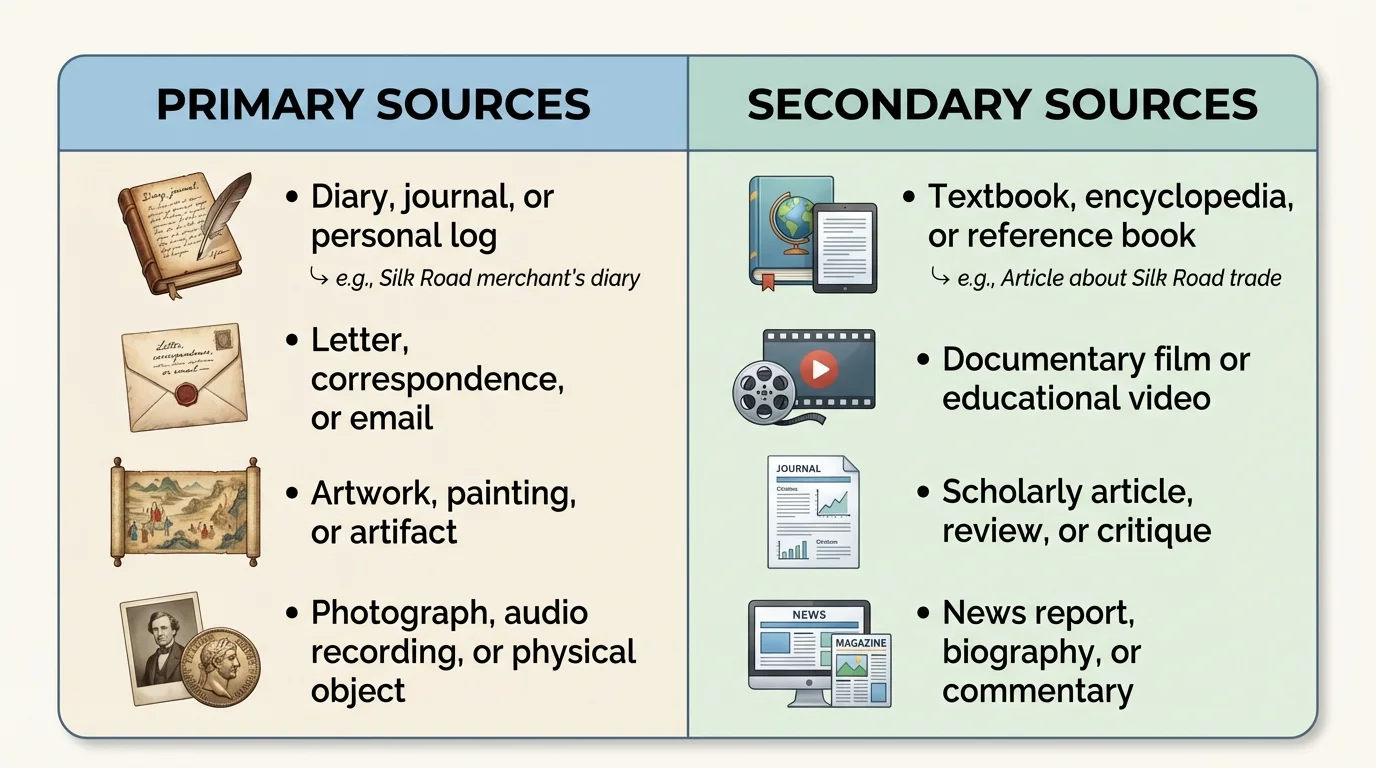
Neither type is "better" on its own. Primary sources bring us closer to the people of the past, but they can be confusing or one-sided. Secondary sources help us see the bigger picture, but they depend on what the author chose to include or leave out.
Within primary and secondary sources, there are many specific types. When you see a new source, it helps to first ask, "What kind of source is this?" That question is part of a skill historians call sourcing.
Common types of sources include:
| Type of Source | Description | Eastern Hemisphere Example |
|---|---|---|
| Written documents | Anything written or printed | A royal decree from ancient Egypt carved on a stone stele |
| Visual sources | Images, art, photos, maps | A Japanese woodblock print showing life in Edo (Tokyo) |
| Artifacts | Objects made or used by people | A fragment of pottery from a Greek city-state |
| Oral traditions | Stories, songs, and histories passed down by word of mouth | Griots' stories from West African kingdoms about past rulers |
| Secondary texts | Texts that analyze and explain the past | A modern book explaining the rise of the Ottoman Empire |
Written documents often give us exact words people used. For example, a law from Hammurabi's Code in Mesopotamia shows what rulers thought justice should look like. Visual sources, such as Persian miniatures, show clothing, tools, and beliefs that might not be described in writing. Artifacts help us understand daily life: what people ate, how they traded, and which technologies they used. Oral traditions keep memories alive where there were few written records, such as in many parts of precolonial Africa.
When you read or look at any of these, you should also think about the creator's point of view.
Every source is created by a real person (or group) who has their own experiences, goals, and beliefs. Historians ask: Who created this? When? Why? These questions help us understand the source's point of view and possible bias.
Point of view is the creator's position, background, or role that shapes how they see and describe events.
Bias is a slant, preference, or unfair leaning for or against something or someone, which can affect how information is presented.
Reliability describes how trustworthy and accurate a source is likely to be for a specific question.
Consider a simplified example about the Mongol Empire in the 1200s–1300s:
Both wrote during or soon after Mongol rule, so both are primary sources. But their point of view is different. The Chinese official represents a conquered people who lost power. The Persian historian is writing in a region where the Mongols supported trade. Each might be exaggerating certain details and ignoring others.
To judge reliability, we do not simply ask, "Is this source true?" Instead we ask, "What is this source useful for?" The Chinese official might be very reliable for understanding how some people felt under Mongol rule, but less reliable for an overall judgment on Mongol government.
No single source can tell the whole story. To understand an event in the Eastern Hemisphere, historians look at multiple perspectives—different ways people experienced or understood the same thing.
Imagine historians are studying trade in an East African Swahili city-state around 1400:
All three are primary sources, but each perspective is limited:
Historians compare these accounts. This process of checking different sources against each other is called corroboration. When two or more independent sources agree on a detail—such as that the city traded gold and ivory—historians feel more confident that this detail is accurate.
When sources disagree, that disagreement itself becomes interesting. It can reveal conflicts, inequalities, or cultural differences that shaped people's experiences.
Once historians study several sources, they do not just list facts. They answer a focused historical question with a clear thesis.
Thesis is a clear, specific claim or main idea that answers a historical question and is supported by evidence from sources.
A typical process looks like this:
This thesis is "appropriate" because it:
Next, you must choose which evidence best supports your thesis.
To turn your thesis into strong historical writing or discussion, you must connect it to relevant evidence. That means selecting information that really helps prove your point, not just interesting extra facts.
A simple way to organize evidence is to use a chart like this:
| Part of Thesis | Source | Evidence (Quote or Description) | How It Supports the Thesis |
|---|---|---|---|
| Trade wealth | Traveler's description | "The bazaars were filled with silks, spices, and precious stones…" | Shows that markets along the Silk Road were rich and busy. |
| Spread of religion | Modern historian's chapter | Explains how Buddhism spread from India to China along trade routes. | Connects religious change to Silk Road travel. |
| Connecting cultures | Chinese official's report | Mentions foreign merchants living in Chinese cities. | Shows people from different cultures meeting and living together. |
When you write or speak about your thesis, you should:
This is what it means to have your thesis "supported by relevant evidence."
Let's put these skills together using a case study of the Silk Road, a network of trade routes crossing the Eastern Hemisphere.
Historians might explore this question: "In what ways did the Silk Road connect different regions of the Eastern Hemisphere?" It helps to picture where these routes went, as shown in [Figure 2].
Imagine we have these simplified sources:
First, we identify what type of sources these are and their point of view:
Looking at all four sources and the map, we see patterns:
A possible thesis might be:
"The Silk Road tied together distant parts of the Eastern Hemisphere by allowing long-distance trade in valuable goods and by helping religions and ideas spread across continents."
Now we connect each part of the thesis to specific evidence:
If another source (say, Source E) argued that the Silk Road mostly benefited wealthy merchants and rulers, we might adjust our thesis to recognize that the benefits were not equal for everyone. This shows we are thinking critically, not just accepting one simple story.
When you analyze sources from the Eastern Hemisphere, you are practicing several important historical thinking skills at the same time:
When you use these skills, you can:
These abilities are not just useful in history class. They also help you judge information you see online, in the news, or in conversations. Learning to ask, "Who said this?" "Why?" and "What evidence do they have?" makes you a stronger, more careful thinker 🎯.
