What would it feel like to live through not just one, but several revolutions in your lifetime—changing your king, your government, your rights, and even the meaning of freedom itself? 🤔 Between the 1760s and the 1870s, people in what became the United States experienced exactly that. In about 100 years, the colonies broke from Britain, created a new nation, fought a brutal civil war, and then tried to rebuild and redefine what it meant to be American.
By the mid-1700s, thirteen British colonies stretched along the Atlantic coast of North America. Most white colonists saw themselves as loyal British subjects, but daily life in the colonies already felt different from life in England. Land was more available for white settlers, there was a mix of religions, and local colonial assemblies practiced a kind of self-government.
The big turning point came with the French and Indian War (also called the Seven Years' War, 1754–1763). Britain and its colonists fought against France and many of its Native allies for control of North America. Britain won a huge victory and gained Canada and other territory. As shown in [Figure 1], Britain controlled a vast area east of the Mississippi River after the war, but the cost of this victory was enormous.
To avoid more costly conflict with Native nations on the frontier, the British government issued the Proclamation of 1763, drawing a line along the Appalachian Mountains and saying colonists could not settle west of it. Many colonists, especially land speculators and frontier settlers, were furious. They felt the British were blocking them from land they had fought for.
At the same time, the war left Britain deeply in debt. British leaders believed colonists should help pay for their own defense. Colonists, however, thought they already had—through their soldiers and their taxes in the colonies. This disagreement over money and control set the stage for open conflict, just as the new borders and Proclamation Line on [Figure 1] hint at a growing empire that would be hard to manage.
Key Foundations
French and Indian War was a conflict in North America where Britain and its colonists fought against France and Native allies, leading to British control of more territory but also huge debt. Proclamation of 1763 was a British law that banned colonial settlement west of the Appalachian Mountains.
Colonial society itself was unequal. Wealthy merchants and planters held a lot of power. Many poor white farmers struggled with debt. Enslaved Africans worked on plantations, especially in the Southern colonies. Native nations fought to hold on to their lands and ways of life as more colonists pushed west.
After 1763, Britain passed a series of taxes and laws to raise money and tighten control. To many colonists, these felt like unfair Parliament decisions made far away, without asking their opinion.
Some key acts included:
Colonial leaders argued for "no taxation without representation," meaning they believed only their own elected colonial assemblies had the right to tax them, not a distant government where they had no vote. This idea drew on Enlightenment thinkers like John Locke, who wrote about natural rights—basic rights such as life, liberty, and property, which governments are supposed to protect.
Tensions escalated. In 1770, British soldiers fired into a crowd in Boston, killing five colonists in what Patriots labeled the Boston Massacre. In 1773, colonists protesting the Tea Act boarded ships in Boston Harbor and dumped the tea overboard in the famous Boston Tea Party. Britain responded with harsh laws colonists called the Intolerable Acts, closing Boston's port and limiting self-government in Massachusetts.
Colonial leaders from different regions met in the Continental Congress to coordinate their response. For the first time, many colonists began to see themselves not just as Virginians or Massachusetts colonists, but as part of a shared American cause. 💡
By 1775, the conflict had exploded into open fighting. British troops marched to seize colonial weapons at Concord, Massachusetts. Local militia—Minutemen—confronted them at Lexington and Concord. Shots were fired, and the American Revolution had begun. The sequence of these early confrontations, along with later battles and key documents, forms a chain of turning points, as seen in [Figure 2].
In 1776, the Second Continental Congress chose George Washington to lead the Continental Army. On July 4, 1776, the Congress approved the Declaration of Independence, written mainly by Thomas Jefferson. The Declaration argued that all men are created equal and have unalienable rights to life, liberty, and the pursuit of happiness. It listed the ways King George III had violated colonists' rights and declared the colonies free and independent states.
The war included many critical battles and turning points:
The war officially ended with the Treaty of Paris (1783), where Britain recognized the independence of the United States and set new borders, from the Atlantic Ocean to the Mississippi River.
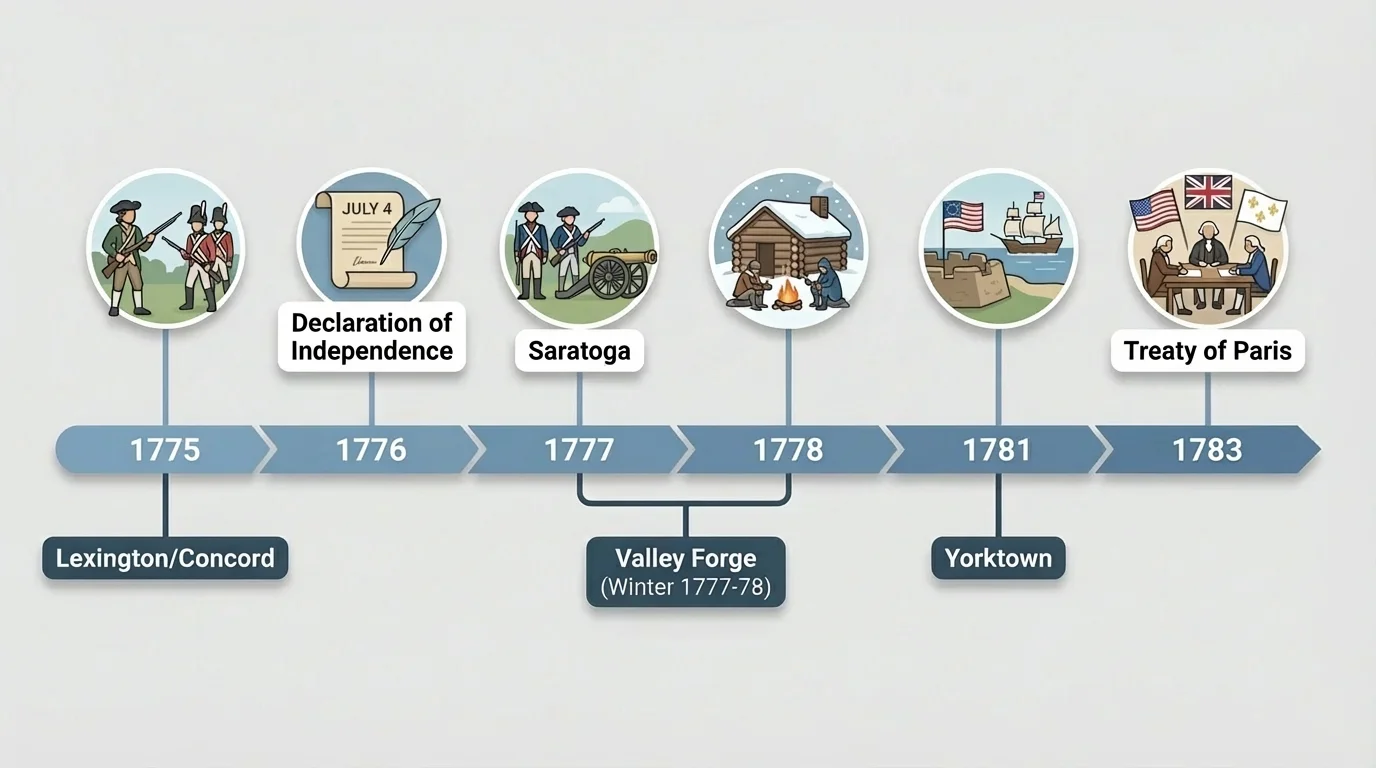
Many groups shaped the war's outcome. Women ran farms and businesses, worked as nurses, and some even disguised themselves to fight. Enslaved people sometimes escaped to British lines when promised freedom, or fought for the American side hoping independence would bring change. Native nations often tried to protect their land by choosing sides or staying neutral, but many suffered loss of land and power no matter who won, a pattern that continued long after the final date on [Figure 2].
Winning independence created a new problem: how to govern a large, diverse country. The first national plan was the Articles of Confederation. Under the Articles, the states formed a loose union, or "league of friendship." The national government had a Congress but no president and no national court system.
The Articles did accomplish some things, such as the Northwest Ordinance, which organized the Northwest Territory and created a process for new states to join the Union. Importantly, it banned slavery in that territory. However, the Articles had serious weaknesses:
Economic troubles led to Shays' Rebellion (1786–1787), when Massachusetts farmers, many of them war veterans, rose up against high taxes and farm foreclosures. The rebellion frightened many leaders and convinced them that a stronger national government was needed.
In 1787, delegates met in Philadelphia for the Constitutional Convention. They ended up writing a whole new Constitution. Major compromises shaped the new system:
The Constitution created a federal system with shared power between national and state governments and three branches—legislative, executive, and judicial—with checks and balances.
Many Americans feared this new government might become too powerful. To win support, leaders promised a Bill of Rights, the first ten amendments to the Constitution. These amendments protect freedoms such as speech, religion, and the press, and guard against unfair trials and cruel punishments. Over time, courts and citizens have argued over how to apply these rights, but they remain a core part of American political culture. 🎯
Under President George Washington, the new government began to operate. Washington set many traditions, like serving only two terms. Two main groups soon disagreed about how powerful the federal government should be and how the economy should grow. These disagreements created the first political parties.
Federalists, led by Alexander Hamilton, favored a strong national government, a national bank, and closer ties with Britain. Democratic-Republicans, led by Thomas Jefferson and James Madison, wanted a more limited national government, more power for states, and support for farmers instead of merchants.
As the nation grew, it expanded west. Under President Jefferson, the United States bought the Louisiana Territory from France in 1803, doubling the country's size. The Lewis and Clark Expedition explored this new land, with crucial help from Native guides and translators like Sacagawea.
This expansion created new conflicts. The War of 1812 between the United States and Britain involved trade disputes and British support of Native resistance. Although neither side gained much land, the war boosted American national pride. At the same time, U.S. settlers continued to pressure Native nations. Over the next decades, policies like Indian Removal forced many Native communities off their homelands.
By the 1820s and 1830s, more white men (though not women or most people of color) could vote, and politics became more fiercely democratic—but also more divided—under leaders like Andrew Jackson.
While some Americans gained more political power, millions of African Americans remained enslaved, especially in the South. The invention of the cotton gin in the 1790s made it easier to process cotton, and cotton became a highly profitable crop. This led to the expansion of slavery westward and deeper into the South.
At the same time, a wave of religious energy—the Second Great Awakening—inspired many to push for reforms. Activists worked for public education, women's rights, better prisons, and the end of slavery. Abolitionists such as Frederick Douglass, Sojourner Truth, and William Lloyd Garrison spoke and wrote powerfully against slavery. The Underground Railroad helped enslaved people escape to freedom.
The country struggled to balance free and slave states. Key political compromises tried to keep peace:
New events further raised tensions: the publication of Uncle Tom's Cabin, a powerful anti-slavery novel; violent clashes in "Bleeding Kansas"; and the Dred Scott v. Sandford Supreme Court decision in 1857, which said that African Americans could not be citizens and that Congress could not ban slavery in the territories.
In 1860, Abraham Lincoln, a Republican who opposed the spread of slavery (though not at first calling for its immediate end everywhere), was elected president. Southern leaders feared that their political power and the future of slavery were in danger. Several Southern states seceded (left the Union) and formed the Confederate States of America. The long-building conflict had finally broken into civil war.
The Civil War (1861–1865) was the deadliest conflict in U.S. history, pitting the Union (North) against the Confederacy (South). At first, Lincoln's main goal was to preserve the Union. Over time, ending slavery became a central aim as well.
The Union had more factories, railroads, and people, while the Confederacy had strong military leaders and fought mostly on its own territory. Early in the war, major battles like Bull Run showed that the war would be long and bloody. Later turning points included:
The Emancipation Proclamation changed the meaning of the war. It encouraged many enslaved people to escape to Union lines, where they often found protection. Nearly 200,000 African American men served in the Union army and navy, fighting for their own freedom and the future of the country.
In 1863, Lincoln gave the Gettysburg Address, a brief but powerful speech that described the war as a test of whether a nation "conceived in Liberty, and dedicated to the proposition that all men are created equal" could endure. In 1865, Union forces under generals like Ulysses S. Grant and William Tecumseh Sherman finally wore down the Confederacy. Confederate General Robert E. Lee surrendered at Appomattox Court House in April 1865. Just days later, Lincoln was assassinated.
After the war, the United States faced a difficult question: How should the South be brought back into the Union, and what would freedom mean for nearly 4 million formerly enslaved people? Different leaders had competing answers, and their disagreements shaped the period known as Reconstruction. As [Figure 3] shows, there were at least two main approaches.
President Andrew Johnson favored a fairly easy path for Southern states to rejoin the Union. Many former Confederate leaders quickly returned to power. Southern state governments then passed Black Codes—laws that severely limited the rights of African Americans, trying to keep them in a position close to slavery.
In response, Radical Republicans in Congress pushed for a stricter form of Reconstruction. Congress passed the Reconstruction Acts, placed the South under military districts, and required new state constitutions that protected African American men's right to vote.
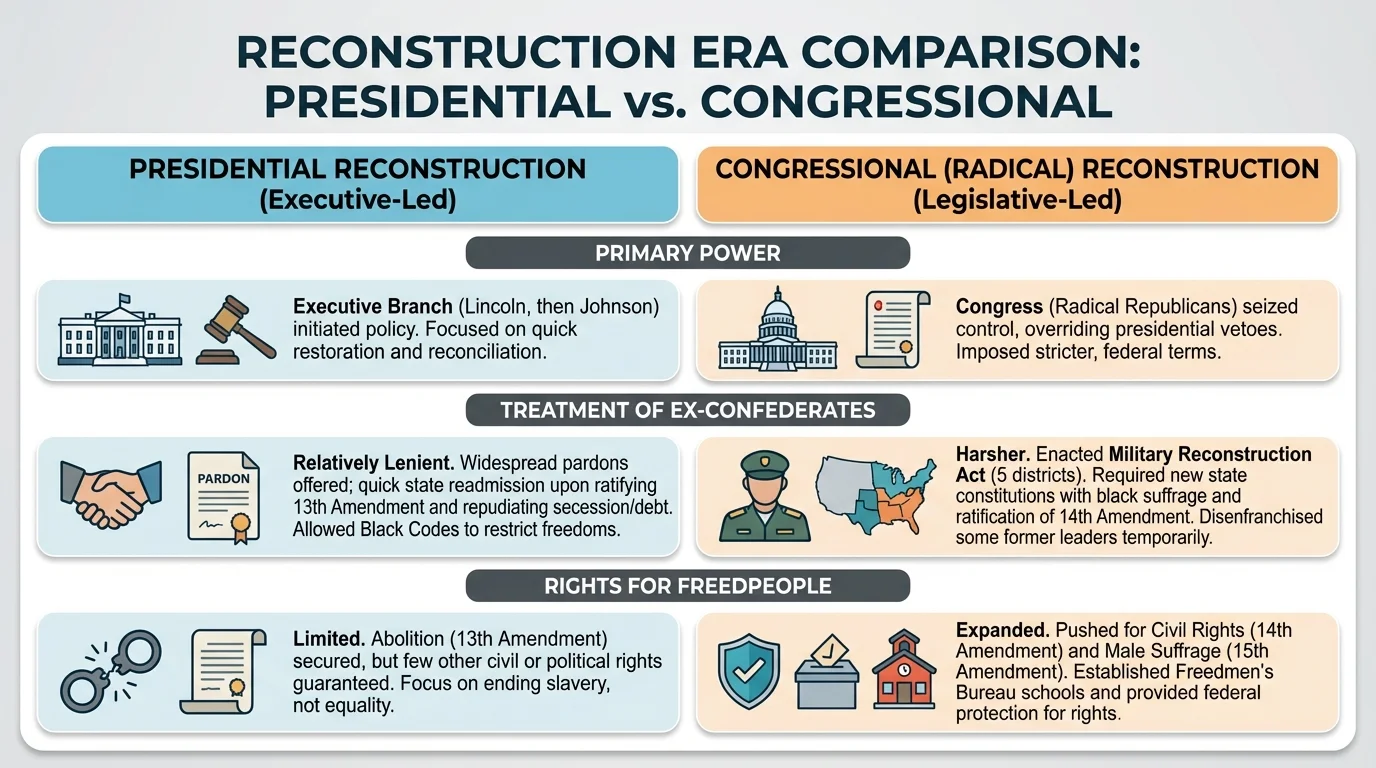
Several important constitutional amendments reshaped the nation:
New institutions such as the Freedmen's Bureau helped formerly enslaved people find work, education, and basic supplies. African American men won elections and served in state legislatures and even in Congress. For a short time, the South experienced a remarkable experiment in interracial democracy.
But white resistance was fierce. Groups like the Ku Klux Klan used terror and violence to try to restore white supremacy. Many white Southerners developed systems like sharecropping, where African American families farmed land owned by whites in exchange for a share of the crop. In practice, high debts and unfair contracts often trapped sharecroppers in poverty and dependence, limiting the freedom that the 13th Amendment promised.
Over time, Northern interest in protecting Reconstruction faded. The disputed election of 1876 led to a political deal that effectively ended Reconstruction in 1877. Federal troops withdrew from the South, and white Southern leaders quickly passed new laws, including poll taxes and literacy tests, that stripped many African Americans of their voting rights. As the simplified division in [Figure 3] suggests, ambitious promises of equality clashed with powerful efforts to control who truly held political power.
From the first protests against British taxes to the struggles after Reconstruction, certain big ideas and themes connect these historical eras.
These themes stretch across the maps of territory, the timelines of battles, and the charts of political power, like those shown in [Figure 1], [Figure 2], and [Figure 3]. Understanding them helps explain not only what happened between the American Revolution and Reconstruction, but also how those events still influence debates about rights, justice, and belonging today. ⭐
The phrase "Four score and seven years ago" in the Gettysburg Address refers to 87 years, taking listeners back from 1863 to 1776 and linking the Civil War directly to the ideals of the American Revolution.
