On paper, the United States in 1865 and the United States today look completely different—yet some debates, fears, and hopes sound strangely familiar. 🤔 How can both be true? Historians answer this by analyzing patterns of continuity and change, causes and effects, layers of complexity, moments of unity and conflict shaped by diversity, and the powerful ideas that move people to act. This lesson uses U.S. history from Reconstruction to the present as a huge case study in how to think historically, not just memorize dates.
Before examining specific eras, it is important to understand the analytical tools you will use.
Continuity and change over time refers to what stays the same and what transforms. Almost no period is “all change” or “no change.” For example, between 1870 and 1920, technology and cities changed dramatically, but beliefs about race and gender showed strong continuities.
Cause and effect is about why something happened and what it led to. Causes are often multiple and interacting, not a single trigger. The Great Depression did not start only because stock prices dropped; it was shaped by banking practices, global trade problems, and income inequality. Effects can be immediate (millions out of work) and long-term (new expectations about the federal government’s role).
Complexity means recognizing that history is rarely simple or one-sided. People make choices under pressure, and events can have both positive and negative results at the same time. A policy may expand freedom for one group while limiting it for another.
Unity and diversity focuses on how Americans have tried to hold together as “one nation” while including people of many races, religions, regions, and identities. Sometimes the U.S. has emphasized unity so strongly that it has tried to silence difference; at other times, people have demanded that diversity be recognized and celebrated.
Significant ideas are beliefs that shape action—ideas like freedom, equality, opportunity, security, states’ rights, and democracy. These words appear again and again from Reconstruction to the present, but different groups define them differently. Who gets freedom? Who is “equal”? What counts as “security”?
As you move from Reconstruction to the 21st century, you will use these concepts to analyze and evaluate major developments in U.S. history.
Reconstruction (roughly 1865–1877) is a powerful starting point for studying continuity, change, and cause and effect in the modern United States. It raised urgent questions: What did freedom mean for nearly 4 million formerly enslaved people? Would the federal government protect their rights? How would white Southerners respond?
Historians trace a chain of causes and effects in this era, as shown by the sequence of amendments, laws, and resistance that unfold over time, similar to what a timeline in [Figure 1] illustrates. The assassination of Abraham Lincoln in 1865, for example, had huge effects: his more lenient approach to the South was replaced by Andrew Johnson’s policies, which clashed with Congress and shaped Reconstruction’s course.
Key events and figures include the passage of the 13th Amendment (abolishing slavery), the 14th Amendment (defining birthright citizenship and equal protection), and the 15th Amendment (barring states from denying the vote based on race). Radical Republicans in Congress, such as Thaddeus Stevens and Charles Sumner, pushed for strong federal protection of Black rights. Black men briefly held political office in the South; Hiram Revels and Blanche K. Bruce, for example, served in the U.S. Senate from Mississippi.
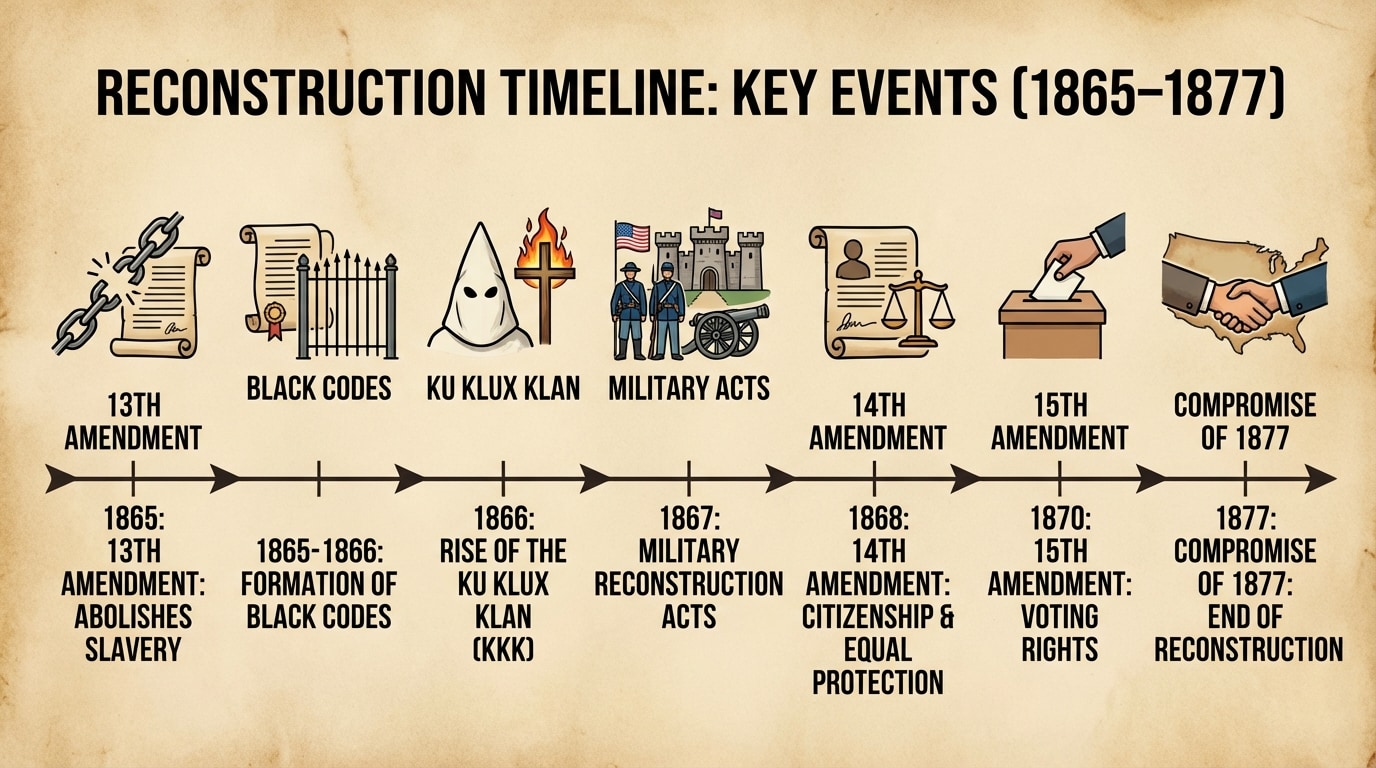
Continuity and change in Reconstruction are striking. Slavery as a legal institution ended—an enormous change—but systems of racial control did not disappear. They shifted into new forms: Black Codes, sharecropping contracts that trapped many in debt, and violent white supremacist organizations like the Ku Klux Klan. Primary sources such as the text of Mississippi’s Black Codes or testimonies of freedpeople collected by the Freedmen’s Bureau reveal both new rights (wage labor, legal marriages) and harsh limits (vagrancy laws, labor contracts enforced by courts).
Cause and effect relationships are clear but complex. The South’s defeat in the Civil War and the abolition of slavery caused a crisis over labor and social order. White elites tried to regain control through laws and violence. In response, Congress passed the Reconstruction Acts, placing Southern states under military rule until they ratified new constitutions and the 14th Amendment. This federal intervention allowed many Black men to vote and hold office. But Northern fatigue, economic concerns (like the Panic of 1873), and deal-making in the Compromise of 1877 contributed to the withdrawal of federal troops. The effect was the rapid rise of Jim Crow segregation and disenfranchisement.
Complexity appears in the mixed outcomes. For formerly enslaved people, Reconstruction brought schools, churches, and political power, often described in letters and speeches by Black leaders who celebrated new possibilities. Yet it also brought violence, uncertainty, and betrayal when promised land reforms (like “40 acres and a mule”) largely failed to materialize. White Southerners were not a single block: some accepted change, others resisted violently, and many fell somewhere in between.
Unity and diversity were at stake in debates over national citizenship. The 14th Amendment attempted to create a more unified definition of citizenship, but the reality remained sharply divided along racial lines. Who counted as an American, and on what terms, would continue to be contested all the way into the Civil Rights Era and beyond, echoing the struggles visible in [Figure 1].
Significant ideas in this era included equality before the law, federal power versus states’ rights, and the meaning of freedom. White Southern politicians often invoked states’ rights to resist Reconstruction; Radical Republicans argued that the federal government had a duty to secure equal rights.
From the late 1800s into the early 1900s, the U.S. was transformed by industrialization and massive immigration. Factories, railroads, and corporations reshaped everyday life. Cities expanded rapidly as immigrants from southern and eastern Europe (Italians, Poles, Jews, and others) arrived alongside internal migrants, including African Americans moving north.
Continuity and change: Economic opportunity remained a major draw—people still came to the U.S. seeking a “better life.” But the nature of work changed. Instead of small workshops and farms, many people labored in large factories and steel mills, often for long hours and low wages. Inequality widened: industrialists like Andrew Carnegie and John D. Rockefeller accumulated enormous fortunes, while many workers struggled.
Cause and effect: New technologies (the Bessemer process for steel, expanded railroads, electrical power) caused productivity to soar. This led to cheaper goods and rapid urban growth, but also to dangerous working conditions, child labor, and environmental damage. Workers responded with strikes and unions, such as the American Federation of Labor and later the Industrial Workers of the World. Clashes like the Haymarket Affair (1886), the Homestead Strike (1892), and the Pullman Strike (1894) illustrated the tensions between labor and capital.
Complexity is visible in the mixed impacts of industrialization. Industrial growth made the U.S. a global economic power and created a consumer society, but it also produced slums, political corruption, and backlash against immigrants. Muckraking journalists like Ida B. Tarbell and Upton Sinclair exposed abuses, while reformers in the Progressive Era (such as Jane Addams and Theodore Roosevelt) pushed for regulations and social reforms. Progressivism itself was complex: it included noble efforts to improve labor, housing, and public health, but also embraced paternalistic or racist policies, such as some advocates of eugenics.
Unity and diversity in this period were tested by massive demographic change. Ethnic neighborhoods, such as Little Italy or Chinatown, reflected cultural diversity and support networks, while nativist groups like the American Protective Association argued that “true Americanism” required restricting immigration and assimilation. Laws such as the Chinese Exclusion Act (1882) and later the Immigration Act of 1924 (with national origins quotas) showed the government using policy to shape the nation’s cultural and racial makeup.
Significant ideas included individualism, the “self-made man,” and Social Darwinism, which some used to justify inequality. At the same time, new ideas about social responsibility and the social gospel argued that society owed help to the poor. These competing ideas influenced whether people saw poverty as a personal failure or a structural problem.
The first half of the 20th century brought two world wars, the Great Depression, and the rise of the U.S. as a global power. These crises accelerated changes in the federal government’s role and in citizens’ expectations.
Cause and effect stand out in the Great Depression. The stock market crash of 1929 was a dramatic symbol, but historians also point to underlying causes: fragile banks, overproduction in agriculture and industry, unequal distribution of income, and shaky international financial arrangements after World War I. The effects were catastrophic: unemployment soared, families lost homes and farms, and confidence in the economic system collapsed.
Franklin D. Roosevelt’s New Deal in the 1930s represented a major change in government philosophy. Federal agencies such as the Works Progress Administration (WPA) and the Civilian Conservation Corps (CCC) directly hired millions; Social Security created a safety net for older Americans and some workers. Yet there was also continuity: the basic capitalist system survived, and many programs excluded or disadvantaged certain groups, such as agricultural and domestic workers, many of whom were Black or Latino.
Complexity is crucial here. Some Americans saw the New Deal as life-saving and democratic; others feared it moved the country toward too much government control. Business leaders, conservative politicians, and the Supreme Court sometimes pushed back, while many Black Americans and left-wing activists argued the reforms did not go far enough. Primary sources like FDR’s “fireside chats” and letters from ordinary citizens show both gratitude and frustration.
World War II further expanded the federal government’s reach. Massive mobilization, rationing, and war production pulled the U.S. out of the Depression, while military service and home-front work turned millions into active participants in national sacrifice. The war’s effects included the G.I. Bill, which helped many veterans attend college and buy homes—though again, access was unequal by race and region.
After 1945, the Cold War reshaped foreign and domestic policy. The U.S. embraced the idea of containing communism, leading to the Marshall Plan in Europe, the Korean War, the Vietnam War, and a global network of alliances. At home, anti-communism fueled loyalty oaths, investigations by the House Un-American Activities Committee (HUAC), and the rise of Senator Joseph McCarthy. The fear of communism had real effects on civil liberties and political debate.
Unity and diversity: During WWII, propaganda and shared danger encouraged national unity. Yet diversity continued to matter. Japanese Americans, for example, were forced into internment camps after Executive Order 9066—a severe violation of civil liberties based on race and fear. African American activists launched the “Double V” campaign: victory against fascism abroad and racism at home, showing how wartime unity did not erase internal conflicts.
Significant ideas that dominated this era included democracy versus totalitarianism, freedom of speech versus loyalty, and the promise of the “American Dream” through education and homeownership. Many Cold War speeches framed U.S. actions as defending freedom, even as some policies at home restricted dissent.
The mid-20th century through the 1970s saw powerful movements that challenged long-standing inequalities. These movements drew directly on the unfinished business of Reconstruction and the promises of the 14th and 15th Amendments.
Continuity and change are especially clear when you compare Jim Crow–era segregation with the breakthroughs of the Civil Rights Movement. School segregation, voter suppression, and racial violence had deep roots extending back to the late 1800s. Yet Supreme Court decisions such as Brown v. Board of Education (1954), which declared segregated public schools unconstitutional, and civil rights legislation such as the Civil Rights Act of 1964 and the Voting Rights Act of 1965 marked dramatic legal changes.
Cause and effect: Grassroots activism, legal challenges, and media coverage combined to pressure federal action. The Montgomery Bus Boycott (1955–1956), sit-ins at lunch counters, Freedom Rides, and the March on Washington in 1963 exposed injustice to national and global audiences. Violent reactions from segregationists, seen in photographs and news footage, caused many Americans to support reform. Leaders like Martin Luther King Jr., Malcolm X, Rosa Parks, and organizations like the NAACP, SNCC, and SCLC played different but interconnected roles.
Complexity appears inside the movement itself. There were debates over nonviolence versus self-defense, integration versus Black Power, working within the political system versus more radical transformation. Similarly, the women’s movement, influenced by both earlier suffrage activism and the Civil Rights Movement, contained liberal feminists seeking equal opportunities within existing institutions and more radical feminists questioning deeper structures of patriarchy.
Other movements—such as the Chicano movement, the American Indian Movement (AIM), the LGBTQ+ rights movement that gained visibility after the 1969 Stonewall uprising, and environmental activism—also pushed for change. They often drew on similar significant ideas: human rights, dignity, self-determination, and environmental protection.
Unity and diversity are central here. On one hand, many activists formed coalitions, recognizing that struggles against racism, sexism, homophobia, and environmental destruction were connected. On the other hand, differences in race, class, gender, and strategy sometimes caused tension. For example, some women of color criticized mainstream feminism for ignoring racism, while some working-class activists felt that middle-class leaders did not understand economic hardship.
The federal government again played a crucial role, just as in Reconstruction and the New Deal. Court decisions and legislation changed the legal landscape, but social and economic inequalities persisted, reminding us that legal change does not instantly transform everyday life.
From the late 20th century into the 21st, the U.S. has been shaped by globalization, the digital revolution, new immigration patterns, and political polarization.
Continuity and change: The ideal of the “American Dream” still attracts migrants from around the world, but the pathways to economic security have shifted. Deindustrialization closed many factories, especially in the Midwest and Northeast, while service and technology sectors grew. This created new opportunities in fields like computing and finance but left some communities behind.
The spread of computers, the internet, and smartphones transformed communication, work, and politics. Social media enabled new forms of activism (for example, online organizing for movements challenging police violence) and new forms of misinformation. This continues earlier patterns (using media to shape politics, as with radio in the 1930s or television in the 1960s) but on a faster, global scale.
Cause and effect: Trade agreements, automation, and corporate decisions caused job shifts and economic anxiety in many regions. Terrorist attacks, especially those on September 11, 2001, led to wars in Afghanistan and Iraq and expanded security measures at home, such as the creation of the Department of Homeland Security and new surveillance powers. These changes affected debates over privacy, civil liberties, and immigration policy.
Complexity is intense in this era. A policy that increases global trade can make goods cheaper and benefit some workers, while harming others whose industries move overseas. The same digital tools that allow people to document injustice and build community can also spread hate speech and conspiracy theories. Understanding these issues requires looking beyond simple “good/bad” labels.
Unity and diversity remain central themes. The United States has become even more racially and ethnically diverse, with growing Latino, Asian American, and multiracial populations and ongoing Native, Black, and white communities. Some celebrate multiculturalism; others fear loss of a more traditional national identity. Political conflicts often revolve around whose stories and experiences are recognized in schools, media, and law.
Significant ideas today include human rights, national security, privacy, equality under the law, and debates over what democracy should look like in a digital, global age. Different groups invoke the Constitution, the Founders, and historical memory to support very different visions of policy. Students and young people have become visible actors in movements related to climate change, gun violence, racial justice, and more. 🌍
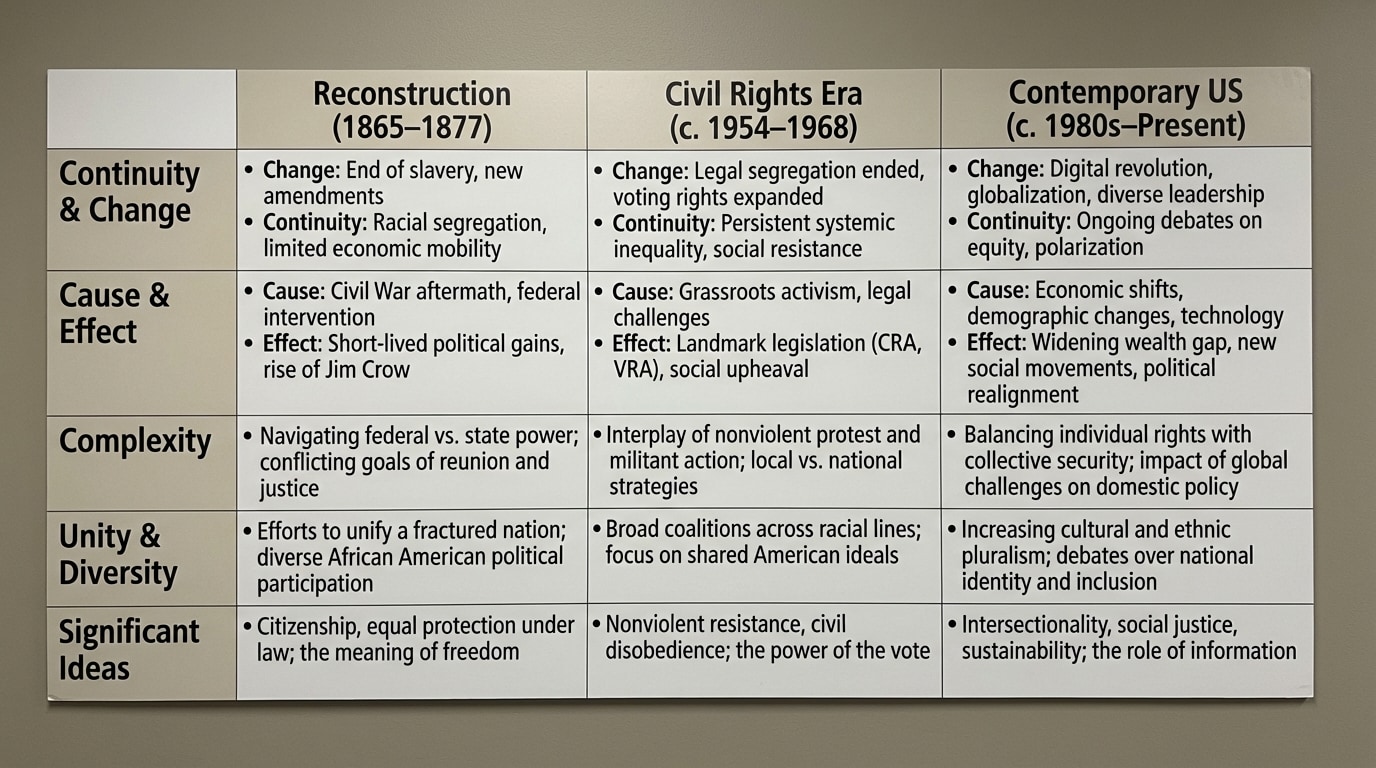
When you compare Reconstruction, the early 20th century, the Civil Rights Era, and recent decades side by side, patterns emerge. Historians often organize these patterns across key analytical concepts, much like an overview chart in [Figure 2] that lays out continuities, changes, and significant ideas by era.
Continuity and change across the whole period show that struggles over race, citizenship, and economic opportunity never fully disappear; they reappear in new forms. The fight over Black voting rights begins in Reconstruction, continues through Jim Crow, is reshaped by the Voting Rights Act of 1965, and surfaces again today in debates over voter ID laws, redistricting, and access to polling places. Similarly, the debate over the government’s role in the economy runs from laissez-faire industrial capitalism, to the New Deal, to arguments about welfare reform and health care in the 21st century.
Cause and effect chains also stretch across time. The failure to fully protect Black rights after the Compromise of 1877 contributed to a century of segregation, which in turn provoked the Civil Rights Movement. U.S. foreign policy choices during the Cold War influenced conflicts and alliances that still affect international relations today. Economic decisions about trade and technology in the late 20th century help explain current job markets and political anger in some regions.
Complexity is a constant. Almost every major development from Reconstruction onward includes gains and losses, winners and losers, intended and unintended consequences. The G.I. Bill expanded opportunity but deepened racial inequality in housing. Civil rights laws struck down legal segregation but did not automatically eliminate discrimination or unequal schools. The internet spread information and connection while creating new risks.
Unity and diversity form a recurring tension. During crises—wars, depressions, terrorist attacks—leaders often call for unity and shared sacrifice. At the same time, marginalized groups push to have their specific experiences recognized. This tension appears when considering whose stories are included in “American history,” whose languages and religions are visible in public life, and who is considered fully “American.” [Figure 2] highlights how each era renegotiates this balance in its own way.
Significant ideas like freedom, equality, democracy, and rights do not stay fixed. They are reinterpreted by each generation. For example, “freedom” meant emancipation from slavery in the 1860s, freedom from want and fear for many in the 1930s and 1940s, freedom from segregation and discrimination in the 1950s and 1960s, and now often includes debates about digital freedom, gender and sexual freedom, and freedom from violence.
Understanding these patterns helps you do more than recite what happened; it helps you evaluate how and why the United States has developed as it has—and to think critically about how today’s choices will shape tomorrow’s continuities and changes. 🎯
From Reconstruction to the present, U.S. history involves ongoing battles over who counts as a full member of the nation, what equality and freedom mean, and how power is used. Key tools for analyzing this history are continuity and change over time, cause and effect, attention to complexity, awareness of unity and diversity, and close study of significant ideas.
Reconstruction created new constitutional guarantees but left racial hierarchies partly intact, setting up later conflicts. Industrialization and immigration reshaped the economy and society, bringing both opportunity and exploitation. The Great Depression, New Deal, World Wars, and Cold War expanded the federal government’s role and redefined citizens’ expectations. Mid‑century civil rights and social movements challenged deep-rooted inequalities and inspired new activism among many groups. Recent decades of globalization and technological change have opened new possibilities while introducing fresh tensions over security, privacy, and identity.
Across all these periods, debates over rights, responsibilities, and American identity reveal both repeating patterns and genuine transformations. Recognizing how causes, effects, and ideas connect across time allows a deeper, more critical understanding of the United States—past, present, and future.
