Four hundred years before smartphones and social media, a new technology changed how people shared ideas as dramatically as the internet does today. The printing press helped launch the Renaissance, a period that reshaped art, science, religion, and politics—yet many older traditions survived at the same time. From that moment to the present, human history is a mix of what changes and what stays the same. To make sense of that story, historians use powerful lenses: continuity and change, cause and effect, complexity, unity and diversity, and significant ideas.
Historians do more than memorize dates. They analyze patterns over time, ask why events happened, and judge which ideas mattered most. Five key concepts guide this work.
Continuity and change describe what stays the same and what transforms over time. For example, political power has existed in every era, but who holds it and how they justify it has changed greatly from kings ruling “by divine right” to modern democracies claiming power from the people.
Cause and effect focuses on why events happen and what results they produce. One event rarely has a single cause. Instead, there are long-term causes, short-term triggers, and a chain of effects that can last for centuries.
Complexity reminds us that history is rarely simple. Different groups experience the same event in different ways. Economic, political, social, cultural, and environmental factors interact, and outcomes are often unpredictable.
Unity and diversity highlight how people and societies are connected while also being different. Trade routes, religions, languages, and technology link regions together, even as local cultures, beliefs, and identities remain distinct.
Significant ideas are beliefs and concepts that shape decisions and institutions far beyond their original moment. Human rights, nationalism, capitalism, socialism, feminism, and environmentalism are examples of ideas that have changed laws, borders, and everyday life.
From the Renaissance to the present, these lenses help us interpret key events, movements, and figures across the globe.
The Renaissance, roughly from the 1300s to the 1600s, began in Italian city-states like Florence and Venice and spread across Europe. It is often described as a “rebirth” of interest in classical Greek and Roman art, literature, and learning. Historians use continuity and change to evaluate how revolutionary it really was, as well as cause and effect to explain why it started when and where it did. When we place major Renaissance developments on a timeline, as in [Figure 1], we can see how new ideas and institutions emerge while older traditions continue alongside them.
Several causes combined to spark the Renaissance. Growing trade enriched cities like Florence, allowing wealthy families such as the Medici to patronize artists and scholars. Contact with the Islamic world brought preserved Greek and Roman texts back into European circulation. Crises like the Black Death weakened old structures and forced people to rethink society, religion, and science.
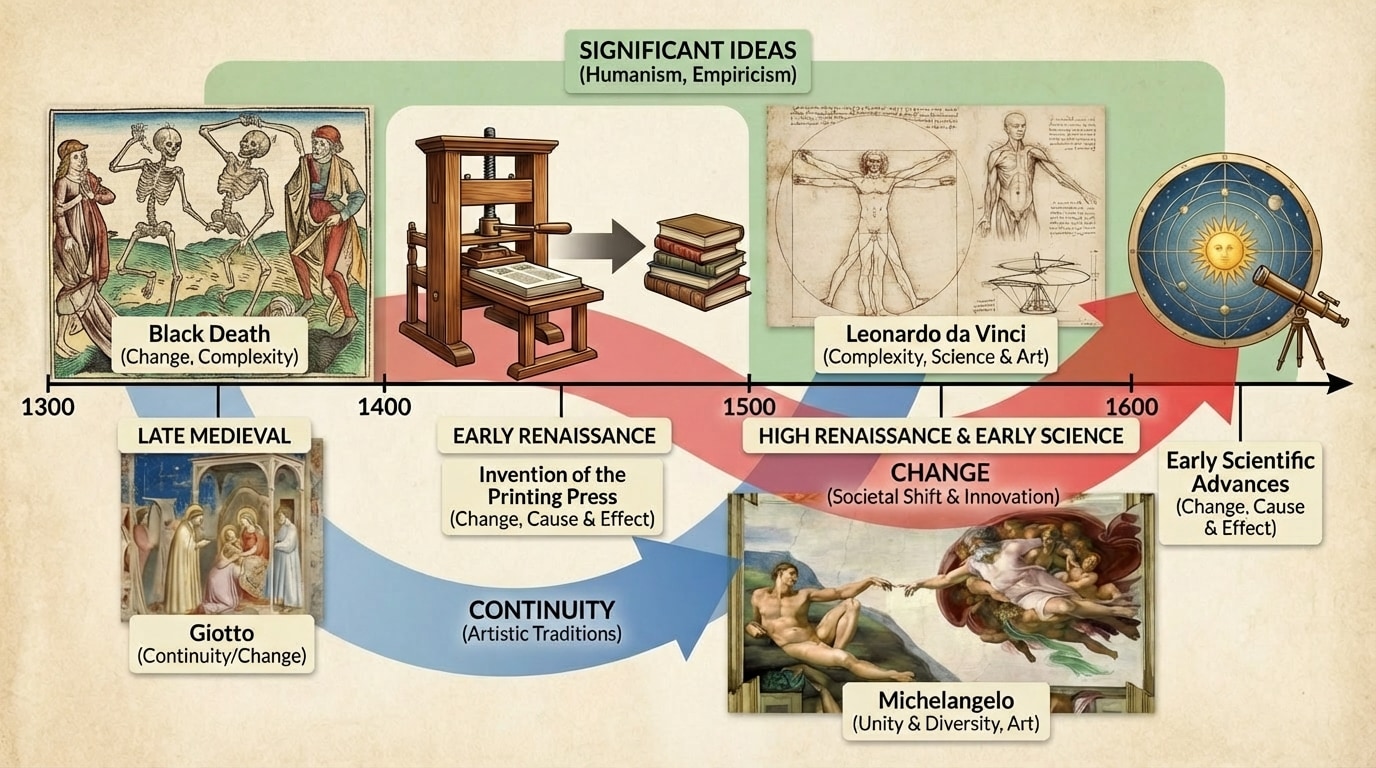
In terms of continuity, the Catholic Church remained extremely powerful, Latin was still the language of scholarship in many places, and most people continued to be peasants working the land. Yet there was striking change: artists like Leonardo da Vinci and Michelangelo focused more on realistic human bodies and emotions; architects and painters used perspective to create depth; and writers like Petrarch and Erasmus promoted humanism, an outlook emphasizing human potential and critical thinking about texts.
A major technological shift, the printing press, shows clear cause and effect. Around the 1450s, Johannes Gutenberg adapted existing technologies to create movable-type printing in Europe. Cheaper, faster book production led to higher literacy, spread ideas rapidly, and weakened the Church’s control over information. This technology later helped fuel the Protestant Reformation and scientific debates.
The Renaissance also had complex and uneven impacts. While elite men in cities often benefited most from new education and art, women, peasants, and non-Europeans had limited access. At the same time, Renaissance navigation and mapping supported European expansion overseas, which would later transform global history in both positive and devastating ways.
If we look back at the long transition from the medieval world to early modern Europe, the Renaissance marks a significant idea shift: a growing confidence in human reason, individual achievement, and direct observation of nature. These ideas did not immediately replace religion or tradition, but they laid foundations for later scientific and political revolutions, building on the changes visible in [Figure 1].
By the 1600s and 1700s, Renaissance curiosity, religious conflict, and new global contacts set the stage for the Scientific Revolution and the Enlightenment. Thinkers challenged old authorities and asked whether reason could improve society as well as science.
Scientists like Copernicus, Galileo, and Newton used careful observation and experimentation to question traditional views of the cosmos. Copernicus argued that the Earth orbits the Sun, contradicting long-accepted geocentric models. Galileo’s telescopic observations supported this, and Newton’s laws of motion and universal gravitation suggested that nature followed consistent principles. These scientific advances changed how people viewed the universe and humanity’s place in it.
Enlightenment philosophers applied similar reasoning to government and society. John Locke argued that governments should protect natural rights such as life, liberty, and property and that political authority comes from the consent of the governed. Montesquieu explained the benefits of separating powers among branches of government. Voltaire criticized intolerance and supported freedom of thought. Jean-Jacques Rousseau emphasized the “general will” and the importance of the community.
These significant ideas had powerful effects. They influenced the American Revolution (1775–1783), where colonists declared independence from Britain and created a republic with a written constitution and a Bill of Rights. They also helped inspire the French Revolution (1789), where revolutionaries challenged monarchy and privilege, leading to periods of radical change and violence, including the Reign of Terror.
The age of revolutions reveals continuity and change clearly. Even as new republics formed, slavery, gender inequality, and class divisions often remained. In the new United States, enslaved people had no rights, and women could not vote. In France, power shifted repeatedly between different forms of government. Old and new structures coexisted and competed.
Looking globally, unity and diversity and complexity are crucial. Enlightenment and revolutionary ideas spread through print, trade, and war, influencing movements in Latin America (Simón Bolívar and others), Haiti (the Haitian Revolution led by Toussaint Louverture, which overthrew slavery and colonial rule), and beyond. But people adapted these ideas to local conditions, mixing them with existing beliefs and struggles.
In the late 1700s and 1800s, another major turning point reshaped the world: the Industrial Revolution. New machines like the spinning jenny, steam engine, and power loom, along with coal and iron, transformed how goods were produced. Factories grew in Britain first, then spread to Europe, North America, and later parts of Asia.
Industrialization shows cause and effect on multiple levels. New technologies emerged from earlier scientific and practical knowledge. Access to coal, iron, and capital helped Britain industrialize early. Once factories and railroads appeared, they increased production and transportation speeds, making goods cheaper and encouraging more consumption. Cities expanded rapidly as people moved from rural areas to factory jobs.
The Industrial Revolution also deepened complexity. On one hand, many people eventually enjoyed higher standards of living, more goods, and improved transportation. On the other, workers—often including children—faced long hours, low wages, and dangerous conditions. Slums with poor sanitation grew quickly, and pollution harmed air and water. Capitalist economic systems created enormous wealth for some, while many others remained poor.
Industrial power fed the growth of global empires. European countries like Britain, France, Belgium, and later Germany, along with others such as the United States and Japan, expanded control over territories in Africa, Asia, and the Pacific. They sought raw materials, new markets, and strategic routes. These empires connected much of the world through trade and communication, but also through conquest and exploitation. The global spread and overlap of imperial territories can be seen clearly on a world map, as in [Figure 2].
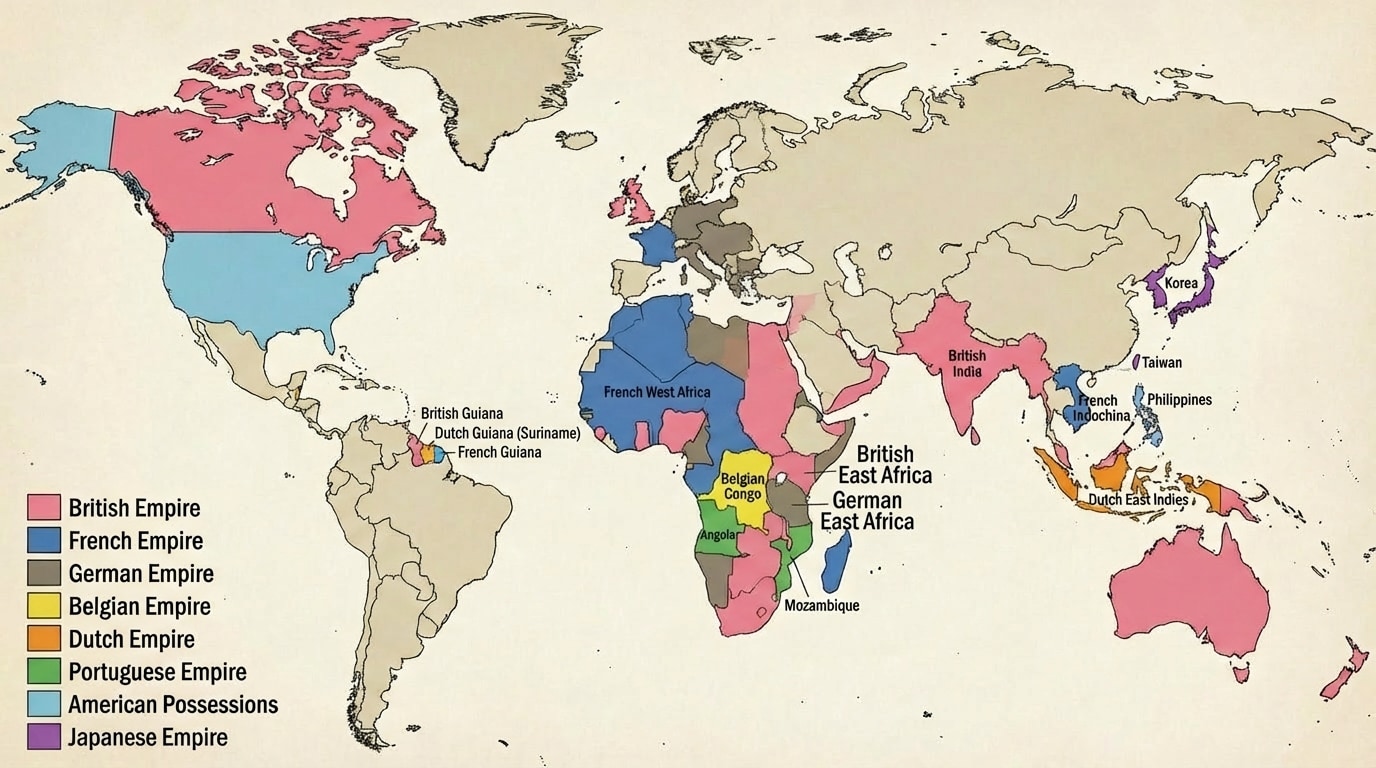
Here, unity and diversity are striking. A person in India, a British colony, might wear British-made cloth, read newspapers discussing events in Europe, and serve in the British army, yet maintain local languages, religions, and customs. African societies under European rule experienced land loss and forced labor but also sometimes used European law or education to resist. Colonized intellectuals across Asia and Africa blended Western ideas like nationalism and democracy with local traditions to demand independence.
Industrialization and empire also reveal important continuities. Power imbalances and economic inequality remained, though now on a global scale. At the same time, significant ideas such as socialism and labor rights emerged in response to harsh factory conditions. Thinkers like Karl Marx criticized capitalism and inspired labor movements and later revolutions. As we later examine the causes of World War I, the imperial rivalries visible in [Figure 2] become crucial background.
The 20th century opened with two devastating global conflicts: World War I (1914–1918) and World War II (1939–1945). These wars demonstrate how long-term causes—many rooted in earlier periods—can explode into crisis.
The causes of World War I included militarism (an arms race and belief in military solutions), alliances (complex agreements like the Triple Entente and Triple Alliance), imperial rivalries (competition for colonies, as seen in the overlapping empires of [Figure 2]), and rising nationalism. The assassination of Archduke Franz Ferdinand in 1914 was a short-term trigger, but the deeper tensions made a large-scale war more likely.
The effects were enormous: tens of millions dead or wounded, the collapse of empires (Austro-Hungarian, Ottoman, Russian, and German monarchies), and redrawn borders in Europe and the Middle East. The Treaty of Versailles punished Germany heavily, contributing to economic hardship and resentment that later helped Adolf Hitler and the Nazi Party rise to power.
World War II had its own complex causes: unresolved issues from World War I, the Great Depression, aggressive expansion by Nazi Germany, Fascist Italy, and Imperial Japan, and the failure of international institutions like the League of Nations. Its effects included the Holocaust, the use of atomic bombs on Hiroshima and Nagasaki, massive civilian casualties, and widespread destruction.
Yet even in these violent periods, we see unity and diversity. Soldiers and workers came from colonies as well as European states. For example, Indian, African, and Caribbean troops fought in both world wars. Women entered factories and support roles in larger numbers, challenging traditional gender roles and contributing to later movements for rights and equality.
Out of the ruins of World War II came significant ideas and institutions: the United Nations, efforts to define and protect human rights, and early steps toward European cooperation. The horrors of genocide and total war led many to question racism, imperialism, and blind obedience to authority.
After 1945, the world entered the Cold War era, a period of tension between the United States and its allies on one side and the Soviet Union and its allies on the other. This struggle was both geopolitical and ideological, pitting capitalism and liberal democracy against communism.
Continuity and change appear, for example, in military competition. The arms race and formation of alliances like NATO and the Warsaw Pact continued older patterns of rivalry, but nuclear weapons introduced the terrifying possibility of global destruction. Conflicts in Korea, Vietnam, Afghanistan, and elsewhere became “proxy wars” where the superpowers supported different sides without directly fighting each other.
At the same time, decolonization transformed the political map. Countries in Asia, Africa, and the Middle East pushed for and gained independence from European empires. Leaders like Mahatma Gandhi in India, Kwame Nkrumah in Ghana, and Ho Chi Minh in Vietnam used a mix of nonviolent resistance, political organizing, and armed struggle. The process was complex and often violent, with new nations facing challenges such as drawing borders, building economies, and navigating Cold War pressures.
The mid-20th century also saw the rise of global human rights as a significant idea. In 1948, the United Nations adopted the Universal Declaration of Human Rights, a document stating that all people, regardless of race, gender, religion, or nationality, have basic rights and freedoms. This idea influenced later movements against apartheid in South Africa, for civil rights in the United States, and for democracy around the world.
Unity and diversity shaped these developments. Newly independent nations joined the Non-Aligned Movement, trying to stay out of the US–Soviet rivalry, while also advocating for economic justice and respect for their cultures. Meanwhile, within countries, diverse groups—women, ethnic minorities, Indigenous peoples—used human rights language to demand recognition and equality.
These struggles highlight the complexity of progress. Legal independence did not always mean real freedom or equality. Economic dependency, internal conflicts, and authoritarian governments sometimes limited the gains of decolonization. Yet the spread of ideas about self-determination and rights continues to influence global politics today.
In the late 20th and early 21st centuries, the pace of change has accelerated, especially through globalization and technological innovation. However, many continuities—such as inequality, conflict, and the search for identity—remain.
Globalization refers to the increasing interconnectedness of economies, cultures, and populations. International trade agreements, multinational corporations, and global supply chains mean that a t-shirt might be designed in one country, made in another, and sold worldwide. Information technologies and social media allow ideas, music, and news to spread instantly across borders.
These developments show cause and effect clearly. Advances in computing, satellite communication, and the internet made rapid global communication possible. Lower transportation costs contributed to global trade. Economic policies encouraging open markets further integrated national economies.
Yet globalization is deeply complex. It created new opportunities, such as jobs in export industries and access to a wider range of goods and information. It also produced challenges, including job losses in some regions, cultural homogenization, and greater vulnerability to global financial crises. Environmental problems like climate change, deforestation, and pollution reveal how actions in one part of the world affect others.
Unity and diversity are central to understanding this era. Global culture brings shared experiences—international sports events, worldwide movie releases, global activism—yet local identities, languages, and traditions persist. Migrants and refugees move across borders for work or safety, reshaping societies and raising questions about citizenship and belonging.
Several significant ideas shape current debates: human rights, democracy, nationalism, religious revival, feminism, LGBTQ+ rights, and environmentalism. International agreements aim to address global issues like climate change, while nationalist movements in various countries challenge international cooperation and prioritize local control.
New technologies—from smartphones to artificial intelligence—continue patterns that began with the printing press and industrialization: faster communication, more data, and new ways of working and relating. At the same time, they raise questions about privacy, misinformation, and who controls powerful technological tools.
From the Renaissance to today, the lenses of continuity and change, cause and effect, complexity, unity and diversity, and significant ideas help make sense of a complicated global story. Historians apply these lenses to specific events, figures, and sources.
When analyzing continuity and change, a historian might track how forms of government evolved from absolute monarchies in early modern Europe, to constitutional monarchies and republics after revolutions, to today’s diverse mix of democracies and authoritarian states. They would ask what stayed the same—such as persistent inequality or elite influence—and what transformed, such as voting rights expanding over time.
To study cause and effect, historians break down events like World War II into long-term causes (such as nationalism and unresolved grievances from World War I), intermediate causes (economic crises and the rise of fascist regimes), and short-term triggers (specific invasions or political decisions). They then trace effects: border changes, the Cold War, decolonization, and social movements.
Recognizing complexity means looking at multiple perspectives and factors. For instance, industrialization brought both progress and exploitation; decolonization created both hope and instability. Historians compare evidence from different groups—workers and factory owners, colonizers and colonized, political leaders and ordinary citizens—to understand the full picture.
Unity and diversity appear when we examine global connections. Trade, migration, wars, and ideas link regions together, but people interpret and adapt influences differently. For example, Enlightenment ideas about rights inspired independence movements around the world, yet each movement reflected local histories and cultures.
Finally, significant ideas like humanism, nationalism, socialism, feminism, environmentalism, and human rights are central to historical analysis. Historians examine where these ideas came from, how they spread (often through technologies like the printing press or the internet), and how they affected institutions, laws, and everyday life.
From the Renaissance to the present, global history is shaped by both innovation and tradition. New technologies—from printing presses to smartphones—change how people live and think, while older beliefs and structures often persist and adapt. Political revolutions, industrialization, world wars, decolonization, and globalization all emerge from complex layers of causes and produce far-reaching effects.
Across these centuries, people have been linked by trade, war, ideas, and technology, even as they maintain diverse cultures and identities. Powerful ideas—about reason, rights, nationhood, class, gender, and the environment—have inspired both liberation and conflict.
By using the lenses of continuity and change, cause and effect, complexity, unity and diversity, and significant ideas, we can move beyond memorizing events to understanding how and why the modern world came to be—and how today’s choices may shape the future. 🤔
