Have you ever seen a plant leaning toward a window or a droopy flower that perks up after a drink? Plants may look still and quiet, but they are busy living, growing, and responding to the world around them. Scientists ask questions about living things, and one important question is: Do plants need sunlight and water to grow?
To answer that question, we do not just guess. We carry out an investigation. An investigation is a careful way to find out what happens. We make a plan, follow the plan, watch closely, and use what we notice as evidence.
Plants are living things. Like other living things, they have needs. Plants need water, light, air, and space to grow. Some plants also need animals to help with pollination or moving seeds. In this lesson, we focus on two important needs: sunlight and water.
Sunlight is light from the Sun. Plants use light to help make food.
Water is the liquid plants take in through their roots. Water helps plants stay healthy and grow.
Grow means to get bigger and change over time.
A healthy plant often has green leaves, a strong stem, and new growth. A plant that is not getting what it needs may stay small, turn yellow or brown, or wilt. Wilt means the plant looks droopy because it is not getting enough water.
Even though plants need many things, a good test changes only one thing at a time. That helps us know what caused the result.
A science investigation starts with a question. Our question is about whether plants need sunlight and water to grow. Next, we make a plan for a fair test. A fair test means we keep most things the same and change only one thing.
The thing we change on purpose is called a variable. In this lesson, it is important to test one variable at a time. That means we should not change sunlight and water in the same test. We do one sunlight test and one water test separately.
Why one variable at a time matters
If a plant gets no sunlight and no water, and it does not grow, we would not know which missing need caused the problem. Testing one variable at a time helps us find a clearer answer.
Scientists also make observations. An observation is something you notice with your senses. You might observe that a plant is taller, greener, or droopier than before.
[Figure 1] To test whether plants need sunlight, we change only the amount of light. We can use two plants that are as alike as possible. They should be the same kind of plant, in the same-sized pot, with the same soil, and they should get the same amount of water.
One plant goes in sunlight, and the other goes in a dark place or a place with very little light.
This is a fair test because only sunlight changes. Water stays the same. If one plant grows better, the difference helps us understand whether sunlight matters.
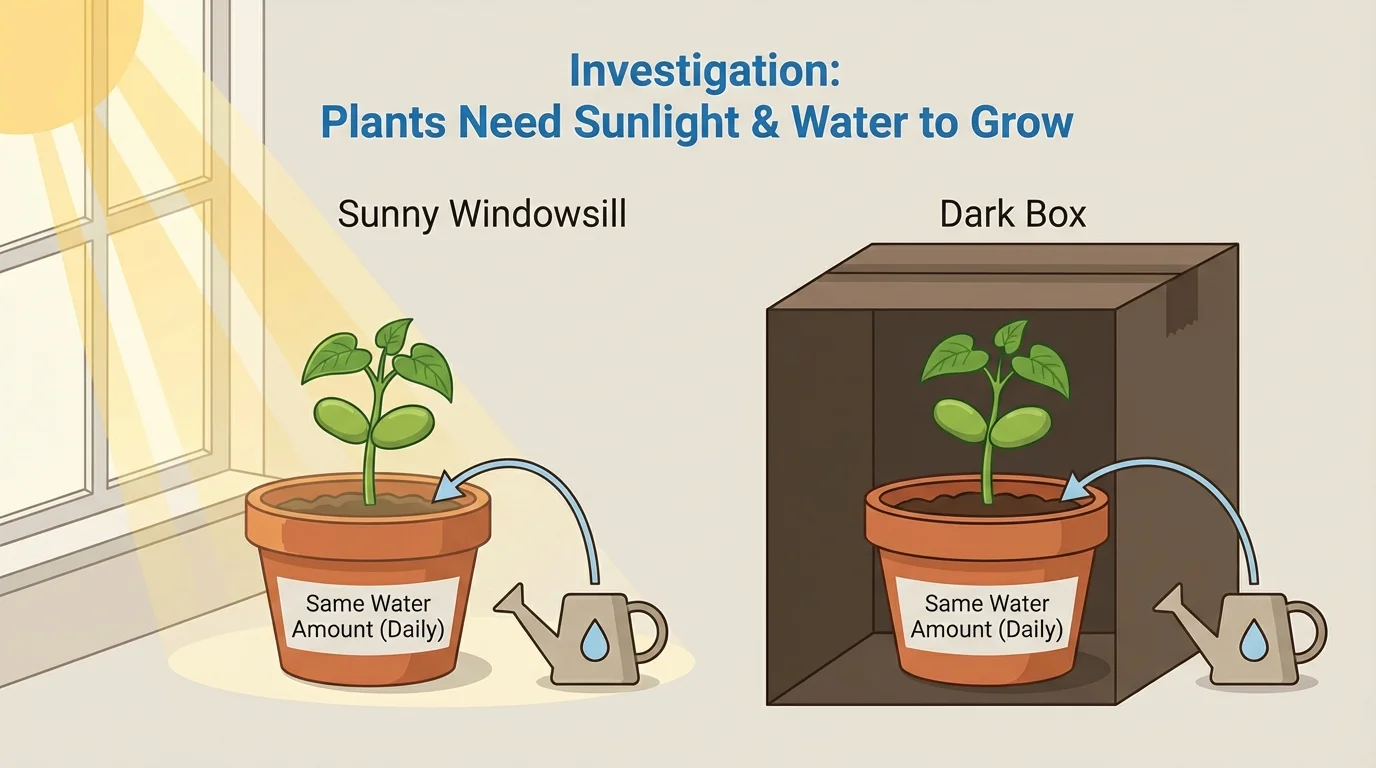
A simple plan might look like this: choose two bean plants, water each plant with the same amount each day, and observe both plants for several days. For example, each plant could get the same small amount of water, such as one spoonful each day. The exact amount matters less than keeping it the same for both plants.
If the plant in sunlight grows taller, stays greener, or makes more leaves, that is evidence that sunlight helps plants grow. The plant kept in the dark may become pale, weak, or lean strangely as it searches for light.
[Figure 2] To test whether plants need water, we change only the water. We again use two plants that are as alike as possible. They should both stay in the same light conditions and in similar pots with similar soil.
One plant gets water regularly, and the other gets little or no water.
This test is fair because sunlight stays the same. Only water changes. Then we can watch to see how the plants respond.
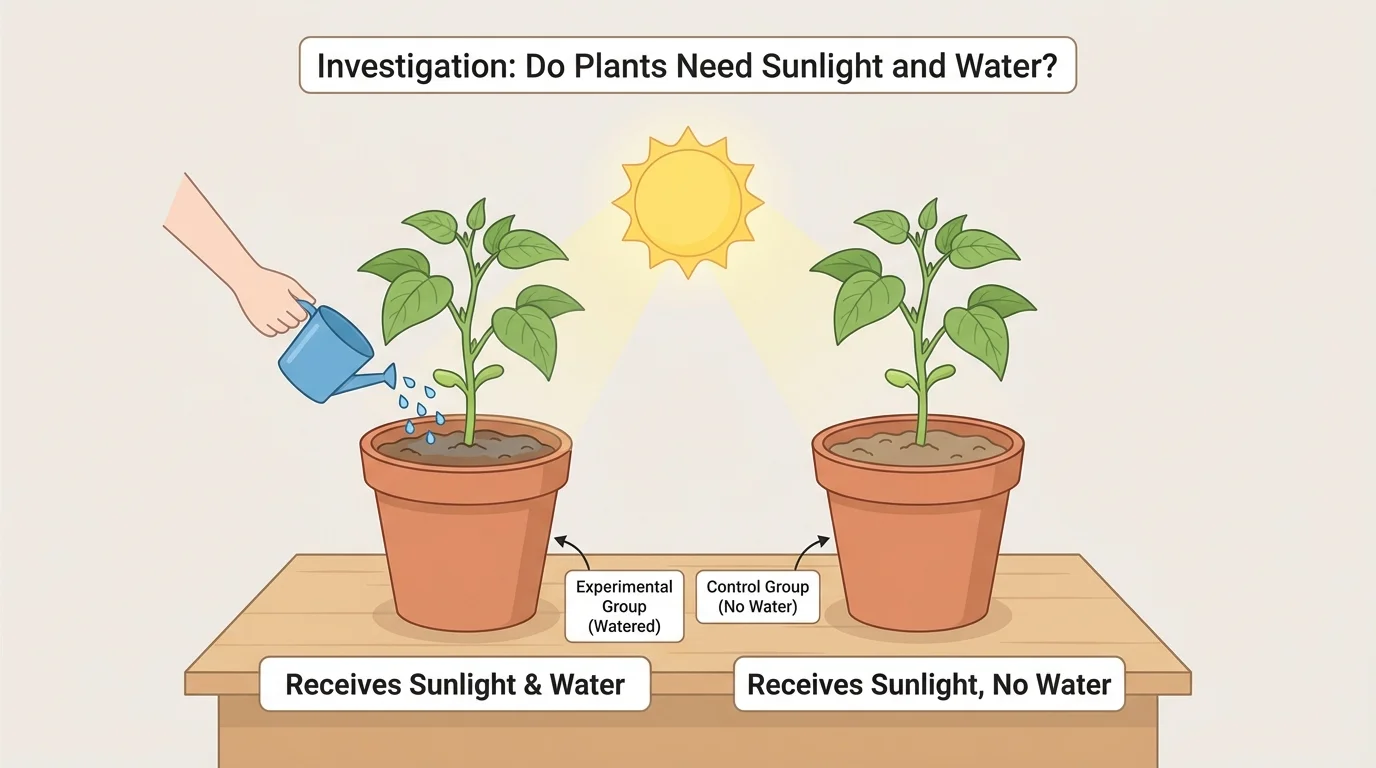
After a few days, the watered plant will likely stay firmer and greener. The plant without enough water may wilt, look dry, or stop growing. When we compare the two plants, we gather evidence about the need for water.
Notice that in both investigations, we compare two plants very carefully. We are not trying to test everything at once. That is what makes the answer clearer.
[Figure 3] When scientists do an investigation, they do not just look once and forget.
A simple chart helps keep observations organized and easy to compare.
You can observe many things about a plant: how tall it is, what color the leaves are, how many leaves it has, and whether it looks strong or droopy. You can also write the day of each observation so you can notice changes over time.
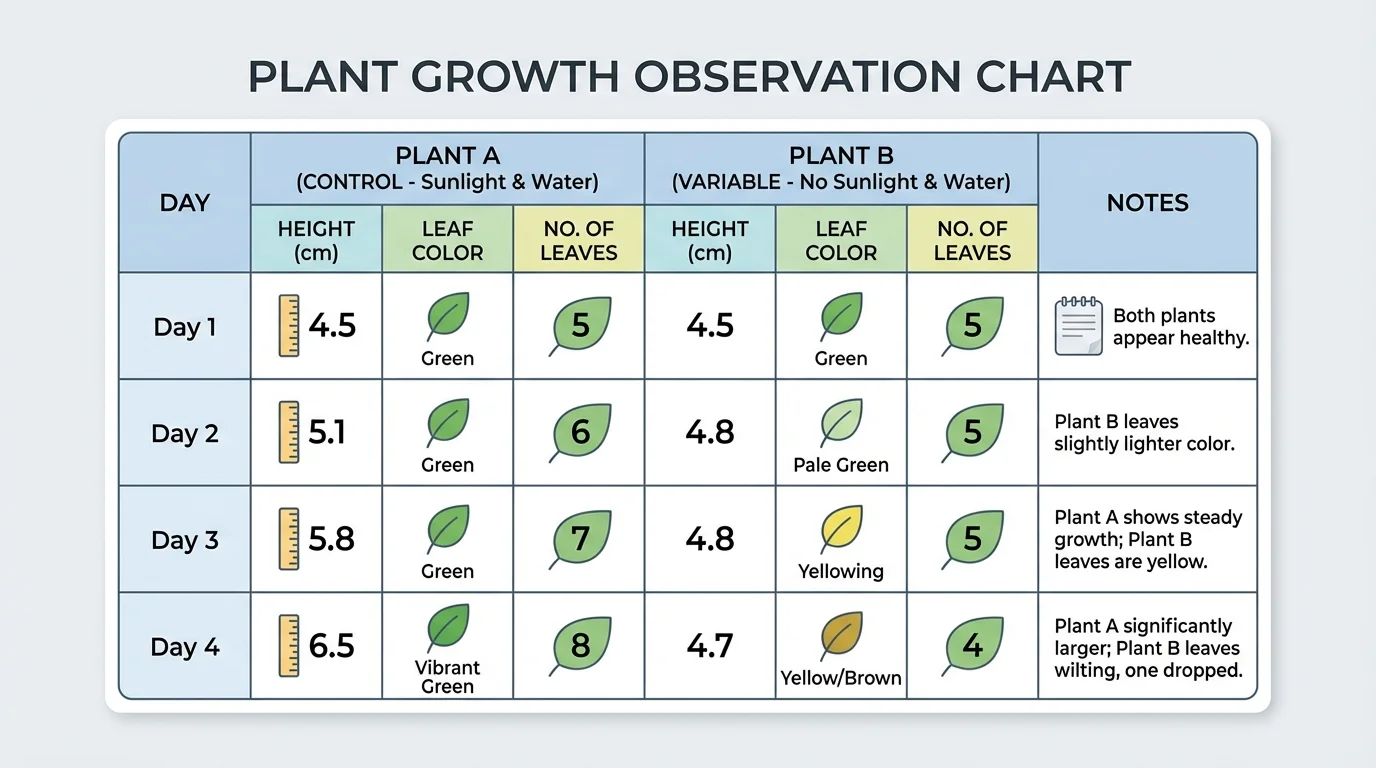
Here is one way to organize observations:
| Day | Plant A | Plant B | What I Notice |
|---|---|---|---|
| 1 | short | short | Both look green |
| 3 | taller | same size | One plant has lighter leaves |
| 5 | tall and green | droopy or pale | Plants look different now |
You do not need hard math for this lesson, but you can still compare amounts. If Plant A grows from height 2 to height 5, it grows by \(5 - 2 = 3\) units. If Plant B stays at height 2, it grows by \(2 - 2 = 0\) units. This kind of comparison helps you describe results clearly.
Example: Reading plant evidence
Suppose two bean plants start the same size. Both get the same soil and the same pot. One gets sunlight, and one stays in the dark.
Step 1: Observe both plants after several days.
The plant in sunlight is taller and green. The plant in the dark is pale and weak.
Step 2: Compare what is different.
The only changed variable is sunlight.
Step 3: Make a claim using evidence.
The evidence supports the claim that plants need sunlight to grow well.
Good scientific work involves making careful observations and reporting them honestly. If a plant did not change much, that is still useful information. Scientists report what really happened.
When you conduct an investigation, follow your plan closely. Put each plant where it belongs. Give water as planned. Observe at about the same time each day. Careful routines help make the results more trustworthy.
Handle plants gently. Do not tear leaves or break stems. If using water, clean up spills so no one slips. Wash hands after touching soil.
Living things can change slowly. A plant may not show a big difference in one day, but over several days the changes become easier to notice.
It is also important to start with plants that are as similar as possible. If one plant is already much bigger than the other, the test is less fair. Using the same kind of seedling makes the comparison stronger.
Later, when thinking back to the sunlight setup in [Figure 1], remember that equal watering is what makes it a fair test. In the water setup from [Figure 2], equal light is the part that stays the same.
After several days, look back at all the observations. Which plant grew more? Which one looked greener or healthier? Which one wilted or stopped growing? Your answers should come from evidence, not just from what you expected.
A claim is an answer to the investigation question. Evidence is what supports the claim. If the watered plant stayed healthy and the dry plant wilted, your claim might be: Plants need water to grow well.
Claim, evidence, and reasoning
A claim tells what you learned. Evidence tells what you observed. Reasoning is the idea that connects them. For example, if the plant with sunlight grew better than the plant without sunlight, the evidence supports the claim that sunlight helps plants grow.
The chart in [Figure 3] helps because it keeps your evidence in one place. When we can look across days, we can see patterns more clearly.
Sometimes results are not perfect. Maybe one plant was bumped, or one pot dried out faster. That can happen in real science too. Scientists still learn by noticing problems and trying again carefully.
These investigations connect to everyday life. Gardeners put many plants where they can get enough sunlight. People water houseplants because dry plants wilt. Farmers pay close attention to rain and sunlight because crops need both to grow.
Plants are important for animals too. Plants provide food and places to live. Many flowering plants also depend on animals such as bees, butterflies, and birds for pollination. Some plants depend on animals to move their seeds to new places. Healthy plant growth helps whole habitats.
Some plants turn or bend toward light. This helps their leaves catch more sunlight, which can help them grow.
When we study what plants need, we learn more than just how to keep a classroom plant alive. We learn how living things depend on parts of their environment. Sunlight and water are not alive, but they are still very important to life.
