A rushing river can move tiny bits of sand, and over time it can even push big rocks. That is amazing because water may look soft, but it is one of the most powerful agents of change on Earth's surface. Water is found in many places, and wherever it goes, it helps shape land and support life.
Oceans, rivers, lakes, and ponds are all places where water is found on Earth's surface, as shown in [Figure 1]. Some water is spread out in huge bodies, like the ocean. Some water is in smaller places, like a pond in a park or a lake near mountains.
Water is also found as ice on snowy mountains, in glaciers, and in places that stay very cold. Even though these places look different, they are all part of Earth's water. A tiny pond and a giant ocean both contain water, and both affect the land and living things around them.
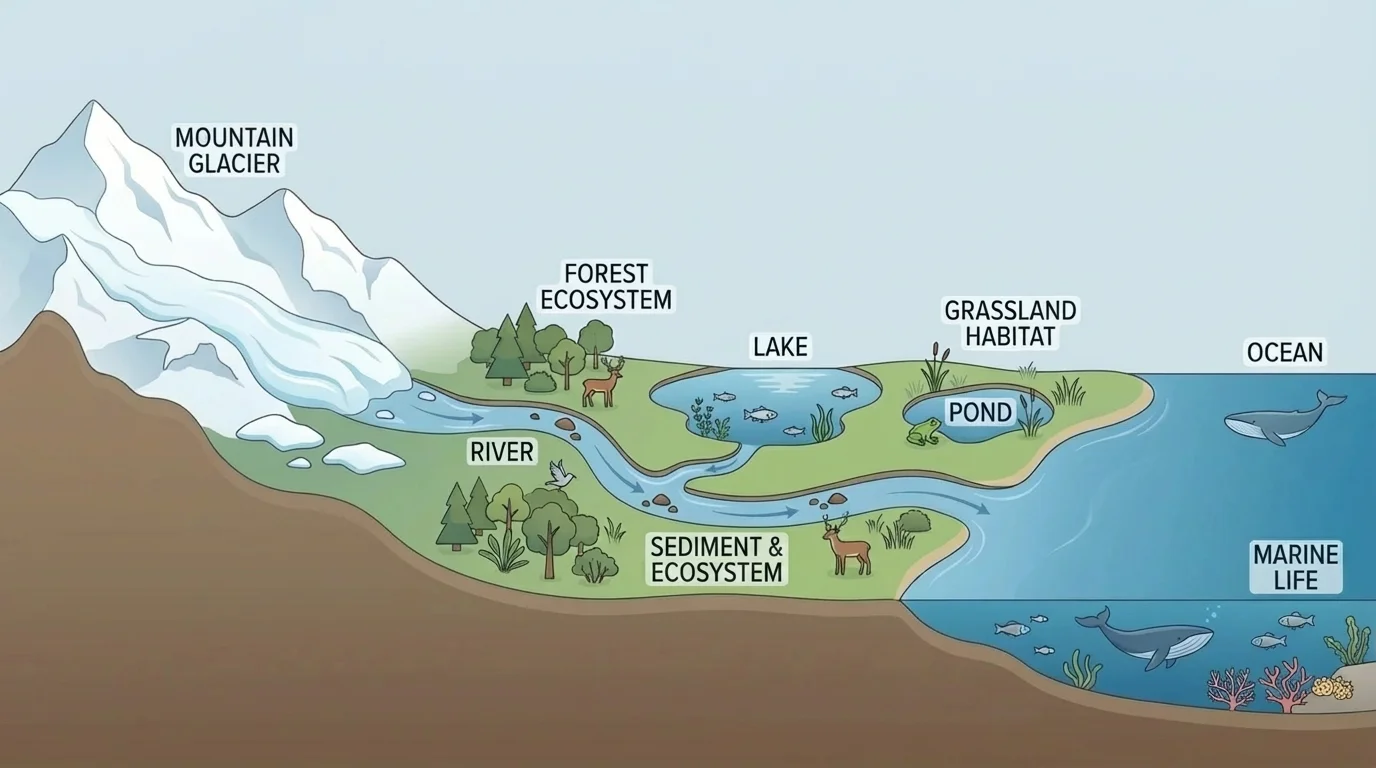
The ocean covers a very large part of Earth. Rivers carry water across land. Lakes and ponds collect water in low places. In cold places, water freezes and becomes ice. All of these forms and places matter because they work together to change Earth's surface.
Earth's surface is the outside part of our planet, including land and water. Ice is water in a solid form, and liquid water is water that can flow.
When rain falls, some water moves into streams and rivers. Some stays in lakes or ponds. Some reaches the ocean. This movement means water does not remain in just one place forever.
Water can be a liquid or ice, as shown in [Figure 2]. Liquid water flows. It can move downhill, splash, drip, and spread out. Solid ice keeps its shape until it warms up enough to melt.
This difference is important. A river can flow around bends and carry bits of dirt and rock. A sheet of ice on land moves much more slowly, but it can still scrape and push Earth materials. Frozen water and liquid water both help shape land, just in different ways.
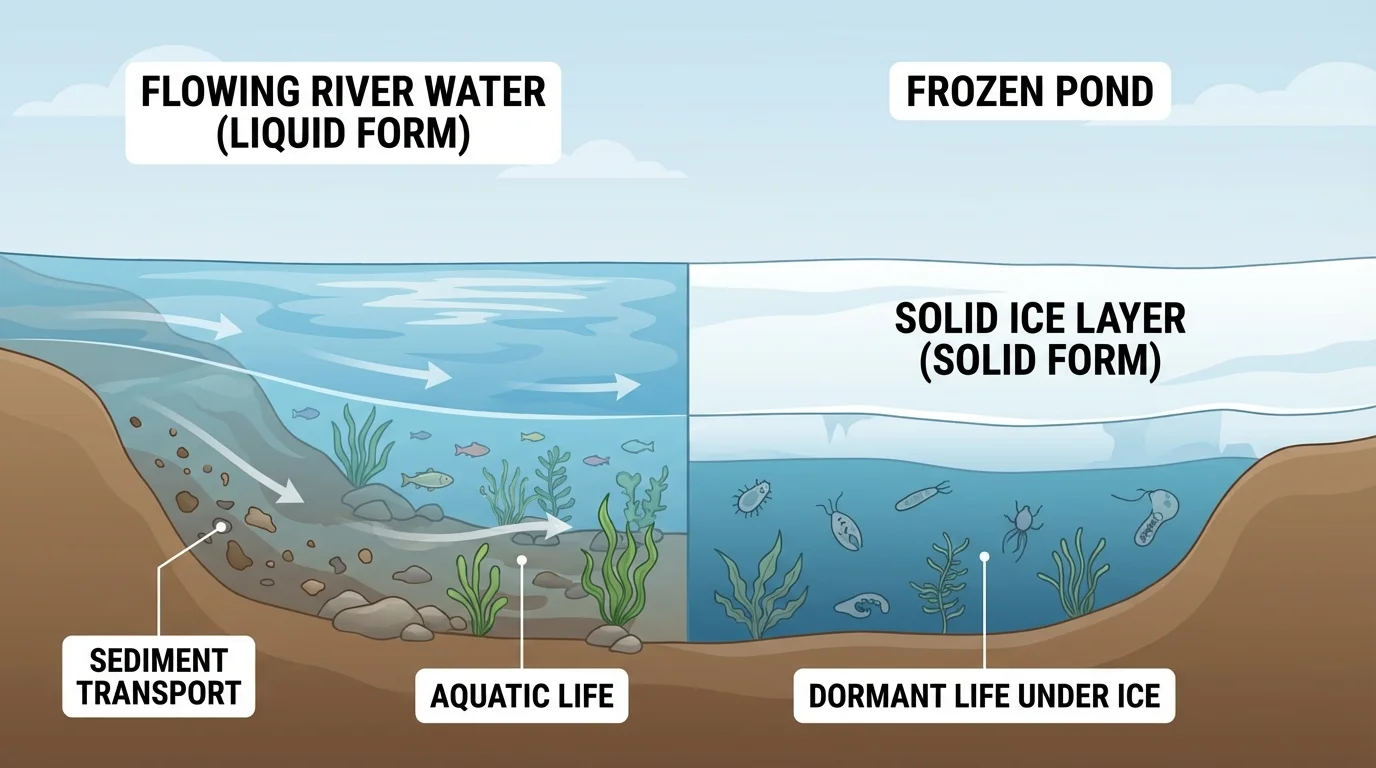
Think about a winter pond. When it is warm, the water is liquid and ripples when wind blows. When it is very cold, the pond may freeze and become solid ice. The same water is there, but it behaves in a different way.
Snow is another form of frozen water. When snow melts, it becomes liquid water and can flow into streams. So, water often changes form and keeps moving through nature.
Glaciers are giant, slow-moving masses of ice. They may seem still, but they can move across land over long periods of time and change the shape of the ground.
We can write water's chemical formula as \(\textrm{H}_2\textrm{O}\). That means each water molecule contains hydrogen and oxygen atoms. For this lesson, the big idea is that the same water, \(\textrm{H}_2\textrm{O}\), can be flowing liquid or solid ice depending on temperature.
One of water's most important roles is changing land by moving materials. As [Figure 3] illustrates, flowing water can pick up small pieces of soil, sand, and tiny rocks. Sometimes it can also push larger rocks. When water carries these materials away, the land slowly changes shape.
This wearing away and movement of Earth materials is called erosion. Erosion happens when water loosens soil and rocks and carries them somewhere else. A strong stream after heavy rain may look muddy because it is carrying lots of soil.
Water usually moves downhill. As it flows, it may cut small paths into the ground. Over a long time, rivers can make valleys, stream banks, and curved channels. Waves in the ocean can also move sand and change the shape of a beach.
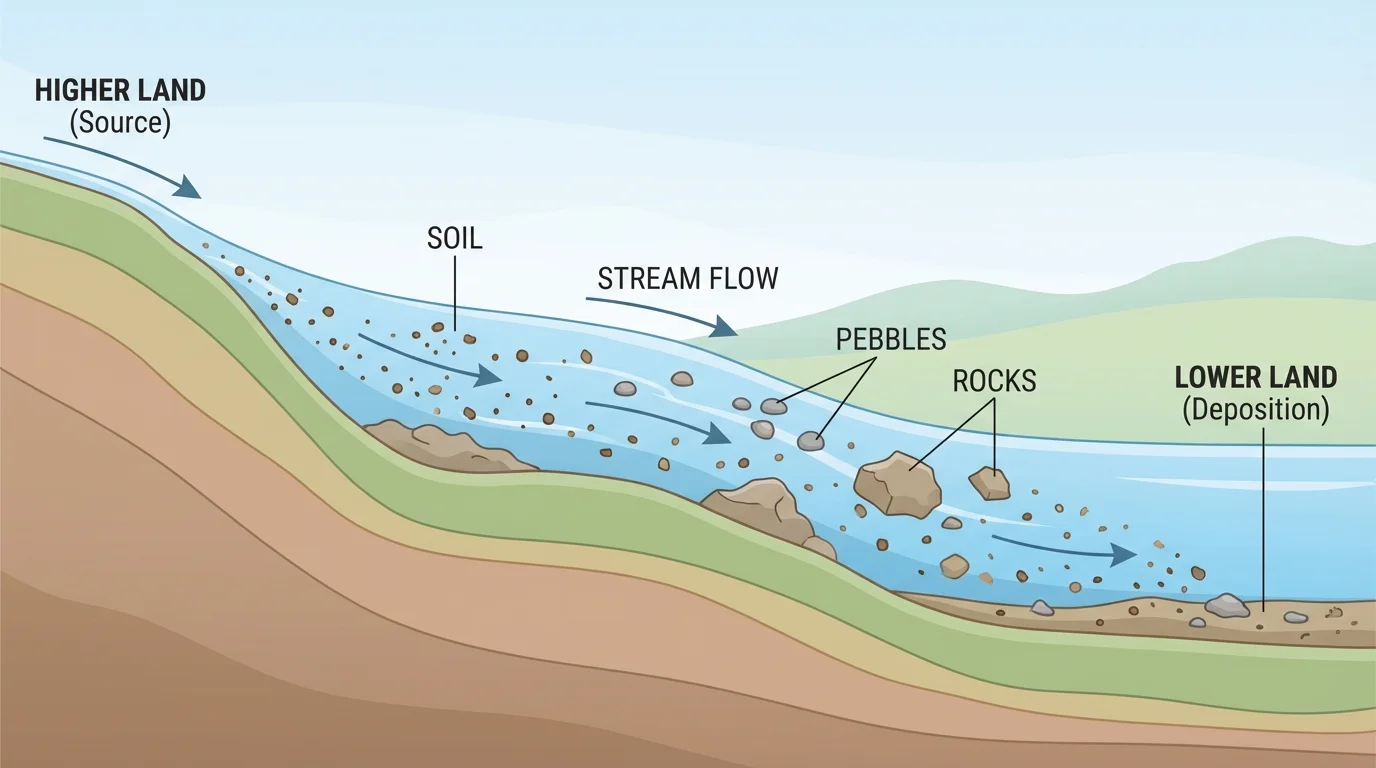
If a hill loses soil because rainwater keeps washing it away, the hill may become smoother or lower. If a river drops some of the soil it was carrying, the soil may build up in a new place. So water not only takes materials away; it also leaves them in new places.
How moving water reshapes land
Water works like a slow builder and mover. It breaks loose tiny pieces of Earth materials, carries them along, and places them down somewhere else. This is why rivers, beaches, and muddy places can look different after storms or after many years.
You may have seen this in real life. After rain, puddles may carry soil across a sidewalk. A schoolyard may have little channels in the mud where water has flowed. At the beach, waves can pull sand away from one spot and pile it up in another. These are small examples of the same work that water does across Earth.
Earlier, [Figure 2] showed that water can be liquid or ice. Both forms can change land. Liquid water flows quickly in rivers and rain runoff, while ice can slowly scrape and push land in very cold regions.
Real-world example: A rainy hillside
A grassy hillside gets a lot of rain.
Step 1: Rain lands on the ground.
The water soaks in a little, but some flows downhill.
Step 2: Flowing water picks up soil.
Tiny bits of dirt and small pebbles are moved by the water.
Step 3: The water reaches a lower place.
Some of the soil is dropped there, making a muddy patch.
This shows how water moves Earth materials from one place to another.
Water can also wear away rock very slowly. It may take many years, but water's steady movement is powerful. Even though each drop is small, many drops over time can make big changes.
Water does more than shape land. It also helps decide which living things can survive in a place, as shown in [Figure 4]. A habitat is a place where a plant or animal lives. Different habitats have different amounts of water.
A pond with plenty of water can be home to fish, frogs, insects, and water plants. A riverbank may have grasses, birds, and animals that need regular water. A very dry place has fewer kinds of plants and animals because water is harder to find.
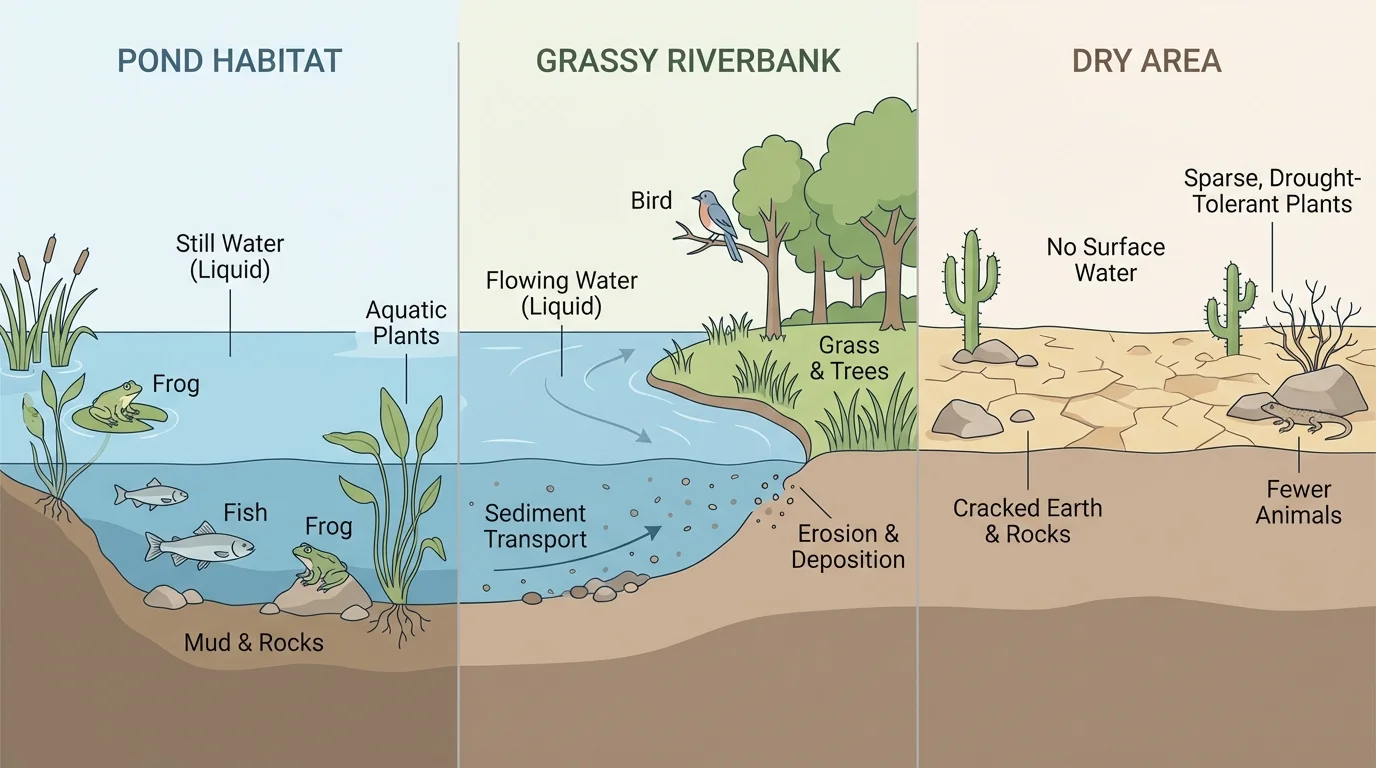
Plants need water to grow. Animals need water to drink, and many animals also need watery places for shelter or food. If a pond dries up, the living things there may have to move or may not survive. If a place has fresh water all year, more kinds of life may be able to live there.
Living things need resources to survive. Water is one of the most important resources for both plants and animals.
Think about the difference between a wet marsh and a dry rocky hill. The marsh may have reeds, frogs, insects, ducks, and fish. The dry hill may have grasses or small bushes, and animals that can live with less water. Water helps create this variety of life.
The idea shown earlier connects here too. When water moves soil and rocks, it can also change habitats. A river that shifts its path can make a new wet area in one place and leave another place drier.
You can notice water's work almost anywhere. At the beach, waves move sand back and forth. Near a creek, the ground may be damp and full of plants. On a cold morning, ice may cover a puddle and show that water can change form.
Farmers care about water because crops need it. Gardeners watch how much water the soil holds. People who build roads and houses also think about water, because rain can wash soil away or collect in low places.
Real-world example: A neighborhood stream
After a storm, a small stream may become fast and muddy.
Step 1: Rain adds more water to the stream.
The stream flows faster than usual.
Step 2: Faster water carries more soil.
The water turns brown because tiny pieces of soil and sediment are mixed in.
Step 3: The stream slows down later.
Some of the soil settles in a quieter place.
This is one way people can observe erosion close to home.
People also depend on clean water for drinking, farming, and animals. When water is polluted, it can harm habitats and make it harder for living things to survive. Clean water helps both nature and people.
Because water is so important, caring for it matters. Plants can help hold soil in place with their roots. When land has many plants, rainwater may not wash soil away as easily. This helps protect the land from too much erosion.
Keeping trash and harmful chemicals out of rivers, lakes, and ponds helps protect habitats. Fish, frogs, birds, and many other living things depend on safe water. People do too.
"Water is small in a drop, but powerful over time."
Water is found in oceans, rivers, lakes, ponds, and ice. It can be liquid or solid. It moves soil and rocks, shapes land, and helps decide what living things can live in a place. When we watch rain, streams, beaches, and ponds, we can see Earth's systems at work.
