Why does one dog have curly fur while another has straight fur? Why do sunflowers grow tall, but moss stays low to the ground? Why can ducks swim so well, while squirrels climb trees with ease? The living world is full of patterns like these. Organisms look and act differently because they carry different inherited information, and that information helps build their bodies and affects how their bodies work.
Every living thing is an organism. Some organisms are animals, some are plants, some are fungi, and some are tiny living things such as bacteria. Even though they are all alive, they do not all have the same body parts, the same needs, or the same ways of surviving. A cactus stores water in thick stems. A fish has gills to take in oxygen from water. A bird has wings and feathers. These differences are not random. They are connected to inherited information passed from parents to offspring.
Living things have different structures, which are their body parts and body features. They also have different functions, which are the jobs those parts do. A bat's wings help it fly. A bear's claws help it dig and catch food. A maple tree's broad leaves help it collect sunlight. Structure and function are linked: the shape and design of a body part often help it do a certain job.
These structures and functions are shaped by inherited information. For example, the information in a rabbit helps produce long ears, fur, teeth that keep growing, and strong back legs for hopping. The information in an oak tree helps produce roots, bark, branches, and leaves with a certain shape. Different inherited information leads to different traits, so different kinds of organisms grow and function in different ways.
Trait is a characteristic of an organism, such as fur color, leaf shape, or the ability to curl your tongue.
Inherited information is the biological information passed from parents to offspring that helps determine traits.
Offspring are the young produced by parents.
Some traits are easy to notice, like flower color or the length of a bird's beak. Other traits are about function, such as how a plant handles dry weather or how fast a cheetah can run. Both visible features and ways the body works are connected to inherited information.
Inside living things is gene information that is passed from parents to offspring. Scientists often talk about this information in units called genes. Genes are like instructions that help guide how an organism grows and what traits it can have. As [Figure 1] shows, a puppy gets inherited information from its mother and father, and a young bean plant gets inherited information from the plants that produced the seeds.
This does not mean offspring are exact copies of their parents. A kitten may look a lot like its mother, but it may have a different pattern of stripes. A pea plant may resemble the parent plants, but its flowers may be a slightly different shade. Offspring inherit information from parents, but the combination can be different in each new organism.
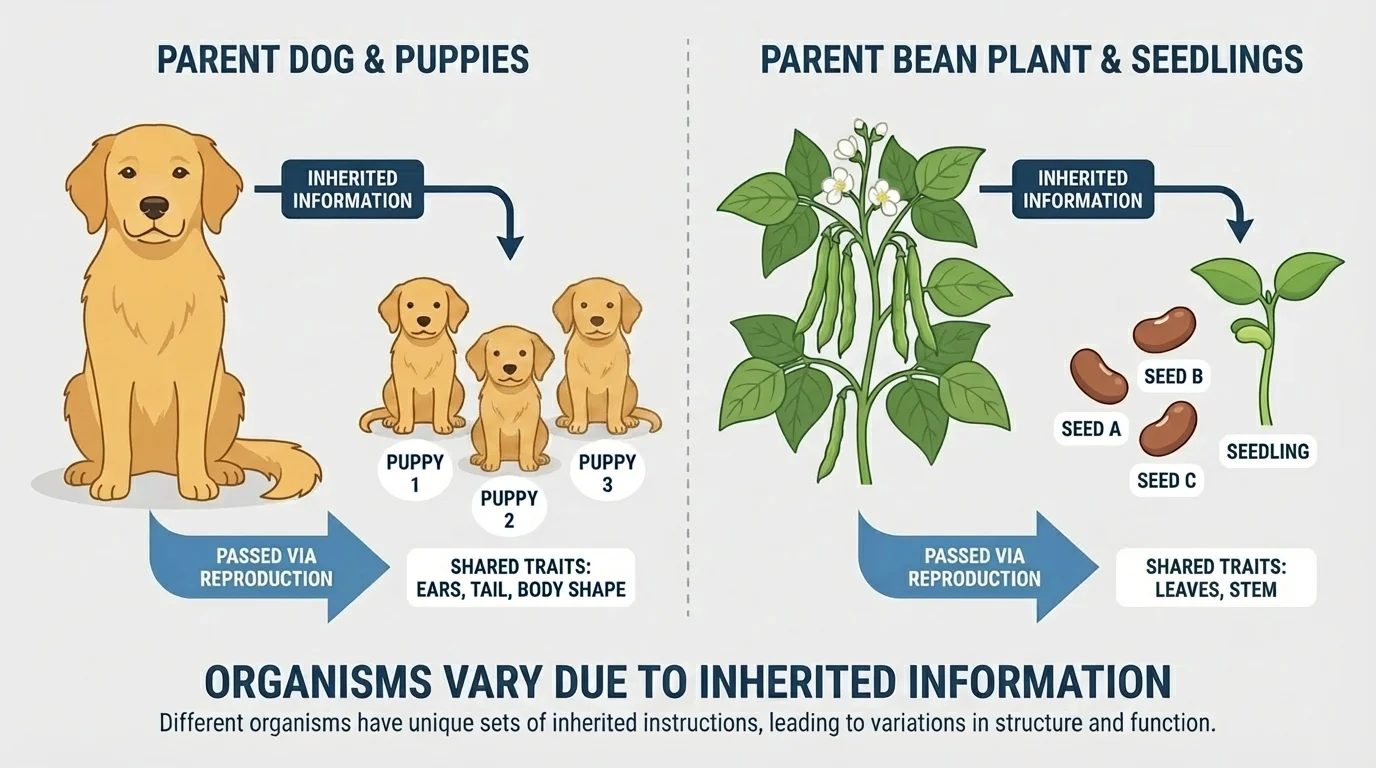
Inherited information is found in nearly all living things. It helps explain why baby robins grow into robins rather than turtles, and why acorns grow into oak trees rather than pine trees. The information passed down gives each organism a pattern for developing as part of its own kind.
At the same time, the environment also matters. Sunlight, water, food, space, temperature, and safety can affect how well an organism grows. For example, two tomato plants may have inherited similar information, but if one gets more sunlight and water, it may grow larger. Inherited information sets possibilities, while the environment can influence the final result.
Some traits can be seen even in seeds. A tiny seed already contains inherited information that can guide the growth of roots, stems, leaves, and flowers when conditions are right.
Scientists study inherited information to understand families, animal breeds, plant varieties, and even how diseases can run in families. Farmers use this knowledge when choosing plants with traits such as sweeter fruit or stronger stems. Veterinarians and doctors also use it to better understand health.
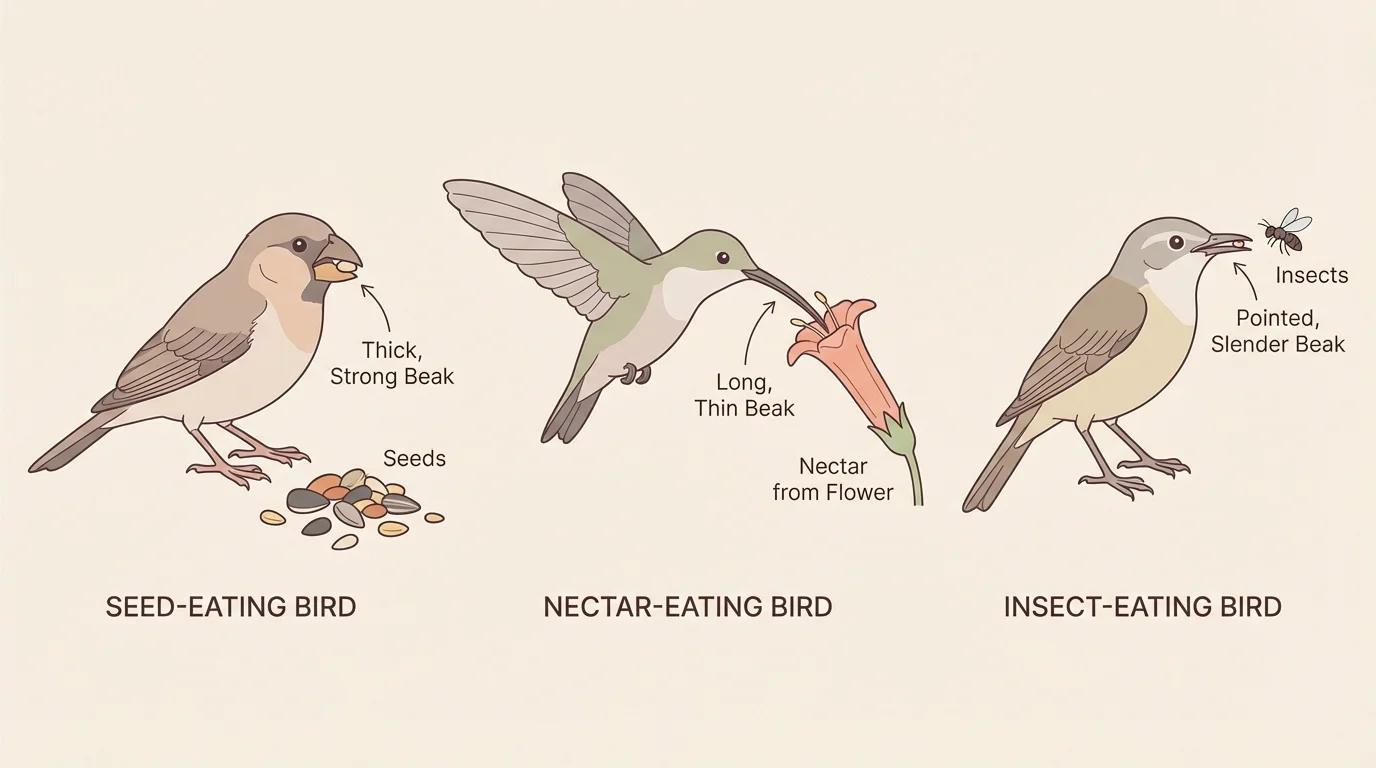
Traits are not only about appearance. They can affect how an organism gets food, stays safe, finds shelter, and survives in its environment. In birds, beak shape is a good example. As [Figure 2] illustrates, different birds have different beaks, and those beaks help them eat different foods. A short, strong beak can crack seeds. A long, narrow beak can reach nectar in flowers. A pointed beak can grab insects.
Plants also show this connection between structure and function. Cacti have thick stems that store water and spines that help protect the plant. Water lilies have broad leaves that float on water. Pine trees have needle-like leaves that help them survive in cold or dry places. These structures help plants do important jobs in their habitats.
In animals, inherited traits can affect movement. Fish have fins that help them swim. Deer have long legs for running. Moles have strong front paws for digging underground. In each case, a structure supports a function. The body part is shaped in a way that helps the organism live.
Inherited traits can also affect body processes you cannot easily see. Some plants can survive with very little water. Some dogs have an excellent sense of smell. Some people are more likely to have attached earlobes, while others have free earlobes. Some traits help with survival, and some are simply differences among individuals.
Structure and function work together. If a body part has a certain shape, size, or material, that often helps explain what it does. A duck's webbed feet push against water, a hawk's curved claws hold prey, and a thick tree trunk supports tall branches.
Later, when scientists compare organisms, they often ask two questions: What structures does this organism have? What functions do those structures help it perform? Those questions can reveal how inherited information shapes living things.
Members of the same species share many important traits, but they are not perfectly identical. A species is a group of organisms of the same kind, such as wolves, oak trees, or humans. As [Figure 3] shows with puppies from the same litter, individuals in one species can differ in size, color, pattern, or shape while still clearly belonging to the same kind of organism.
Think about a group of tulips. They all have roots, stems, leaves, and flowers, but one may be red, another yellow, and another pink. Think about kittens from the same mother. They may all have fur, whiskers, tails, and similar body shapes, but one may be gray, one black, and one spotted. These differences are examples of variation.
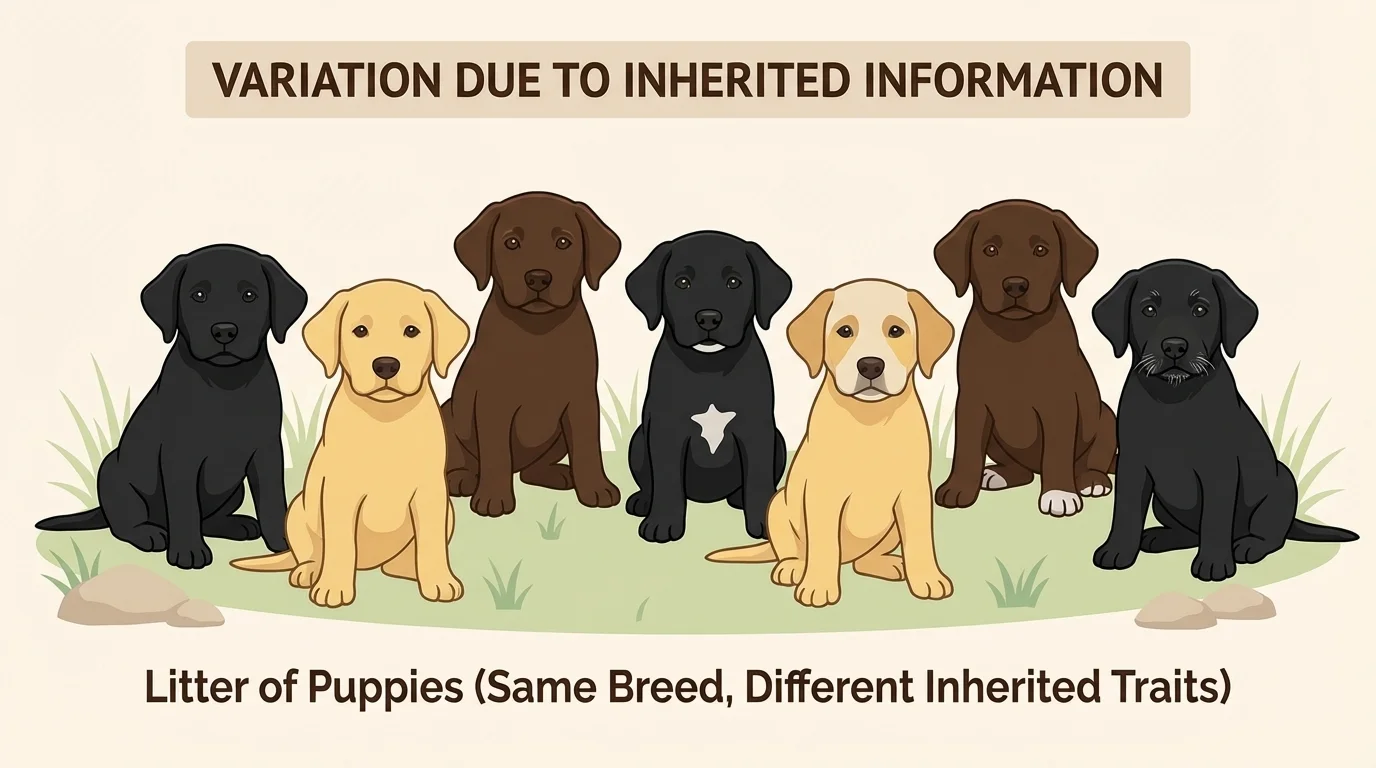
Variation means the differences in traits among individuals of the same species. Variation is normal in living things. It helps explain why no two leaves look exactly the same and why brothers and sisters may share some features but not all of them.
Humans are a useful example. People all belong to one species, but they can vary in hair color, eye color, height, fingerprint patterns, and many other traits. Family members often resemble one another because they share inherited information, yet each person is unique.
| Organism | Traits Shared by the Same Kind | Traits That May Vary |
|---|---|---|
| Dogs | Fur, tails, four legs, teeth | Fur color, ear shape, size |
| Sunflowers | Stems, roots, yellow petals, seeds | Height, number of petals, leaf size |
| Humans | Two eyes, hair, hands, feet | Height, hair texture, eye color |
Table 1. Examples of traits shared within a kind of organism and traits that can vary among individuals.
Variation matters because it means a population has many combinations of traits. That can be important when environments change. We will return to this idea when we look at changes across generations.
Not everything about an organism comes from inherited information. Some characteristics are inherited traits, while others are behaviors learned through experience. As [Figure 4] shows, a duck's webbed feet are an inherited trait, but a dog learning to sit when trained is a learned behavior.
A spider spinning a web is mostly using inherited behavior patterns. A young bird learning a song from adult birds is using learning. A person may inherit the ability to grow curly hair, but learning to ride a bicycle takes practice. It is important to separate what is passed down biologically from what is taught or learned.
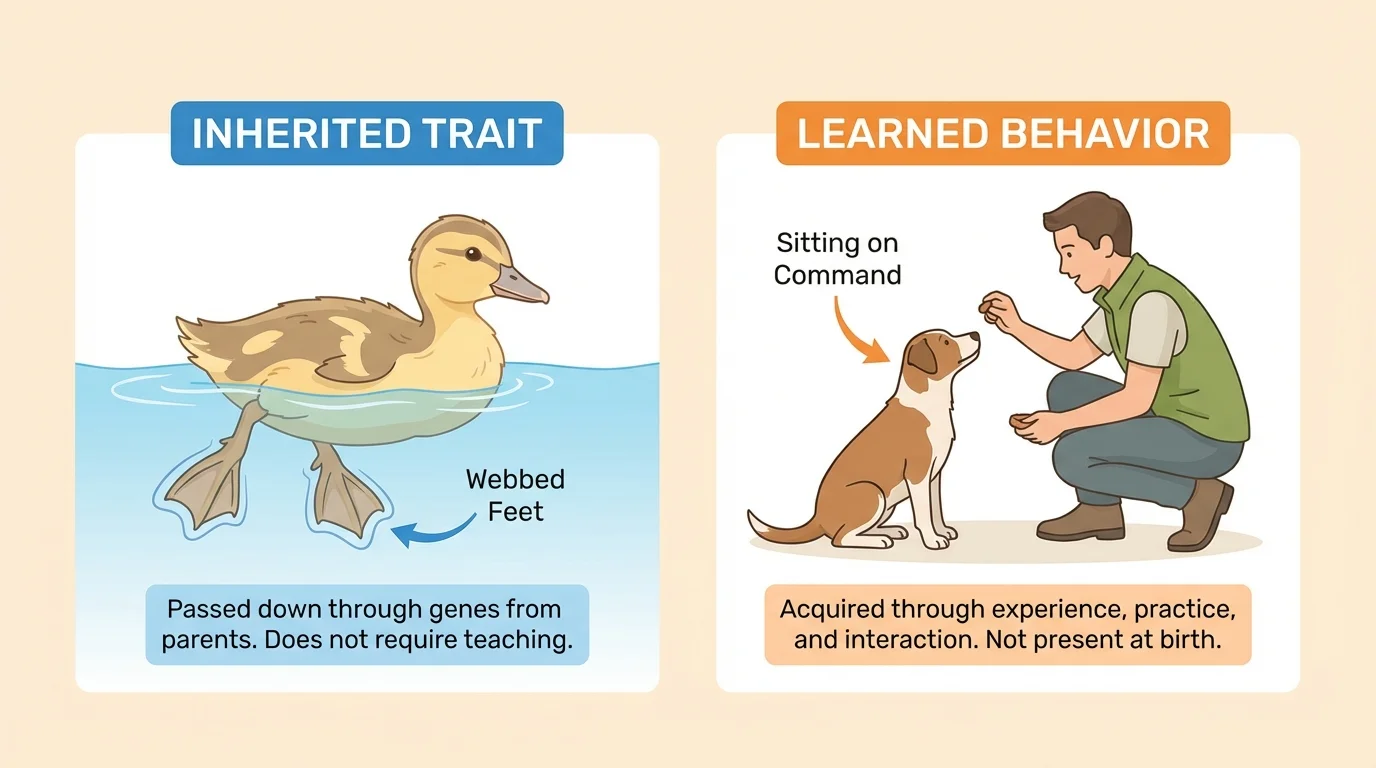
Some behaviors involve both inherited information and learning. For example, many animals are born with the ability to move in certain ways, but they improve with practice. A cheetah inherits a body built for running, yet it still needs experience to become a skilled hunter. A human inherits muscles and a brain that make language possible, but speaking a specific language must be learned.
Real-world example: pet dogs
Dogs show both inherited traits and learned behaviors.
Step 1: Consider inherited traits.
A border collie may inherit a body shape, fur type, and strong natural herding instincts.
Step 2: Consider learned behaviors.
The same dog can learn commands such as "come," "stay," or how to walk politely on a leash.
Step 3: Put them together.
The dog is born with inherited information, but training and experience shape some of what it does.
When scientists study animal behavior, they look carefully at this mix. They ask: Which parts were likely inherited? Which parts were learned from the environment?
Inherited traits matter in everyday life, not just in science books. Gardeners choose tomato plants that produce juicy fruit. Farmers may breed sheep with thick wool or chickens that lay many eggs. People who care for pets notice traits such as size, coat type, and energy level. These traits come from inherited information.
In medicine, doctors sometimes ask whether certain conditions run in a family. That is because inherited information can affect health as well as appearance. For example, some people may inherit a greater chance of having certain vision problems or allergies. Learning about family history can help people take care of their health.
Bananas sold in stores often come from plants that are very similar to one another. That can make farming easier, but it can also be risky because if the plants all share the same weakness, one disease can harm many plants at once.
Conservation scientists also care about variation. If a group of animals has very little variation, it may be harder for the population to handle changes such as new diseases, changing temperatures, or habitat loss. A population with more variation may have a better chance that some individuals possess helpful traits.
This is one reason protecting biodiversity is important. Biodiversity means the variety of living things in an area or on Earth as a whole. Different species and different traits within species help make life on Earth more resilient.
Offspring usually receive inherited information from two parents. That means each offspring gets its own combination of information. This helps explain why brothers and sisters can look alike but not exactly the same, and why seeds from the same plant can grow into similar but slightly different plants.
For example, if one parent plant has purple flowers and another parent plant also has purple flowers, many offspring may have purple flowers too. But depending on the inherited information, some offspring in later generations might show different colors. Scientists use careful observations over many generations to study these patterns.
Animal breeding provides familiar examples. Some puppies in a litter may have spots while others do not. Some may have longer fur, while others have shorter fur. They all belong to the same species and often the same breed, but each puppy has its own combination of inherited traits.
Living things need resources such as food, water, air, and shelter. Traits can affect how well an organism gets these resources. A long root system helps some plants reach water, and sharp eyesight helps some animals find food.
Simple inheritance patterns are often taught with easy examples, but real organisms are complex. Many traits are influenced by more than one gene and by environmental conditions too. Even so, the big idea remains the same: inherited information helps explain both similarity and difference.
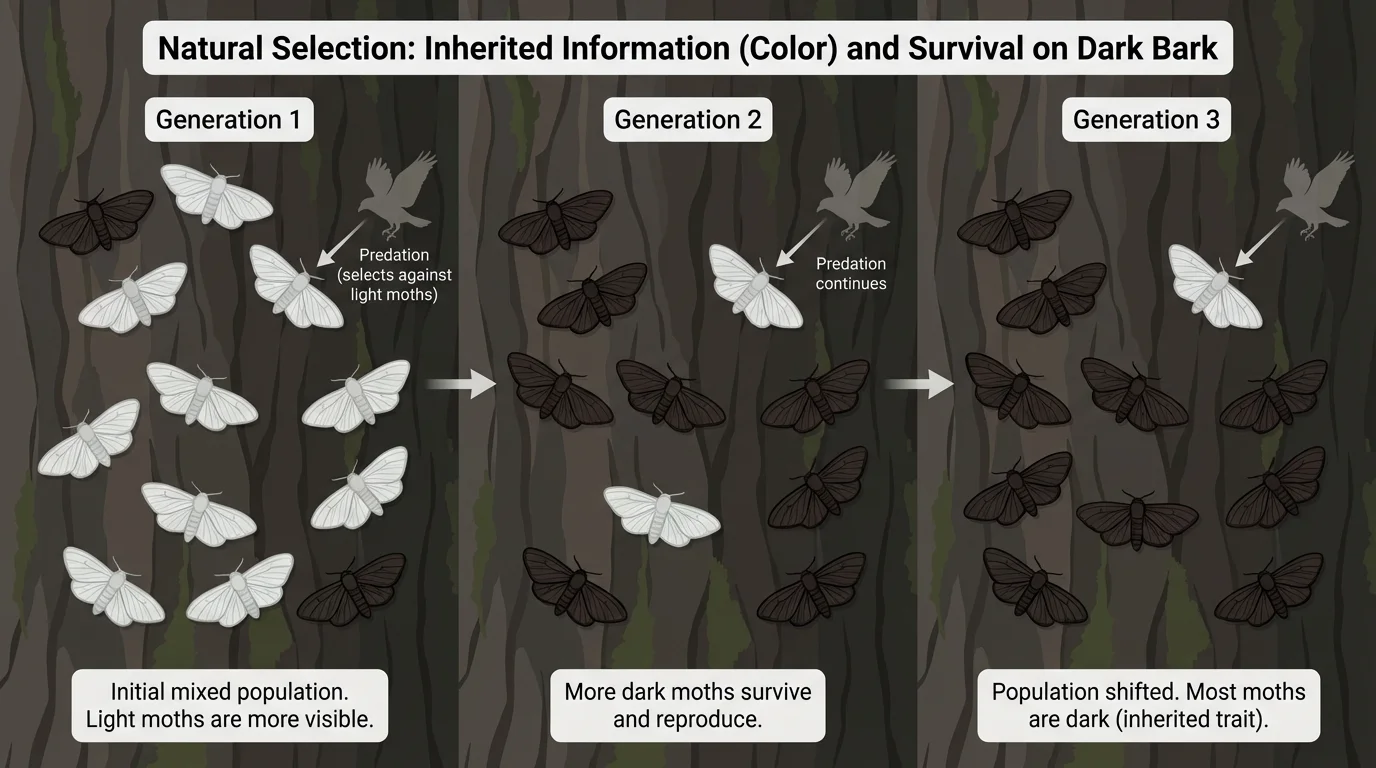
Sometimes a trait helps an organism survive and reproduce in its environment. If that happens, the trait may become more common over many generations. As [Figure 5] illustrates, if dark-colored moths are harder for predators to see on dark tree bark, they may survive more often and have more offspring. Over time, more moths in the population may have dark coloring.
This kind of change does not happen because a single organism decides to change. Instead, it happens in populations over many generations. Organisms with traits that help them survive are more likely to pass those traits on. Helpful inherited traits can spread in a population.
The same basic idea can apply to plants, insects, fish, birds, and mammals. In a dry place, plants with traits that help save water may leave more offspring. In a cold place, animals with traits that help keep body heat may do better. Variation gives nature many possibilities, and the environment influences which traits are especially useful.
This idea also helps explain why populations can change over long periods of time. The changes are usually small in each generation, but they can add up. Earlier, we saw that variation exists within a species, as shown in [Figure 3]. That variation gives natural populations different traits to work with over time.
When you observe an organism, you can ask questions that scientists ask. What traits does it have? Which of those traits might be inherited? How do its structures help it function? How is it similar to others of its kind, and how is it different? These questions help connect observation with explanation.
A hummingbird's long beak and fast wings help it feed from flowers, connecting back to the relationship between structure and function that we saw with bird beaks in [Figure 2]. A duckling's body plan comes from inherited information, just as the parent-offspring patterns in [Figure 1] show. A puppy's unique markings reveal variation within a species, and some of its actions will be learned over time.
The more closely scientists study life, the more they discover how important inherited information is. It helps shape bodies, behaviors, and body functions. It helps explain why oak trees make acorns, why robins hatch from robin eggs, why children resemble family members, and why organisms are adapted to the places where they live.
"Living things are similar in some ways, different in other ways, and those patterns tell a story about inheritance."
Understanding inheritance helps us make sense of the natural world. It shows why organisms are not all built the same, why members of one species still vary, and why some traits become more common across generations. The incredible variety of life on Earth is deeply connected to the information that living things pass on.
