A cactus can live for a long time in a hot desert, but it would have a hard time in a dark pond. A fish can swim easily in water, but it cannot live on a dry sidewalk. These examples show a big idea in life science: for any particular environment, some kinds of organisms survive well, some survive less well, and some cannot survive at all. Living things are not all built for the same places. Their body parts, behaviors, and needs matter.
An environment is everything around an organism. It includes living things, like plants and animals, and nonliving things, like water, air, sunlight, soil, rocks, and temperature. In a pond, for example, frogs, fish, insects, and water plants live together with mud, water, light, and oxygen. An environment includes these living and nonliving parts.
Every organism has basic needs. Animals need food, water, air, and a place to live. Plants need water, air, sunlight, nutrients from soil or water, and space to grow. As [Figure 1] shows, if an environment provides these needs in the right amounts, an organism has a better chance of surviving.
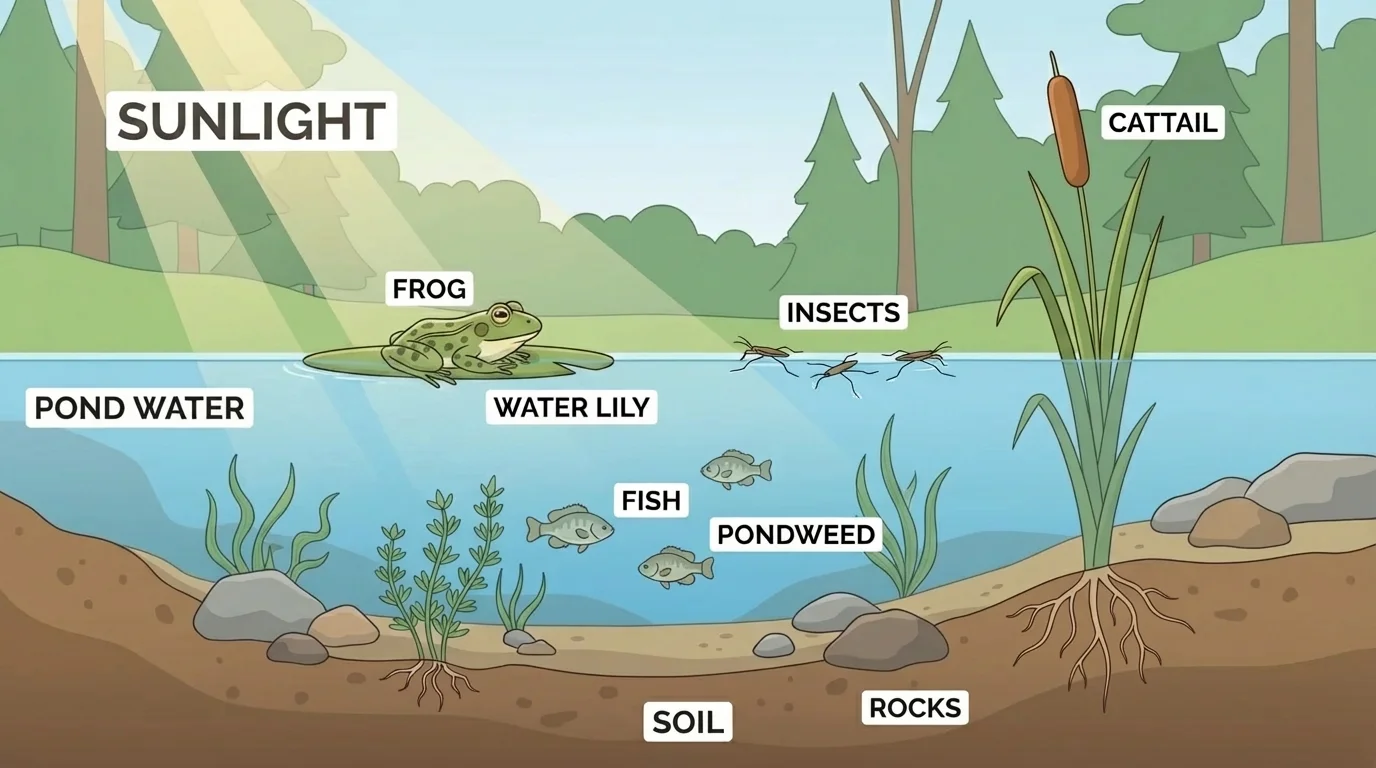
Scientists often use the word habitat for the place where an organism lives. A habitat is not just an address. It is a place that meets the organism's needs. A fallen log can be a habitat for fungi, insects, and worms. A tree can be a habitat for birds, squirrels, and many tiny organisms living in its bark.
Organism means a living thing. It can be as small as a bacterium or as large as a whale.
Habitat is the place where an organism lives and gets what it needs to survive.
Environment includes all the living and nonliving things around an organism.
Two places may look nice to us but be very different for a living thing. A shady forest, a windy beach, a frozen tundra, and a grassy field all have different temperatures, amounts of water, kinds of food, and hiding places. Because of that, the same organism will not do equally well in all of them.
Survival depends on how well the features of a living thing match its surroundings. If an organism's needs are met and it can stay safe long enough to grow and reproduce, it is more likely to survive well. If only some needs are met, or if danger is high, it may survive less well. If the environment cannot meet its basic needs at all, it cannot survive there.
This idea is connected to adaptation. An adaptation is a body part, body covering, or behavior that helps a living thing survive in its environment. Adaptations are not choices an animal makes in one day. They are traits that help organisms live successfully in certain conditions.
Think about shoes. Snow boots work well in deep snow, but flip-flops do not. Flip-flops may still be wearable for a moment in snow, but they do not work nearly as well. Bare feet on ice may quickly become dangerous. In a similar way, some organisms are well matched to an environment, some are poorly matched, and some are not matched at all.
Matching traits to conditions
When an organism has traits that fit its habitat, it can get food, find water, stay safe, and handle temperature better. A poor match makes these tasks harder. A complete mismatch may make survival impossible.
For example, a trout survives well in cold, clean streams with lots of oxygen in the water. In warm, muddy water with less oxygen, the trout survives less well. On dry land, it cannot survive at all. The environment did not change what a trout needs. It only changed how well those needs could be met.
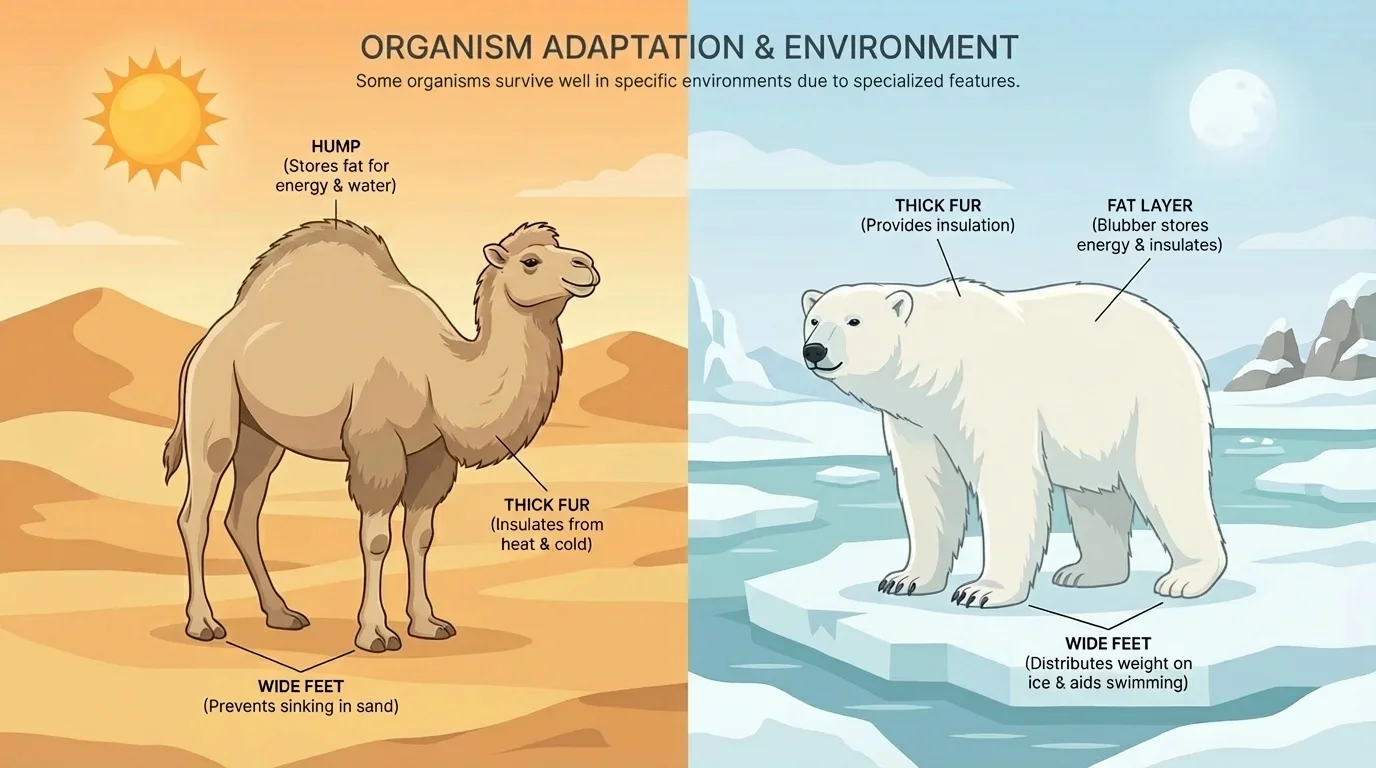
Many organisms have special structures that help them survive, as [Figure 2] illustrates when it compares animals from very different habitats. Body parts such as thick fur, wide feet, waxy leaves, sharp claws, or gills can make a major difference in whether an organism survives well.
A camel survives well in a hot desert because it has features that help in dry, sandy conditions. Its long legs keep its body farther from the hot ground. Its wide feet help it walk on sand. It can also go a long time without water compared with many other animals.
A polar bear survives well in the Arctic because it has thick fur and a thick layer of fat to keep warm. Its white fur helps it blend into snowy surroundings. But a polar bear would survive poorly in a hot desert. It would overheat, and the environment would not match its needs.
Plants also have structures that fit their environments. A cactus survives well in the desert because its thick stem stores water and its waxy covering helps reduce water loss. Its spines protect it and also reduce water loss compared with broad leaves. A water lily, on the other hand, survives well in a pond because its leaves float on water and can collect sunlight there.
Behaviors matter too. Some birds migrate when seasons change. Some squirrels store food before winter. Some animals are active at night when the air is cooler. These behaviors help organisms live in environments that might otherwise be difficult.
Some desert animals stay in underground burrows during the hottest part of the day. The cooler burrow helps them avoid losing too much water and energy.
Later, when we compare habitats, the camel and polar bear in [Figure 2] help us remember an important rule: a trait that is helpful in one place may be unhelpful in another place.
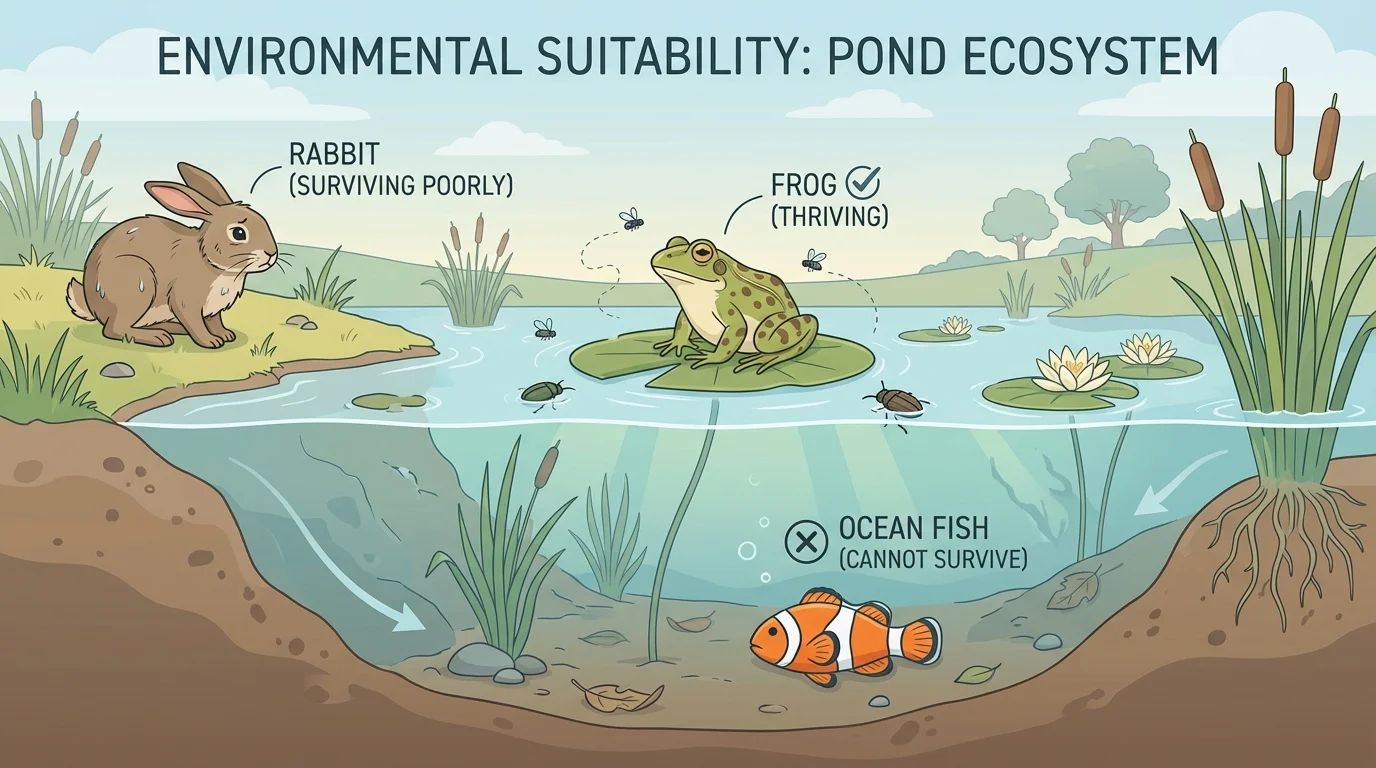
As [Figure 3] shows, one environment can lead to very different results for different organisms. A frog may survive well there because it can live near water, hide among plants, and find insects to eat. A rabbit at the edge of the pond may survive less well because it can drink there but does not swim or live in the water. A saltwater fish from the ocean cannot survive in a freshwater pond at all.
This does not mean the pond is a "good" or "bad" environment by itself. It means the pond is a good match for some organisms and not for others. The same idea works in forests, deserts, grasslands, and oceans.
Consider a tree in a backyard. A robin may survive well there by building a nest and eating worms from the ground. A deer might visit and survive less well if there is not enough food nearby. A coral reef fish cannot survive there at all because a backyard tree is not its habitat.
Even closely related organisms can differ. Some plants grow best in shade, while others need full sunlight. Some frogs need very wet places, while others can live in drier areas. Small differences in needs can lead to big differences in survival.
| Environment | Organism that survives well | Organism that survives less well | Organism that cannot survive there |
|---|---|---|---|
| Desert | Cactus | Frog | Kelp |
| Pond | Water lily | Rabbit | Polar bear |
| Arctic | Polar bear | Camel | Tropical parrot |
| Forest | Squirrel | Cactus | Clownfish |
Table 1. Examples of how the same environment can be a strong match, a weak match, or no match at all for different organisms.
The pond comparison also reminds us that survival is not only about staying alive for a few minutes. Surviving well means an organism can continue meeting its needs over time.
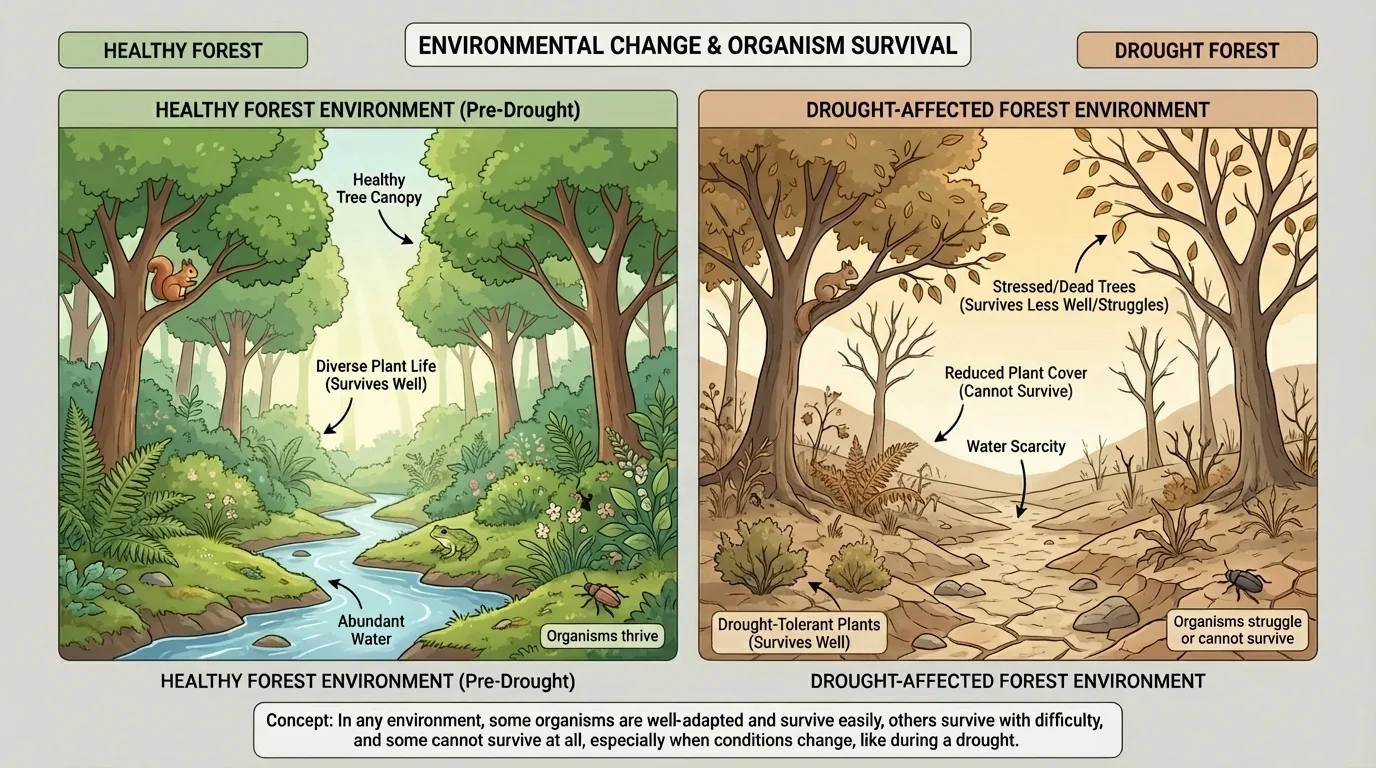
As [Figure 4] shows, environments do not always stay the same. Rain may stop for a long time. Temperatures may rise or fall. Fires, floods, storms, and droughts can change what food, water, and shelter are available in a forest that becomes much drier.
When a pond dries up, fish may die because they lose the water they need. Frogs may survive only if they can move to another wet place. Some insects may increase if new muddy areas appear. A change can help some organisms and harm others at the same time.
Seasonal changes are another example. In winter, some trees lose leaves, so animals that eat those leaves may have less food. Snow can make it harder for some animals to find food, but easier for others to hide or hunt. A snowy owl may do well in winter conditions that would be difficult for a lizard.
Real-world case study: A dry summer in a school garden
Step 1: The environment changes.
There is less rain, so the soil becomes dry and hard.
Step 2: Some organisms survive well.
Plants with deep roots may still reach water underground.
Step 3: Some survive less well.
Shallow-rooted plants may droop and grow slowly.
Step 4: Some cannot survive at all.
If the dry conditions continue, some small plants may die because they cannot get enough water.
This shows how one environmental change can create different outcomes for different organisms.
Human actions can also change environments. Building roads, cutting forests, polluting water, or bringing new species into an area can affect survival. If a stream becomes polluted, organisms that need clean water may disappear, while a few tougher organisms may remain.
The before-and-after habitat helps explain why environmental change is so important. When the conditions change, the list of organisms that survive well can change too.
Organisms do not live alone. They interact with other living things in their environment. They may compete for food, water, space, or sunlight. They may hunt, hide, pollinate flowers, spread seeds, or build homes in other organisms.
Competition happens when organisms need the same resource and there is not enough for everyone. Two plants growing close together may compete for sunlight and water. A larger plant may survive better because it shades the smaller one.
Predators and prey also affect survival. A rabbit survives better where it can find food and hide from foxes or hawks. If there are few hiding places, the rabbit may survive less well. If the area has no plants to eat and nowhere to hide, it may not survive there at all.
Living things need resources from their environment. Resources include food, water, air, sunlight, and space. When resources are limited, not all organisms can do equally well.
Plants depend on pollinators in many habitats. Bees, butterflies, birds, and bats help some flowering plants reproduce. If pollinators disappear from an area, those plants may survive less well over time because making seeds becomes harder.
Decomposers such as fungi and bacteria break down dead material. This returns nutrients to the soil, helping plants grow. So even organisms that are small or hidden play an important role in whether a habitat can support life.
A desert is hot and dry. Cacti, kangaroo rats, and lizards often survive well there because they have ways to save water or avoid heat. A salamander that needs cool, wet skin would survive poorly or not at all in the same desert.
The Arctic is cold and icy. Polar bears, Arctic foxes, and some seals survive well because they can handle freezing temperatures. Many tropical plants cannot survive there because they are not built for extreme cold.
A freshwater pond supports ducks, frogs, fish, snails, insects, and water plants. But many ocean organisms cannot live in freshwater because salt levels matter to their bodies. This is one reason a clownfish belongs in the ocean, not in a pond or stream.
Salt, temperature, and oxygen matter
Some survival differences are caused by conditions we cannot easily see. Water may be too salty or not salty enough. Air or water may be too hot, too cold, or low in oxygen. These invisible conditions are part of why an organism may thrive, struggle, or fail to survive.
Cities are environments too. Pigeons, rats, squirrels, ants, and some weeds survive well in cities because they can use buildings, trash, small green spaces, and human-made structures. Other organisms survive less well because there is less natural shelter or food.
Even inside a home, one organism may do well while another does not. A houseplant may survive near a sunny window but not in a dark closet. Mold may grow in a damp bathroom but not on a dry shelf. Different conditions create different winners and losers.
Scientists observe where organisms live and compare the conditions in those places. They ask questions such as: What food is available? How much water is there? What is the temperature? Are there predators? Is there shelter?
They may record data in tables and look for patterns. For example, if more frogs are found near clean ponds with lots of plants, scientists can infer that those conditions support frog survival. If almost no frogs are found in polluted ponds, that suggests the environment is a poor match.
Students can do simple observations too. In a schoolyard, you might notice that some plants grow best in sunny spots and others in shade. Under rocks or logs, you may find pill bugs and worms where it is dark and moist. These patterns help explain why organisms are found where they are.
Simple observation idea
Compare two places outdoors, such as a sunny patch and a shady patch. Look for differences in moisture, temperature, and the kinds of organisms present. This helps show that even small environmental differences can change which organisms survive best.
Scientists also study how populations change over time. If food becomes scarce, some organisms may leave, some may die, and others may increase if they can use a different food source. Survival is connected to the whole web of life in that habitat.
Because organisms depend on suitable environments, protecting habitats matters. Clean water, healthy soil, native plants, and safe shelter help many species survive. When habitats are damaged, the organisms that depend on them may struggle.
People can help by planting native species, reducing pollution, protecting wetlands and forests, and keeping streams clean. A small action, such as leaving part of a school garden for pollinators, can make a real difference for bees and butterflies.
"The right home can mean the difference between thriving and disappearing."
Understanding survival in different environments helps us make wise choices. It explains why zoos create special habitats for animals, why farmers pay attention to soil and weather, and why conservation groups work to protect forests, reefs, grasslands, and wetlands.
