Have you ever seen a paper clip jump toward a magnet even though nothing touched it? That tiny jump is a clue about a powerful science idea: some forces happen without contact. Magnets can help people solve real problems, from keeping a cabinet closed to picking up dropped metal objects. To use magnets well, we first need to clearly define the problem we want to solve.
A magnet is an object that can pull certain kinds of metal, such as iron or steel. A magnet can also push away or pull on another magnet. This happens because of magnetic force, a force that acts at a distance, as shown in [Figure 1]. That means the objects do not have to touch for the force to happen.
Some forces need contact. For example, your hand pushes a toy car only when your hand touches it. Magnetic force is different. A magnet can pull a paper clip across a small space. This is an important scientific idea because it helps us think of tools and devices that work without direct touching.
Magnet means an object that can attract certain metals and can attract or repel another magnet.
Magnetic force means the push or pull caused by a magnet.
Contact force means a force that happens when objects touch.
Not every metal is strongly attracted to a magnet. A steel paper clip is usually pulled by a magnet, but a coin or an aluminum can may not be. This matters when we plan a solution. If the material is not magnetic, a magnet may not help.
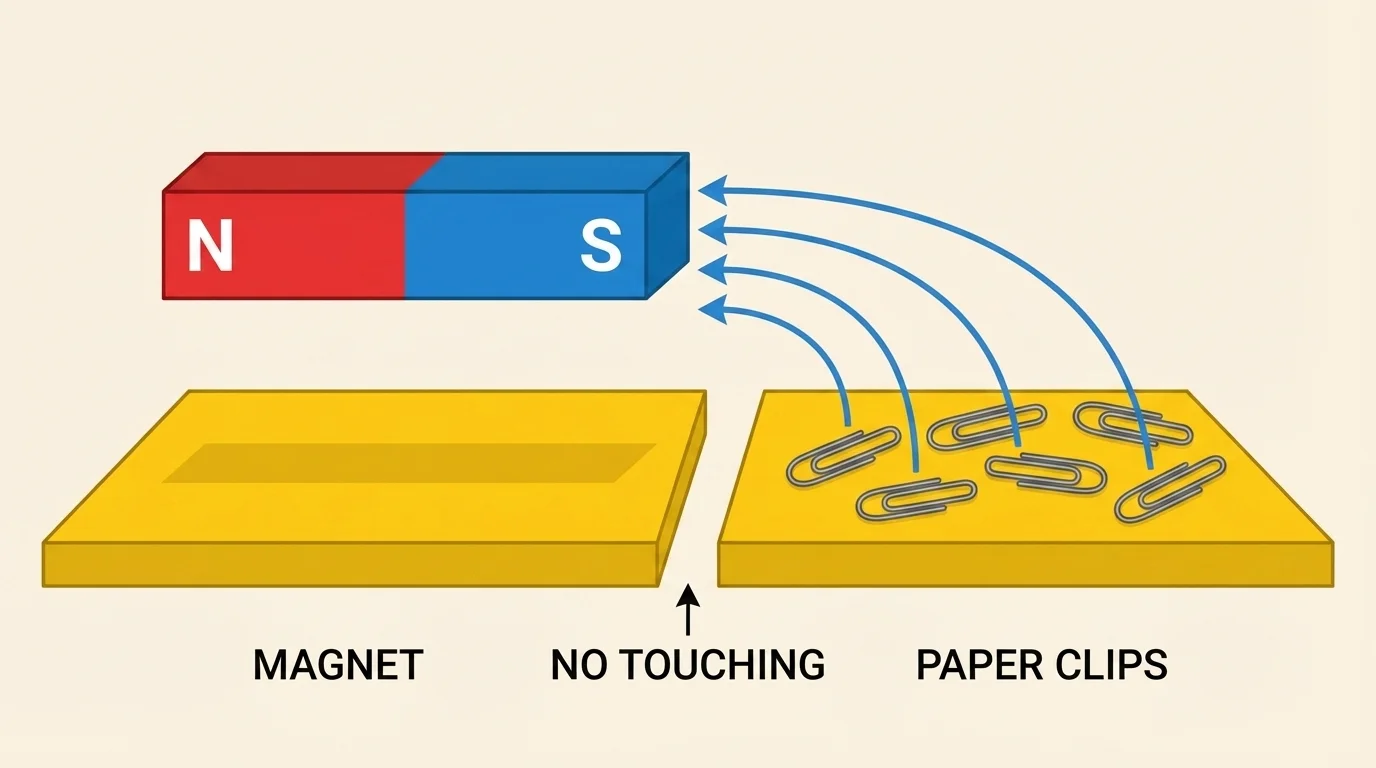
Because magnets act across a space, they are useful in places where touching is hard, messy, or inconvenient. A magnet can pick up a pin from a tight spot. A magnetic strip can hold a note on a refrigerator door. In both cases, the science idea is the same: objects in contact can exert forces, but magnetic forces can act even when objects are not touching.
A design problem is a need or want that can be solved by making or improving something. The problem must be clear. If we say, "I want to use a magnet," that is not really a problem. But if we say, "I need a way to keep my art papers attached to a metal board," that is a design problem because it tells what needs to be done.
When we define a problem, we describe what the solution should do. We also think about limits. For example, the solution may need to be safe, small, strong enough, or made from materials we already have. Good problem statements help us choose good designs.
A clear design problem has four parts: a goal, materials, limits, and a way to tell if the design works. If a student says, "I need a tool that uses a magnet to pick up three paper clips from under a desk," the goal is clear, the material is a magnet, and success can be checked by seeing whether the tool really picks up the clips.
Defining the problem comes before building. Engineers and scientists do not start by guessing. They first ask: What is the need? Who will use the solution? What materials will work? What will count as success?
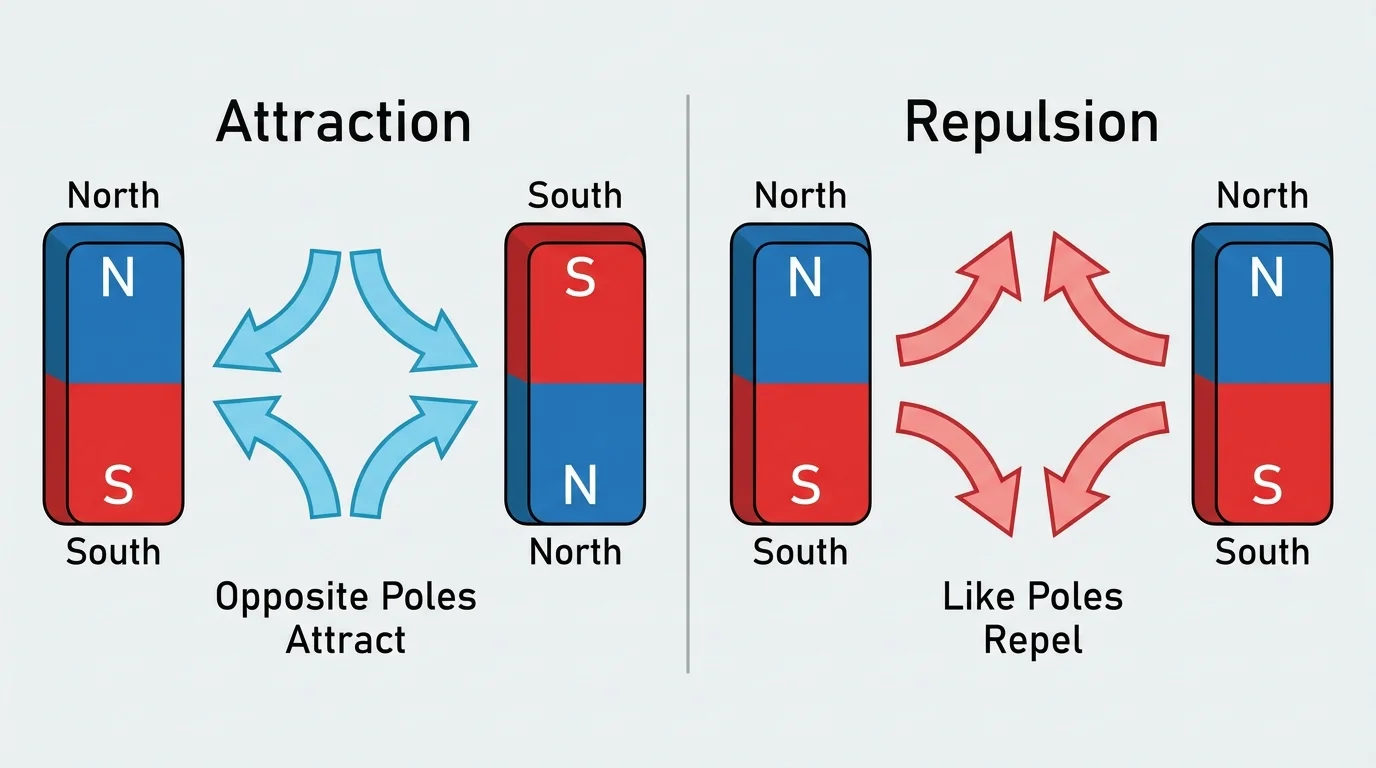
To define a good magnet problem, we need a few more science ideas. Every magnet has poles. Magnets have two poles, called north and south. The way the poles face each other changes what happens, as [Figure 2] illustrates. Opposite poles attract, and like poles repel.
If the north pole of one magnet faces the south pole of another magnet, they pull together. If north faces north, or south faces south, they push apart. This helps us understand why some magnet designs hold things together and why others can make objects move away from each other.
Another important idea is that distance matters. Magnetic force is usually stronger when magnets are closer together and weaker when they are farther apart. If a magnet is too far from a paper clip, the clip may not move. So a design problem should match the strength and placement of the magnet to the job.
Material matters too. Iron and steel are often attracted to magnets. Wood, plastic, glass, paper, and rubber usually are not. So if we want to use a magnet to hold something in place, at least one part of the design often needs to be magnetic.
A magnet can act through some materials, such as paper or thin plastic. That is why a magnet can hold a paper note to a metal door even though the paper is between the magnet and the door.
The pole idea in [Figure 2] also helps explain moving objects. If two magnets are arranged so like poles face each other, they repel. A designer might use that push to make part of a game or toy move without direct contact.
When students define a magnet design problem, they should include four main parts: the goal, the materials, the limits, and the test for success. This keeps the problem simple and clear.
The goal tells what the design should do. For example, "hold a drawing on a metal board" or "pick up metal objects from a hard-to-reach place." [Figure 3]
The materials tell what can be used. A problem might allow a bar magnet, string, tape, cardboard, and paper clips. This matters because a great idea is not useful if we do not have the needed materials.
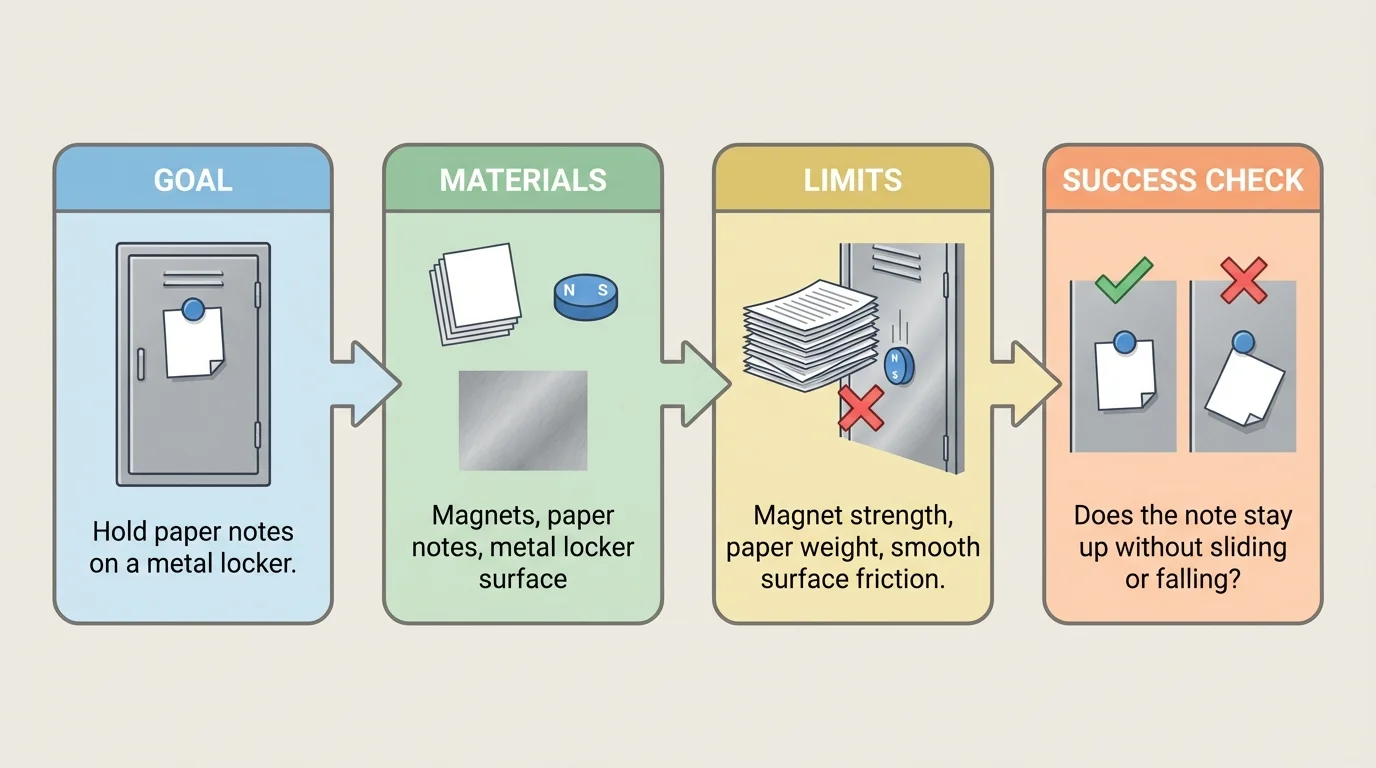
The limits are the rules or boundaries. Maybe the design must fit in a pencil box. Maybe it must be safe to use in class. Maybe it can use only one magnet. Limits help narrow the choices.
The success check tells how we will know the design works. For example, "The magnet holder keeps one sheet of paper on the board for one hour," or "The pickup tool lifts five steel paper clips."
Example: turning a need into a clear design problem
A student keeps losing metal hair clips under a bed and wants a simple tool to get them back.
Step 1: State the need clearly.
The need is to pick up small metal objects from a place that is hard to reach.
Step 2: Name the materials.
The student can use a magnet, a stick, and tape.
Step 3: Add limits.
The tool must be safe, light, and long enough to reach under the bed.
Step 4: Decide how to test success.
The tool works if it can pick up at least three steel hair clips from under the bed.
A clear design problem could be written as: "Design a safe tool that uses a magnet attached to a stick to pick up at least three steel hair clips from under a bed."
Notice that this problem does not just say "make something with a magnet." It explains the job, the materials, and the way to test the design. That makes it much easier to build and improve.
Magnets are used in many everyday objects, and these examples can help us define strong problems. One common use is keeping a door or cabinet closed, as [Figure 4] shows. Another use is holding notes or pictures on a metal surface. Another is collecting scattered steel items such as paper clips or small screws.
Here are several simple design problems that fit what young students can understand:
Problem 1: Design a holder that uses a magnet to keep one paper note on a metal locker door.
Problem 2: Design a tool that uses a magnet to pick up five steel paper clips from the floor.
Problem 3: Design a magnetic cabinet catch that uses a magnet to keep a small cabinet door closed but easy to open.
Problem 4: Design a game board piece that uses a magnet so it stays in place on a metal board when the board is moved gently.
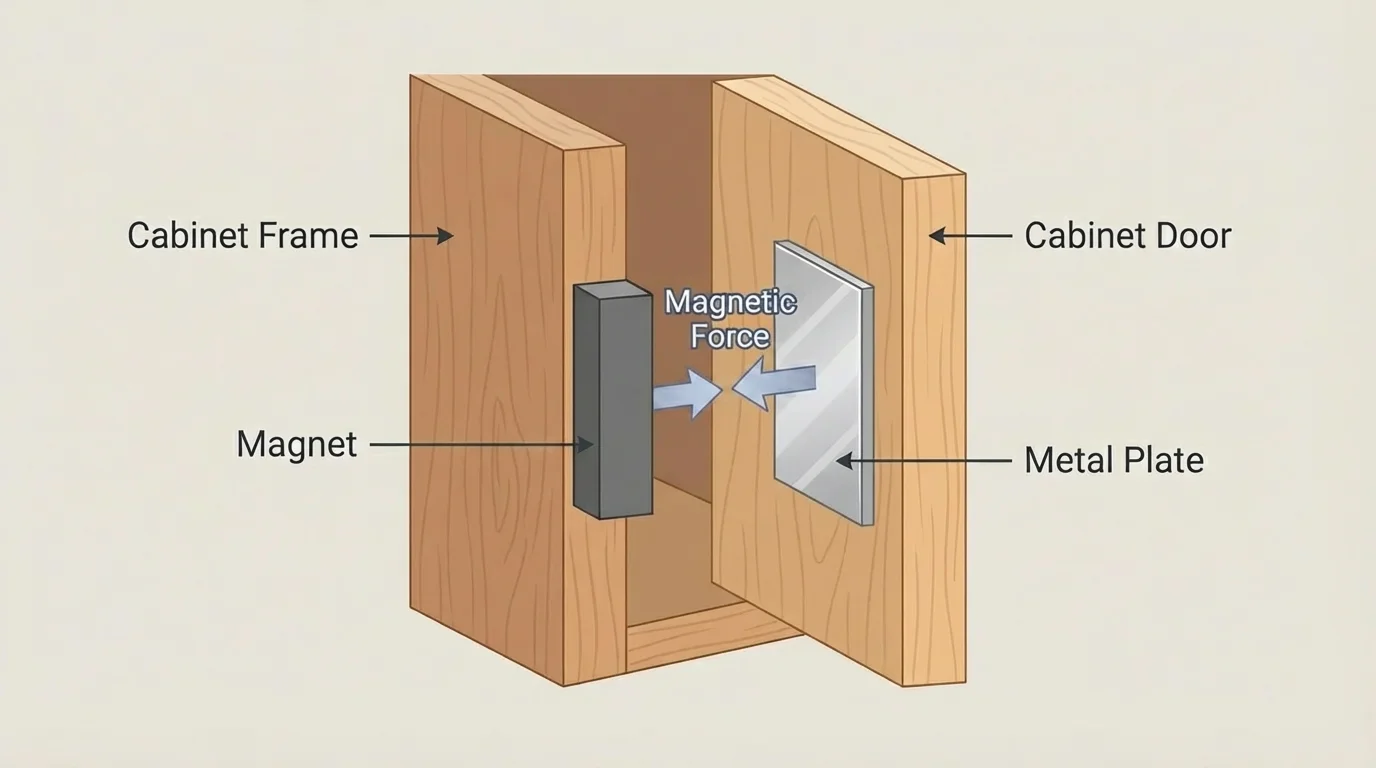
Each of these problems has a clear job. They also use scientific ideas about magnets. For the locker note holder, the designer knows the magnet can attract the metal door without needing glue. For the paper clip tool, the designer knows steel clips will be attracted. For the magnetic cabinet catch, the designer knows the magnetic pull must be strong enough to hold the door closed but not so strong that the door is hard to open.
The cabinet example helps show an important idea: a design must fit the need. A giant strong magnet would not be a good choice for a tiny classroom cabinet. The magnet should match the size and job of the design.
Sometimes magnets are a great solution, and sometimes they are not. We can compare different situations to decide whether a magnet is useful.
| Situation | Can a Magnet Help? | Why or Why Not? |
|---|---|---|
| Holding a note on a steel locker | Yes | The locker is metal and can be attracted by the magnet. |
| Picking up steel paper clips | Yes | Steel is magnetic. |
| Holding a paper cup to a wooden wall | No | Wood is not magnetic. |
| Keeping a small cabinet closed | Yes | A magnet can pull on a metal piece and hold the door shut. |
| Picking up a plastic straw | No | Plastic is not magnetic. |
Table 1. Examples showing when magnets can and cannot solve a design problem.
This comparison shows why scientific ideas matter. A designer who knows which materials are magnetic can avoid wasting time on a poor plan. Good design problems are based on real science, not guessing.
Forces can make objects start moving, stop moving, speed up, slow down, or change direction. Magnetic force is one kind of force, but unlike many pushes and pulls, it does not require touching.
If someone tries to define a problem like "Use a magnet to pick up marbles made of glass," the science tells us there is a problem. Glass is not usually attracted to a magnet, so the design idea does not fit the material.
One mistake is making the problem too broad. "Make something useful with a magnet" is not clear enough. A better version is, "Design a tool that uses a magnet to collect ten steel paper clips from under a table."
A second mistake is forgetting the limits. If a student says, "Make a magnet machine that lifts a bicycle," that may be unrealistic for a simple classroom design. The task should match the materials, time, and size that are actually available.
A third mistake is forgetting to explain how success will be measured. If we do not know what counts as success, we cannot tell whether the design works. The test should be easy to observe. For example, "The magnet holder keeps two sheets of paper on the board for the whole class period."
Clear and unclear problem statements
Compare each pair.
Step 1: Unclear statement
"Make something with a magnet."
Step 2: Clear statement
"Design a tool that uses one magnet and a cardboard handle to pick up four steel paper clips from a narrow space."
Step 3: Why the second one is better
It states the goal, materials, and a test for success.
Clear problem statements help people work together. If two students read the same clear problem, they will understand the same goal. That makes planning, building, and improving much easier.
When you define a magnet design problem, you are thinking like an engineer. Engineers use science ideas to solve needs in the world. They ask careful questions, use what they know about forces and materials, and plan before they build.
Magnets are especially interesting because they can create pushes and pulls without contact. That makes them useful in many designs. But magnets do not solve every problem. The material has to be right, the distance must make sense, and the magnet must be strong enough for the job.
A strong problem statement often begins with a need and ends with a test. For example: "Design a classroom tool that uses a magnet to collect six steel paper clips from the floor safely and quickly." This kind of statement gives a clear direction for making a real solution.
Science and engineering work together here. Science explains why the magnet can attract steel and why distance matters. Engineering uses those ideas to create something useful. When the problem is clearly defined, the design has a much better chance of working well.
