Why can a fish live easily in a pond while a rabbit cannot? Why does a cactus do so well in a dry desert but not in a shady swamp? Organisms survive best in places that meet their needs. When scientists study nature, they look for evidence to explain why one organism does well in a place while another does not.
Every habitat is a little like a neighborhood. As [Figure 1] shows, it has food, water, shelter, space, temperature, sunlight, and other features. Some organisms match that neighborhood very well. Others can live there only with difficulty. Some cannot live there at all. By looking closely at what organisms need and what a habitat provides, we can make a strong argument about survival.
A habitat is the place where an organism lives. A habitat gives living things what they need to stay alive. A habitat is not just one thing. It includes many parts, such as water, food, places to hide, and enough room to live and grow.
For example, a forest habitat may have trees for shelter, nuts and seeds for food, puddles or streams for water, and branches where animals can rest. A pond habitat has water, plants, insects, mud, sunlight, and places where animals can swim or hide.
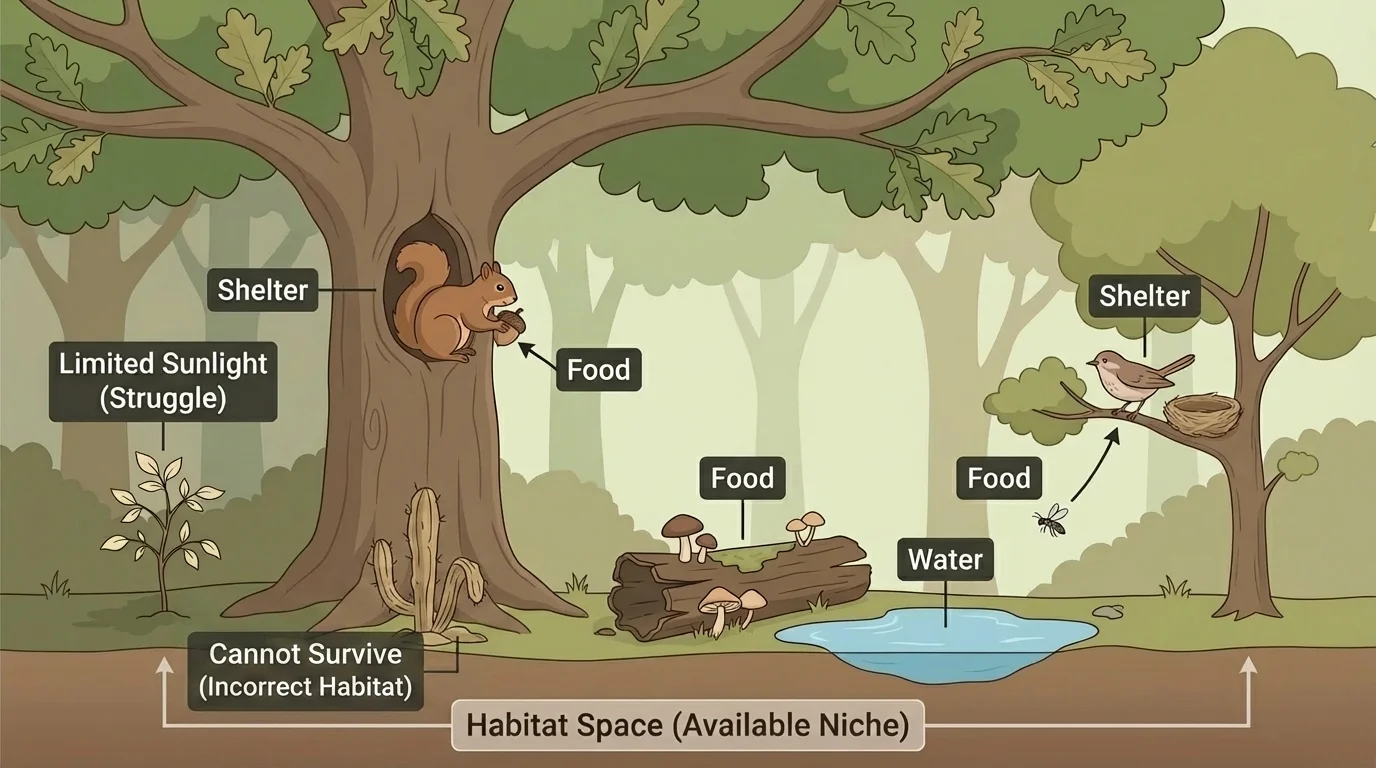
Living things do not all need exactly the same things. A frog needs water and wet places. A bird may need branches to build a nest. A cactus needs dry soil and lots of sunlight. If a habitat does not have the right conditions, the organism will struggle or die.
Habitat means the natural home of a living thing.
Organism means any living thing, such as a plant, animal, fungus, or tiny living thing.
Evidence is information we can observe, measure, count, or record to support an idea.
Scientists often ask, "Does this habitat meet the organism's needs?" That question helps them explain why certain plants and animals are found in some places but not in others.
When we compare organisms in one habitat, we can sort them into three categories. As [Figure 2] illustrates, some survive well. This means the habitat meets their needs very well, so they can stay alive, grow, and often reproduce. Some survive less well. They may stay alive for a while, but the habitat is not a great match for them. Some cannot survive at all because an important need is missing.
Think about a pond. Fish survive well because they have gills for getting oxygen from water and fins for swimming. A frog may survive well too because it can live in water and on land. A rabbit survives less well near a pond if the ground is too wet and there are many aquatic predators. A cactus cannot survive at all in deep pond water because it is built for dry places, not for living underwater.
This idea is important: surviving less well does not mean an organism is "bad." It means the habitat is not the best fit. A rabbit is very successful in a grassy field. A cactus is very successful in a desert. The match between the organism and the habitat matters.
All living things need certain basics to survive: food, water, air, shelter, and space. Different habitats provide these needs in different ways.
So when we make an argument about survival, we are really asking how well the organism's needs match the habitat's conditions.
Living things have special features called traits. Traits are body parts, coverings, colors, or behaviors that help organisms live. Even individuals of the same species can have small differences, and those differences can matter for survival.
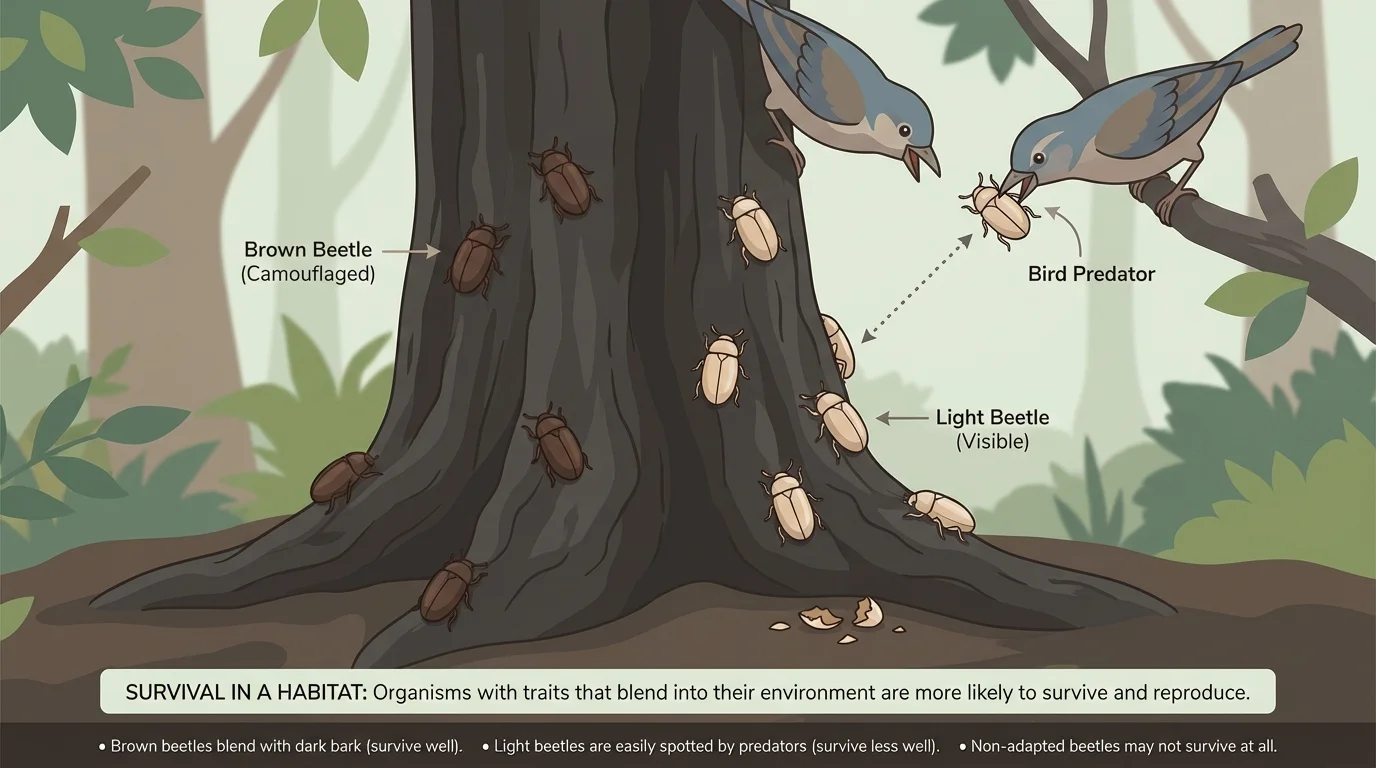
For example, imagine beetles living on dark tree bark. As [Figure 2] shows, some beetles are darker, and some are lighter. Birds can see the lighter beetles more easily. The darker beetles are harder to spot, so they are more likely to survive and later have young. In that habitat, dark color gives an advantage.
This does not mean the lighter beetles are not real beetles or that they can never live anywhere. It means that in this particular place, one difference helps more than another. A different habitat, such as light-colored sand, might help lighter beetles instead.
Animals also have traits such as fur, feathers, webbed feet, sharp claws, or long beaks. Plants have traits too, such as thick stems for storing water, waxy leaves, deep roots, or flexible stems. Each trait can help an organism get food, stay safe, move, or live in a certain temperature.
When scientists explain why some individuals survive better, they look at these differences carefully. The key idea is simple: a trait that helps in one habitat may not help in another. We can connect what we observe to many other examples in nature.
Some polar animals have thick fur or blubber to stay warm, while many desert animals are active at night to avoid the hottest part of the day. Different habitats reward different traits.
These differences help us understand why organisms are diverse and why not every living thing can thrive in every place.
Let's look closely at one habitat: a pond. As [Figure 3] shows, in this case study, we compare several organisms living in or near the same place. The pond contains water, muddy edges, water plants, insects, and nearby land. Those features help some organisms much more than others.
Fish survive very well in a pond. They live in water, swim easily, and get oxygen with gills. The pond provides what they need every day.
Frogs also survive well. They begin life in water as tadpoles, and adult frogs can move between water and land. The wet habitat helps keep their skin moist, and the pond gives them food such as insects.
Ducks survive well too. Their webbed feet help them paddle, and the pond offers food and water. They can also move onto land when needed.
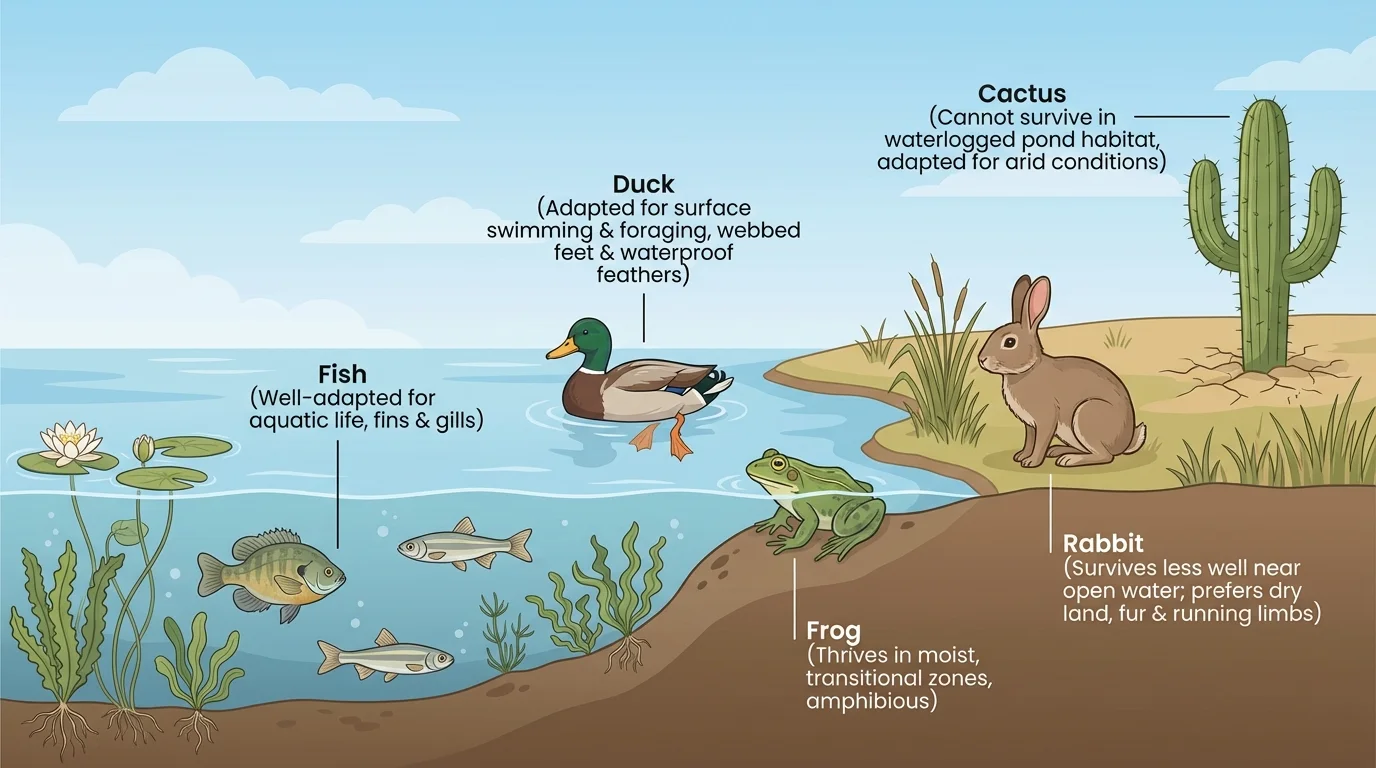
Rabbits may survive less well right at the pond's edge. They can drink water there and may find food nearby, but rabbits are not built for swimming and can be in danger from wet conditions or pond predators. The pond is not the best match for them.
Cacti cannot survive in the pond water at all. They are adapted to dry environments with little water. Their thick stems store water, but that trait does not help them live underwater or in soil that stays soaked.
From this example, we can build an argument: fish, frogs, and ducks survive well in a pond because the habitat matches their traits and needs. Rabbits survive less well because only some of their needs are met there. Cacti cannot survive at all because the habitat does not match their basic needs.
| Organism | How it does in a pond | Evidence |
|---|---|---|
| Fish | Survives well | Lives in water, has gills and fins |
| Frog | Survives well | Needs wet habitat, uses water and land |
| Duck | Survives well | Webbed feet, finds food in pond |
| Rabbit | Survives less well | Can use nearby land, but not adapted to water life |
| Cactus | Cannot survive at all | Adapted to dry habitats, not waterlogged conditions |
Notice that the argument is based on facts we can observe, not on guesses. That is how science works.
Case study: Building an argument about a pond
Step 1: Make a claim.
Claim: Fish survive better in a pond than rabbits do.
Step 2: Add evidence.
Fish have gills and fins, live in water, and get food there. Rabbits live on land and are not adapted for water life.
Step 3: Explain the reasoning.
Because the pond meets more of the fish's needs than the rabbit's needs, fish survive better in that habitat.
This makes a complete scientific argument: claim + evidence + reasoning.
You can use the same thinking for deserts, forests, oceans, grasslands, and even your schoolyard.
Scientists do not just say, "I think so." They use evidence. Evidence can come from observations, simple measurements, counts, notes, photos, or graphs. A simple graph can help us compare which organisms are seen doing well in the same habitat.
Suppose students visit a pond several times and record what they observe. They might count how many times they see fish swimming actively, frogs resting near the edge, ducks feeding, rabbits nearby, and cacti growing there. If they often observe fish, frogs, and ducks in healthy ways, but never observe a cactus growing in the pond, that pattern supports their argument.
Graphs do not have to be complicated. Even a basic bar graph can help us compare results. We do not need hard math to make a good argument. We only need careful observations and a clear explanation of what the evidence means.
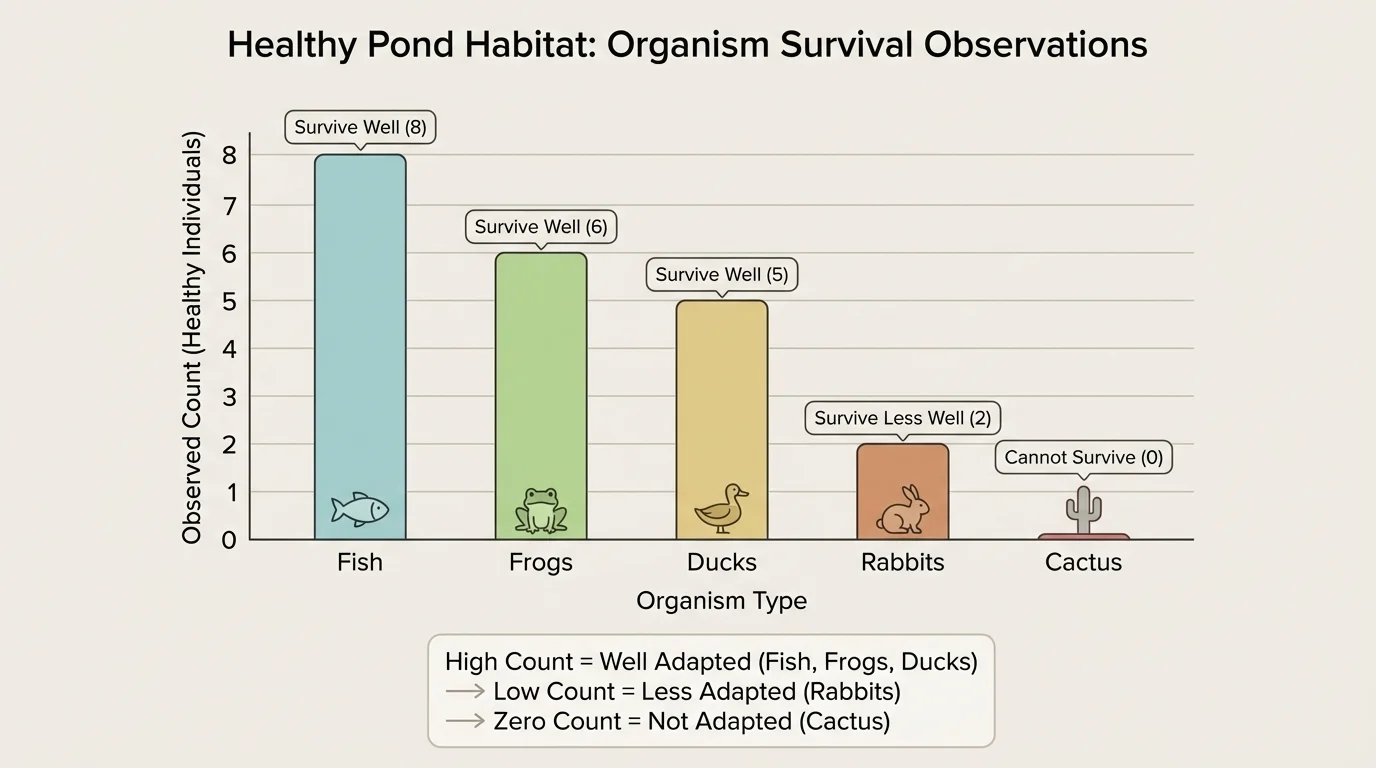
For example, imagine these observation counts from several visits. As [Figure 4] shows, fish are observed often, frogs and ducks are also observed often, rabbits are observed only sometimes near the pond, and cacti are not observed growing there. That is enough to support the idea that some organisms fit the pond much better than others.
We can also use evidence from body parts and behavior. Fish have gills. Ducks have webbed feet. Frogs need moisture. Cacti store water for dry habitats. Those facts work together with observation counts. Later, when we look back at [Figure 4], the graph helps us see the pattern quickly.
Claim, evidence, and reasoning work together in science. A claim answers a question. Evidence is the information that supports the claim. Reasoning explains why the evidence supports the claim.
Here is another argument: "A cactus cannot survive in a pond habitat." The evidence is that cacti are adapted to dry land, not underwater conditions. The reasoning is that an organism cannot survive where its basic needs are not met.
Habitats do not always stay the same. Rain, drought, heat, cold, fire, floods, and human actions can change them. When a habitat changes, the organisms that survive best can change too.
Suppose a pond begins to dry up. Fish may survive less well because there is less water and less oxygen in the water. Frogs may also struggle if wet places disappear. But plants that can live in drier soil may begin to do better. The "best survivor" depends on the habitat at that time.
This is another reason traits matter. A trait that helps during wet times may not help during dry times. A trait that helps one individual may not help another if the environment changes.
The same idea from [Figure 3] still matters here: survival depends on how well the organism matches the habitat. Change the habitat, and you may change which organisms do well.
Case study: After a dry season
Step 1: Observe the change.
The pond becomes smaller and the muddy edge becomes dry.
Step 2: Compare organisms.
Fish now have less space and less water. Rabbits can still use the dry land around the pond.
Step 3: Make a new argument.
Fish may survive less well than before because the habitat changed, even though fish were once among the best survivors there.
Scientific arguments can change when new evidence is collected.
This is why scientists keep observing habitats over time instead of looking only once.
People use this kind of thinking all the time. Gardeners choose plants that fit the amount of sunlight and water in a yard. Pet owners learn what kind of habitat helps their animals stay healthy. Wildlife helpers protect wetlands because many organisms survive well there and need those places.
Farmers also think about habitats. They know some crops grow well in warm, sunny places while others need cooler temperatures or more rain. If a crop is planted in the wrong place, it may survive less well or fail completely.
Even city planners and park workers need this science. When they protect ponds, forests, and grasslands, they are helping organisms keep the habitats that match their needs.
"The right living thing in the right place has a better chance to survive."
Understanding habitats also helps us respect nature. We stop expecting every organism to live everywhere. Instead, we ask what each organism needs and whether that place can provide it.
When you build an argument about survival, be specific. Name the habitat. Name the organism. Tell what evidence supports your claim. Avoid broad statements like "all animals can live anywhere" or "one trait always helps." Nature is more precise than that.
A strong argument might sound like this: "In a pond habitat, ducks survive well because they have webbed feet, can float, and find food in the water. Rabbits survive less well because they live on land and are not adapted for water life. Cacti cannot survive at all in the pond because they need dry conditions."
That argument is strong because it includes the habitat, compares organisms, and gives evidence. It also shows that differences in characteristics can give advantages. Just as dark beetles may survive better on dark bark in [Figure 2], organisms with helpful traits are more likely to do well where those traits match the habitat.
Science is not only about knowing facts. It is also about connecting facts to make sense of the natural world. When we study habitats and traits, we learn why some organisms survive well, some survive less well, and some cannot survive at all.
