A coach blows one short whistle blast, and every player stops. A crossing guard raises a sign, and drivers stop their vehicles. A lighthouse flashes in the dark, and ships know where the shore is. These are not random actions. They are patterns that carry information. People and animals use patterns every day to send messages without writing long sentences. Learning how these patterns work helps us solve problems in smart ways.
Information does not always travel as printed words. It can travel as sound, light, movement, color, or touch. When we make a system that uses a pattern to mean something, we are creating a solution for communication. A good solution helps the sender and receiver understand the same message clearly.
When something is used to carry information, it is often called a signal. A signal can be a sound, a flash, a color, or a motion. For example, a bell ringing can mean "class is starting." A raised hand can mean "stop." Three quick knocks can mean "someone is at the door." In each case, the signal stands for a message.
Some signals happen only once, but many useful signals are organized into patterns. A pattern is a planned order that can be repeated or recognized. If you hear clap-clap-pause-clap, that order can mean something if everyone agrees on it. If the order changes, the meaning may change too.
Pattern is an organized arrangement that can be repeated or recognized. Information is a message or meaning being shared. To encode information means to put a message into a pattern, and to decode means to figure out the message from the pattern.
For a pattern system to work, both the sender and the receiver must know what the pattern means. If one person thinks two flashes mean "yes," but another person thinks two flashes mean "help," the message will fail. That is why communication systems need shared rules.
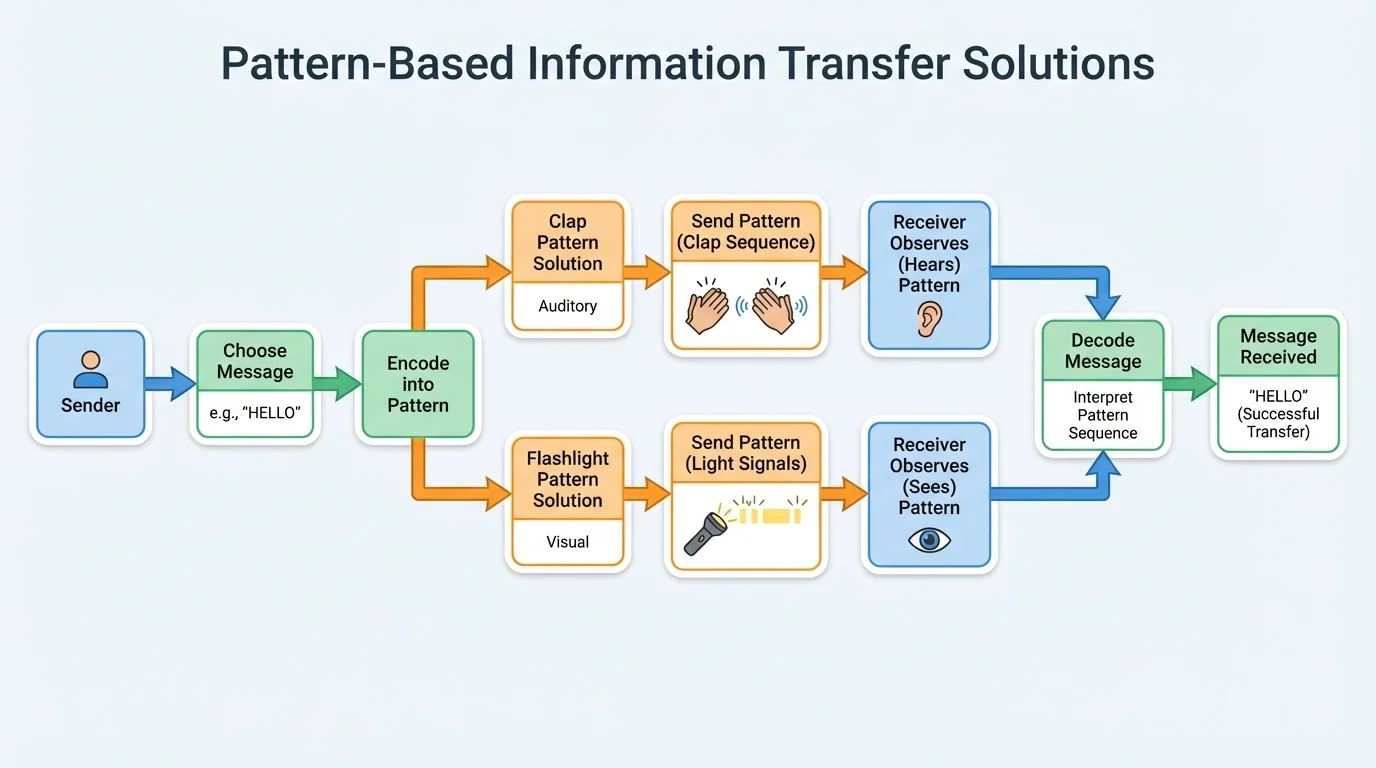
A pattern used for information is more than decoration. It has meaning. As [Figure 1] shows, the process begins when a person chooses a message, turns it into a pattern, sends it, and another person decodes it. For example, one flash of light might mean "ready," and two flashes might mean "come here." The flashes are the pattern, but the meaning comes from the shared agreement.
Think about a simple code made with sounds. One tap could mean "yes," and two taps could mean "no." The taps are easy to hear, and they can be repeated. This makes them useful when people are far apart or cannot speak. The same idea works with colored cards, hand motions, or flashlight flashes.
Patterns can be short or long. A short pattern may send only one idea, such as "stop" or "go." A longer pattern can send more detailed information, such as directions or warnings. However, longer patterns can be harder to remember and easier to mix up. That is one reason people compare different solutions before choosing the best one.
Another important idea is that patterns must be clear enough to notice. If a light is too dim, a receiver may miss the flashes. If a drumbeat is too quiet, the pattern may not travel far enough. The quality of the signal matters just as much as the pattern itself.
Honeybees use movement patterns to share information. A worker bee can perform a special dance to tell other bees where food is located.
The bee example shows that information patterns are not just a human idea. Nature also uses signals and repeated motions to communicate. This helps us see that pattern-based communication is a powerful way to solve survival problems.
People can transfer information in several ways, and [Figure 2] introduces three common kinds: sound patterns, light patterns, and visible motion patterns. Each kind works well in some situations and poorly in others. Choosing the right one depends on the problem you are trying to solve.
Sound patterns include claps, drumbeats, bells, whistles, and spoken rhythm. These are useful when the receiver cannot see the sender. A referee's whistle on a noisy field is a good example. Sound can travel around corners, but loud background noise can make it harder to understand.
Light patterns include flashlight flashes, blinking lights, and signal lamps. These are useful in darkness or across open spaces. A lighthouse uses repeating flashes so sailors can recognize a location. Light signals can be very clear, but they need a line of sight. If something blocks the light, the message may not get through.
Visible motion patterns include waving flags, hand signs, and colored cards held up in a certain order. These are useful when people can see each other clearly. In sports, officials often use hand motions to show a decision. These patterns are silent, which is helpful in places where noise would be a problem.
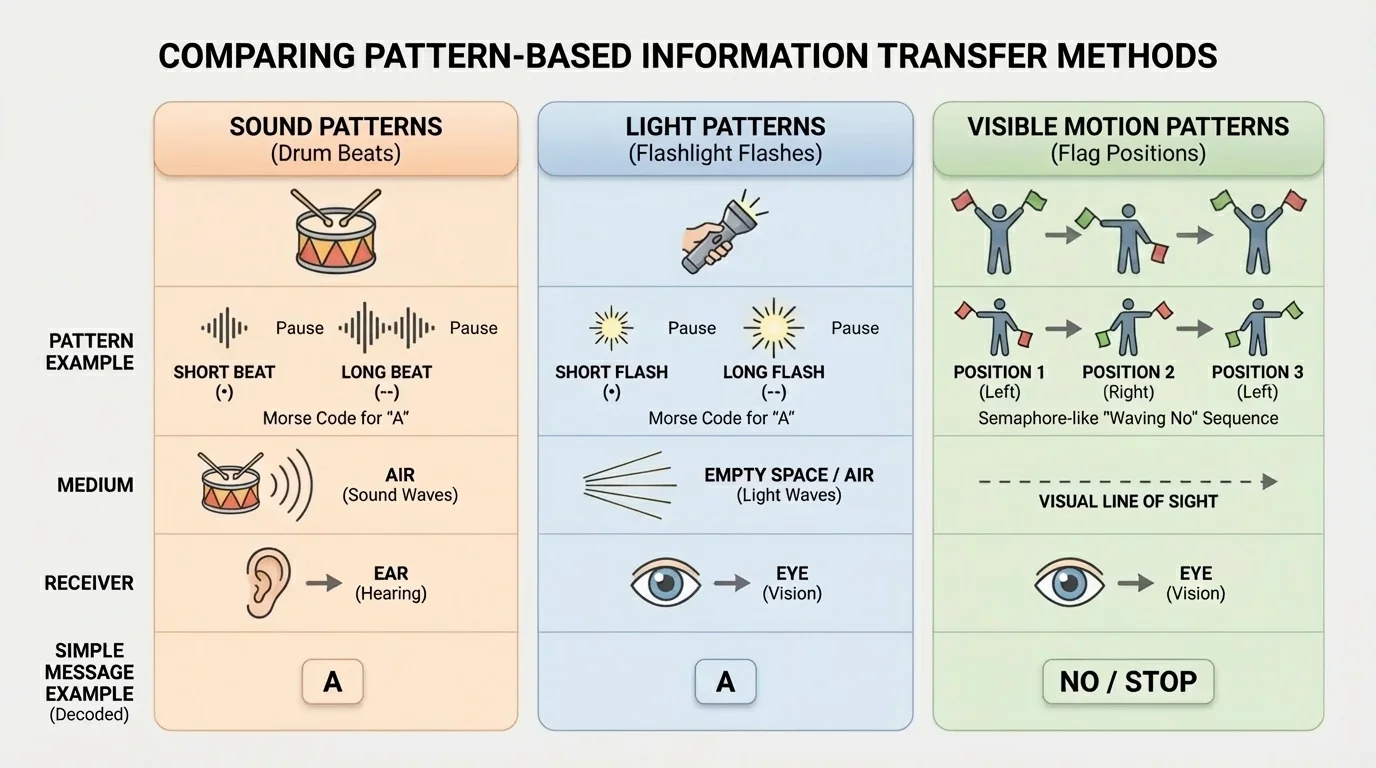
Each method has strengths. Sound may work better in fog than light. Light may work better at night than colored cards. Hand signals may work better when silence is important. When we generate multiple solutions, we are thinking like engineers: we create several possible systems and compare them.
The earlier encode-and-decode process from [Figure 1] still applies in every method. Whether the pattern is a whistle or a wave of a flag, the sender encodes the message and the receiver decodes it.
To generate solutions means to come up with different ways to solve the same problem. Suppose two students need to send the message "come to the door" from opposite sides of a playground. They could use three drum taps, two flashlight flashes, or a red card held up high. These are three different solutions using patterns to transfer the same information.
Good problem solvers do not stop at the first idea. They ask questions such as: How far away is the receiver? Is it bright or dark? Is it noisy or quiet? Do we need the message to be private, quick, or easy to repeat? These questions help narrow down the best solution.
Case study: one message, several solutions
Problem: A student on the soccer field needs to tell a partner on the sideline "bring water."
Step 1: Sound solution
The student could use a whistle pattern, such as one long blast followed by one short blast. This works well if the partner can hear clearly.
Step 2: Light solution
The student could use a flashlight with two quick flashes and one long flash. This works better if it is dark and the partner is looking toward the field.
Step 3: Visual card solution
The student could raise a blue card, if the group already agreed that blue means water. This is simple, silent, and easy to recognize in daylight.
All three are valid solutions because each uses a pattern that can be recognized and decoded.
Generating several solutions is important because one method may fail while another works. If the field is loud, a whistle may be missed. If it is too sunny, a flashlight may be hard to see. If people are too far apart, a small card may not be visible. Different conditions change which solution is best.
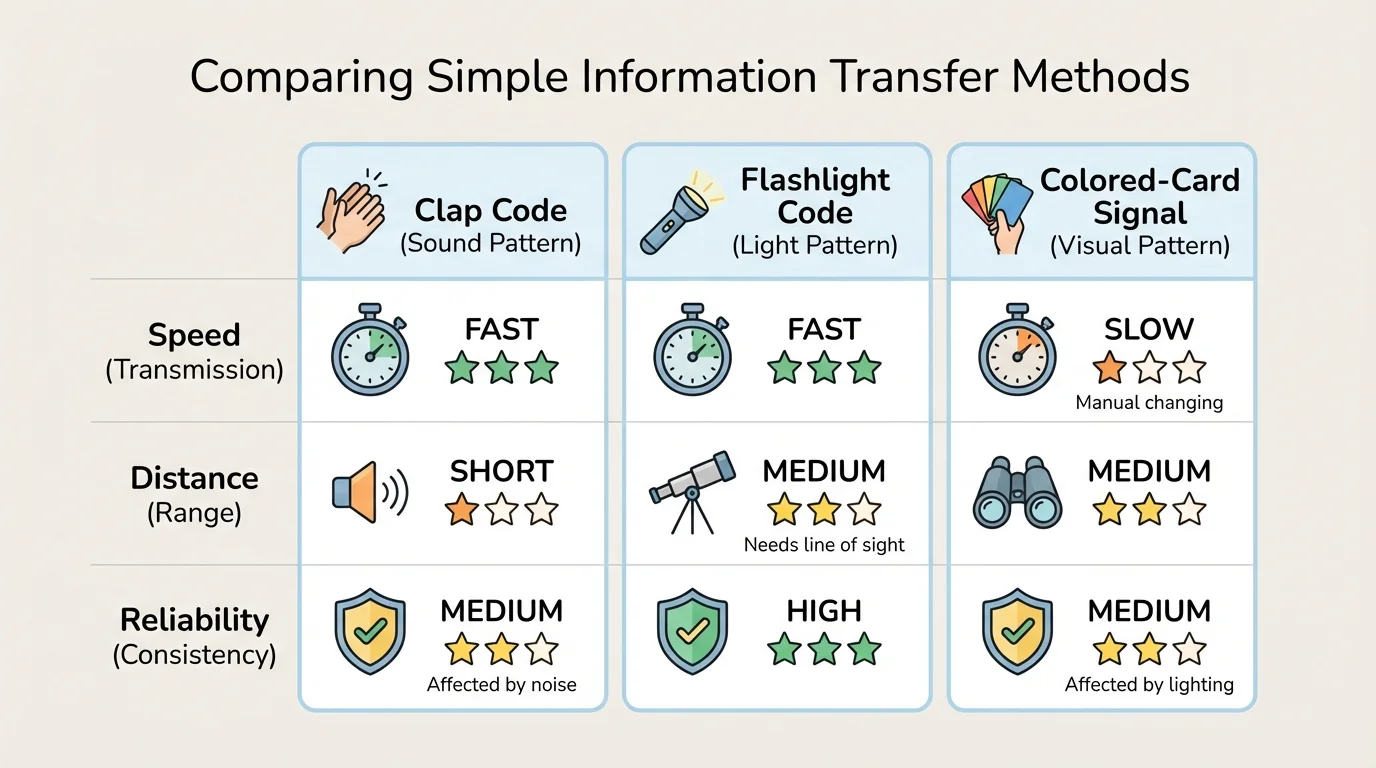
Once we have more than one idea, we need to compare them. As [Figure 3] illustrates, we can compare solutions by asking how fast they send the message, how far they work, how clear they are, and how reliable they are in different conditions. A strong solution is not just creative. It matches the situation well.
One useful way to compare is to think about criteria. Criteria are the things we use to judge a solution. For this topic, common criteria include distance, speed, visibility, loudness, safety, and ease of use. If a solution is hard to remember, it may not be a good choice even if it travels far.
| Solution | Works Best When | Possible Problem |
|---|---|---|
| Clap or drum pattern | The receiver can hear clearly | Noise may cover the sound |
| Flashlight pattern | It is dark or the space is open | Objects may block the light |
| Flag or card pattern | The receiver can see the sender | Fog or distance may make it hard to see |
Table 1. Comparison of three pattern-based communication solutions and when each works best.
Sometimes people also think about how many messages a system can send. A simple traffic light has a small set of messages: stop, slow, and go. That is enough for its job. A more detailed pattern system may need more signals, but too many choices can confuse users. There is often a balance between simplicity and detail.
A good comparison does not simply state that one solution is "better" than another. It explains why. For example, a flashlight pattern may be better than clapping for a message sent across a dark campsite because the light is easier to notice at a distance. But the same flashlight may be worse than clapping in bright daylight.
When students compare solutions carefully, they are using science and engineering thinking. They are looking at evidence, conditions, and possible problems before making a choice.
Best does not always mean perfect
The best solution is the one that works most effectively for a certain situation. A system can be excellent for one setting and poor for another. Engineers often improve a solution after testing it in real conditions.
The comparison chart in [Figure 3] makes this clear. Each solution has strengths and weaknesses, so the job is to choose the one that fits the need.
Pattern-based communication is everywhere. Traffic lights use color patterns to direct drivers. Emergency vehicles use flashing lights and sirens to warn others to move aside. Referees use hand signals and whistles to share decisions quickly during games.
[Figure 4] In schools, bells ring in patterns to mark time. One sound may mean the day is starting, and another may mean an emergency drill. In music, conductors use hand motions to tell performers when to begin, stop, or change speed. In nature, birds use songs and calls, and some animals use repeated body motions to warn others about danger.
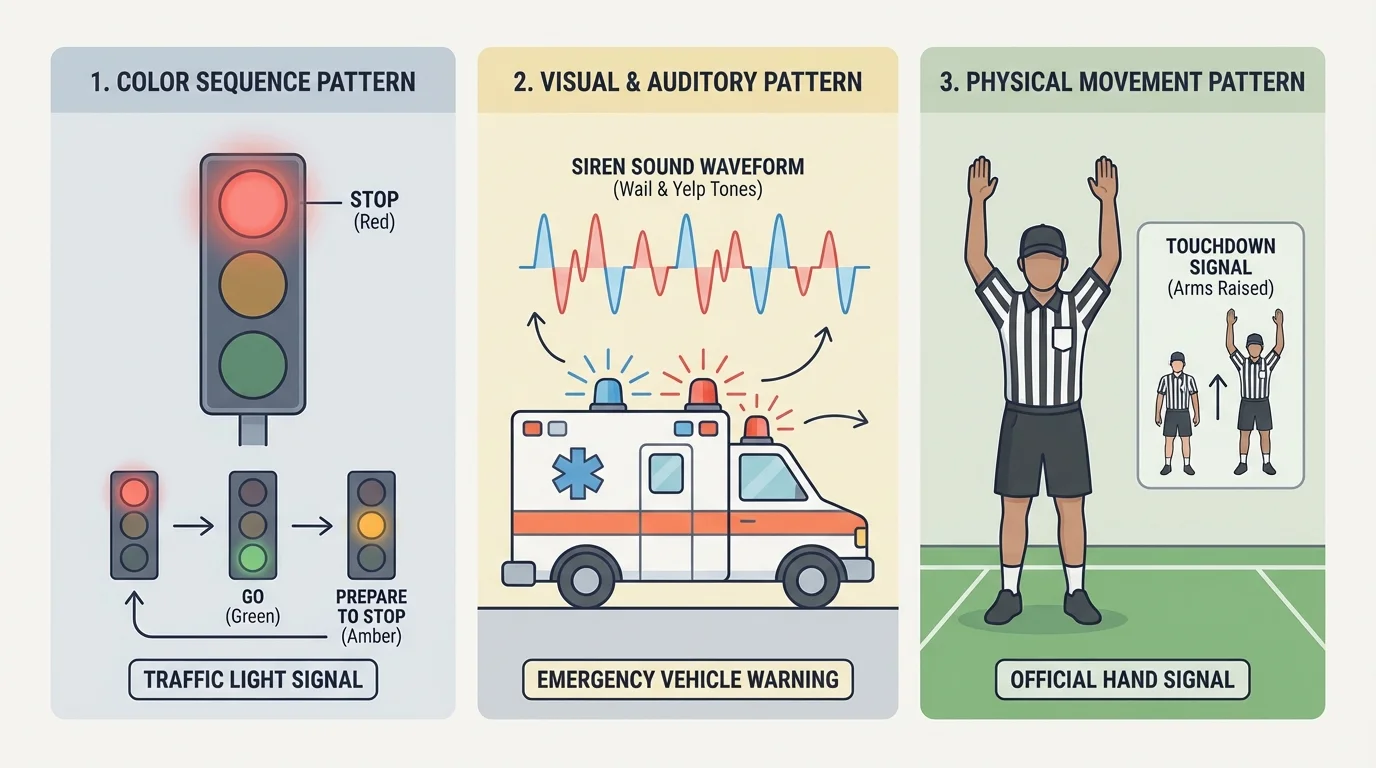
These examples matter because they show that communication systems are designed for a purpose. A traffic light must be easy to notice and understand quickly. An ambulance siren must stand out from normal city sounds. A referee signal must be visible to players, coaches, and the crowd. The message needs to be fast and clear.
The same idea from [Figure 2] appears here again: different types of signals fit different jobs. Sound is helpful when people may not be looking. Light is helpful when visibility is strong. Motion is helpful when a silent message is needed.
Earlier science learning shows that waves can transfer energy. In communication systems, waves such as sound waves and light waves can also transfer information when they are arranged into organized patterns.
That connection is important. The message is not floating through the air by magic. It is carried by a signal, and that signal often travels using waves such as sound or light.
No communication system works perfectly all the time. A pattern may be too complicated. The receiver may forget the meaning. Weather may block visibility. Background sounds may cover an audio signal. If a solution does not work well, we can improve it.
One way to improve a system is to make the pattern simpler. A shorter signal is easier to remember. Another way is to make the signal stronger, such as using a brighter light or a louder whistle. Sometimes adding spacing helps too. For example, a pause between signals can make the pattern easier to notice.
Testing matters. If people try a pattern system in a real setting, they can see what goes wrong. Maybe two patterns sound too much alike. Maybe a red card is hard to see against a brick wall. These problems help people redesign the solution.
Improving a weak solution
Problem: A team uses two whistle patterns that are too similar, and players confuse them.
Step 1: Identify the issue
One short whistle means "stop," and two short whistles mean "come in." In a noisy place, players may miss one of the short sounds.
Step 2: Change the pattern
The team could switch to one long whistle for "stop" and three short whistles for "come in." These are easier to tell apart.
Step 3: Test again
If players respond correctly more often, the new solution is better for that setting.
Improvement happens when people notice a weakness and redesign the signal system.
Improving solutions is part of engineering. A first design is often only the beginning. Better solutions come from observing, comparing, and revising.
Suppose hikers need to signal each other across a dark campsite. A flashlight pattern may be the best choice because it is easy to see at night. Suppose swimmers need a warning on a bright beach with crashing waves. A brightly colored flag may be better than a whistle because the ocean sound may be too loud. Suppose a teacher needs students to freeze immediately during an indoor game. A whistle or bell may work best because everyone can hear it quickly.
These examples show that the "best" solution changes with the setting. Students who can generate several ideas and compare them using clear criteria are doing strong scientific thinking. They are not guessing. They are using evidence about distance, light, noise, and visibility.
When you look again at the message process in [Figure 1], you can see why careful design matters. If the encoding is confusing or the signal is weak, decoding fails. A successful pattern system helps the message travel clearly from one person to another.
Pattern-based communication may seem simple, but it solves important problems. It helps people stay safe, work together, move in order, and respond quickly. From a whistle on a field to a flashing light on a road, patterns turn signals into meaning.
