A fallen leaf does not disappear. A dead insect does not simply vanish. The water in a juicy apple, the matter in a bird's feathers, and the soil under your feet are all part of a giant recycling system on Earth. In ecosystems, matter keeps moving from place to place. It goes from the environment into living things, from one living thing to another, and back into the environment again.
To understand this movement, scientists build models. A model is a simple way to show how something works. In this topic, a model helps us trace matter as it moves among plants, animals, decomposers, and the environment. We are not focusing on atoms or molecules. Instead, we are tracking matter in ways we can describe clearly: food, water, air, waste, dead organisms, and nutrients in soil.
If matter did not cycle, life could not continue. Plants need matter from air, water, and soil to grow. Animals need matter from the food and water they take in. When living things produce waste or die, decomposers break down that material and return matter to the environment. Then that matter can be used again.
This is why ecosystems are often called connected systems. A tree, a squirrel, a mushroom, the soil, and the air are not separate parts doing unrelated jobs. They are linked. When one part changes, the movement of matter through the whole ecosystem can also change.
Matter is the "stuff" that makes up living things and nonliving things. In ecosystems, matter includes air, water, food, waste, and materials in soil.
Ecosystem is a community of living things and the nonliving environment around them interacting as a system.
Producer is an organism, such as a plant, that makes its own food using energy from sunlight.
Consumer is an animal that gets matter by eating plants or other animals.
When you describe matter movement, it helps to ask a simple question again and again: Where did this material come from, and where does it go next? That question turns a complicated ecosystem into a pattern you can follow.
[Figure 1] An ecosystem model often includes four big parts: plants, animals, decomposers, and the environment. The environment includes air, water, and soil. Matter moves back and forth among these parts instead of staying in just one place.
Plants are producers. They take in water from the soil and carbon dioxide from the air. They also take in nutrients from the soil that help them grow. The matter they take in becomes part of roots, stems, leaves, flowers, and fruits.
Animals are consumers. They cannot make their own food the way plants do, so they get matter by eating plants or other animals. The matter in food becomes part of the animal's body, and some of it leaves the body as waste.
Decomposers include organisms such as fungi, bacteria, and some worms. They break down dead plants, dead animals, and waste. This process returns matter to soil and air, where it can become available again in the ecosystem.
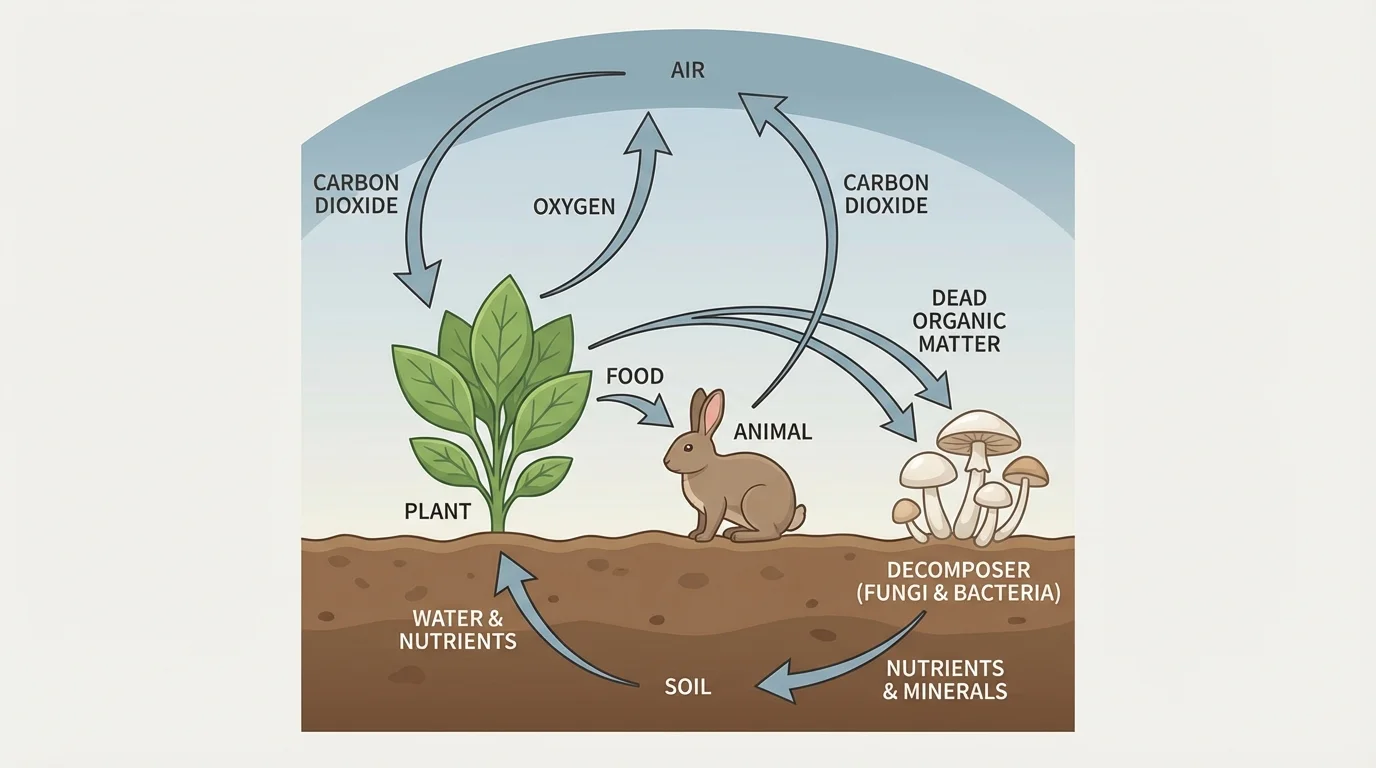
The environment is not just the background. It is an active part of the cycle. Air provides gases. Soil holds water and nutrients. Water carries matter into plants and animals. Without the environment, the cycle would stop.
A good model uses arrows to show movement. For example, an arrow from soil to plant shows that matter from the soil enters the plant. An arrow from plant to rabbit shows that matter moves into the rabbit when it eats the plant. An arrow from dead rabbit to decomposers shows that decomposers take in matter from dead organisms.
[Figure 2] The movement of matter usually begins with producers. Plants take in water through their roots and take in gases from the air through their leaves. They also absorb materials from the soil. These materials become part of the plant's body as it grows.
If a bean plant grows taller, makes new leaves, and forms seeds, that new plant matter has to come from somewhere. It comes from what the plant takes in from air, water, and soil. The plant does not create matter from nothing.
Animals get matter in a different way. A rabbit eats grass. A caterpillar eats leaves. A hawk eats a mouse. In each case, matter moves from food into the animal's body. That matter helps build muscles, fur, feathers, skin, and other body parts.
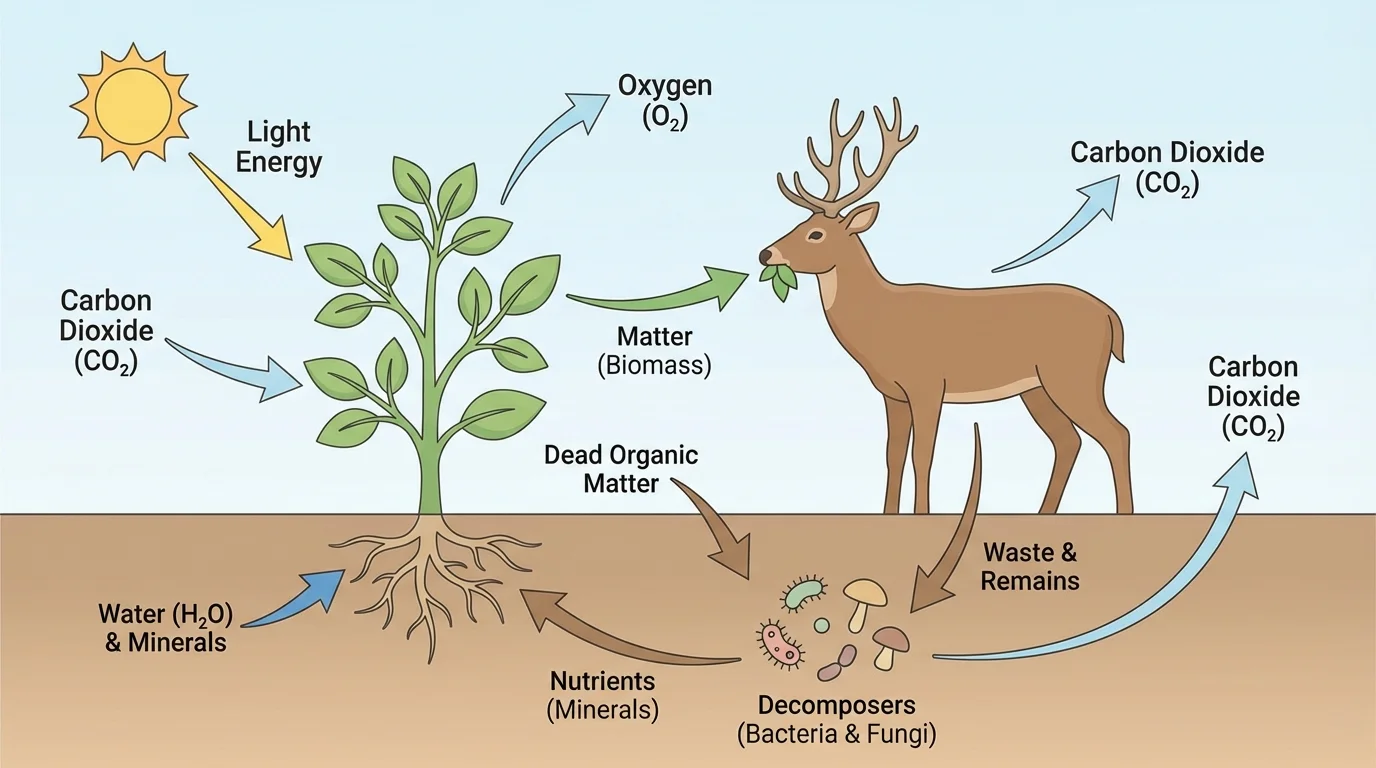
Animals also drink water, and that water becomes part of their bodies too. Some matter leaves the body as waste. Some matter is used for growth and repair. Some remains in the body until the animal dies, when decomposers begin their work.
Food chains show who eats whom, but this topic goes one step further. We are tracing the matter that moves along those feeding relationships.
Even a simple lunch can be traced through this idea. If a student eats an apple, some of the matter in the apple becomes part of the student's body. The apple got that matter from air, water, and soil while growing on the tree. Matter has moved from environment to plant to animal.
A food chain is a simple path showing who eats whom. For example, grass is eaten by a grasshopper, and the grasshopper is eaten by a frog. Matter moves along this path. The grasshopper gets matter from the grass. The frog gets matter from the grasshopper.
Many ecosystems are more complex than one chain. They have food webs, where many feeding relationships connect together. In a pond, algae may be eaten by insects, snails, and small fish. Small fish may be eaten by larger fish or birds. Matter can follow many pathways through the same ecosystem.
This is important because matter does not travel in only one straight line. A plant may be eaten by different animals. A dead organism may be broken down by many decomposers. Matter spreads through the ecosystem in many directions.
Matter cycles, but it does not disappear
When a leaf is eaten, the leaf's matter becomes part of the animal, part of its waste, or part of dead material later on. When decomposers act on that material, matter returns to the environment and can be taken up by plants again. The same matter can be used over and over in different forms.
Think about a forest acorn. The acorn grows on an oak tree. A squirrel eats it. Some matter becomes part of the squirrel's body. The squirrel leaves waste, and one day the squirrel dies. Decomposers break down the waste and remains, returning matter to the soil. The oak tree can later take in matter from that soil again. The cycle continues in a forest-floor setting.
[Figure 3] Decomposers are the recyclers of ecosystems. They work on dead leaves, waste, and remains on the ground. Without decomposers, dead material would pile up, and matter would stay trapped in it instead of returning to the environment.
When fungi grow on a rotting log or when tiny organisms in soil break down fallen leaves, they are helping return matter to the soil and air. The returned matter can then be taken up by plants again. Decomposers connect the living and nonliving parts of the ecosystem.
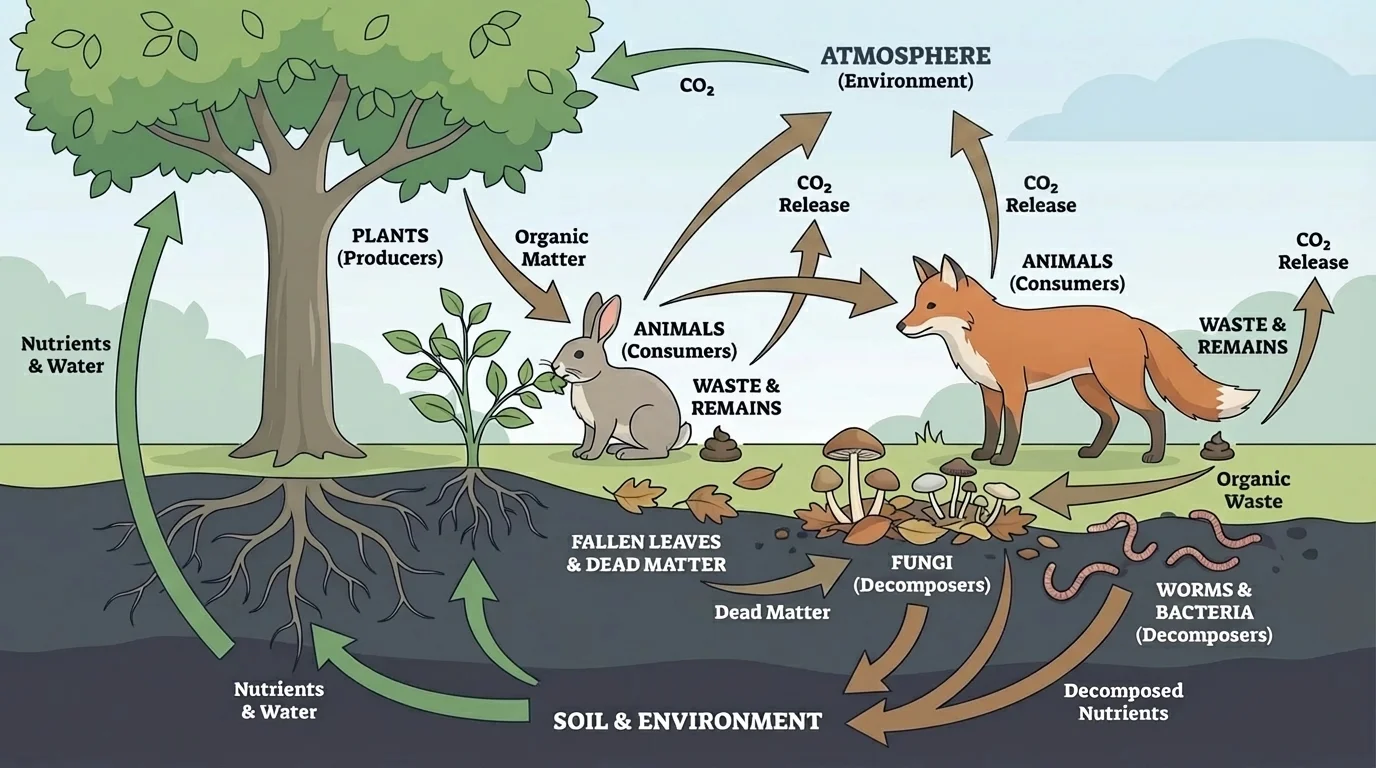
Waste is part of the cycle too. Animal droppings and other wastes contain matter. Decomposers break down this material, adding to the matter in soil. This is one reason rich soil can support strong plant growth.
A compost pile is a great real-world example. Banana peels, dry leaves, and vegetable scraps are added to the pile. Decomposers break them down over time. The material changes into dark, crumbly compost that gardeners mix into soil. Matter from old plant material returns to the soil and helps new plants grow.
A teaspoon of healthy soil can contain millions of tiny living things. Many of them help break down dead material and return matter to the ecosystem.
In a pond, decomposers work on dead algae, fish waste, and fallen plant parts. In a meadow, they work on grass, insects, and animal remains. In a garden, they work on dead roots and leaves. The place changes, but the job of decomposers stays the same.
[Figure 4] Scientists often use boxes and arrows to represent parts of a system. A model does not include every detail. It highlights the most important pathways.
One simple model includes boxes labeled air, soil, plants, animals, and decomposers. Arrows connect the boxes to show matter movement. For example, arrows can go from air and soil to plants, from plants to animals, from plants and animals to decomposers, and from decomposers back to soil and air.
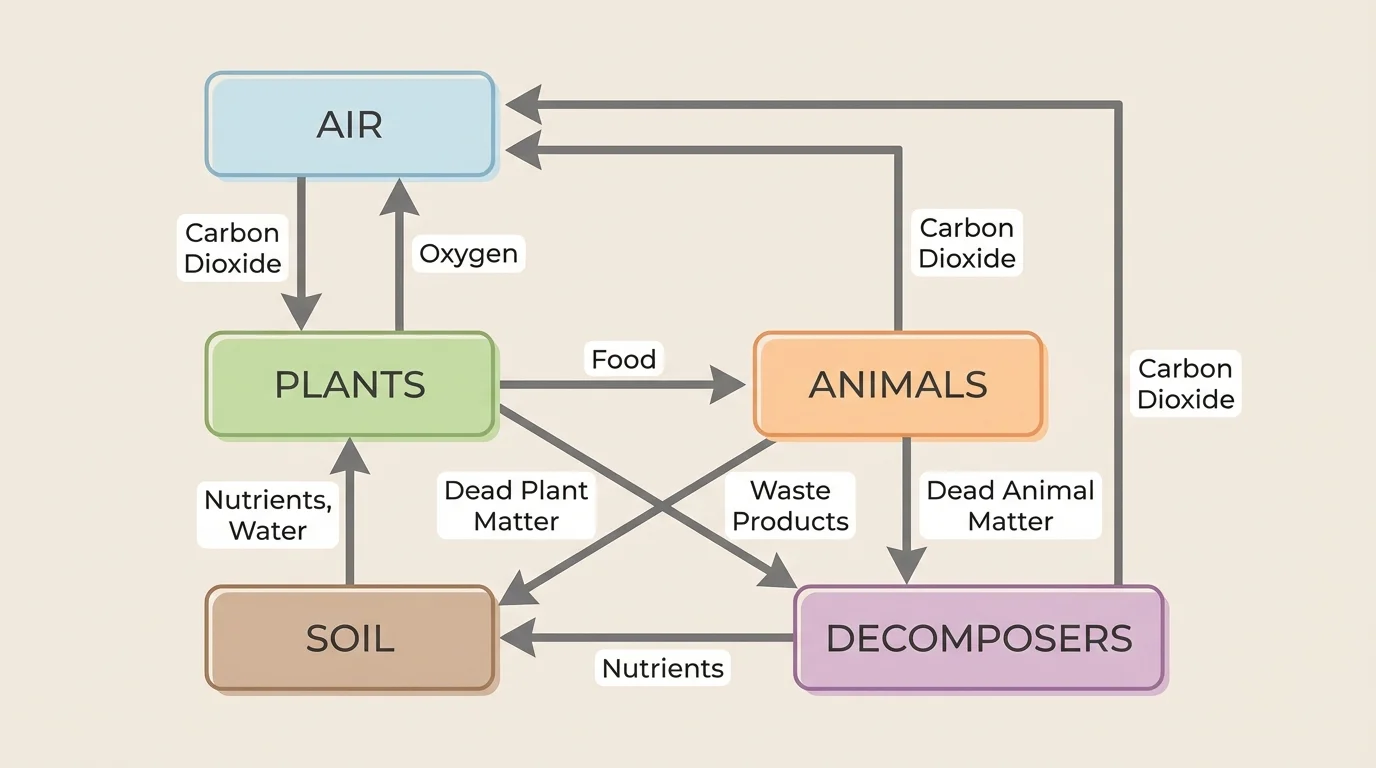
When building a model, start with the environment because it supplies matter to living things. Then add producers, consumers, and decomposers. Finally, draw arrows to show movement. Each arrow should answer the question, Where does the matter go next?
A model can also include examples. Instead of writing "animal," you could write "rabbit." Instead of writing "plant," you could write "grass." Then your arrows might show soil to grass, grass to rabbit, rabbit waste to decomposers, and decomposers back to soil.
Example: Modeling matter in a school garden
Step 1: Identify the parts
The garden has soil, air, bean plants, caterpillars, birds, and decomposers such as fungi and worms.
Step 2: Show matter entering plants
Draw arrows from air and soil to bean plants because the plants take in matter from both.
Step 3: Show matter moving to animals
Draw an arrow from bean plants to caterpillars because caterpillars eat leaves. Draw another arrow from caterpillars to birds because birds may eat caterpillars.
Step 4: Show matter returning
Draw arrows from dead plants, dead animals, and waste to decomposers. Then draw arrows from decomposers back to soil.
This model shows that matter keeps moving through the garden instead of stopping in one organism.
As seen earlier in [Figure 1], the strength of a model is that it makes invisible connections visible. A student can look at the arrows and explain how matter travels through the system.
In a forest, trees take in matter from air, water, and soil. Deer eat leaves and grasses. Wolves may eat deer. Fallen branches, dead animals, and waste are broken down by decomposers. The matter returns to soil and air and becomes available again.
In a farm field, corn plants take in matter from the environment. Chickens may eat corn. People may eat the chickens or the corn. Leftover plant parts, manure, and dead organisms are broken down by decomposers, helping matter return to the soil.
In the ocean, seaweed and phytoplankton are producers. Small animals eat them. Larger fish eat smaller animals. When organisms die, decomposers help return matter to the water and seafloor environment. Even though the ecosystem is very different from a forest, the same pattern appears.
| Ecosystem | Producer example | Consumer example | Decomposer example | Environment parts |
|---|---|---|---|---|
| Forest | Oak tree | Deer | Fungi | Air, soil, water |
| Garden | Bean plant | Caterpillar | Worms | Air, soil, water |
| Pond | Algae | Fish | Bacteria | Water, mud, air |
| Field | Corn | Chicken | Soil microbes | Air, soil, water |
Table 1. Examples of producers, consumers, decomposers, and environment parts in different ecosystems.
The exact organisms change from place to place, but the movement of matter follows the same general pattern. Matter enters producers from the environment, moves to consumers, and returns to the environment through waste and decomposition.
A scientific model is useful because it can help us predict what might happen if something changes. If there are fewer plants after a drought, less matter enters the living part of the food web. Animals may have less food, and decomposers may later have less dead material to break down.
If decomposers were removed, dead material and waste would build up. Matter would not return as effectively to soil and air. Plants would have less available matter from the environment, and the whole ecosystem would be affected. This is one reason decomposers are so important, as the recycling pathways in [Figure 4] make clear.
If a new animal enters an ecosystem and eats many plants, matter may move differently through the food web. More matter may go into that animal population, while less remains in plant biomass or for other consumers. Models help scientists think through these changes.
Example: What happens if fallen leaves are removed from a forest floor?
Step 1: Start with the normal pattern
Leaves fall, decomposers break them down, and matter returns to the soil.
Step 2: Change one part
If many leaves are removed, decomposers have less dead material to break down.
Step 3: Predict the result
Less matter returns to the soil from those leaves, which can affect soil richness and future plant growth.
This shows how a model helps us connect one change to a larger system effect.
Models are not perfect copies of nature. They are tools for thinking. A simple model may leave out many species but still correctly show the main pathways of matter.
One common misunderstanding is that matter is the same as energy. They are related in ecosystems, but they are not the same. Energy flows through ecosystems, while matter cycles. Matter is reused.
Another misunderstanding is that dead things are "gone." They are not gone. Their matter remains in the ecosystem. Decomposers help move it back into soil and air, where it can be used again. The forest floor in [Figure 3] shows this return pathway clearly.
A third misunderstanding is that plants get all their matter from soil alone. Plants do take in matter from soil and water, but they also take in matter from the air. A complete model must include both the environment and living organisms.
When you think of ecosystems as recycling systems, many patterns begin to make sense. Growth, feeding, waste, death, and decay are not separate events. They are connected steps in the movement of matter.
