A single storm can wash trash into a stream, carry soil off a hillside, and fill the air with dust from busy roads. That may sound like three separate problems, but communities use science ideas to study each one carefully and solve them one at a time. Science helps people notice patterns, ask questions, measure change, and test which actions really protect Earth's resources.
Earth's resources include things people use from nature, such as water, soil, air, plants, animals, rocks, and energy sources. The environment is everything around us in nature, including land, water, air, and living things. Communities depend on healthy resources every day for drinking, growing food, building homes, and enjoying parks and outdoor spaces.
When people change the land, use water, drive cars, throw away materials, or build neighborhoods, they affect Earth systems. Some effects are helpful, and some can cause harm. The good news is that communities can use science to understand these effects and choose smarter actions. They do this by collecting information, comparing results, and combining ideas from many sources.
Resource means something from Earth that people use, such as water or soil. Environment means the natural world around us. Evidence is information that helps us know whether an idea is true. Community means a group of people living and working in the same area.
A community can be a neighborhood, a town, a city, or even a group of people who share a place such as a watershed or coastal area. Communities face real questions: Is the local stream clean enough for fish? Is the air healthy to breathe? Is too much soil being washed away after rain? To answer these questions, people need more than guesses. They need science.
Science is not just facts in a book. It is also a way of finding out. People observe what is happening, measure changes, keep records, compare places, and look for causes. For example, if a pond becomes cloudy after heavy rain, community members can investigate whether soil is washing into the water. They can compare what happens before and after planting grasses or building barriers to slow runoff.
Scientists are not the only people who use science ideas. Farmers, park workers, city planners, engineers, teachers, families, and students all use evidence to make decisions. A community may combine test results, maps, weather records, and local observations to understand one environmental problem and decide what action will help most.
Some communities keep long-term records of rainfall, stream depth, or bird sightings for many years. These records help people notice slow changes that would be hard to see in just one day or one season.
To protect resources, people often begin with a question. A town might ask, "Why is less water reaching our reservoir?" or "Why are fewer butterflies seen in this park?" Next, they gather information. They may measure water levels, count insects, test water quality, or compare pictures from different times.
Then they look for patterns. If water samples near a storm drain are dirtier after a rainfall, that pattern gives a clue. If soil disappears fastest from bare ground but stays in place where plants grow, that is another clue. Science helps people connect causes and effects instead of making random choices.
Communities also compare solutions. One action might work better than another. For example, if a school wants to reduce wasted paper, it can measure how much paper is thrown away before and after starting a recycling program. If the amount drops, the evidence suggests the program is helping. If not, the school may need to change its plan.
Science ideas become useful when people test them in real places. Communities protect Earth best when they do three things: gather accurate information, compare evidence over time, and use that evidence to guide action. This is why observation, measurement, and communication are so important in environmental work.
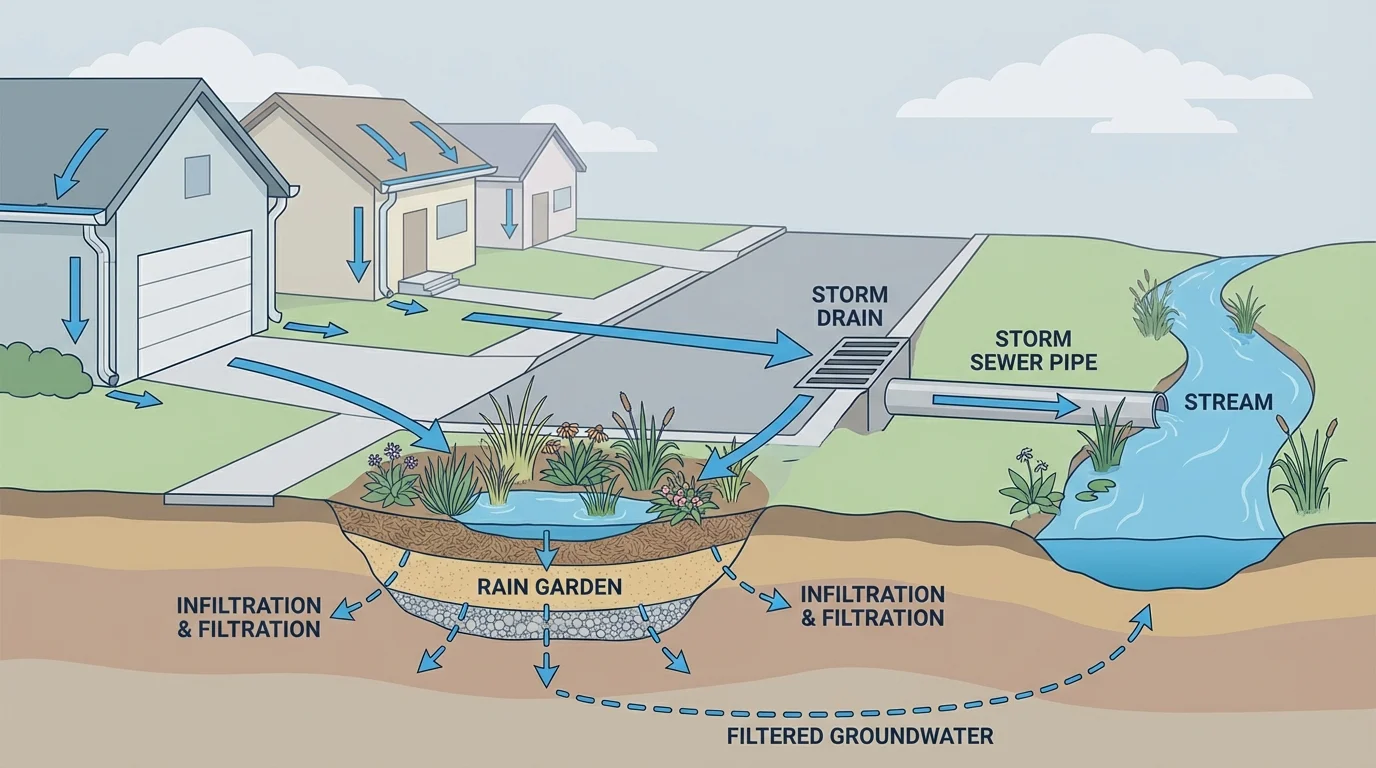
Runoff is water that flows over land after rain or melting snow instead of soaking into the ground. As [Figure 1] shows, communities study runoff because it can carry soil, oil, and trash into streams and ponds. When that happens, water resources can become less healthy for people and wildlife.
One community action is building rain gardens. A rain garden is a planted area that slows water down and helps it soak into the ground. The plants and soil act like a filter. Instead of rushing straight into storm drains, some of the water is absorbed. This can reduce flooding in small areas and help keep nearby water cleaner.
Another action is testing water quality. People may collect water samples and check for cloudiness, unusual smell, or signs of pollution. If water is too cloudy after storms, the community may learn that soil is washing in from nearby bare land. Then people can plant grasses, place stones, or improve drainage to protect the water source.
Communities also save water by using science ideas about limited supply. If families fix leaks, turn off water while brushing teeth, or use collected rainwater for gardens where allowed, they reduce waste. A leaking faucet may seem small, but repeated dripping adds up over time. Measuring water use before and after fixing leaks gives evidence that conservation works.
Water protection is not only about cleaning dirty water. It is also about making sure enough water remains for the future. When communities track rainfall, stream levels, and water use, they can make wiser choices. The pathways of runoff in [Figure 1] remind us that what happens on streets and yards can affect rivers and lakes nearby.
Community example: A schoolyard and cleaner stormwater
Step 1: Students observe that puddles race across the blacktop during rain and disappear into a storm drain.
Step 2: They notice litter and muddy water moving with the flow.
Step 3: The community adds a planted strip beside the pavement.
Step 4: After later storms, students compare observations and see slower water movement and less mud washing away.
The evidence shows that changing the ground surface and adding plants can help protect water resources.
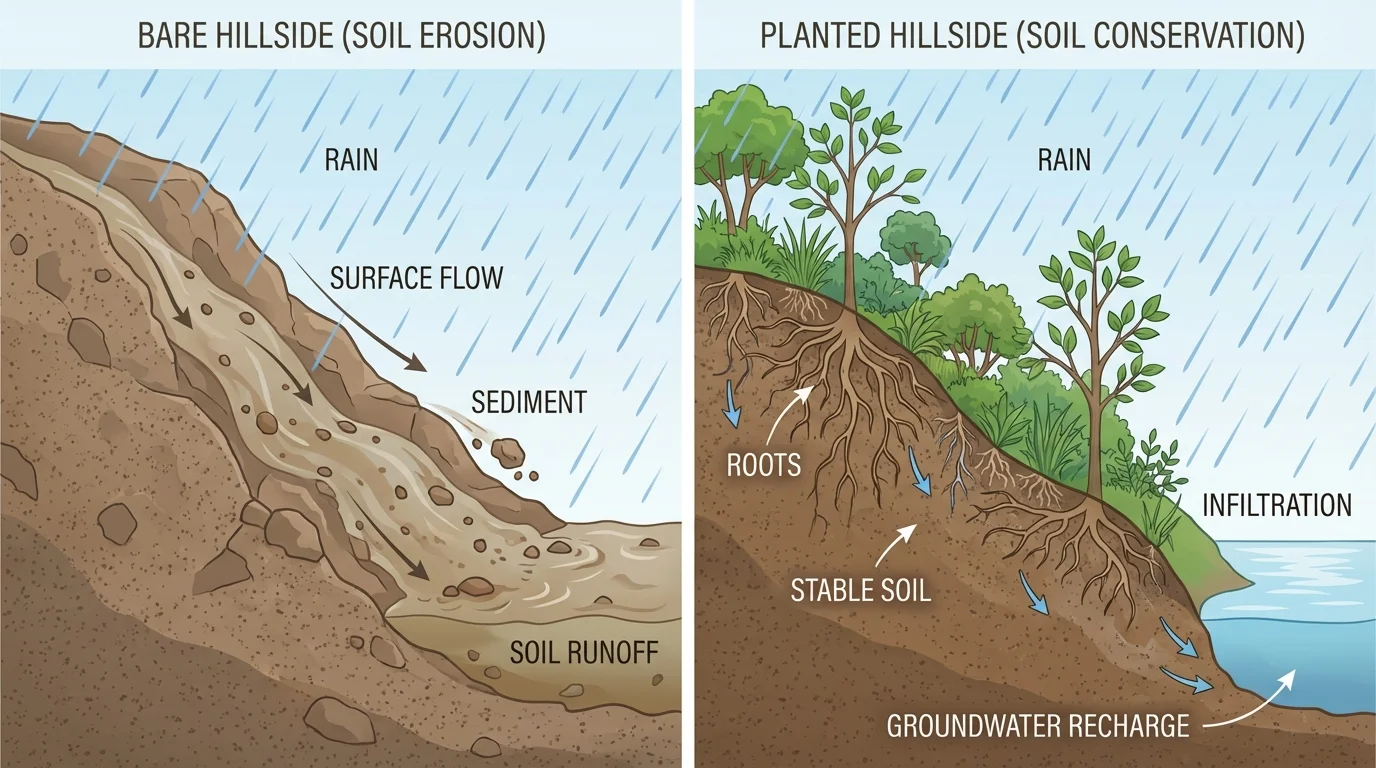
Erosion happens when water, wind, or ice moves soil or rock from one place to another. As [Figure 2] shows, communities pay close attention to erosion because soil is an important resource for plants, farms, and habitats. On bare hillsides, rain can remove topsoil quickly.
One science idea communities use is that plant roots help hold soil in place. Roots act like tiny nets underground. When people plant grasses, shrubs, or trees on slopes, the roots reduce how easily the soil washes away. This is why parks, farms, and roadsides are often planted instead of being left bare.
Communities can also place barriers such as rocks, logs, or special fences to slow moving water. When water slows down, it has less power to carry soil away. People may compare one area with barriers and one without barriers to see which keeps more soil after a storm. This is a clear use of evidence.
Soil protection matters because healthy soil helps plants grow, stores water, and supports many tiny living things. Losing topsoil can make gardens, farms, and natural areas less productive. By observing where soil is lost and where it stays put, communities can choose the best places to plant ground cover or add supports.
The comparison in [Figure 2] also teaches an important idea: small changes in land cover can make a big difference. A patch of grass is not just decoration. It can be a science-based solution that protects a valuable Earth resource.
Plants need soil, water, air, and sunlight to grow. When soil stays healthy and does not wash away, plants can keep growing and continue protecting the land.
Air quality describes how clean or polluted the air is. As [Figure 3] shows, communities study air quality because people and animals need clean air to stay healthy. Dust, smoke, and gases from vehicles or burning materials can make air less healthy. In one community, comparing busy traffic areas with cleaner transportation choices gives useful evidence.
One action communities take is reducing the amount of pollution released into the air. For example, schools may encourage walking school buses, biking, or shared rides instead of many separate car trips. Fewer cars idling in a pickup line can mean less fuel burned and fewer pollutants released nearby.
Communities may also plant trees in suitable places. Trees do not remove every kind of pollution, but they can trap some dust and provide shade that makes neighborhoods cooler. Scientists and city planners use data about traffic, weather, and tree cover to decide where planting will help most.
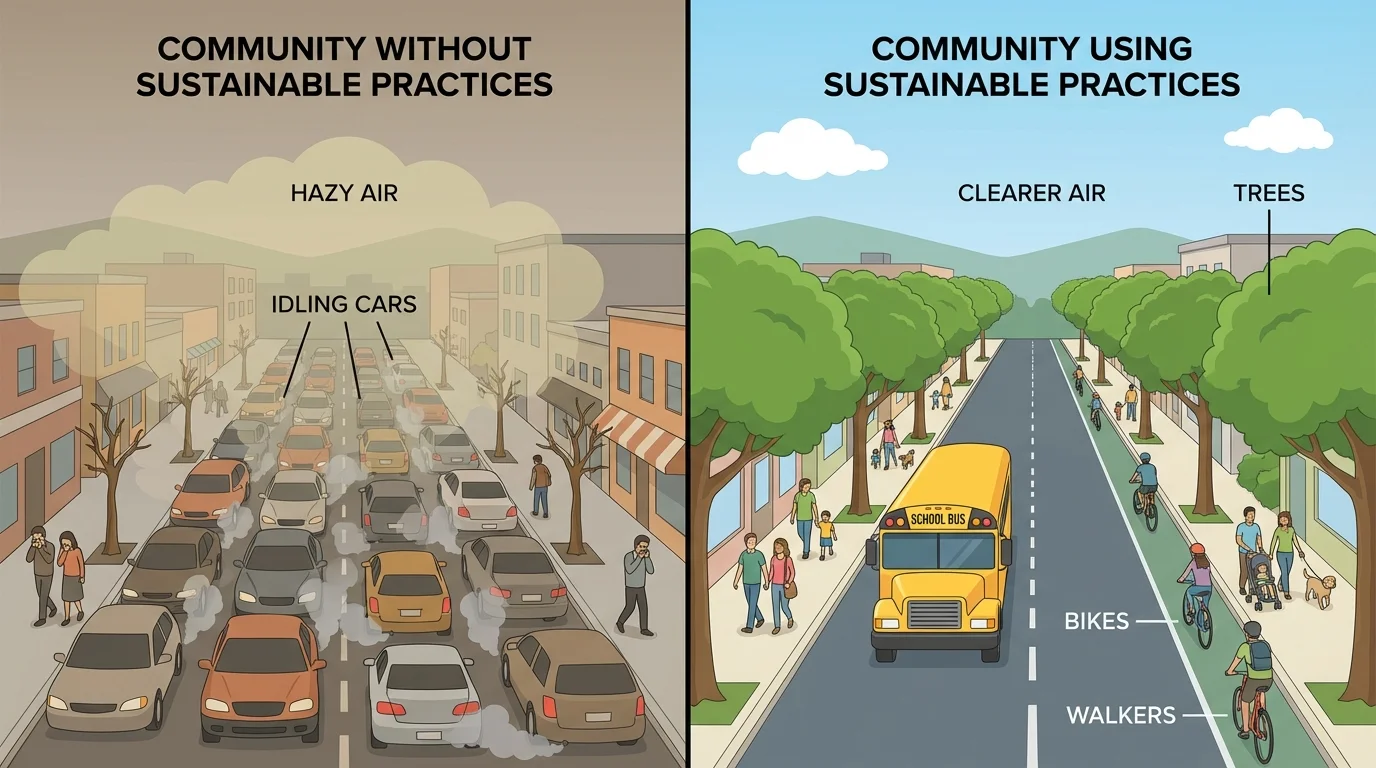
To make good decisions, people gather information over time. They may count cars, notice when smoke is strongest, or compare air conditions at different times of day. Then they combine this information with health and weather observations. The contrast in [Figure 3] shows that community choices can affect what the air around a school or neighborhood is like.
Air protection works best when communities focus on specific actions they can measure. If a school changes pickup rules and then notices fewer idling cars and less exhaust smell, that is evidence the action helped. Science makes the decision stronger because the change is based on observation, not just opinion.
Air can look clear and still contain pollutants that are too small to see. That is why communities often use measuring tools and repeated observations instead of trusting eyesight alone.
A habitat is the place where a plant or animal lives and finds what it needs to survive. Communities use science ideas to protect habitats because living things depend on clean water, healthy soil, safe shelter, and enough food. If one of these parts is damaged, the habitat may support fewer species.
One way communities help is by restoring native plant areas. Native plants are plants that naturally grow in a region. They often provide food and shelter for local insects, birds, and other animals. If a park has lost many native plants, the community can observe which species used to be there, study soil and sunlight conditions, and then replant suitable native species.
Communities may also monitor animal populations. Counting birds, butterflies, or frogs at the same place over time helps people notice changes. If more animals return after habitat restoration, that suggests the action is working. If not, the community may need to change the plan and gather more evidence.
Community example: Restoring a butterfly garden
Step 1: Volunteers notice that few butterflies visit a school garden.
Step 2: They learn that many butterflies need specific local plants for food and egg-laying.
Step 3: The school adds native flowering plants and avoids disturbing the area.
Step 4: Over time, observers record more butterfly visits.
The community combines plant knowledge and observation data to protect living things in one habitat.
Trash does not simply disappear when people throw it away. As [Figure 4] illustrates, communities use science ideas to manage materials and reduce waste. One important action is separating paper, metal, glass, and certain plastics so these materials can be used again instead of sent to a landfill.
Recycling works because many materials keep useful physical properties even after people finish using them once. Paper fibers can be processed into new paper products. Metal can be melted and reshaped. Glass can be crushed and remade. Communities study which materials can be collected, sorted, and reused effectively.
Science also helps people understand that reducing waste is often better than creating waste in the first place. Using a refillable bottle, reusing a bag, or choosing products with less packaging can decrease the amount of material that must be transported and processed. Communities may measure how many bags of trash a school produces before and after a reuse campaign.
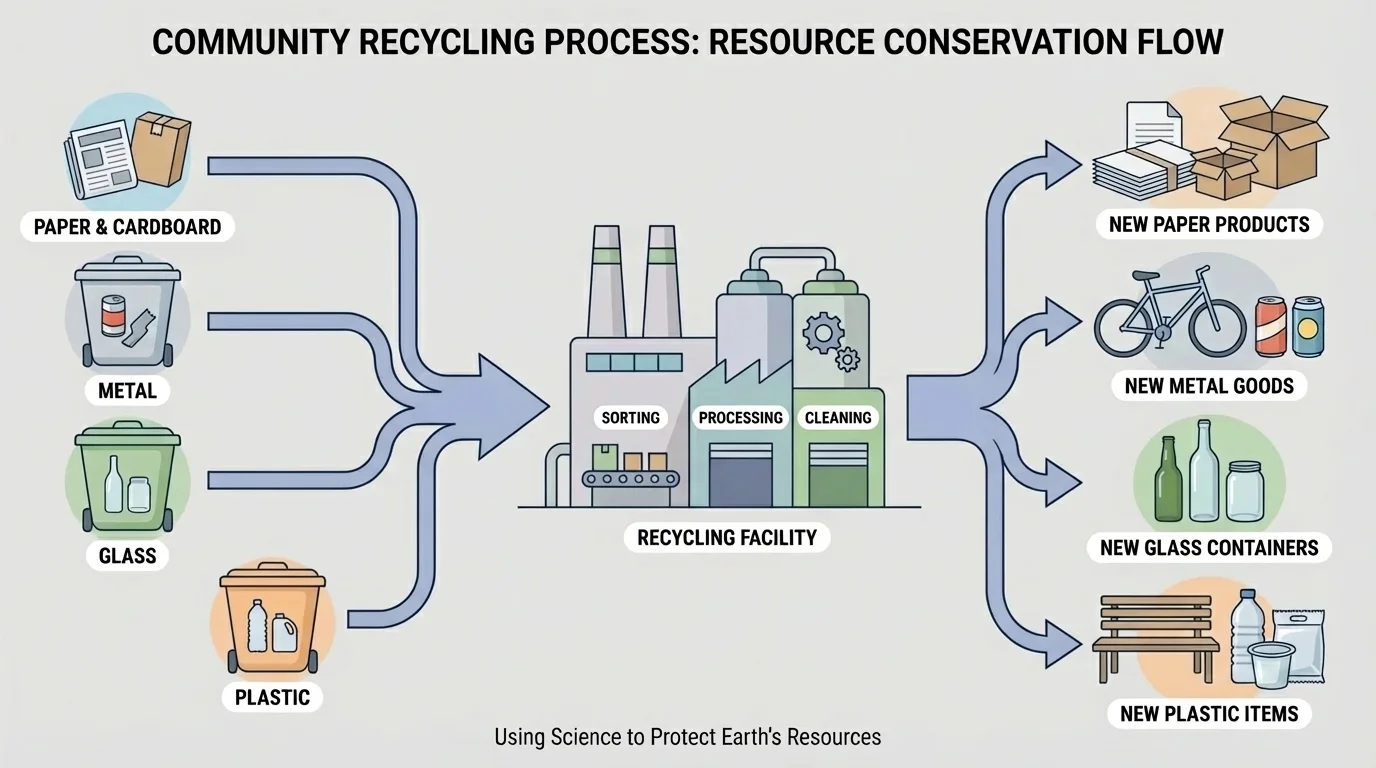
Good waste management depends on accurate information. If people place the wrong items in a recycling bin, the system works less well. That is why communities post clear signs, collect data, and teach residents how to sort materials correctly. The flow of materials in [Figure 4] shows that recycling is a process, not just a bin.
Reducing waste protects Earth's resources because making new products often requires raw materials, energy, and water. Reusing and recycling can lower the need to remove as many resources from Earth. Communities that compare their waste amounts over time can see whether their programs are making a real difference.
Protecting the environment usually requires more than one kind of evidence. A community might use maps, photographs, weather records, water tests, and people's observations together. Each source gives part of the story. When combined, they provide a clearer picture of what is happening.
For example, if a creek becomes muddy, one source of information might be water samples. Another might be photos showing a nearby construction site with bare soil. A third might be rainfall records showing a recent heavy storm. None of these alone explains everything, but together they help people understand the cause and decide what action to take.
| Source of information | What it can tell a community | Example use |
|---|---|---|
| Observation | What people notice directly | Seeing litter near a storm drain |
| Measurement | Amounts and changes | Recording water depth each week |
| Photographs | How a place changes over time | Comparing a hillside before and after planting |
| Maps | Where features are located | Finding which streets drain toward a stream |
| Counts | How many items or organisms are present | Counting birds in a restored habitat |
Table 1. Different kinds of information communities use to understand environmental problems and solutions.
Combining information does not mean mixing random facts. It means choosing evidence that fits the question. If a town wants to protect soil on a slope, it should focus on rainfall, slope steepness, plant cover, and soil movement. If the town wants to improve air quality near a school, it should focus on traffic patterns, pollution observations, and times of day.
Strong environmental decisions come from connected evidence. A single observation can be useful, but decisions become stronger when communities compare several kinds of information. This helps people avoid mistakes and understand cause and effect more clearly.
Every community uses Earth's systems, and every community can help protect them. Science ideas give people tools for making responsible choices. Instead of saying, "This seems like a good idea," they can say, "We observed this problem, gathered evidence, tested a solution, and saw improvement."
Protecting Earth's resources and environment is not only the job of experts. Students, families, schools, and local leaders can all collect observations and learn from evidence. A class can monitor school waste. A neighborhood can plant to reduce erosion. A town can study cleaner water practices. One careful action, supported by science, can improve a place over time.
When communities obtain and combine information, they become better problem-solvers. They learn that Earth is always changing and that human choices matter. By focusing on one environmental interaction at a time and studying it closely, people can protect water, land, air, habitats, and resources more effectively.
