A century may sound like a long time, but in Earth science it is a very short snapshot. During that short time, global average temperature has risen enough to affect glaciers, sea level, heat waves, ecosystems, and even the timing of flowering plants. The big scientific question is not just whether Earth is warming. It is why. To answer that, scientists gather evidence and ask careful questions that test competing explanations.
When people hear about climate change, they sometimes jump straight to opinions. Science begins somewhere else: with observations, measurements, and questions. If global temperatures have risen over the past century, what evidence shows that change? Which factors could cause it? How can we tell whether a factor is important, minor, or unrelated?
These questions matter because decisions about energy, transportation, farming, cities, and technology depend on them. If the main cause were a natural cycle, one set of responses might make sense. If the main cause is human activity, then reducing certain emissions, improving engineering systems, and changing land use become much more important.
Global temperature means the average temperature of Earth's surface, measured across land and oceans over time. Climate is the long-term pattern of weather in a region or across the planet, usually studied over decades. Global warming is the long-term rise in Earth's average temperature, especially since the late nineteenth century.
To understand causes, scientists do not rely on one thermometer or one hot summer. They look for patterns across many places, over many years, and from many kinds of measurements.
Climate scientists use several types of evidence, as [Figure 1] shows, because one source alone can be incomplete. Surface thermometers measure air temperature over land. Ships and floating instruments measure ocean temperatures. Satellites collect global data from space. Ice cores and tree rings help scientists learn about older climates before modern instruments existed.
This is important because each kind of evidence has strengths and limits. A thermometer gives direct measurements at one location. A satellite covers large areas. Ice cores contain tiny bubbles of old air that reveal past amounts of gases such as carbon dioxide, written as \(\textrm{CO}_2\). Tree rings can show whether growing seasons were warmer or cooler in past years. When different sources point to the same overall trend, confidence increases.
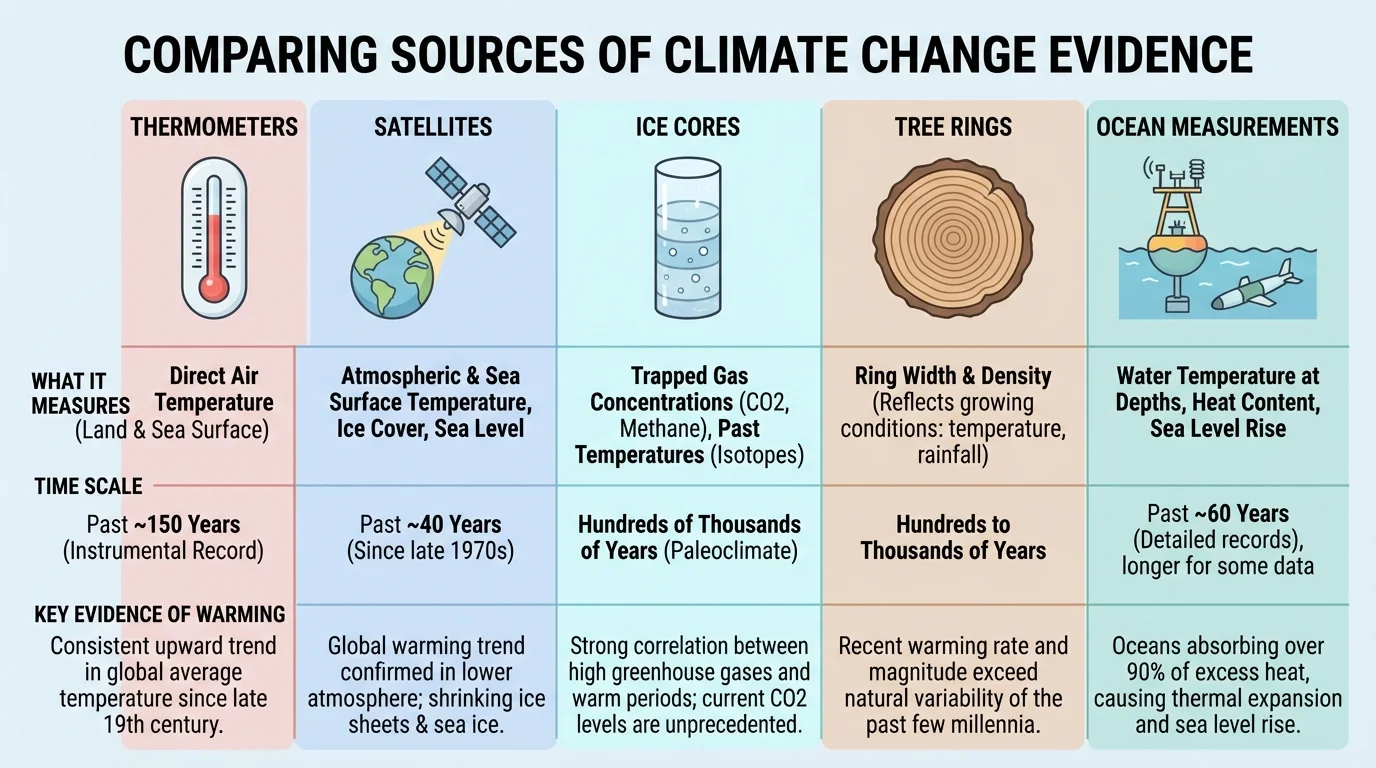
Scientists also ask clarifying questions about data quality. Was the instrument calibrated correctly? Was the measurement made in the same way over many years? Are there enough measuring stations around the world? Could local effects, such as a growing city around a weather station, affect results?
Even with these questions, the overall picture is strong. Independent research groups using different methods all find that Earth's average temperature has increased since the late nineteenth century. Oceans have also gained enormous amounts of heat, and that matters because water stores much more thermal energy than air.
The ocean absorbs more than \(90\%\) of the extra heat captured by greenhouse gases in the climate system. This means the warming is not limited to the air above us.
Another useful question is What would we expect to see if warming were real? We would expect rising air temperatures, warming oceans, melting ice, shrinking glaciers, earlier spring events in many places, and rising sea level. Scientists observe all of these.
The greenhouse effect is a natural process that keeps Earth warm enough for life. Energy from the Sun reaches Earth mostly as visible light. Earth's surface absorbs some of that energy and then gives off heat energy in the form of infrared radiation. Certain gases in the atmosphere absorb and re-emit some of this outgoing heat, slowing how fast it escapes to space.
[Figure 2] Without a natural greenhouse effect, Earth would be much colder. Water would freeze over much more easily, and many present-day ecosystems could not survive. So the greenhouse effect itself is not bad. The concern is that human activities are adding more heat-trapping gases, creating an enhanced greenhouse effect.
The most important human-produced greenhouse gases include \(\textrm{CO}_2\), methane \(\textrm{CH}_4\), and nitrous oxide \(\textrm{N}_2\textrm{O}\). Water vapor is also a greenhouse gas, but it mostly acts as a feedback. As air warms, it can hold more water vapor, which can trap even more heat.
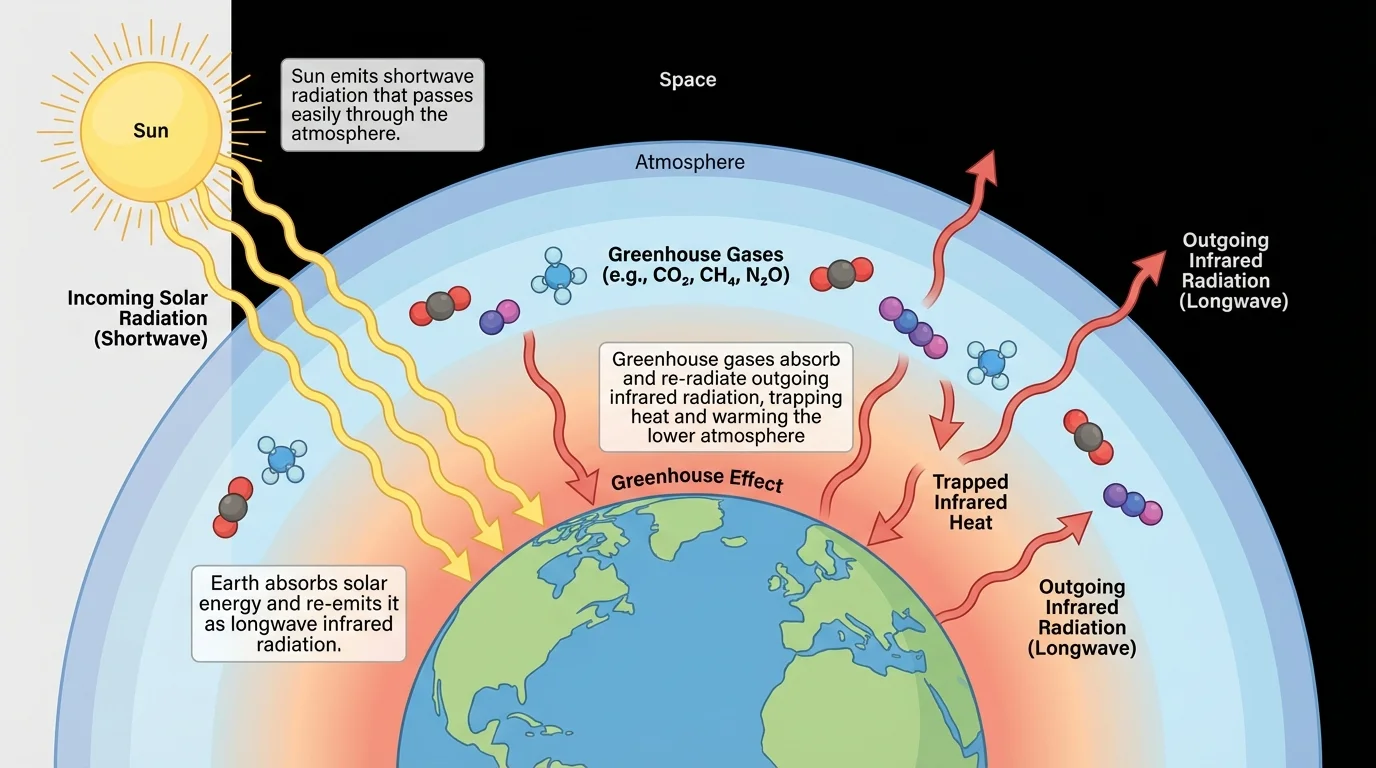
A useful way to think about this is with a blanket. A blanket does not create body heat. It slows the escape of heat your body already produces. In a similar way, greenhouse gases do not create solar energy, but they slow the escape of heat from Earth's surface and lower atmosphere.
Natural versus enhanced greenhouse effect
Earth naturally has greenhouse gases in its atmosphere, and they are essential for life. Problems arise when human actions increase these gases beyond their usual range. Burning coal, oil, and natural gas releases carbon that was stored underground. That extra carbon enters the atmosphere mainly as \(\textrm{CO}_2\), adding to the heat-trapping effect.
Scientists can measure the strength of this change. For example, if atmospheric \(\textrm{CO}_2\) increases from about \(280\) parts per million before widespread industrialization to over \(420\) parts per million today, that is a rise of more than \(140\) parts per million. This increase changes how energy moves through the atmosphere.
Numeric example: estimating the increase in atmospheric \(\textrm{CO}_2\)
Step 1: Identify the earlier and later values.
Earlier level: \(280\) parts per million. Later level: \(420\) parts per million.
Step 2: Find the increase.
\[420 - 280 = 140\]
Step 3: Interpret the result.
The atmosphere contains about \(140\) more parts of \(\textrm{CO}_2\) per million air molecules than it did before major industrial growth.
That increase is scientifically important because even small changes in atmospheric composition can affect Earth's energy balance.
Later, when scientists compare causes of warming, they return to the process shown in [Figure 2]. The pattern of warming must match the physics of heat being trapped more effectively in the atmosphere.
To explain warming fairly, scientists compare several possible causes, as [Figure 3] shows, instead of choosing an answer first. Some factors are natural. Others are caused by human activities. Good science asks how large each effect is, when it happened, and whether it fits observed evidence.
Natural factors include changes in the Sun's energy output, volcanic eruptions, and long-term shifts in Earth's orbit. Volcanic eruptions can release particles into the atmosphere that reflect sunlight and often cause temporary cooling. Changes in Earth's orbit affect climate over thousands to tens of thousands of years, not mainly over a single century.
Human factors include burning fossil fuels, cutting forests, making cement, and certain agricultural practices. Burning fossil fuels transfers carbon from underground into the atmosphere. Deforestation reduces the number of trees that can remove \(\textrm{CO}_2\) from the air through photosynthesis.
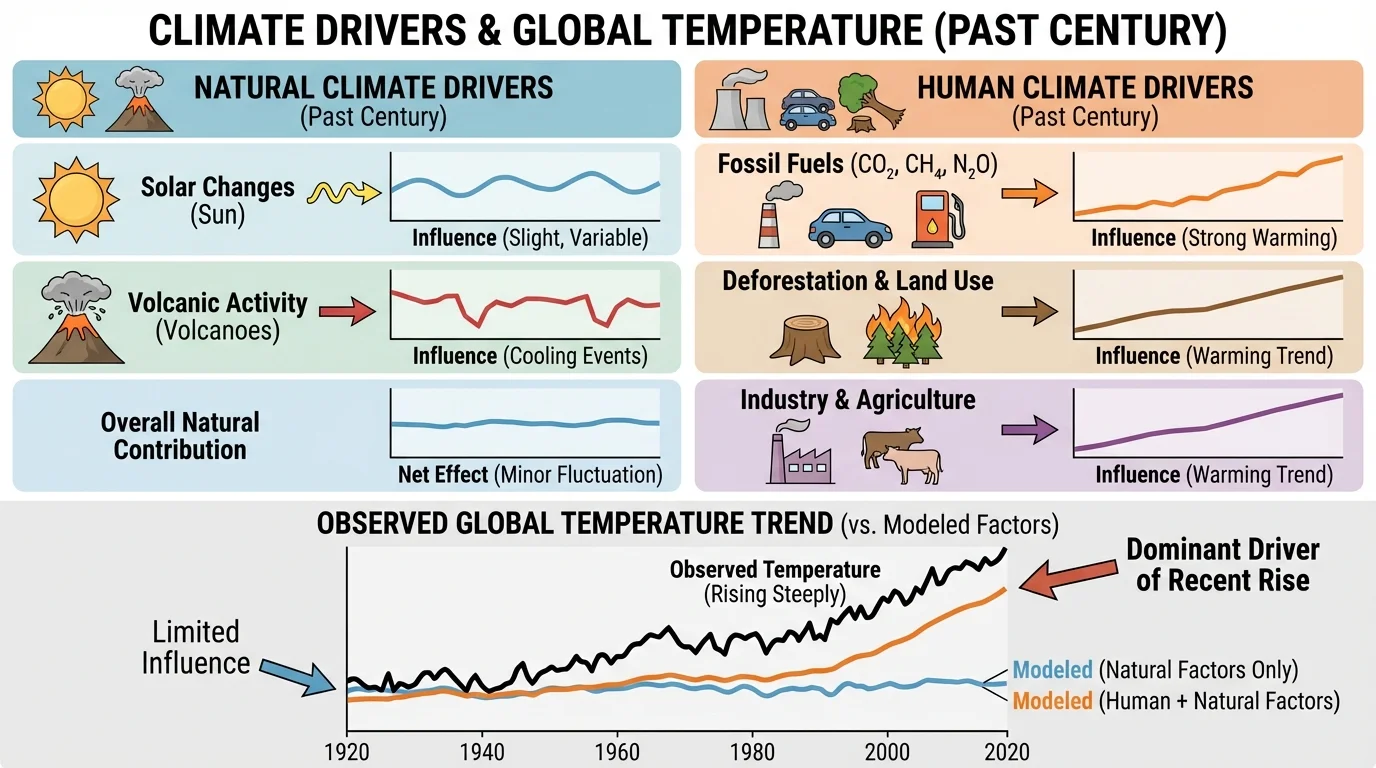
Scientists ask a powerful clarifying question here: If this factor were the main cause, what pattern should we observe? For example, if the Sun were causing most modern warming, scientists would expect warming through more layers of the atmosphere in a different pattern. But observations show strong warming near the surface and cooling in parts of the upper atmosphere, which better matches greenhouse gas increases.
Another question is about timing. Did the factor increase during the same period that temperatures rose? Human greenhouse gas emissions grew rapidly after industrialization, especially during the twentieth century. That timing matches the strongest recent warming much better than orbital changes do.
| Possible factor | Source | Typical effect | Matches recent warming well? |
|---|---|---|---|
| Solar change | Natural | Can affect incoming energy | Only partly; not enough to explain most recent warming |
| Volcanic eruptions | Natural | Usually short-term cooling | No, pattern is mostly opposite |
| Orbital changes | Natural | Long-term climate shifts | No, timescale is too long |
| Fossil fuel burning | Human | Raises atmospheric \(\textrm{CO}_2\) | Yes, strongly |
| Deforestation | Human | Reduces carbon uptake and can release stored carbon | Yes, contributes |
Table 1. Comparison of major natural and human-related factors that can influence Earth's temperature.
Asking questions is not a sign of doubting science; it is part of doing science well. Strong questions help us test claims and understand evidence more deeply.
Here are some useful kinds of clarifying questions:
Example: turning a weak question into a strong scientific question
Weak question: "Is climate change real?"
Step 1: Make the question more specific.
Ask: "What measurements show that average global temperature has changed over the past century?"
Step 2: Ask how reliable the evidence is.
Ask: "Do thermometers, satellites, and ocean heat data all show the same trend?"
Step 3: Ask about causes.
Ask: "Which possible causes fit the timing, size, and pattern of the warming best?"
These stronger questions lead to evidence-based answers instead of opinions.
Students can also ask whether the evidence is direct or indirect. Thermometers give direct temperature readings. Ice cores give indirect evidence about past climate, but that evidence is still powerful when interpreted carefully and compared with other data.
When scientists compare the rise in atmospheric \(\textrm{CO}_2\) and the rise in temperature, the two trends increase together over the past century. But science does not stop at "they both went up." Scientists ask whether the physical explanation, the timing, and other patterns also fit.
[Figure 4] One key line of evidence comes from the source of the carbon itself. Fossil fuels formed from ancient living things. Carbon from these fuels has a different isotopic pattern than some other carbon sources. When scientists measure carbon in the atmosphere, they find evidence consistent with large amounts coming from fossil fuels.
Another clue is that oxygen in the atmosphere decreases slightly as fossil fuels burn. Combustion uses oxygen and produces \(\textrm{CO}_2\). A simplified chemical idea for burning carbon is:
\[\textrm{C} + \textrm{O}_2 \rightarrow \textrm{CO}_2\]
This does not describe every fuel completely, but it captures the main idea: carbon combines with oxygen to form carbon dioxide.
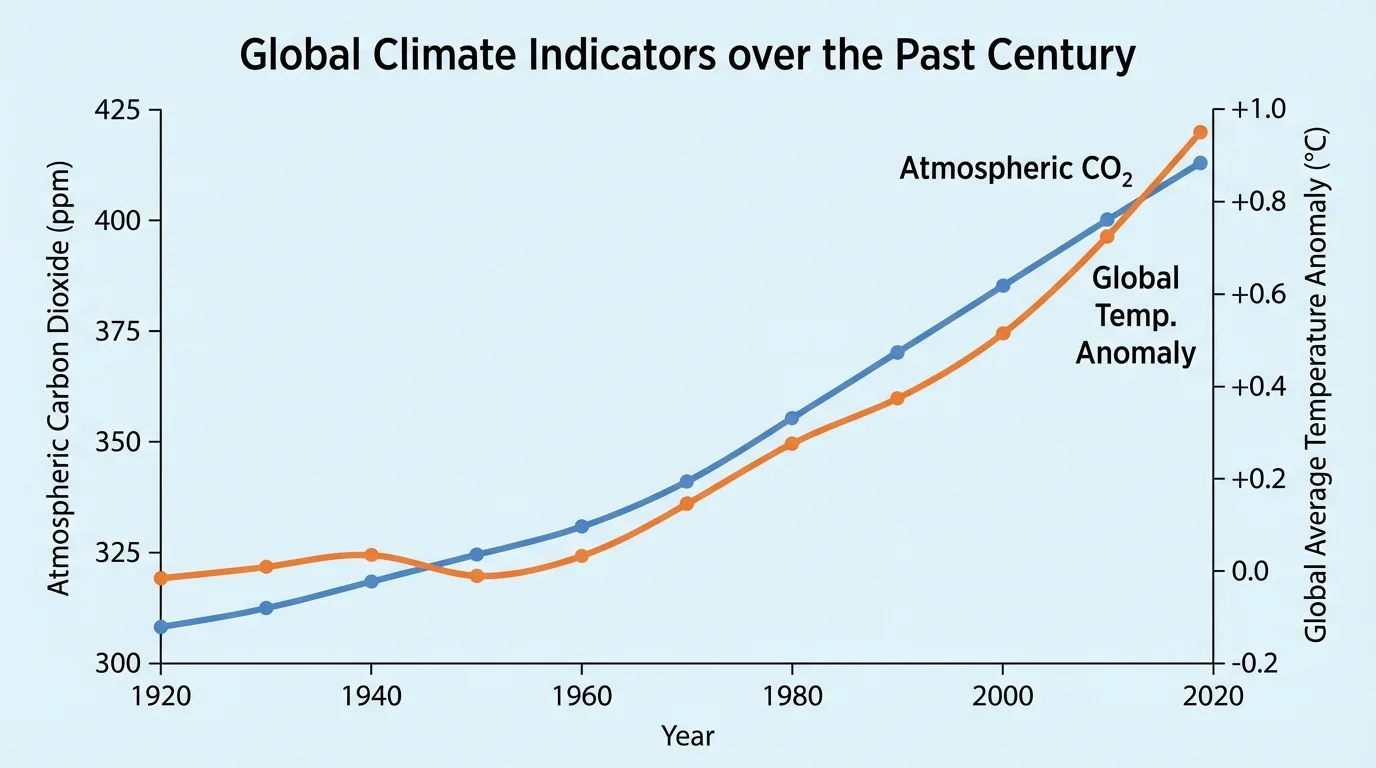
Scientists also use climate models, which are computer tools that test how different factors affect climate. When models include only natural factors such as solar changes and volcanoes, they do not reproduce the strong recent warming very well. When human greenhouse gas emissions are added, the models match observed temperature trends much better.
A later reference to [Figure 4] is helpful here: the graph shows matching trends, but the conclusion becomes much stronger because physics, chemistry, atmospheric patterns, ocean heat, and model results all support the same explanation. In science, agreement across many kinds of evidence is powerful.
Correlation means two things change together, but it does not automatically prove that one caused the other. In climate science, scientists go further by checking whether the mechanism, timing, and spatial patterns match the proposed cause.
Scientists also observe that nights are warming, winters are warming in many regions, glaciers are shrinking, sea ice is declining in key areas, and the lower atmosphere is warming while parts of the upper atmosphere cool. Those fingerprints fit an enhanced greenhouse effect much better than increased solar energy alone.
A common misunderstanding is confusing weather with climate. A cold day or snowy week does not cancel a long-term warming trend. Weather changes from day to day. Climate is the long-term average and pattern.
Another misunderstanding is that cities are hotter, so maybe warming is just caused by urban growth near weather stations. Scientists test this by comparing rural and urban stations, using ocean measurements, satellite data, and many independent methods. The warming trend still appears.
Some people ask whether volcanoes produce more \(\textrm{CO}_2\) than humans. Measurements show that human activities release far more \(\textrm{CO}_2\) each year than volcanoes do. Volcanoes are important in Earth science, but they do not explain the main temperature rise over the past century.
How scientists reduce error
Scientists check instruments, compare measurements from different places, correct known biases, repeat analyses, and publish results so other scientists can test them. This process does not remove all uncertainty, but it helps make conclusions stronger and more trustworthy.
That is why clarifying questions matter so much. Instead of stopping at a claim, scientists ask: What evidence supports it? What evidence challenges it? Does the explanation fit all the data, or only one small part?
Understanding causes is not only about learning facts. It guides choices. If human activities are the main driver of recent warming, then reducing emissions from power plants, vehicles, and industry can help limit future temperature rise. Engineers design more efficient buildings, cleaner transportation systems, and renewable energy technologies partly because climate evidence points to human causes.
Communities also make adaptation decisions. Coastal cities may build protections against sea-level rise. Farmers may change planting schedules or irrigation methods. Public health workers prepare for stronger heat waves. These decisions depend on understanding climate science accurately.
Real-world application: using evidence to choose solutions
Step 1: Identify the main cause.
Evidence shows that increasing greenhouse gases from human activities are one of the main causes of recent warming.
Step 2: Match the solution to the cause.
If burning fossil fuels raises \(\textrm{CO}_2\), then cleaner energy sources, better efficiency, and reduced fuel use can lower the cause.
Step 3: Consider social and engineering limits.
Some solutions cost money, require new technology, or affect jobs and transportation systems, so communities must balance scientific evidence with practical choices.
Science does not make decisions by itself, but it gives decision-makers the best available evidence.
As students, one of the most important habits you can build is asking better questions. Not "What do people argue about?" but "What does the evidence show, how do we know, and which explanation best fits the facts?" That habit is useful in climate science and in every part of scientific thinking.
