A magnet can pull a paper clip without touching it, and a charged balloon can make hair stand up without touching every strand. That seems almost like a magic trick, but it is really science. Electric and magnetic forces are powerful examples of how objects can interact across space. To understand these forces, scientists do not just watch what happens once—they collect data, compare patterns, and ask questions like: What changes when the objects are farther apart? What happens if the charge is larger? Does turning a magnet around change the force?
When you ask questions about data, you are doing one of the most important jobs in science. Data can reveal patterns, and patterns can help you figure out which factors matter most. In this topic, the goal is not only to know that electric and magnetic forces exist, but also to learn how to investigate what affects their strength.
A force field is a region around an object where another object can feel a force. You cannot usually see a field directly, but you can detect it by what it does. Earth's gravitational field pulls objects downward. In a similar way, electric fields and magnetic fields affect objects around them.
These are called electric forces and magnetic forces. An electric force acts between charged objects. A magnetic force acts between magnets or between a magnet and certain metals such as iron. Both can attract or repel, depending on the situation.
Electric force is the push or pull between objects with electric charge.
Magnetic force is the push or pull caused by magnets or magnetic materials.
Field is the area around an object where another object experiences a force.
A force that acts at a distance does not mean "no cause." It means the cause is carried through space by a field. That idea helps explain why a magnet can pull a nail before touching it, or why bits of paper jump toward a charged plastic comb.
Scientists often map a field by seeing how it affects a test object, as [Figure 1] illustrates. A test object is something small enough that it reveals the field without changing it very much. For electric fields, a tiny positive charge can act as a test object. For magnetic fields, a small compass or iron filings can show the field's pattern.
If a test object feels a strong push or pull, the field is stronger in that location. If the effect is weaker, the field is weaker there. Field maps often use arrows. The direction of an arrow shows which way the force acts, and the spacing or length can suggest how strong the force is.
Near a charged object or a magnet, the field is usually stronger. Farther away, the field becomes weaker. This idea appears again and again in data about action-at-a-distance forces.
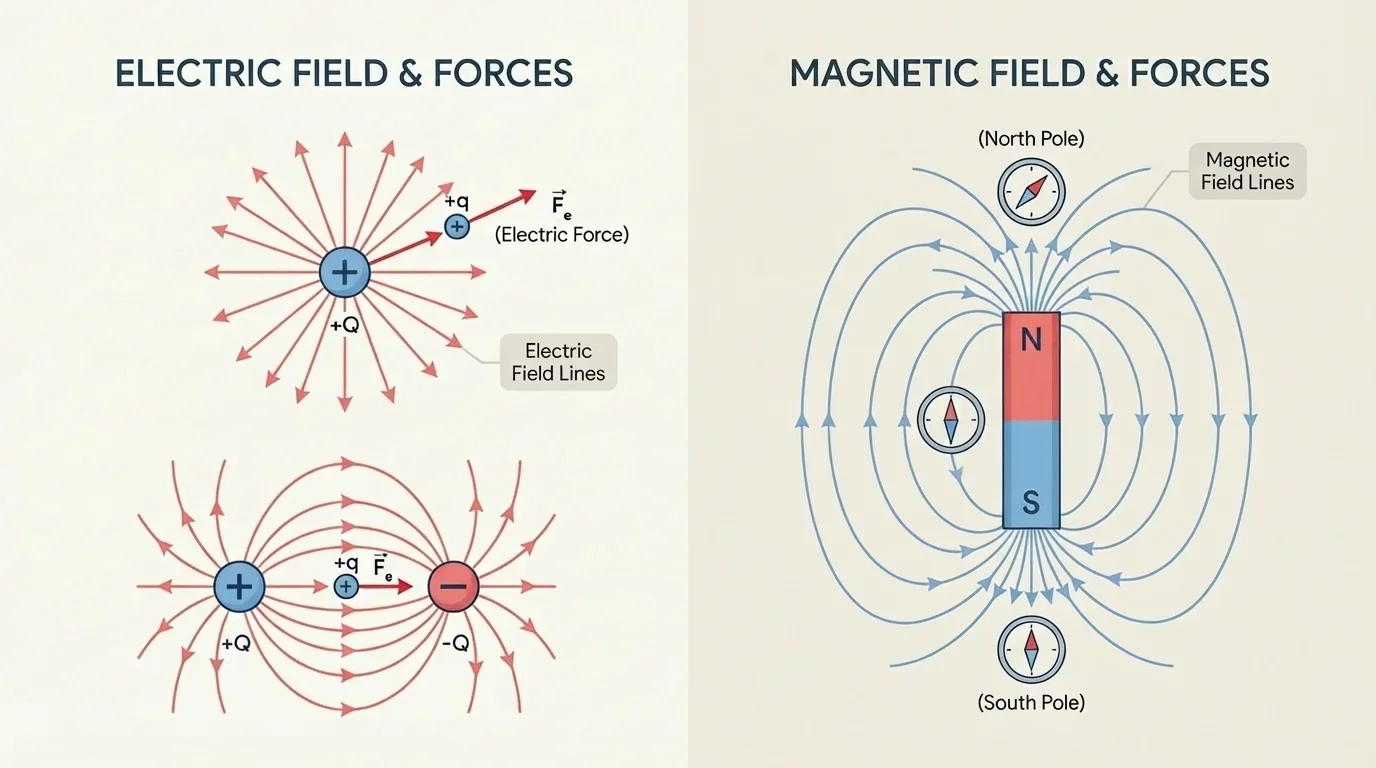
Field maps are useful because they turn invisible interactions into visible patterns. When students look at data tables or diagrams, they should ask: Where is the force strongest? Where does the direction change? What happens as the test object moves farther away?
Remember that a force is a push or a pull. Earlier studies of forces may have focused on contact forces such as friction or a hand pushing a box. Electric and magnetic forces are different because the objects do not need to touch.
Good science begins with good questions. When you look at data about electric or magnetic forces, try asking questions that focus on variables, patterns, and comparisons. A variable is something that can change in an investigation, such as distance, charge, or magnet orientation.
Examples of strong questions include: How does the force change when the distance doubles? Does a stronger magnet always produce a stronger force? Do opposite electric charges behave like opposite magnetic poles? If two tests differ in only one factor, what does the data suggest about that factor?
These questions matter because they help you separate cause from coincidence. If several measurements show that the force decreases as distance increases, that pattern suggests distance is an important factor. If changing the orientation of two magnets changes attraction to repulsion, then orientation is clearly another key factor.
Scientists also ask whether the data are consistent. If one measurement does not fit the pattern, it might be an error, or it might reveal something new. Careful questioning helps you decide which explanation makes the most sense.
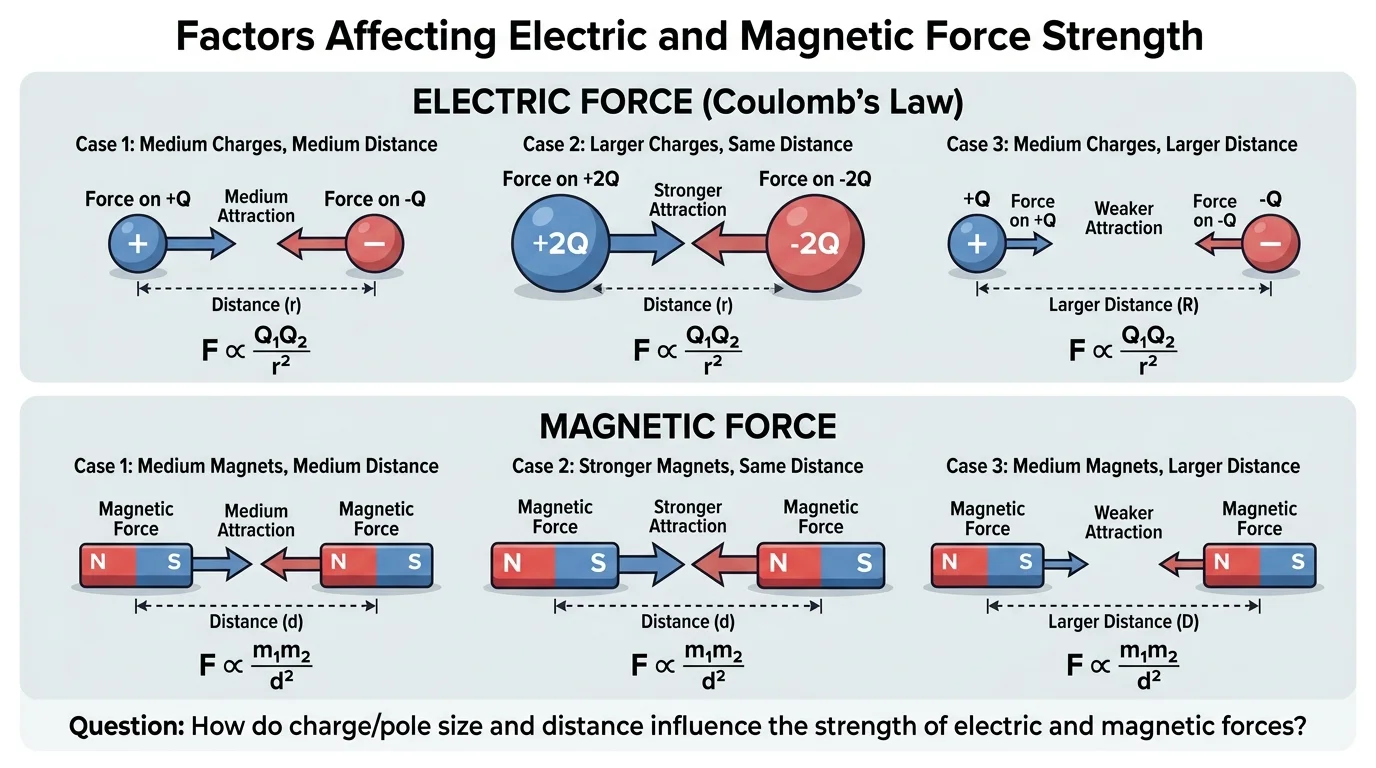
Data about electric force often point to two major factors, as [Figure 2] shows: the magnitude of charge and the distance between objects. Charge is a property of matter that can be positive or negative. Opposite charges attract, and like charges repel.
If the charges are larger, the electric force is stronger. If the charges are smaller, the force is weaker. For example, a strongly charged balloon may pull tiny bits of paper more strongly than a weakly charged balloon. If the same balloon slowly loses charge, the force decreases.
Distance is another major factor. When charged objects are close together, the force is stronger. When they are farther apart, the force becomes weaker. If one trial places two charged objects at distance \(d\) and another places them at distance \(2d\), the force at \(2d\) is weaker. At this grade level, the important idea is the pattern: more distance means less force.
The type of charge matters too. A positive and a negative charge pull toward each other. Two positive charges push away from each other, and two negative charges also push away. The strength can still vary with charge amount and distance, but the direction of the force depends on whether the charges are alike or opposite.
Static electricity gives a familiar example. When you rub a balloon on hair, electrons move, giving the balloon a charge. The charged balloon can then attract neutral bits of paper because charges in the paper shift slightly. This shows that electric interactions can depend not only on total charge but also on how charge is arranged inside materials.
Using data to identify electric-force factors
A student tests a charged rod near a tiny suspended ball.
Step 1: Compare trials where only distance changes.
In Trial A, the rod is \(2 \textrm{ cm}\) away and the ball moves a lot. In Trial B, the rod is \(6 \textrm{ cm}\) away and the ball moves only a little. Since charge stayed the same, the data suggest that increasing distance decreases electric force.
Step 2: Compare trials where only charge changes.
In Trial C, a weakly charged rod at \(2 \textrm{ cm}\) causes a small motion. In Trial D, a more strongly charged rod at the same distance causes a larger motion. Since distance stayed the same, the data suggest that greater charge produces greater electric force.
Step 3: Ask a conclusion question.
Which factors affected the force? The data support two factors: distance and amount of charge.
As with the field map in [Figure 1], electric-force data make more sense when you imagine the space around a charged object filled with a field that becomes weaker farther away.
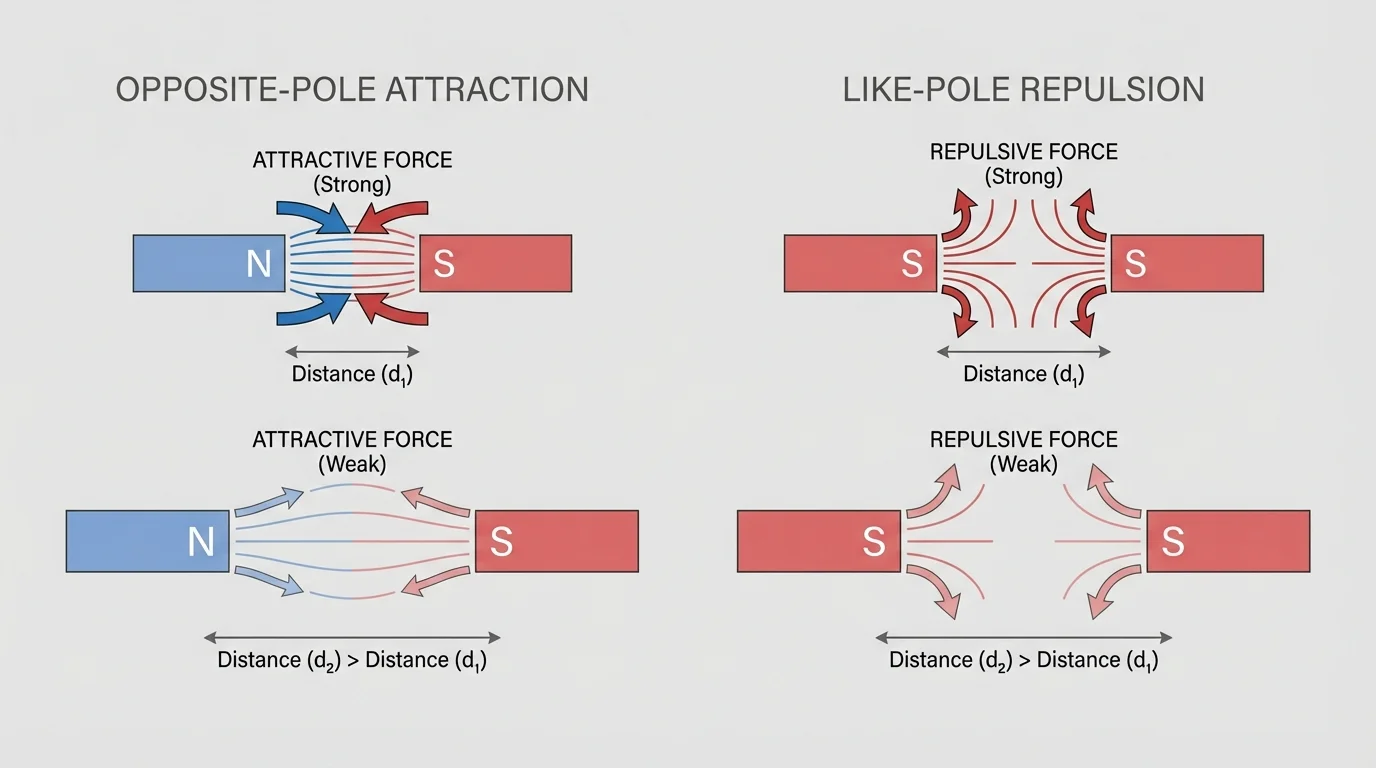
Magnetic-force data also depend strongly on distance and arrangement, as [Figure 3] illustrates. The closer magnets are to each other, the stronger the force between them. Farther apart, the force weakens.
Magnetic force also depends on pole orientation. Magnets have two poles, called north and south. Opposite poles attract, while like poles repel. If you flip one magnet around, the force can switch from attraction to repulsion even when the distance stays the same.
The strength of the magnets themselves matters too. A stronger magnet usually exerts a stronger force than a weaker magnet at the same distance. That is why a large classroom demonstration magnet can hold more paper clips than a tiny refrigerator magnet.
Another factor is the material involved. Magnets strongly affect some materials, such as iron, nickel, and cobalt, but not all materials. A magnet may attract a steel paper clip but have almost no effect on a plastic bead at the same distance. This tells you that the object's material is part of the data story.
A compass is a simple tool for detecting magnetic fields. Near a magnet, the compass needle turns because the magnetic field applies a force that changes the needle's direction. This is one way scientists map magnetic fields without seeing them directly.
A magnet does not need to touch a piece of iron to affect it. In fact, the magnetic field around Earth is so large that it guides compasses across huge distances.
The pattern of attraction and repulsion in magnets is similar in some ways to electric charge, but they are not the same thing. Comparing the two carefully helps prevent confusion.
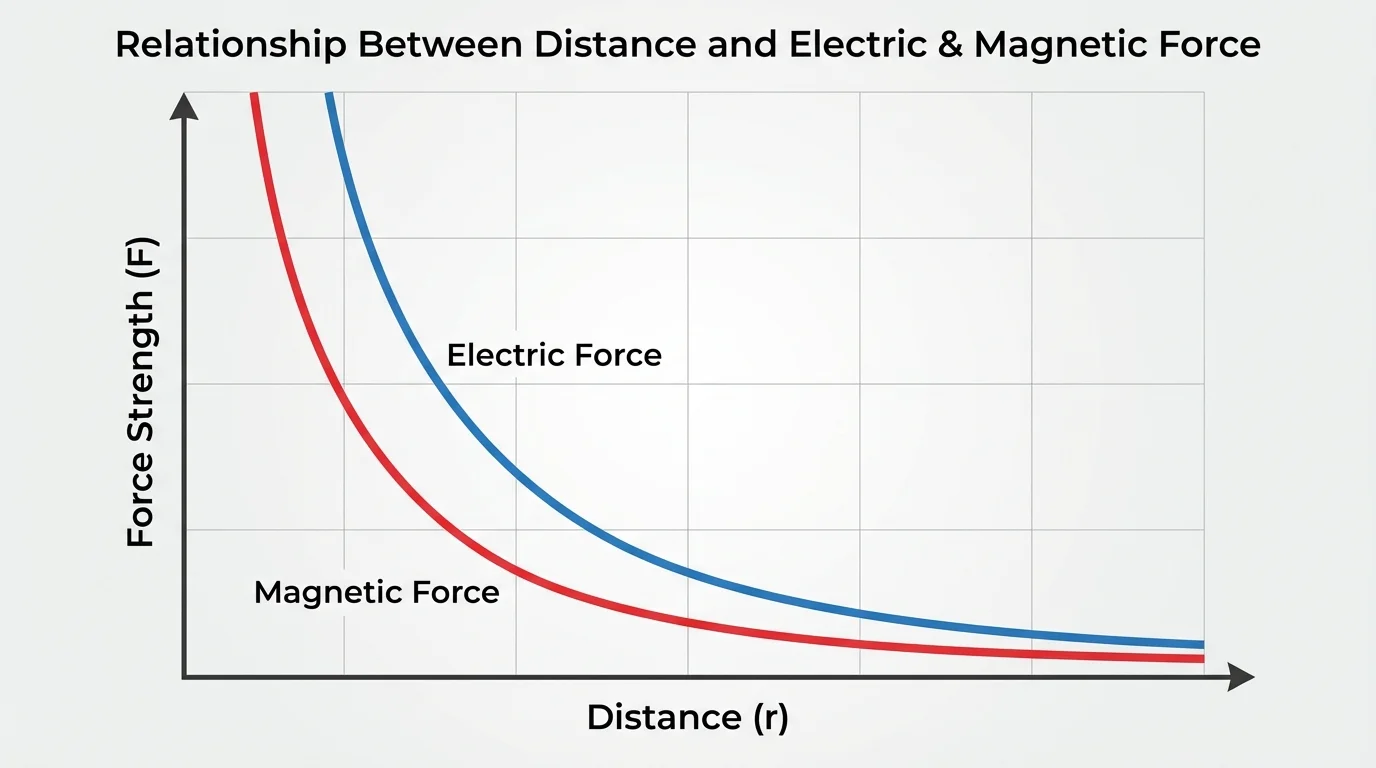
Tables and graphs make patterns easier to see, as [Figure 4] shows for force and distance. When reading a table, first identify what changed from trial to trial. Then look for what happened to the measured force. Did it increase, decrease, or stay about the same?
Suppose a table shows that when distance changes from \(1 \textrm{ cm}\) to \(2 \textrm{ cm}\), the force becomes much smaller, and when distance changes from \(2 \textrm{ cm}\) to \(4 \textrm{ cm}\), it becomes smaller again. Even without advanced equations, you can conclude that distance has a strong effect.
Graphs can reveal trends quickly. If the line slopes downward as distance increases, the force is decreasing. If a graph rises as magnet strength increases, the force is increasing. You do not need advanced algebra here; proportional reasoning is enough. For example, if one magnet picks up about \(2\) times as many paper clips as another under similar conditions, that suggests it may be producing a stronger magnetic effect.
When comparing data, ask whether only one variable changed. If both distance and charge changed at the same time, it is harder to tell which factor caused the result. This is why controlled comparisons are so important.
| Question to Ask | What It Helps You Find Out |
|---|---|
| What changed between trials? | Identifies the variable being tested |
| What happened to the force? | Shows the effect of that variable |
| Was distance greater or smaller? | Tests whether force changes with separation |
| Were the charges or magnets stronger? | Tests whether source strength matters |
| Did the direction switch from pull to push? | Shows attraction versus repulsion |
Table 1. Questions students can ask when analyzing data about electric and magnetic forces.
Suppose one electric-force test gives a motion value of \(4\) units and another gives \(8\) units under the same distance but with more charge. You can say the second effect is about \(2\) times as large. This kind of comparison uses proportional reasoning and helps describe patterns without needing more advanced formulas.
What makes a question useful? A useful scientific question is specific, testable, and tied to evidence. "What affects electric force?" is a good starting question, but "How does electric force change when distance doubles while charge stays the same?" is better because data can answer it clearly.
Electric and magnetic forces are not just classroom ideas. They are built into many devices people use every day. Static electricity can make clothes cling together after drying. Photocopiers and laser printers use electric charges to attract toner onto paper. Magnets are inside speakers, headphones, and electric motors.
In medicine, magnetic resonance imaging, or MRI, uses strong magnetic fields to help doctors create detailed images of the inside of the body. In transportation and engineering, magnetic systems can help reduce friction in special train designs. Understanding what affects magnetic force is part of making these technologies work safely and effectively.
Even simple objects show these ideas. Refrigerator magnets work because magnetic force is strong enough at a short distance to hold paper against a metal door. A small increase in distance, such as a thick object between the magnet and the refrigerator, weakens the force. This matches the distance pattern seen earlier in [Figure 3] and [Figure 4].
Real-world data question
An engineer is testing two magnets for a cabinet door latch.
Step 1: Compare equal distances.
At \(1 \textrm{ cm}\), Magnet A holds \(6\) metal washers and Magnet B holds \(3\) washers. Since the distance is the same, the data suggest Magnet A exerts the stronger magnetic force.
Step 2: Check what happens when distance changes.
At \(2 \textrm{ cm}\), Magnet A holds only \(2\) washers. This shows that increasing distance reduces the magnetic effect.
Step 3: Ask a design question.
Which magnet is better for a latch that must work through a thin wooden panel? The stronger magnet may work better, but the engineer must also test the actual distance in the final design.
One common mistake is thinking that electric and magnetic forces work exactly the same way. They share some patterns, such as stronger effects at shorter distances and the ability to attract or repel. But electric force acts on charge, while magnetic force depends on magnets, moving charges, and magnetic materials.
Another mistake is assuming one trial proves everything. Good conclusions come from repeated measurements and clear patterns. If data vary, scientists look for sources of error, such as accidental movement, uneven charging, or measuring distance inaccurately.
It is also important not to confuse force with field. The field is the region where the force can happen. The force is the actual push or pull on an object placed there. When a test object moves, it reveals the field's effect.
Careful questioning helps you avoid these mistakes. Ask: Is there enough data? Was only one factor changed? Does the pattern repeat? Those questions make your conclusions much stronger.
When you study electric and magnetic forces, you are really learning how scientists connect evidence to explanation. Data may show that force gets weaker as distance increases, stronger when charges are larger, or reversed when poles are switched. From those patterns, you can identify the factors that matter.
The most powerful habit is to keep asking focused questions: What changed? What stayed the same? What pattern appears? Which factor best explains the result? Those questions turn a list of measurements into scientific understanding.
