Why can some people digest milk easily as adults while others get stomachaches? Why are a few mosquitoes resistant to insect sprays that kill almost all the others? These differences are not random accidents — they are linked to changes in genes that can help, harm, or have no effect on an organism's life.
To understand how changes in genes affect living things, we need a clear picture of some basic parts inside cells.
Before going on, recall that every cell in your body contains a nucleus, and inside the nucleus are chromosomes made of DNA. You get half your chromosomes from each parent.
A gene is a section of DNA that gives instructions for building a specific protein. You can think of a gene as a short set of directions in a giant instruction book.
A chromosome is a long, tightly coiled piece of DNA that contains many genes. Humans usually have 23 pairs of chromosomes in most of their cells. Each pair has one chromosome from the mother and one from the father.
Proteins are large molecules that do most of the work in cells. Some proteins help build body structures like hair and muscles. Others help control chemical reactions, carry oxygen in the blood, or recognize germs.
The combination of all your proteins helps create your traits — characteristics like eye color, blood type, certain disease risks, and even how your body responds to exercise or certain foods.
Gene: A section of DNA that contains instructions for making a specific protein.
Chromosome: A structure made of DNA and proteins that carries many genes.
Protein: A large molecule made from gene instructions that performs specific jobs in cells and helps determine traits.
Trait: A characteristic of an organism, such as eye color, height, or fur pattern.
So, in short: DNA is organized into chromosomes, chromosomes hold genes, genes give instructions for proteins, and proteins help produce traits. 🎯
Scientists use models to simplify complicated systems. To understand how genes affect traits, we will use a simple model:
Gene → Protein → Trait
In this model, the gene is like a recipe, the protein is like the dish you cook, and the trait is like the taste and appearance of the dish. As shown in [Figure 1], if the recipe is clear and correct, the dish comes out as expected.
We can imagine a chain: the DNA on a chromosome contains a gene, that gene gives instructions for a protein, and that protein helps create one of the organism's traits.
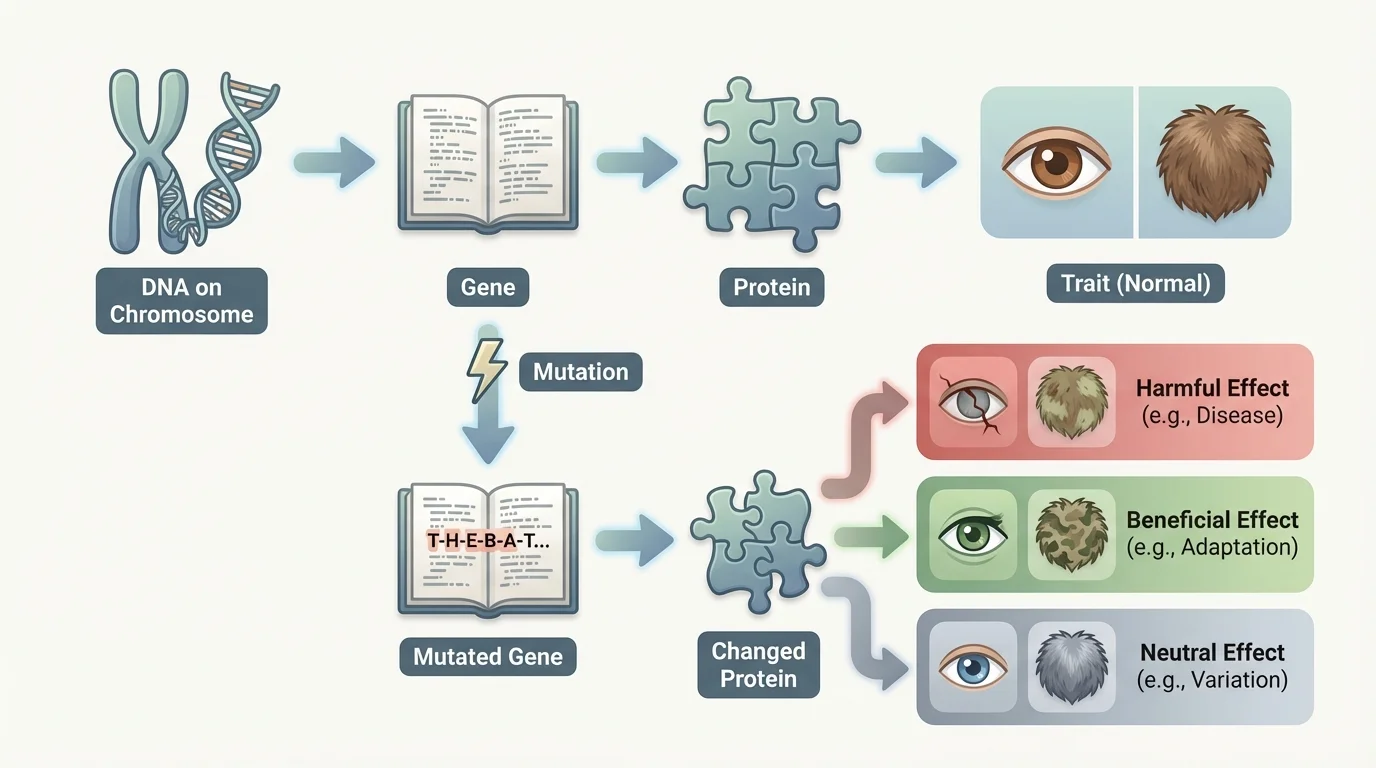
If the structure of a gene changes, the structure and function of the protein it codes for may also change, which can affect the trait.
Remember, traits also depend on the environment. For example, two plants with the same genes for tall height might grow differently if one gets much more water and sunlight than the other. Our model focuses on how gene changes affect traits, but we must keep the environment in mind too.
A mutation is a structural change in a gene located on a chromosome. This means that the gene's instructions are altered in some way.
Think of a long sentence in a set of instructions. If some letters are changed, removed, or added, the sentence might still make sense, or it might become confusing or mean something new. A mutation is like this kind of change in the DNA "sentence" of a gene.
Important points about mutations:
When a mutation remains in a gene, it becomes part of that cell's DNA. If that cell makes eggs or sperm, the mutation can be passed to the next generation. That is how new versions of genes appear in populations over time.
Now we connect our model — Gene → Protein → Trait — to mutations. A structural change in a gene can lead to a structural change in the protein it helps build. As shown in [Figure 2], this can change how well the protein does its job.
We can use a simple flowchart model to show three main possibilities after a mutation: harmful effect, beneficial effect, or neutral effect.
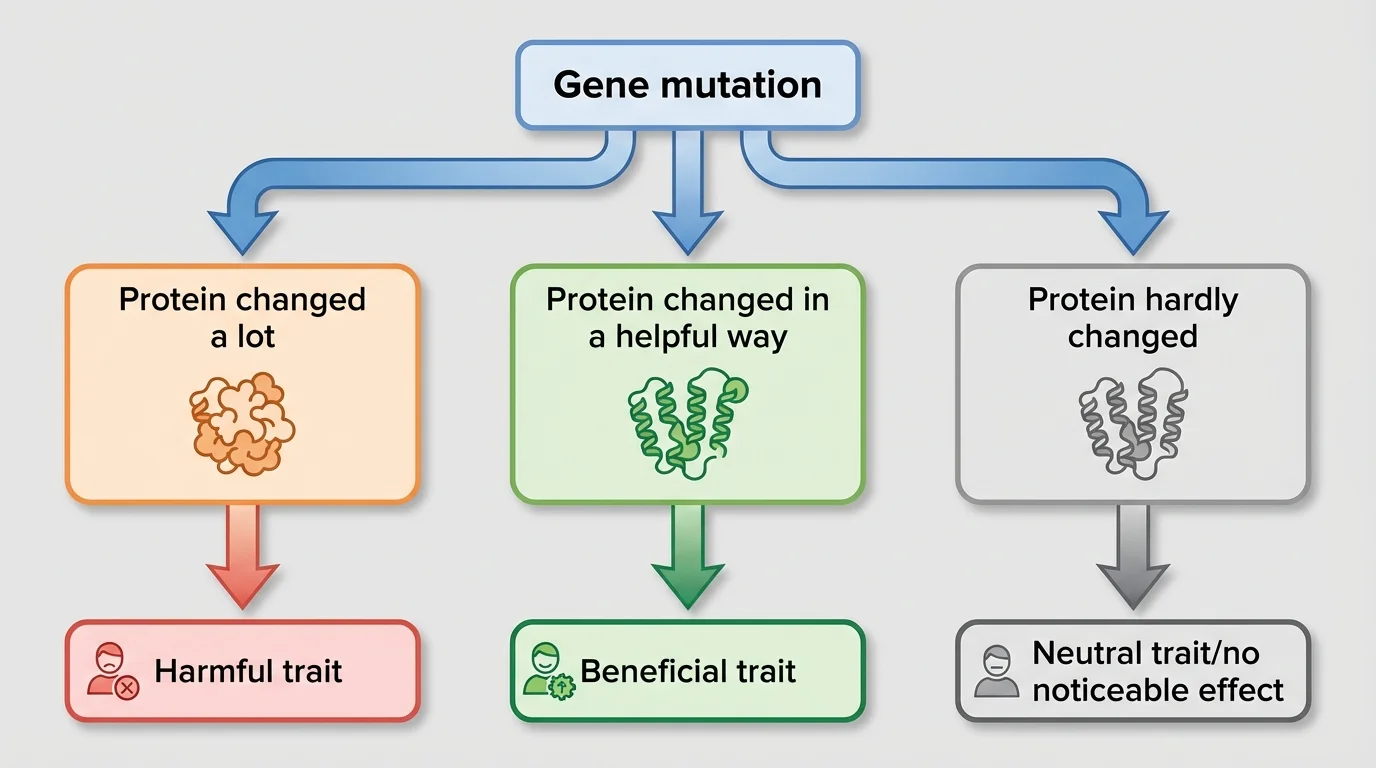
Sometimes a mutation occurs in a part of the DNA that does not strongly affect any protein. In that case, the mutation is very likely to be neutral.
Remember that our model is simplified. In real life, one gene can influence more than one trait, and traits can depend on several genes. But even with this simple model, we can describe and predict many mutation effects.
Many people think all mutations are bad. That is not true, but some mutations are harmful. A harmful mutation leads to a protein that does its job poorly or not at all, causing problems for the organism.
Examples of harmful mutation effects include:
In each of these cases, the path in our model looks like this:
Mutated gene → Faulty protein → Harmful trait → Lower chance of survival or reproduction
Case study: Harmful mutation in an enzyme protein
Some people have a mutation in a gene for an enzyme (a protein that speeds up chemical reactions) that helps the body break down certain substances in food.
Step 1: The gene on a chromosome changes in structure.
Step 2: The enzyme protein made from that gene is shaped differently and works less well.
Step 3: The person may have trouble digesting certain foods and feel sick after eating them. This trait can be harmful, especially in areas where that food is a major part of the diet.
This example follows the harmful branch of the mutation model.
If a harmful mutation strongly reduces survival or the ability to have offspring, it is less likely to be passed on, because individuals with that mutation leave fewer descendants.
Some mutations are beneficial. They lead to proteins that help the organism survive or reproduce better in a certain environment. These are very important in evolution over many generations.
Examples of beneficial mutation effects include:
Here the path in our model looks like this:
Mutated gene → Improved or new protein function → Beneficial trait → Higher chance of survival or reproduction
Some bacteria can survive powerful antibiotics because of beneficial mutations in their genes. These changes alter proteins in a way that stops the medicine from working well, which is a big challenge in modern medicine.
Because organisms with beneficial mutations survive and reproduce more, they can pass these helpful gene versions to many offspring. Over many generations, this can make the beneficial gene version more common in the population.
Not every mutation has a big impact. Many mutations are neutral, meaning they do not noticeably change how well the organism survives or reproduces.
Neutral outcomes can happen when:
For example, imagine a gene that helps decide whether a human has attached earlobes or free earlobes. A mutation might change this trait, but in most environments, earlobe shape does not affect survival or reproduction. This would be neutral.
In our model, the neutral path looks like:
Mutated gene → Similar protein or unimportant change → Neutral trait → No big change in survival or reproduction
Neutral mutations still add to the genetic variety in a population. Even if they do not matter now, they might become helpful or harmful if the environment changes in the future.
Whether a mutation is helpful, harmful, or neutral often depends on the environment. As shown in [Figure 3], a mutation that is beneficial in one place or time might be harmful in another.
The story with rabbits in snowy and forest environments shows that the same color trait can switch from helpful to harmful depending on the surroundings.
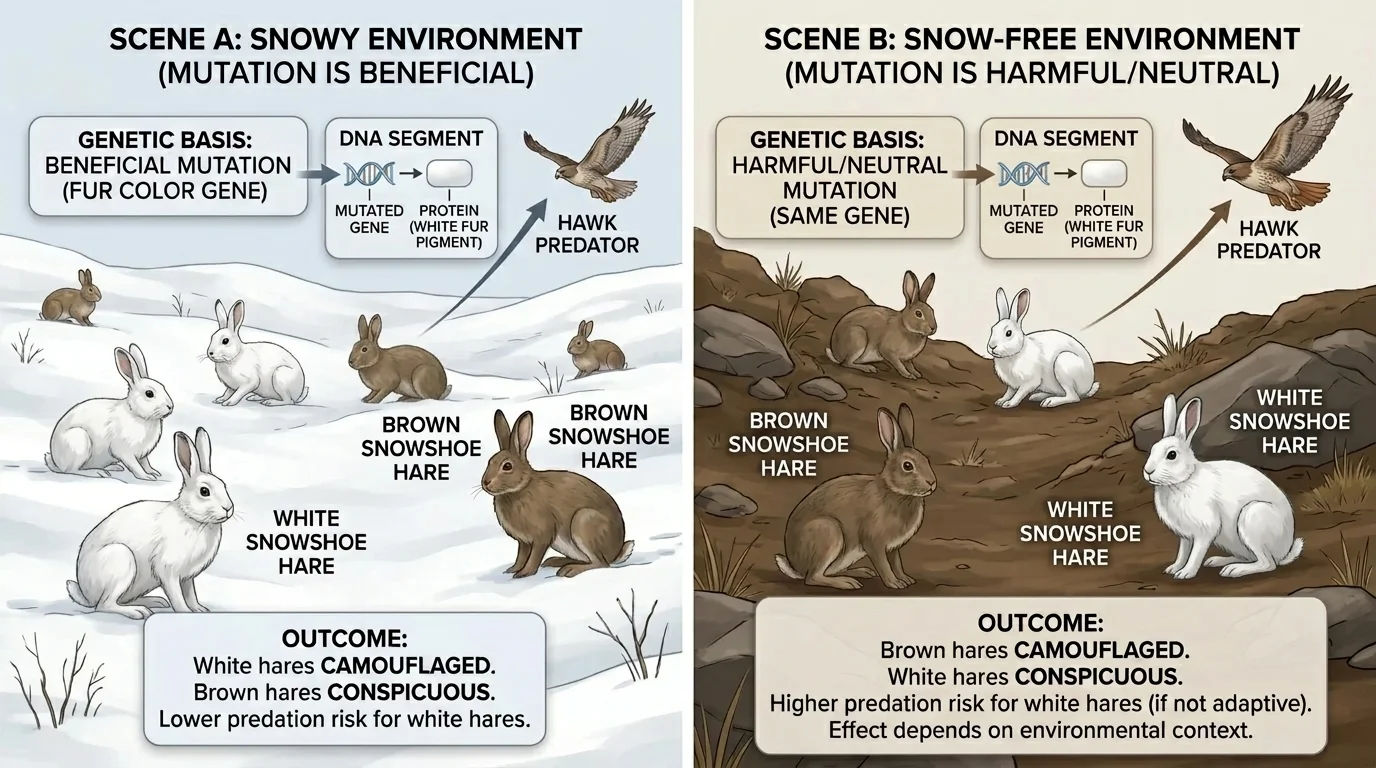
Imagine a group of rabbits. A mutation in a gene involved in fur color creates a new fur pattern:
This connection between mutations, environment, and survival is part of natural selection. Natural selection is the process where traits that help survival and reproduction become more common in a population over many generations.
Here is how the steps fit together:
Over long periods of time, this process can change the average traits in a population. The simple models you saw in [Figure 1] and [Figure 2] still apply: mutations change genes, which may change proteins and traits, and the environment decides which changes are helpful or harmful.
You can develop and use models to think like a scientist about mutations. Models help you organize your thinking and make predictions.
One useful model is a cause-and-effect chain written as simple boxes and arrows, like this (in words):
Start: Gene structure → Protein structure and function → Trait → Effect on survival and reproduction
When you are given a scenario, you can move along this chain and decide whether the mutation is likely harmful, beneficial, or neutral.
Example model: Salt-tolerant plant
Suppose a plant lives near the ocean where the soil is salty. A mutation occurs in a gene related to how its roots handle salt.
Step 1: Gene change A gene on one chromosome in some plants changes in structure.
Step 2: Protein change The new version of the protein in the roots is better at dealing with salt.
Step 3: Trait change These plants can grow in soil with higher salt levels than other plants of the same species.
Step 4: Survival and reproduction In salty areas, plants with the mutation survive and produce more seeds. The mutation is beneficial in this environment.
By following the model, you can clearly explain why this mutation helps in salty soil.
Notice how the same mutation might be neutral or even slightly harmful in normal soil, where high salt tolerance is unnecessary and might use extra energy. This shows why our models must always include the environment.
Example model: Neutral mutation in fur pattern
A small wild animal has a mutation in a gene affecting the exact pattern of stripes in its fur.
Step 1: Gene change The gene's structure on one chromosome is slightly changed.
Step 2: Protein change A protein affecting fur pigment changes a little, producing a slightly different stripe pattern.
Step 3: Trait change The animal now has slightly thinner stripes, but its overall color matches the environment just as well as before.
Step 4: Survival and reproduction Predators notice this animal no more or less than others. It finds food and mates normally. The mutation is neutral.
Our model helps us explain why some gene changes do not really affect the organism's success.
Knowing how structural changes to genes can affect proteins and traits has many real-world uses.
Across all these examples, the same core idea appears: structural changes in genes can change proteins, which can change traits. Depending on the environment and the role of the affected protein, those changes may be harmful, beneficial, or neutral.
