An adult fish, a chicken, and a human do not look much alike. But when scientists compare their early embryos, surprising similarities appear. That is one reason embryo studies are so important in life science: they can reveal connections among living things that are hard to see in adult bodies. By studying pictures of embryos, scientists look for shared patterns in development and use those patterns as evidence of relationships among species.
Embryological development is the process by which an organism grows and changes before birth or hatching. In many animals, especially vertebrates, early embryos share a basic body plan. Vertebrates are animals with backbones, such as fish, amphibians, reptiles, birds, and mammals.
When scientists compare embryos, they are not just noticing that they are all small. They are looking at the embryo stage to see whether major visible structures appear in similar ways. These visible structures might include a tail, a large head, a curved body, body segments, or small limb buds. If several species show the same general pattern early in development, that pattern can suggest that they share an evolutionary history.
Embryo is an early stage in the development of an animal.
Embryology is the study of embryos and how they develop.
Pictorial data means information shown in pictures, diagrams, or image sets that can be analyzed for patterns.
This does not mean embryos of different species are exactly the same. They are not. Instead, scientists ask whether there are enough important visible similarities to suggest a connection. These similarities can be especially useful because adult organisms may become highly specialized. For example, an adult bat wing, whale flipper, and human arm look quite different in shape and use, but earlier developmental stages may show stronger clues that these structures are related.
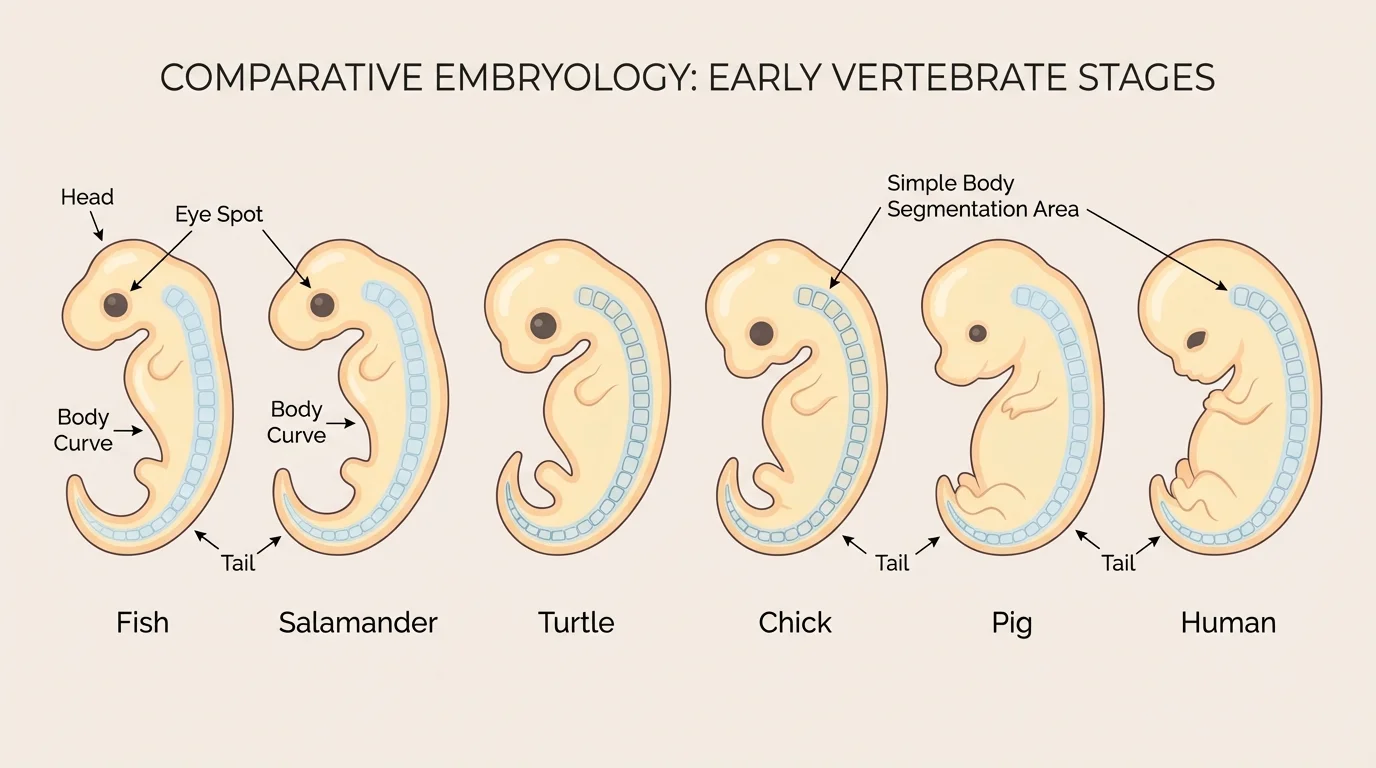
As [Figure 1] shows, scientists analyze pictorial data by comparing embryos side by side so repeated body patterns are easier to notice. They make sure the pictures are arranged at similar stages of development and from similar viewing angles. If one embryo is shown much later than another, the comparison may not be fair.
Students studying embryo images should focus on overall visible anatomy. That means the visible body structures, not tiny cells, genes, or chemical signals. Useful visible features include body shape, the presence of a tail, the size of the head compared with the body, visible eye areas, body segmentation, and early limb buds.
A good comparison asks questions such as: Which embryos have a curved body? Which show a tail? Which have visible limb buds? Which have similar proportions of head to body? Which begin to look different later? By answering questions like these, students can find patterns across multiple species without going beyond what the images clearly show.
Scientists also pay attention to what they cannot conclude from a picture. A single image cannot prove the full evolutionary story of a species. Instead, embryo comparisons are one piece of evidence that becomes stronger when combined with fossils, adult anatomy, and other scientific data.
Earlier studies of fossils show that life on Earth has changed over long periods of time. Fossils provide evidence of organisms from the past, while embryo comparisons provide evidence from living organisms developing today.
That is why careful observation matters. If two embryos look alike in several major features, that pattern is more meaningful than one tiny resemblance. Scientists look for multiple shared traits, not just one.
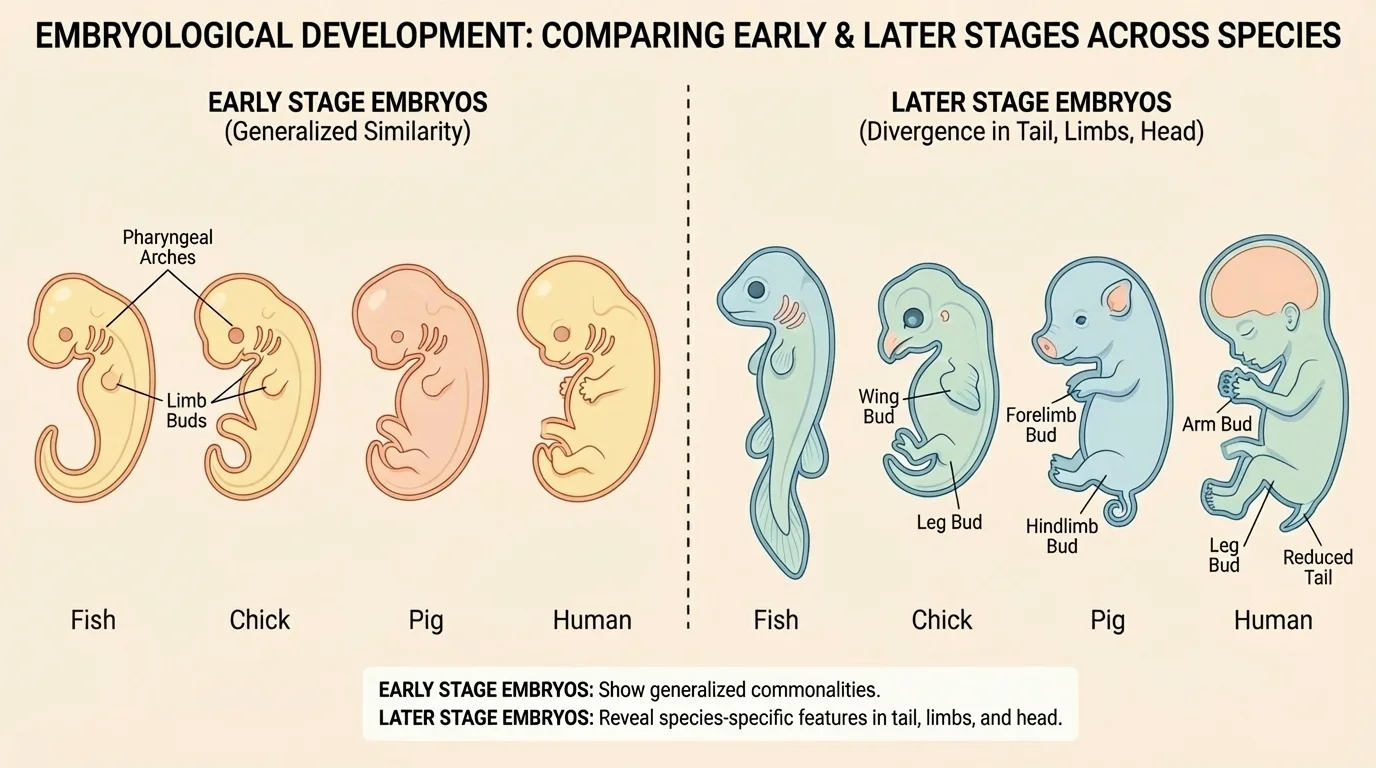
As [Figure 2] illustrates, several vertebrate embryos share a similar basic body plan early in development. For example, early fish, salamander, turtle, chick, pig, rabbit, and human embryos often show a curved shape, a relatively large head, and a tail-like extension. These similarities are not obvious when you compare the adult animals.
An adult fish is built for swimming, a chick develops into a bird with feathers and wings, and a human grows into a walking, talking mammal. Looking only at adults, a student might think these organisms have little in common. But their early embryos can reveal that they begin with some similar visible structures.
Another visible similarity is that some embryos show early bulges where limbs or fins will develop. At first, these structures may appear as small buds rather than full legs, wings, or arms. Their early appearance in similar body positions gives clues that these parts are related in the broad pattern of vertebrate development.
Embryos also often change from looking more alike to looking more different. As development continues, each species follows its own path. A fish embryo becomes more fish-like, with features suited to aquatic life. A bird embryo becomes more bird-like. A mammal embryo develops features that fit mammal life. This pattern matters: early similarity followed by later difference can reveal shared ancestry along with later specialization.
When students compare species, the goal is not to rank them as "more advanced" or "less advanced." All living species are adapted to their own ways of life. The purpose is to identify patterns of similarity and difference that help explain how species may be related.
Some of the strongest similarities among vertebrate embryos appear before the animals begin to look anything like the adults we know. That is one reason embryo pictures have played an important role in the study of evolution.
As seen earlier in [Figure 1], comparing many species at once makes repeated patterns stand out more clearly than comparing only two species. A broad set of images helps scientists notice which features are shared widely across vertebrates and which are unique to smaller groups.
Development is a process, not a single snapshot. If students analyze only one picture from one stage, they may miss the bigger pattern. Scientists often compare embryos from early, middle, and later stages to see how similarities and differences unfold over time.
In early stages, several vertebrate embryos may look surprisingly alike. In later stages, species-specific traits become easier to see. This does not weaken the evidence from embryology. Instead, it strengthens it, because it shows both unity and diversity in life. There is unity in the shared early patterns and diversity in the later differences.
Why early stages matter
Early development often reveals the basic organization of the body before specialized structures fully form. That is why an embryo may display relationships that are harder to notice in the adult organism, whose body has changed to fit a very specific environment or lifestyle.
For example, adult whales, bats, cats, and humans move in very different ways. Yet when scientists compare their development, they can find shared early limb patterns that point to related structures. In this lesson, the focus stays on visible embryo appearance rather than detailed internal or molecular processes.
Scientists use comparative embryology to build evidence-based ideas about how species are related. If two species share several embryo features and show similar changes across development, that can suggest a closer relationship than either has with a species showing fewer similarities.
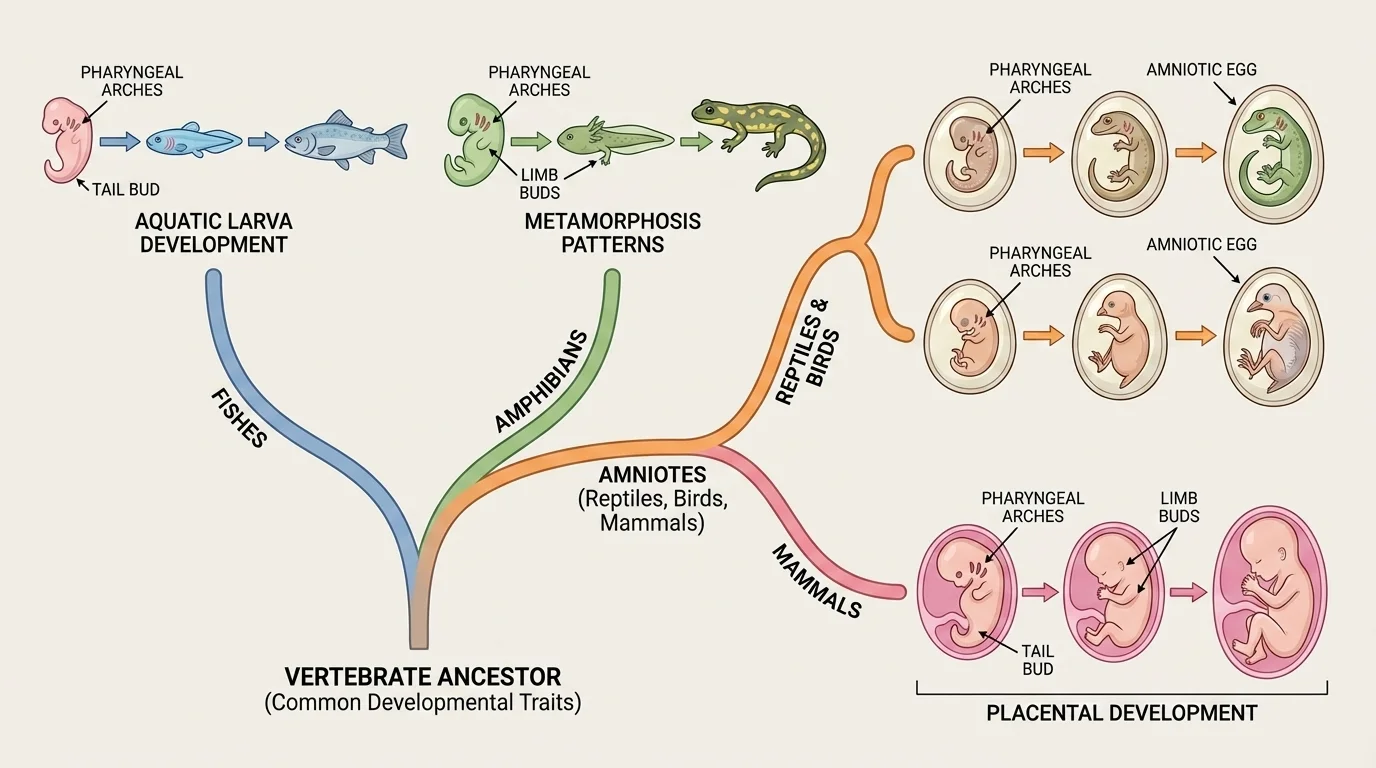
As [Figure 3] suggests, this idea connects to common ancestry, the concept that different species can descend from shared ancestors in the distant past. If many vertebrates begin development with similar visible patterns, that supports the idea that they inherited a basic developmental plan from ancestral vertebrates.
Embryo comparisons can reveal relationships that are hidden by adult adaptation. Consider a bird and a reptile. Their adults differ in major ways, but embryo patterns may show similarities that help scientists recognize their relationship. In the same way, mammals that look very different as adults may still share noticeable embryo features.
This does not mean scientists decide relationships from embryo pictures alone. Instead, embryo evidence works with other evidence. Still, embryo comparisons are especially powerful because they show how structures appear during development, not just how they look at the end.
Case study: comparing four embryos
A student examines images of a fish, chick, pig, and human embryo at a similar early stage.
Step 1: Identify shared visible features.
The student notes that all four have a curved body, a noticeable head region, and a tail-like extension.
Step 2: Look for developing structures.
The student observes that some also show early limb or fin buds in similar body positions.
Step 3: Compare later images.
In later stages, the embryos become more different. The fish becomes more streamlined, while the chick, pig, and human show different limb and head development patterns.
Step 4: Draw a careful conclusion.
The student concludes that the species share important early developmental similarities, suggesting evolutionary relationships not obvious from adult appearance alone.
Later, when scientists compare these observations with fossil evidence and adult anatomy, they can make stronger explanations about how groups of organisms are connected over time.
Embryology is one line of evidence in evolutionary biology. Another major line of evidence comes from fossils, which are preserved remains, traces, or mineral replacements of organisms from the past. Fossils reveal that organisms have changed over long spans of Earth's history.
When fossil evidence and embryo evidence point in the same direction, scientists gain confidence in their explanations. For example, fossils can show that groups changed over time, while embryos can show that living members of those groups still share deep developmental patterns.
| Type of evidence | What scientists compare | What it can reveal |
|---|---|---|
| Embryology | Visible embryo structures across species | Shared developmental patterns and possible relationships |
| Fossils | Preserved remains or traces from the past | Changes in organisms over time |
| Adult anatomy | Body structures in fully formed organisms | Similar structures and adaptations |
Table 1. A comparison of three major types of evidence used to study relationships among organisms.
For middle school science, it is enough to understand that no single kind of evidence tells the whole story. Scientists strengthen conclusions by combining observations from living organisms and the fossil record.
As shown in [Figure 3], relationship diagrams are based on evidence. Embryo similarities help scientists decide which groups may share a more recent ancestor, while fossils help place those relationships into Earth's history.
Scientific thinking requires care. Some old drawings of embryos were too simplified, which reminds us that scientists must use accurate images and fair comparisons. Modern science depends on careful observation and multiple sources of evidence.
Students should also remember the limits of this topic. The focus is on the overall visible anatomical structures in embryo images. That means noticing visible patterns, not studying genes, molecules, or microscopic details. Staying within that boundary helps make the comparisons clear and evidence-based.
"Science is a way of thinking much more than it is a body of knowledge."
— Carl Sagan
A careful conclusion sounds like this: "These embryo images show several shared visible features, so the species may be related." A weak conclusion would be: "These species are identical" or "One picture proves the whole evolutionary history." Good science avoids exaggeration.
Embryo comparisons matter because they help us see the hidden framework of life. Adult organisms can look very different because they are adapted to different habitats and ways of living. But during development, they may reveal a common starting pattern that connects them as members of the same larger branches of life on Earth.
