A single fossil shell trapped in rock can tell a story older than humans, older than dinosaurs, and even older than many mountains. Scientists have found fossils of tiny sea creatures on mountaintops and giant reptile bones in deserts that were once wetlands. These discoveries are not isolated curiosities; together they form a record of life stretching back across Earth's history.
The fossil record is the collection of fossils and their arrangement in time. The fossil record includes not just the fossils themselves, but also where they are found in rock layers and how old those rocks are. By studying this record, scientists learn which organisms lived long ago, when they appeared, how they changed, and when some groups disappeared.
A fossil is preserved evidence of past life. Some fossils are parts of organisms, such as bones, teeth, shells, or leaves. Others are signs of activity, such as footprints, burrows, nests, or even droppings. Fossils are especially important because no human observer was present to watch ancient life directly. Fossils act like clues left behind in Earth's rocks.
Fossil record means the full collection of fossils and the order in which they appear in Earth's rocks. It provides evidence about the existence, diversity, extinction, and change of living things through time.
The fossil record supports the idea that life on Earth has changed over long periods. Some species in the record still exist today, but many do not. Entire groups, such as trilobites and non-avian dinosaurs, appear in the record and then vanish. This pattern shows that Earth's living world has never stayed exactly the same.
Most living things do not become fossils. Usually, bodies decay, are eaten, or are broken apart. [Figure 1] Fossils form only under special conditions, often when an organism is buried quickly by mud, sand, or ash. This process of fossilization can preserve hard parts especially well through several common pathways, including molds, casts, petrified remains, and trace fossils.
For example, a shell may sink into soft mud. Over time, more sediment covers it. The shell might dissolve away and leave a hollow space called a mold. If minerals later fill that space, they create a cast. In other cases, minerals carried by water seep into buried wood or bone and slowly replace the original material, creating a stone-like fossil. Footprints preserved in mud that later hardens into rock are called trace fossils because they record behavior rather than body parts.
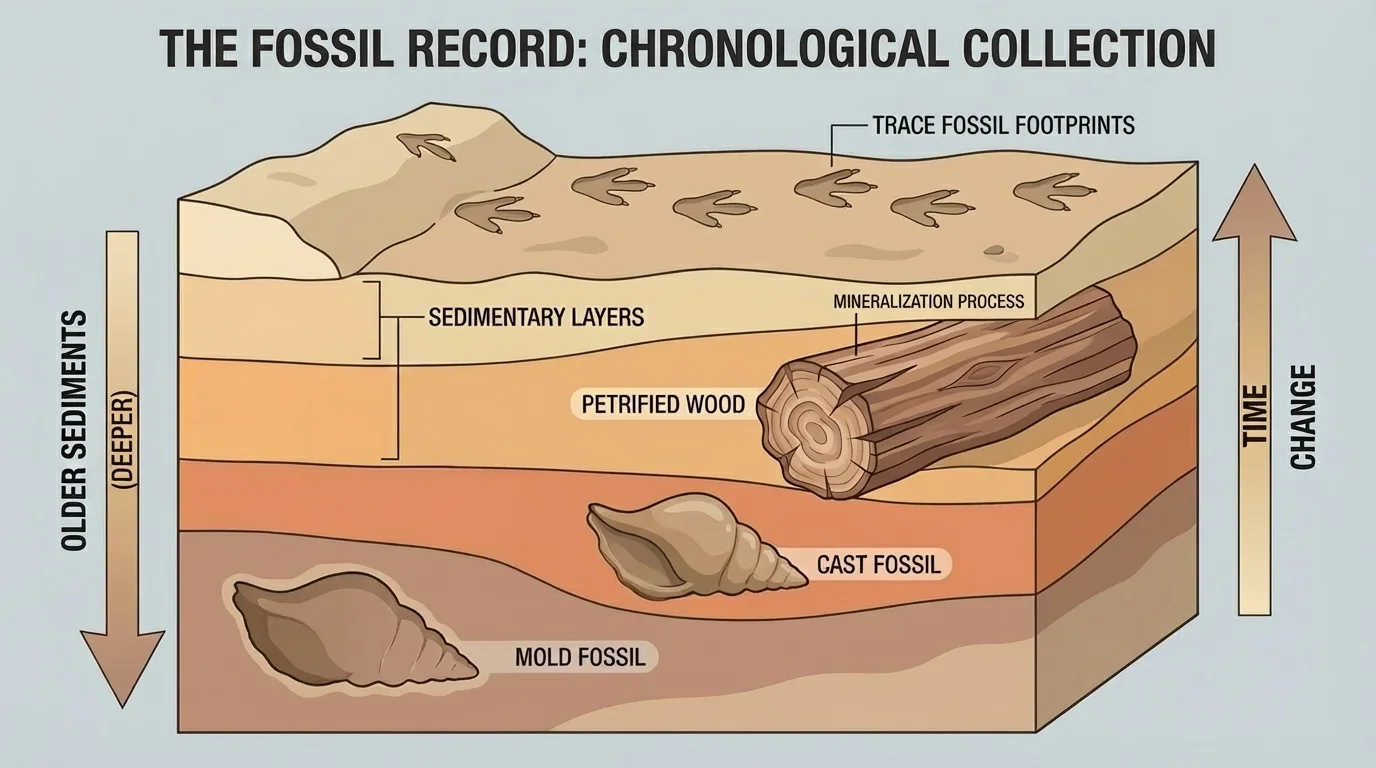
Fossils are often found in sedimentary rock, which forms from layers of sediment that build up over time. Igneous rocks form from cooled melted rock, and metamorphic rocks form under intense heat and pressure. These processes usually destroy remains, so sedimentary rocks are the best places to look for fossils.
Soft-bodied organisms, such as jellyfish or worms, are less likely to fossilize than organisms with shells or bones. That means the fossil record is incomplete. It contains many important clues, but it does not preserve every organism that ever lived. Scientists must work carefully with the evidence they do have.
Some fossils preserve incredible details, including feather impressions, skin patterns, and even stomach contents. Rare fossil discoveries can reveal not only what an organism looked like, but also what it may have eaten.
This incompleteness matters because it reminds us that missing fossils do not mean missing life. It means preservation is rare. Even so, when scientists find fossils in many places and layers, strong patterns begin to appear.
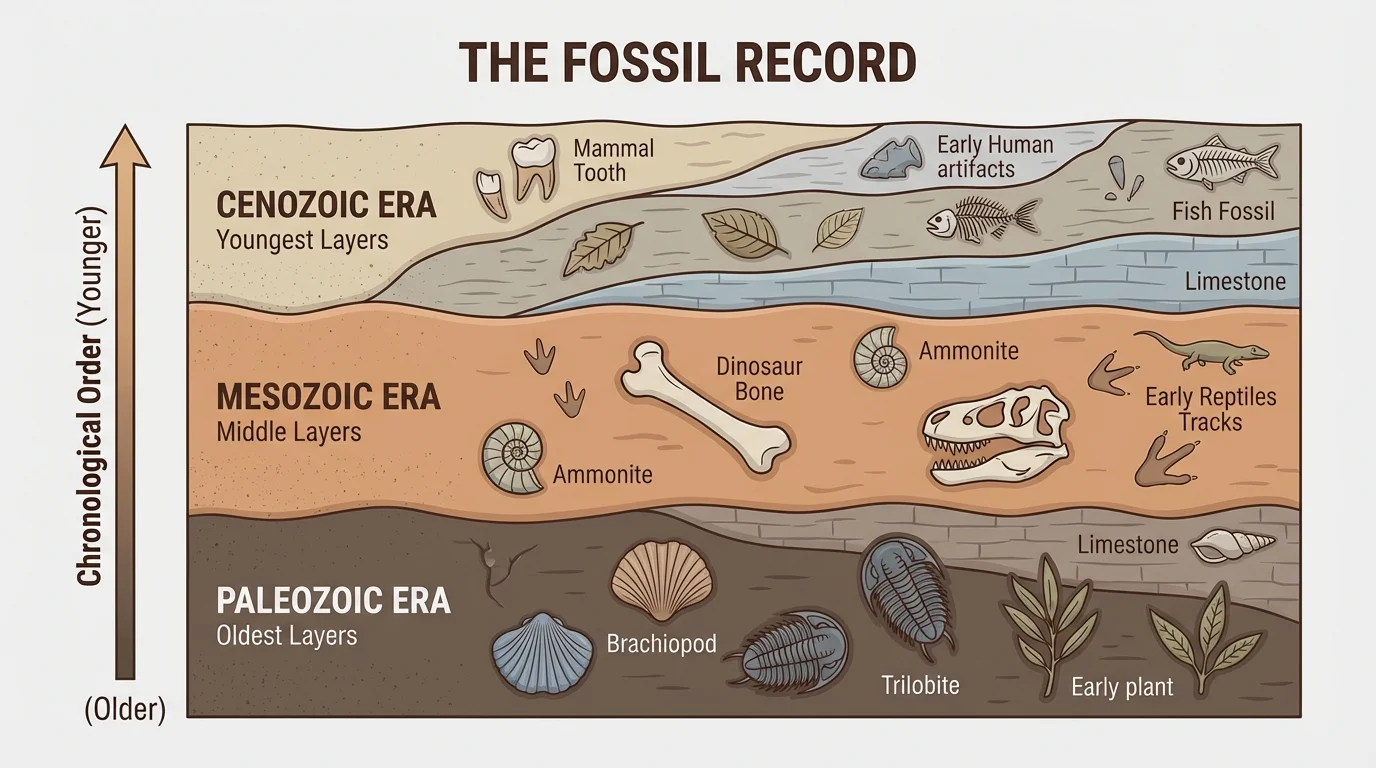
One of the most important ways scientists organize the fossil record is by studying rock layers. In many places, sediments settle one layer at a time, so lower layers usually formed earlier than upper layers. This idea, shown clearly in [Figure 2], helps scientists place fossils in relative order, from older to younger.
This method is called relative dating. It does not give an exact age in years. Instead, it tells whether one fossil or rock layer is older or younger than another. A basic rule used here is the law of superposition: in an undisturbed stack of sedimentary layers, the oldest layers are at the bottom and the youngest are at the top.
Suppose a fossil fern is found below a fossil dinosaur bone. If the layers have not been flipped or heavily disturbed, the fern fossil is older than the dinosaur fossil. Scientists can compare many locations this way and build a wider timeline of life.
Scientists also use index fossils. These are fossils of organisms that were widespread but lived for a relatively short time. If the same index fossil is found in two different places, scientists can often match those layers as being about the same age. This is useful when rock layers are far apart.
Rock layers act like pages in a history book. They do not tell every detail, but they preserve a sequence. By reading the sequence, scientists can track when groups first appear, become common, or disappear from the record.
| Method | What it tells scientists | Example |
|---|---|---|
| Layer position | Whether a fossil is older or younger than another | A fossil in a lower layer is usually older |
| Index fossils | Whether distant rock layers formed at about the same time | The same short-lived marine fossil appears in two places |
| Rock comparison | How environments changed from one layer to the next | Marine shells below land-plant fossils show a changing habitat |
Table 1. Ways scientists use sedimentary rock layers to place fossils in chronological order.
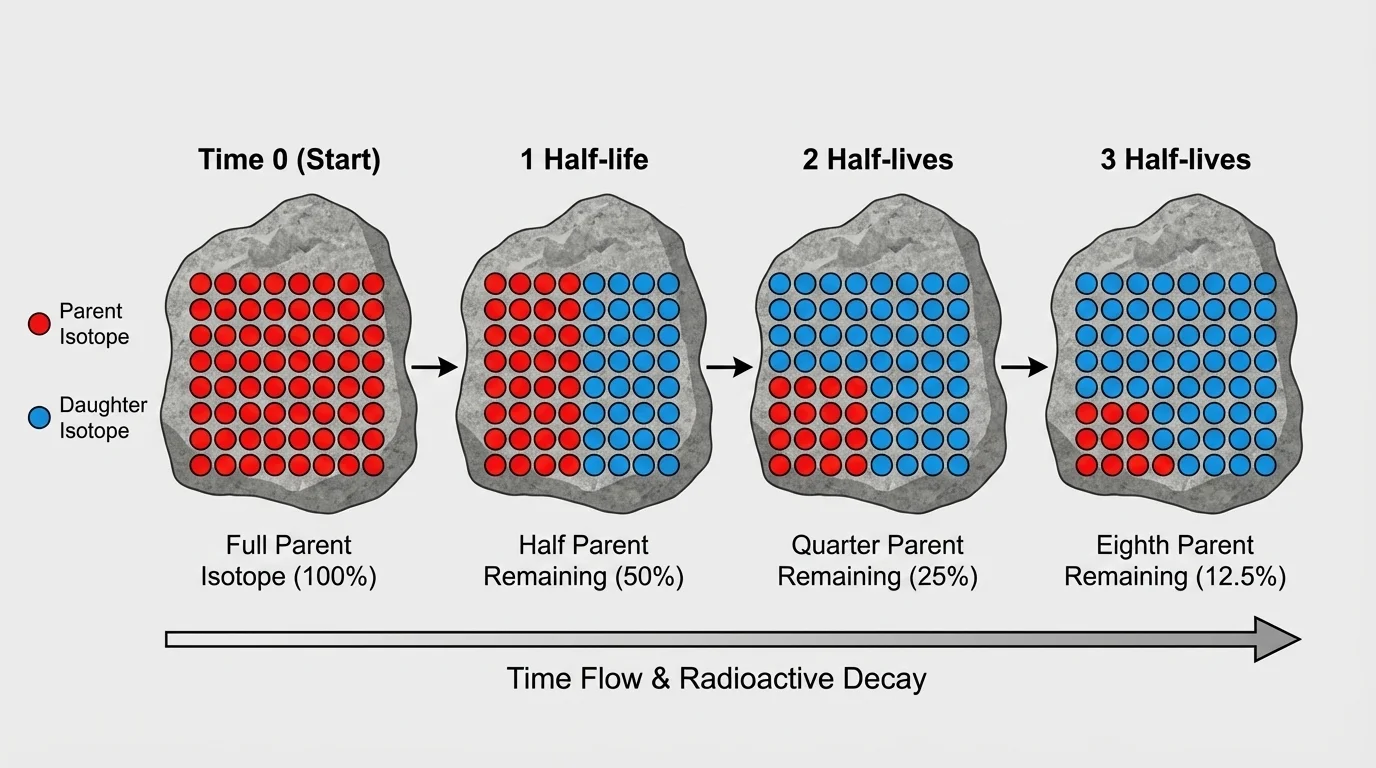
[Figure 3] Relative dating places fossils in order, but scientists often want to know actual ages in years. To do that, they may use radioactive dating. This method uses unstable atoms called radioactive isotopes, which change into other atoms at a steady rate. The time it takes for half of the original atoms to change is called a half-life. The figure illustrates this repeating pattern.
Some fossils themselves are not dated directly, especially if they are very old. Instead, scientists often date nearby igneous rock layers, such as a layer of volcanic ash above or below the fossil-bearing sediment. If the ash layer above a fossil is younger and the ash layer below is older, the fossil's age must fall between those dates.
How half-life helps measure age
If a radioactive isotope has a half-life of 1,000 years, then after 1,000 years half of the original atoms remain. After another 1,000 years, half of that remaining half is left, so only one-fourth remains. The regular pattern lets scientists estimate the age of rocks.
Here is a simple example. Imagine a rock sample begins with an amount of radioactive parent isotope equal to 100 units. After one half-life, 50 units remain. After two half-lives, 25 units remain. After three half-lives, 12.5 units remain. If scientists measure 25 units of the parent isotope left, they infer that two half-lives have passed. If each half-life is 1,000 years, then the sample age is approximately \(2 \times 1,000 = 2,000\) years.
Different isotopes are useful for different age ranges. Carbon dating works for relatively recent remains and uses carbon isotopes, while much older rocks may be dated with isotopes of uranium or potassium. The exact chemistry is advanced, but the key idea is simple: radioactive change acts like a natural clock.
Radioactive dating is powerful because it gives an estimate of absolute age, not just which layer came first. Combined with rock-layer evidence, it helps scientists build a more accurate history of Earth and its life forms.
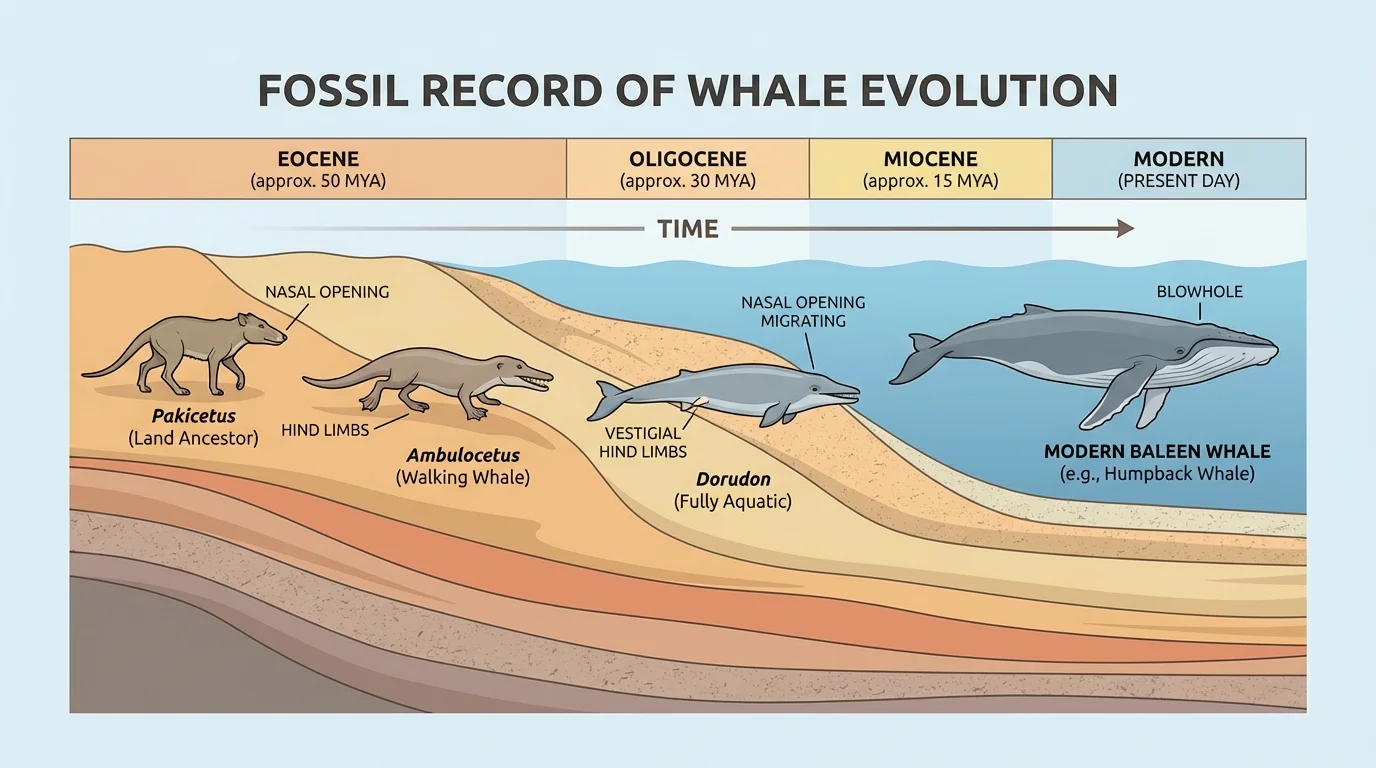
[Figure 4] The fossil record is one of the strongest pieces of evidence for biological evolution. Fossils show that species living today are not the same as the earliest life forms. Over very long times, populations change, new species appear, and others disappear. These patterns are visible across many layers and locations. The figure presents how a series of related fossils can show change in body structure over time.
Scientists sometimes find transitional fossils, which have features that connect older and newer groups. A transitional fossil does not mean an organism is "halfway finished." It means the fossil shows a mix of traits that helps explain how major groups are related. For example, some fossils of ancient reptiles and birds show both tooth-bearing jaws and feather-like structures. These fossils help scientists understand how bird ancestors are connected to certain dinosaur groups.
Another well-known example involves whales. Modern whales live fully in water, but fossils reveal ancestors with legs and land-living features. Over time, the fossils show changes in limb structure, body shape, and skull features that fit a transition from land environments to aquatic life.
The fossil record also documents diversity. At different times in Earth's history, different groups of organisms became especially common. Ancient seas were filled with trilobites and ammonites. Later, dinosaurs dominated many land ecosystems. Mammals expanded after the extinction of non-avian dinosaurs. These changes show that life on Earth is dynamic, not fixed.
The broader fossil record shows long-term patterns of adaptation to changing environments. Climate shifts, sea-level changes, volcanic activity, and continental movement all affect which organisms survive and reproduce.
The fossil record does not only show individual species. It also reveals huge events in Earth's history. One major pattern is extinction, when a species or group no longer exists. Extinction is part of natural history. Most species that have ever lived are now extinct.
Sometimes extinctions happen gradually. At other times, many groups disappear over a relatively short period, creating a mass extinction. The event that ended the age of non-avian dinosaurs around 66 million years ago is one famous example. Evidence suggests that an asteroid impact, along with environmental changes, played a major role.
Case study: Why a missing fossil can still matter
Suppose scientists study three rock layers. The bottom layer contains many marine shell fossils. The middle layer contains very few fossils. The top layer contains land-plant fossils and footprints.
Step 1: Compare the environments.
The lower layer suggests a sea environment. The upper layer suggests land or shallow shore conditions.
Step 2: Interpret the sparse middle layer.
Few fossils in the middle layer may mean poor preservation, erosion, or a rapid environmental shift rather than absence of life.
Step 3: Connect to the fossil record.
Scientists use all available clues together. They do not assume that a gap in fossils means life disappeared completely from the area.
This kind of reasoning helps paleontologists avoid jumping to conclusions from incomplete evidence.
Environmental changes can alter ecosystems dramatically. If a region becomes colder, drier, deeper underwater, or covered by lava, some species may die out while others spread. The fossil record lets scientists detect these shifts even when they happened millions of years before humans existed.
The record is incomplete, but it is still extremely useful. Think of a long movie with many missing frames. You may not see every moment, yet you can still understand the main action. In the same way, fossils do not preserve every generation, but they clearly show long-term trends.
Living things need resources and suitable environments to survive. When environments change, organisms may adapt, move, or die out. The fossil record preserves evidence of these biological responses across deep time.
This is why the fossil record is central to understanding both the unity and diversity of life. All organisms share life processes and basic biological needs, but the forms of life have changed greatly through Earth's history.
Scientists who study ancient life are called paleontologists. They work in deserts, cliffs, quarries, laboratories, and museums. They excavate fossils carefully, record exact locations, and compare new finds with known species. A fossil's position in rock is often just as important as the fossil itself.
Fossil studies also help in other fields. Certain microfossils can indicate the age of rock layers in oil and gas exploration. Plant and pollen fossils help scientists reconstruct past climates. Fossils found in changing coastlines or dried lake beds can show how habitats shifted over time. These are practical uses of the fossil record in geology, environmental science, and Earth history.
Tiny fossils can be just as important as giant dinosaur bones. Microscopic shells and pollen grains often help scientists match rock layers across large distances and learn what ancient climates were like.
Museums display fossils not just because they are exciting, but because they are evidence. A skeleton in a museum gallery represents years of fieldwork, rock analysis, comparison, and dating. Behind every display is a scientific argument built from many clues.
Protecting fossil sites matters too. If fossils are removed without recording where they were found, scientists may lose the information needed to place them correctly in the fossil record. Context is crucial. A bone without its rock layer tells much less than a bone studied in place.
"The present is the key to the past."
— A guiding idea in geology
This idea means that processes we observe today, such as sediment settling, erosion, and volcanic ash falling, help us interpret ancient rocks and fossils. By combining modern observations with fossil evidence, scientists reconstruct the history of life with increasing detail.
