If every cell in your body contains essentially the same DNA, why does one cell become part of a muscle, another help send nerve signals, and another help protect you from disease? That question leads to one of biology's most powerful ideas: the structure of DNA stores information in a form that can direct the building of proteins, and proteins make possible the activities of cells, tissues, and entire organisms.
Life depends on order. Organisms grow in predictable ways, repair damage, respond to the environment, and reproduce. None of that happens by accident. Inside cells, chemical activities are organized and controlled by proteins. Some proteins help build structures, some help move materials, and some help regulate processes. For cells to work correctly, they must make the right proteins at the right time. DNA is the source of the instructions.
This matters in everyday life. A change in DNA can affect how a body develops. A medical test can sometimes detect a DNA change linked to disease risk. Plant breeders and scientists also use knowledge of DNA to understand why some crops resist drought better than others. The connection between DNA and proteins is not just a chapter in a textbook; it is a central explanation for how living things function.
Cells are the basic units of life, and proteins are major working molecules inside cells. Earlier biology study often introduces the idea that traits can be inherited. This lesson connects those ideas by showing how inherited DNA information can influence the proteins cells make.
To build a scientific explanation, it is not enough to say that DNA is important. We need a chain of reasoning supported by evidence: DNA has a structure suited for storing information, that information determines the order of building blocks in proteins, protein structure affects protein function, and the combined actions of proteins allow specialized cells and living systems to operate.
DNA is a molecule built from repeating subunits called nucleotides. Each nucleotide includes a sugar, a phosphate group, and one nitrogen-containing base. In DNA, there are four possible bases: adenine, thymine, cytosine, and guanine. The molecule forms a double helix, but the most important idea for this topic is that the order of the bases carries information. Just as changing one letter in a digital code can change the output of a computer program, changing the sequence of bases can change biological outcomes.
[Figure 1] The sides of the DNA molecule form a repeating sugar-phosphate backbone, while the bases pair in the center. Adenine pairs with thymine, and cytosine pairs with guanine. This pairing helps DNA be copied accurately, which is essential for inheritance. But DNA is more than a stable molecule for copying. Its sequence allows information to be stored in a precise, linear way.
A gene is a segment of DNA that contains instructions for producing a functional product, usually a protein in the context of this lesson. Different genes have different base sequences. That means different genes carry different instructions. Even though all human DNA uses the same four bases, the enormous variety of base sequences allows cells to store an immense amount of information.
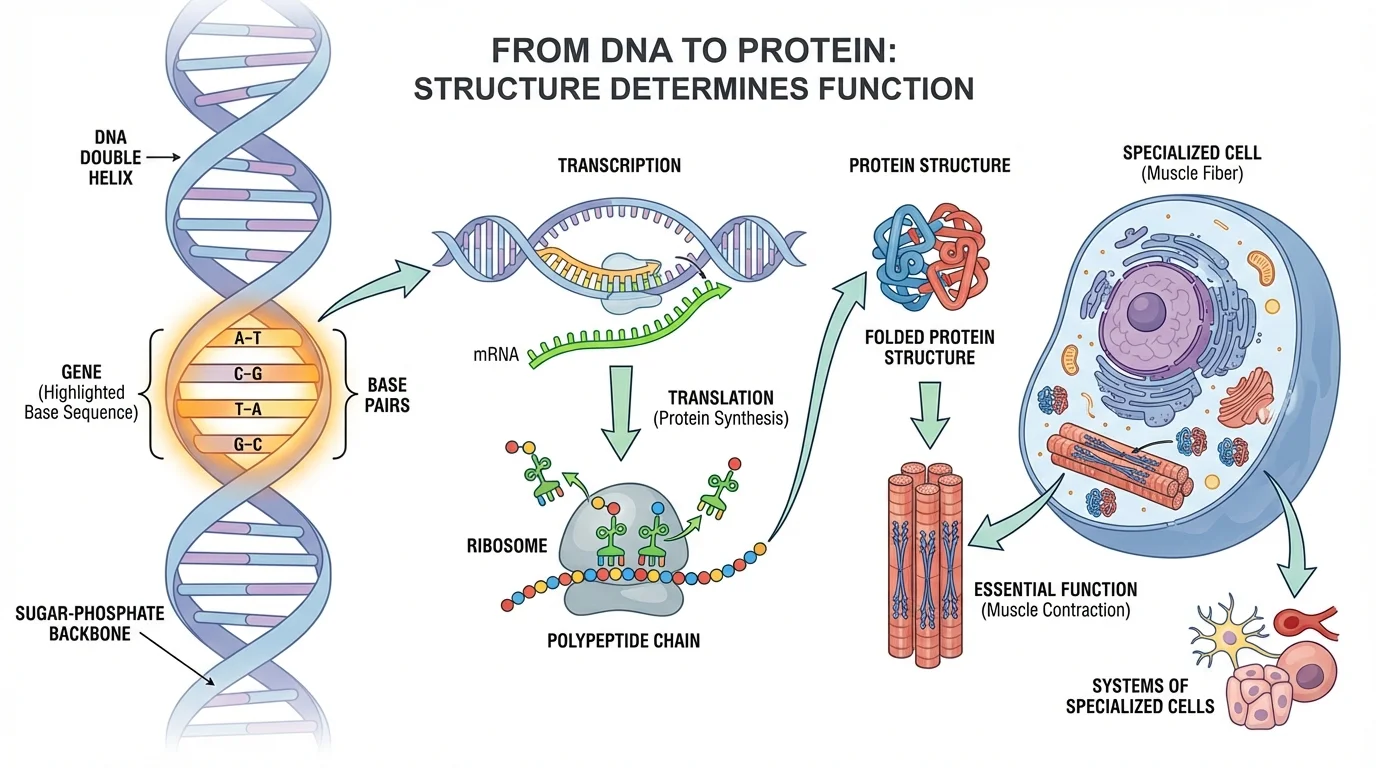
An analogy can help: DNA is not like a pile of ingredients tossed together. It is more like a coded recipe book written in a chemical alphabet of four letters. The elements of the code are simple, but the sequence creates complexity. A small sequence difference can mean a different instruction, and a different instruction can lead to a different protein.
Nucleotide is the repeating unit of DNA, made of a sugar, a phosphate group, and a base.
Gene is a segment of DNA that contains instructions related to making a cellular product.
Sequence is the specific order of bases in DNA.
One important point is that DNA's structure supports its role. Because the molecule is long and made of repeated units, it can store large amounts of information. Because the bases pair specifically, the information can be copied reliably. Because the information is stored in sequence form, the code can specify order in another molecule. That last point is the bridge to proteins.
Proteins are built from smaller units called amino acids. The key explanatory idea is that the sequence of bases in DNA determines the order of amino acids in a protein, as [Figure 2] illustrates. The exact molecular details are complex, but the central principle is straightforward: coded information in DNA is used to specify a particular amino acid sequence.
This is often described as the flow of information from DNA to RNA to protein. For this topic, the most important idea is not the step-by-step chemistry, but the logic of the system. DNA stores information. That information is read using a code. The code links nucleotide sequence to amino acid sequence. Once the amino acids are placed in order, they interact with one another and the protein takes on a specific structure.
Because proteins differ in amino acid sequence, they also differ in structure. And because structure affects function, the DNA sequence indirectly affects what a protein can do. A different gene sequence can produce a different protein, and a different protein can change how a cell behaves.
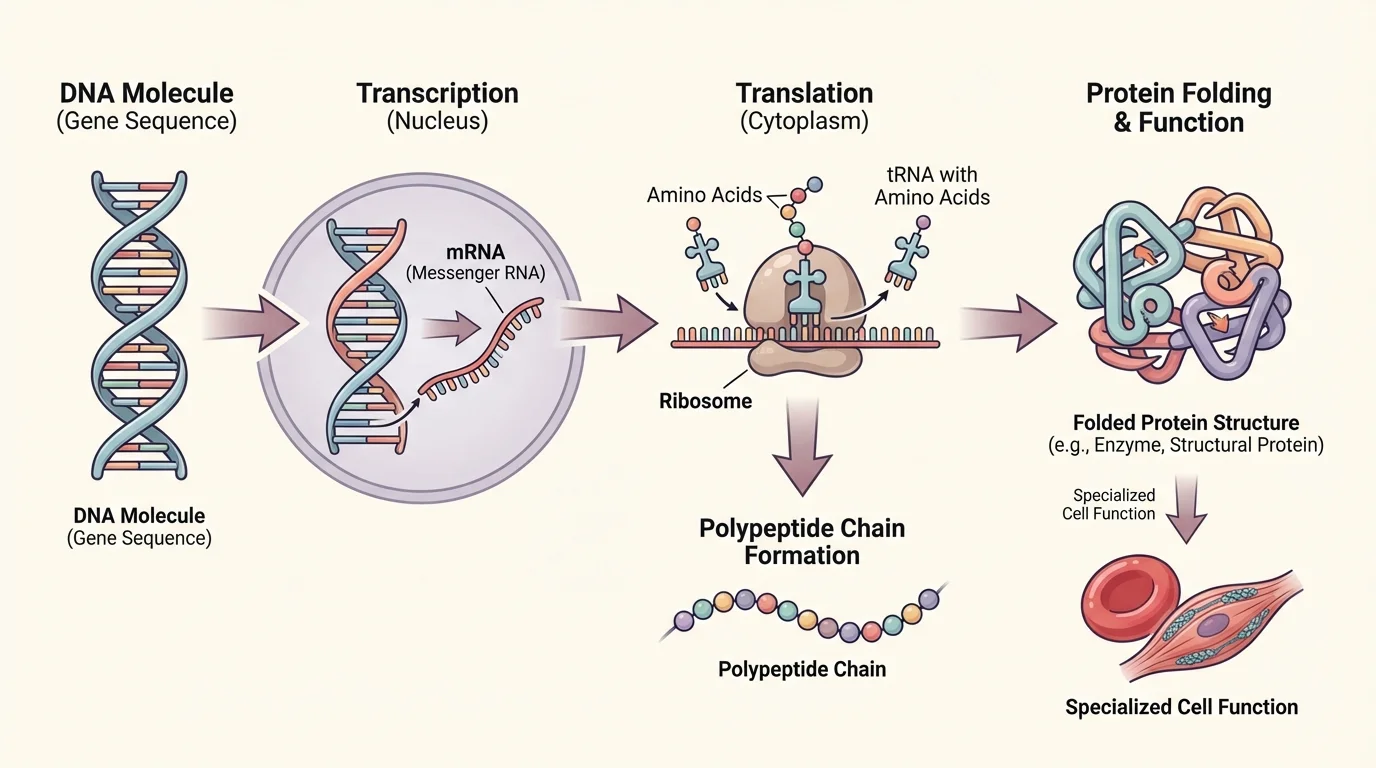
Think about language. The letters in a word matter because order matters. The letters in "tone" and "note" are the same letters arranged differently, but they communicate different meanings. In a similar way, proteins use many of the same amino acids, but different sequences lead to different final structures and different biological roles.
Later in the lesson, when we consider evidence from mutations, we will return to the coding relationship shown in [Figure 2]. That evidence is powerful because it shows that changing the DNA sequence can change the protein that is produced.
The coding relationship
DNA does not directly resemble a protein in shape, but it contains information that determines protein structure. The relationship is similar to how a blueprint does not look like a finished building, yet it specifies the arrangement needed to construct it. In cells, the crucial point is that a change in DNA sequence can lead to a change in amino acid sequence, which can then alter the final protein.
Protein molecules are not just chains; they fold into three-dimensional forms. That shape matters because molecules interact based on structure. If a protein's shape changes, its ability to do its job may change as well. This is why the order of amino acids is so important. The sequence influences how the chain bends, twists, and folds.
A useful scientific explanation therefore works as a chain: DNA base sequence determines amino acid sequence; amino acid sequence influences protein shape; protein shape affects protein function. This chain helps explain why inherited DNA differences can influence traits and why some genetic changes have noticeable effects.
Not every DNA change has a dramatic result. Some changes do not affect the amino acid sequence, and some affect a region that does not strongly alter function. But many important cases show that sequence matters. When sequence changes in a way that changes structure enough to affect function, the consequences can appear at the level of a cell, an organ, or the whole organism.
Some proteins work in only tiny amounts, yet they can still have major effects because they help control larger cellular processes. A small molecular change can therefore have effects far beyond its size.
This is a major theme in biology: microscopic structures can influence macroscopic outcomes. A molecule too small to see directly with your eyes can affect growth, movement, health, or survival. That is one reason molecular biology has transformed medicine and biotechnology.
[Figure 3] Multicellular organisms are made of many cells, but those cells are not all identical in behavior. This figure shows a central idea: many specialized cells contain the same DNA, yet they use different genes at different times. A cell's function depends on which genes are active and which proteins are produced. This selective gene expression helps create specialized cells with different roles.
For example, one type of cell may produce proteins that support contraction, while another produces proteins that help transmit signals, and another produces proteins that help with transport or protection. The assessment boundary here is important: you do not need to memorize many specific cell types or specific protein names to understand the principle. The main point is that different proteins allow cells to perform different functions.
This helps explain the phrase systems of specialized cells. An organism is not just a collection of cells. It is an organized system in which groups of specialized cells work together. Their coordination depends on proteins that carry out structural, transport, signaling, and regulatory roles. DNA, by coding for those proteins, helps make biological organization possible.
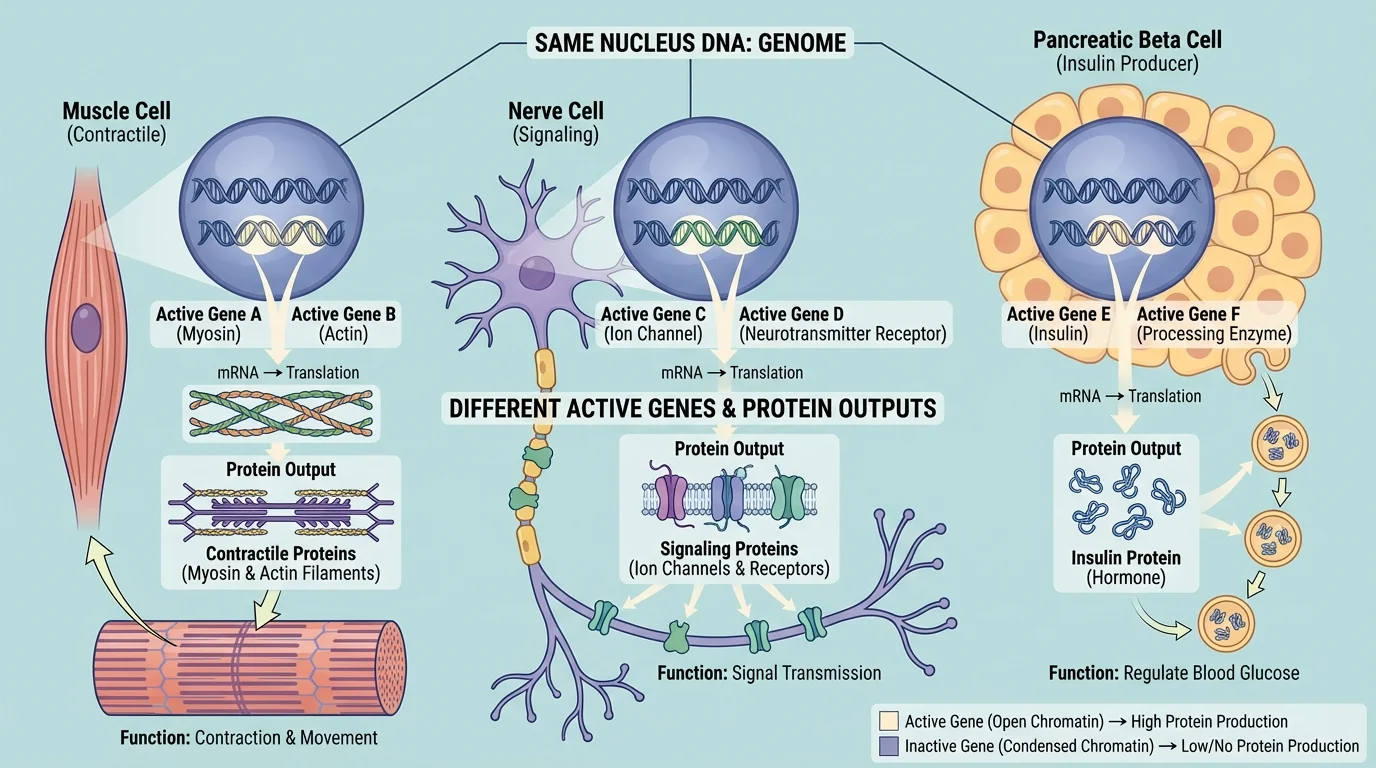
Cell specialization is one reason a single fertilized egg can eventually develop into a complex organism. As cells divide and develop, patterns of gene activity differ. That means different proteins are produced in different cells, leading to different structures and functions. The same underlying DNA can therefore support remarkable diversity within one organism.
The comparison in [Figure 3] also helps explain why damage to gene regulation can disrupt normal function. If the wrong genes are active or inactive, a cell may not produce the proteins it needs in the correct amounts. This can interfere with normal organization and health.
Case study: one genome, many cell functions
Consider an organism developing from a single starting cell.
Step 1: The starting cell copies its DNA as it divides.
Most new cells inherit the same genetic information.
Step 2: Different cells activate different genes.
That means they use different DNA instructions.
Step 3: Different proteins are produced.
Different protein sets lead to different cell structures and activities.
Step 4: Cells become specialized and work in coordinated groups.
Specialized cells form organized living systems.
This example shows how shared DNA can still lead to diverse cell functions.
Scientific explanations are strongest when they are supported by multiple lines of evidence. One of the clearest kinds of evidence comes from mutations, changes in DNA sequence. As [Figure 4] illustrates, a change in the DNA code can alter the amino acid sequence of a protein, which can change its structure and affect cell function. This directly supports the claim that DNA structure determines protein structure.
Inherited disorders provide another line of evidence. In some cases, scientists can trace a change in a gene to a changed protein and then connect that change to altered cellular function. The exact molecular details differ from one case to another, but the pattern is consistent: DNA changes can lead to protein changes, and protein changes can influence organismal traits.
Experimental work also supports this explanation. Researchers can compare DNA sequences among organisms and compare the proteins they produce. Closely related DNA sequences often correspond to similar proteins, while larger DNA differences often correspond to larger protein differences. This pattern makes sense if DNA sequence is the source of protein instructions.
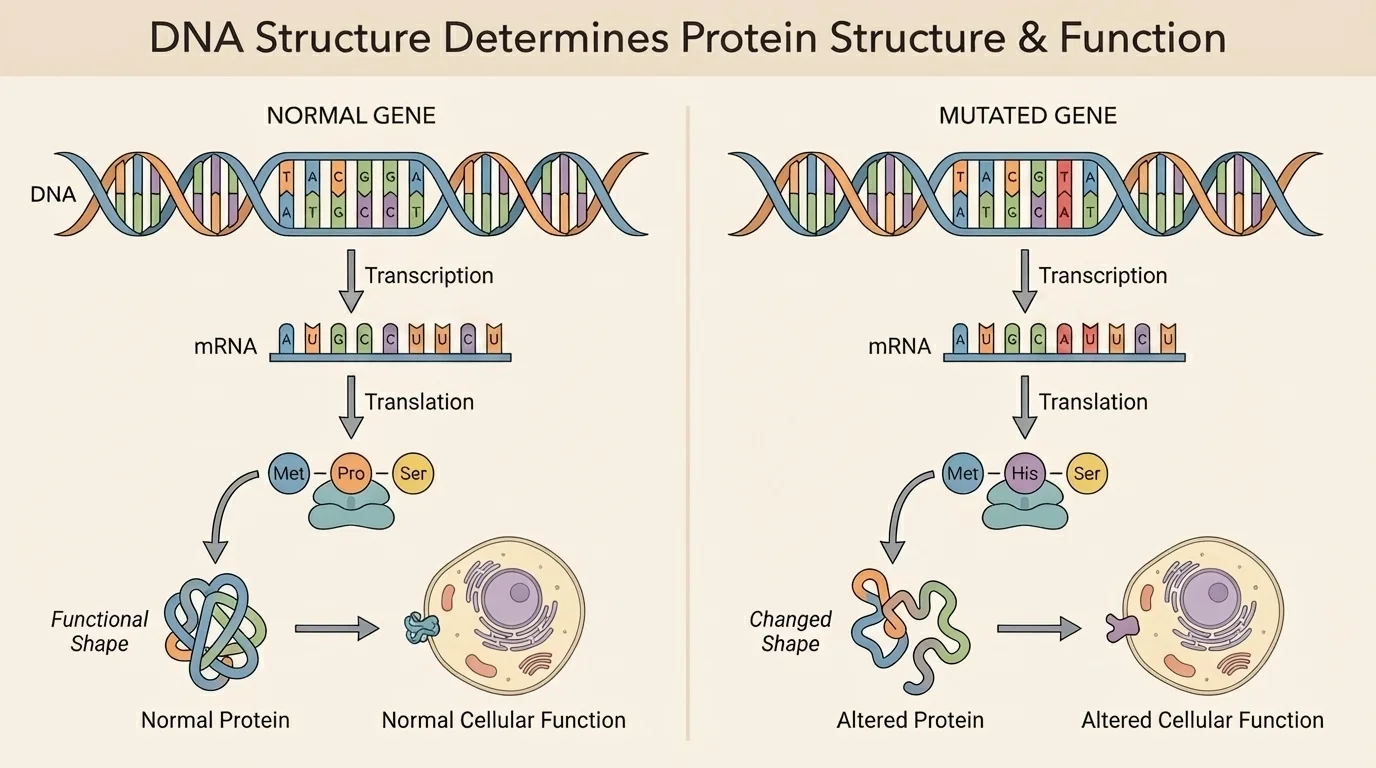
Biotechnology adds even more evidence. When scientists intentionally change a DNA sequence in a controlled setting, they can often observe a predictable change in the resulting protein or in the trait linked to that protein. This does not mean biology is simple; many traits are affected by many genes and environmental factors. But it does provide strong support for the causal link between DNA information and protein outcomes.
The coding relationship introduced earlier in [Figure 2] helps make sense of these results. If DNA truly carries coded instructions for amino acid order, then changing the code should sometimes change the protein. That is exactly what evidence from mutation studies and genetic analysis shows.
| Type of evidence | What scientists observe | What it supports |
|---|---|---|
| DNA sequencing | Different genes have different base orders | Information is stored in DNA sequence |
| Mutation studies | DNA changes can alter traits or cell behavior | DNA changes can affect proteins and function |
| Protein comparison | Different amino acid orders produce different proteins | Protein structure depends on sequence |
| Development and cell specialization | Cells with the same DNA perform different jobs | Different gene use leads to different protein production |
Table 1. Evidence that links DNA sequence, protein structure, and cell function.
An evidence-based explanation is a major goal of science. Rather than memorizing isolated facts, you should be able to connect observations into a cause-and-effect model. Here, the model is powerful because it explains inheritance, development, health, and cellular organization with one connected framework.
Understanding the DNA-protein relationship helps doctors and researchers investigate disease. If a patient has symptoms linked to a protein that is not working properly, scientists may look for a change in the corresponding gene. This can help with diagnosis, risk assessment, and sometimes treatment decisions.
In agriculture, scientists and breeders study DNA variation to understand traits such as resistance to drought, pests, or disease. These traits often depend on proteins that influence how cells respond to environmental stress. By connecting DNA differences to protein-related outcomes, researchers can make more informed choices.
Real-world application: genetic testing
A simplified example shows how DNA information can be used in medicine.
Step 1: A laboratory reads part of a person's DNA sequence.
Scientists compare that sequence with a more common version.
Step 2: They identify a sequence difference in a gene.
This suggests the instructions for a protein may be altered.
Step 3: Researchers study whether the altered protein is linked to a health condition.
If strong evidence exists, doctors may use that information as one factor in medical care.
This application depends on the same core idea: DNA sequence can influence protein structure and function.
Biotechnology also uses these principles to produce useful substances, improve crops, and study how cells work. Even when the technology becomes advanced, the underlying scientific explanation remains the same. DNA stores information in sequence form, and that information helps determine protein structure.
"The most important scientific explanations connect structure to function."
— A guiding principle in biology
It is important to keep the explanation at the right level. You do not need to identify many specific tissues, body systems, or detailed protein structures to understand this topic. You also do not need the full biochemistry of protein synthesis. What matters is the evidence-based chain of ideas.
DNA has a structure that allows it to store information in the order of its bases. Genes are meaningful segments of that information. The code in DNA determines the order of amino acids in proteins. Amino acid order influences protein structure. Protein structure affects function. Different cells produce different proteins, allowing specialization and the organization of living systems.
When students understand that chain clearly, many biological facts start to fit together. Inheritance is no longer just about traits passing from parents to offspring. Development is no longer just about getting bigger. Disease is no longer just about symptoms. Each becomes connected to molecular information, protein structure, and cell function.
